

Effects of GLP-1 on Forearm Vasodilator Function and Glucose Disposal During Hyperinsulinemia in the Metabolic Syndrome
Open accessThe DOI matches its Crossref record; 28 of the 29 references it cites were found in a registry or an index.
Abstract
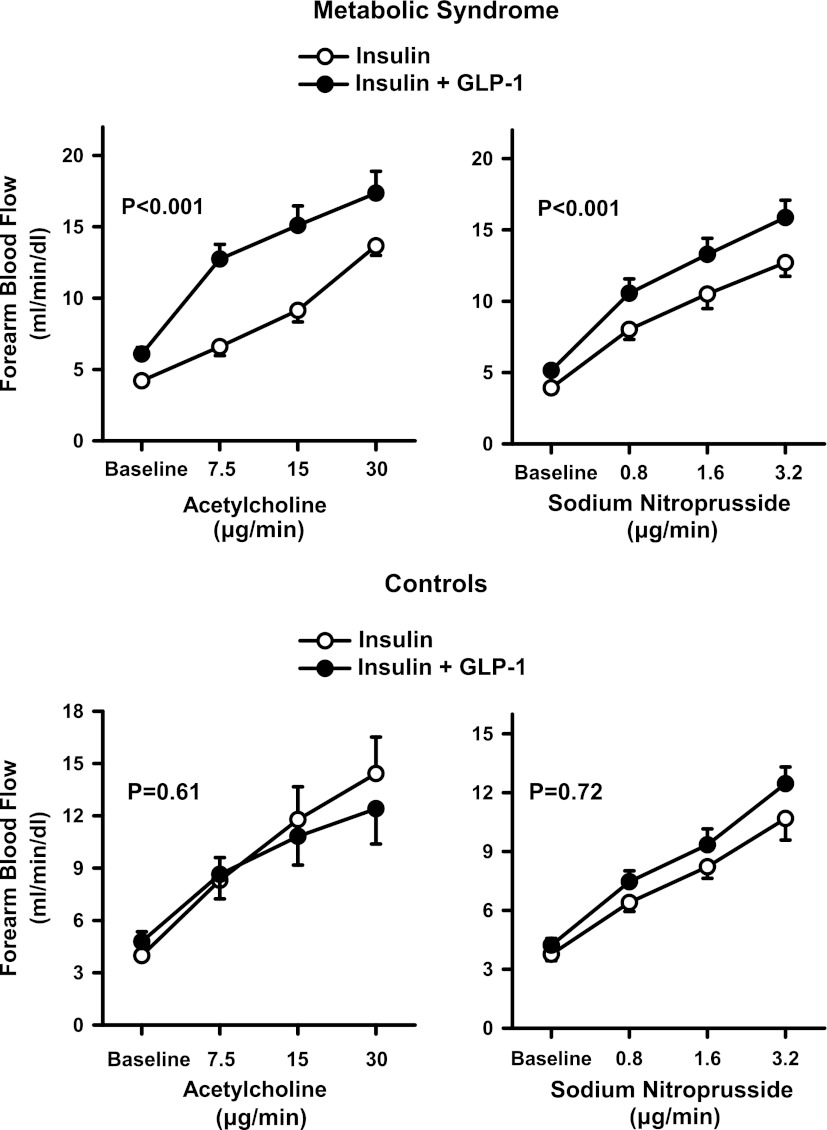
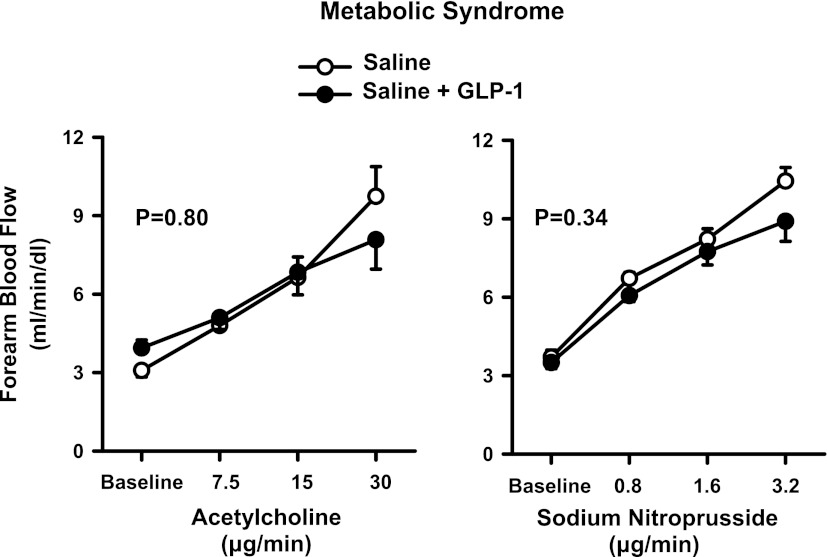
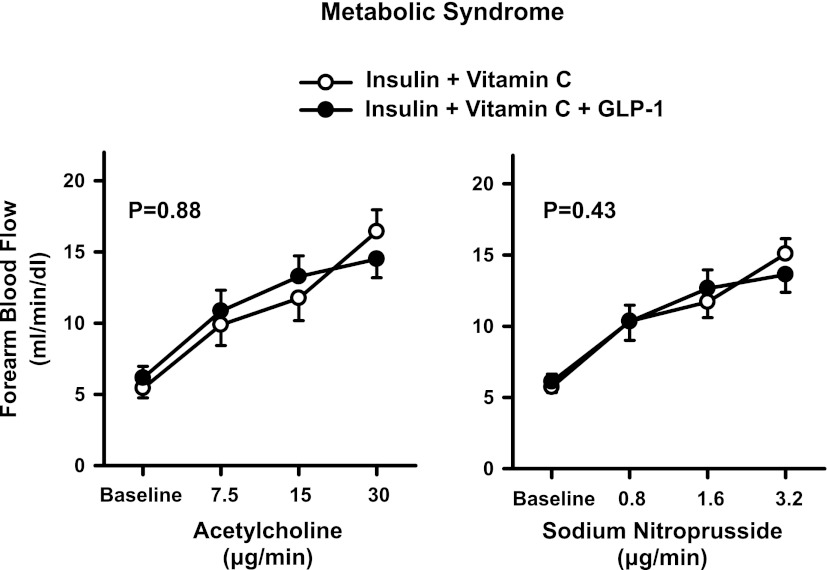
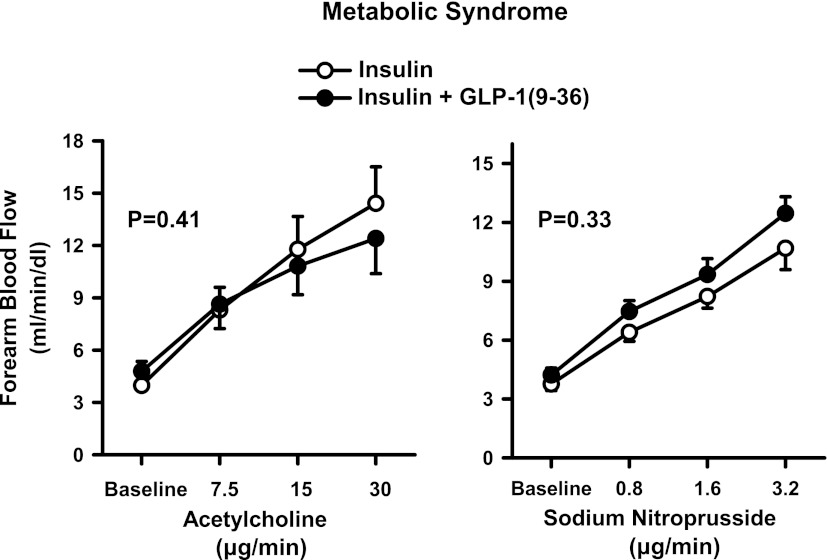
OBJECTIVE: Patients with the metabolic syndrome (MetS) have impaired insulin-induced enhancement of vasodilator responses. The incretin hormone glucagon-like peptide 1 (GLP-1), beyond its effects on blood glucose, has beneficial actions on vascular function. This study, therefore, aimed to assess whether GLP-1 affects insulin-stimulated vasodilator reactivity in patients with the MetS. RESEARCH DESIGN AND METHODS: Forearm blood flow responses to acetylcholine (ACh) and sodium nitroprusside (SNP) were assessed in MetS patients before and after the addition of GLP-1 to an intra-arterial infusion of saline (n = 5) or insulin (n = 5). The possible involvement of oxidative stress in the vascular effects of GLP-1 in this setting was investigated by infusion of vitamin C (n = 5). The receptor specificity of GLP-1 effect during hyperinsulinemia was assessed by infusing its metabolite GLP-1(9-36) (n = 5). The metabolic actions of GLP-1 were also tested by analyzing forearm glucose disposal during hyperinsulinemia (n = 5). RESULTS: In MetS patients, GLP-1 enhanced endothelium-dependent and -independent responses to ACh and SNP, respectively, during hyperinsulinemia (P < 0.001 for both), but not during saline (P > 0.05 for both). No changes in vasodilator reactivity to ACh and SNP were seen after GLP-1 was added to insulin and vitamin C (P > 0.05 for both) and after GLP-1(9-36) was given during hyperinsulinemia (P > 0.05 for both). Also, GLP-1 did not affect forearm glucose extraction and uptake during hyperinsulinemia (P > 0.05 for both). CONCLUSIONS: In patients with the MetS, GLP-1 improves insulin-mediated enhancement of endothelium-dependent and -independent vascular reactivity. This effect may be influenced by vascular oxidative stress and is possibly exerted through a receptor-mediated mechanism.
Overview
The claims and statistics of this paper haven’t been checked yet.
Free: it reads the open-access text and checks the first 5 claims that cite a source we can check. Create a free account to check every claim.
Integrity signals
Registry
Cites
Statistics
Figures
Verification
Claims the paper makes
The claims and statistics of this paper haven’t been checked yet.
Free: it reads the open-access text and checks the first 5 claims that cite a source we can check. Create a free account to check every claim.
Claims other papers make about this one
Each is checked against this paper’s own text: does it say what the citing paper says it does?
The source backs part of the claim, not all of it — or backs it for a different population, condition or comparison.
In the citing paper
“Human studies provide conflicting information about the effect of GLP-1 or stable analogues on endothelial function.212-217”
From The Vasculature in Prediabetes (2018) · cites this paper as [217]
Experimental — accuracy not yet measured
Self-check
Percentages, sums and reported differences re-computed from the paper’s own numbers.
The self-check needs the paper’s full text.
Citations
Cites
Grundy, S. M., Brewer, H. B., Cleeman, J. I., Smith, S. C., & Lenfant, C. (2004) · Circulation · doi:10.1161/01.cir.0000111245.75752.c6 · Cited by 5,982
Obesity and insulin resistance
Kahn, B. B., & Flier, J. S. (2000) · Journal of Clinical Investigation · doi:10.1172/jci10842 · Cited by 3,225
Kim, J.-A., Montagnani, M., Koh, K. K., & Quon, M. J. (2006) · Circulation · doi:10.1161/circulationaha.105.563213 · Cited by 1,652 · cited 8×
“was assessed by infusing its metabolite GLP-1(9-36) (n = 5).”
BackgroundMethodInfluentialZander, M., Madsbad, S., Madsen, J. L., & Holst, J. J. (2002) · The Lancet · doi:10.1016/s0140-6736(02)07952-7 · Cited by 1,297 · cited 8×
“was assessed by infusing its metabolite GLP-1(9-36) (n = 5).”
BackgroundMethodInfluentialBan, K., Noyan-Ashraf, M. H., Hoefer, J., Bolz, S.-S., Drucker, D. J., & Husain, M. (2008) · Circulation · doi:10.1161/circulationaha.107.739938 · Cited by 1,057 · cited 7×
“was assessed by infusing its metabolite GLP-1(9-36) (n = 5).”
BackgroundMethodInfluentialThe role of incretins in glucose homeostasis and diabetes treatment
Kim, W., & Egan, J. M. (2008) · Pharmacological Reviews · doi:10.1124/pr.108.000604 · Cited by 824 · cited 10×
“Effluent venous forearm GLP-1(7-36) plasma levels in patients with MetS receiving intra-arterial infusion of exogenous GLP-1 were 8.”
BackgroundMethodResultInfluentialNyström, T., Gutniak, M. K., Zhang, Q., Zhang, F., Holst, J. J., Ahrén, B., & Sjöholm, Å. (2004) · American Journal of Physiology-Endocrinology and Metabolism · doi:10.1152/ajpendo.00237.2004 · Cited by 680 · cited 8×
“was assessed by infusing its metabolite GLP-1(9-36) (n = 5).”
BackgroundMethodInfluentialJackson, T. S., Xu, A., Vita, J. A., & Keaney, J. F. (1998) · Circulation Research · doi:10.1161/01.res.83.9.916 · Cited by 400 · cited 8×
“was assessed by infusing its metabolite GLP-1(9-36) (n = 5).”
BackgroundMethodInfluentialMeier, J. J., Gallwitz, B., Salmen, S., Goetze, O., Holst, J. J., Schmidt, W. E., & Nauck, M. A. (2003) · The Journal of Clinical Endocrinology & Metabolism · doi:10.1210/jc.2003-030049 · Cited by 369 · cited 8×
“was assessed by infusing its metabolite GLP-1(9-36) (n = 5).”
BackgroundMethodInfluentialOeseburg, H., de Boer, R. A., Buikema, H., van der Harst, P., van Gilst, W. H., & Silljé, H. H. W. (2010) · Arteriosclerosis, Thrombosis, and Vascular Biology · doi:10.1161/atvbaha.110.206425 · Cited by 267 · cited 8×
“was assessed by infusing its metabolite GLP-1(9-36) (n = 5).”
BackgroundMethodInfluential
Cited by
Oxidative Stress in Diabetes: Implications for Vascular and Other Complications
Pitocco, D., Tesauro, M., Alessandro, R., Ghirlanda, G., & Cardillo, C. (2013) · International Journal of Molecular Sciences · doi:10.3390/ijms141121525 · Cited by 401
“In addition, when GLP-1 is given on top of vitamin C it does not further enhance the vasodilator effect of acetylcholine and sodium nitroprusside, thereby suggesting that its effect is influenced by vascular oxidative stress [125].”
BackgroundSelf-citationCardiovascular Actions of Incretin-Based Therapies
Ussher, J. R., & Drucker, D. J. (2014) · Circulation Research · doi:10.1161/circresaha.114.301958 · Cited by 358
Tousoulis, D., Plastiras, A., Siasos, G., Oikonomou, E., Verveniotis, A., Kokkou, E., Maniatis, K., Gouliopoulos, N., Miliou, A., Paraskevopoulos, T., et al. (2014) · Atherosclerosis · doi:10.1016/j.atherosclerosis.2013.10.014 · Cited by 168
The Vasculature in Prediabetes
Wasserman, D. H., Wang, T. J., & Brown, N. J. (2018) · Circulation Research · doi:10.1161/circresaha.118.311912 · Cited by 137
Rizzo, M., Chandalia, M., Patti, A. M., Di Bartolo, V., Rizvi, A. A., Montalto, G., & Abate, N. (2014) · Cardiovascular Diabetology · doi:10.1186/1475-2840-13-49 · Cited by 107
Metadata
- Authors
- Tesauro, M., Schinzari, F., Adamo, A., Rovella, V., Martini, F., Mores, N., Barini, A., Pitocco, D., Ghirlanda, G., Lauro, D., Campia, U., & Cardillo, C.
- Affiliations
- University of Rome Tor Vergata (IT)
- Università Cattolica del Sacro Cuore (IT)
- Northwestern University (US)
- Corresponding author
- Cardillo, Carmine
- ORCID
- Venue
- Diabetes Care
- Publisher
- American Diabetes Association
- Published
- 2013-02-13
- Volume
- 36
- Issue
- 3
- Pages
- 683-689
- ISSN
- 0149-5992 (ISSN-L)
- 1935-5548
- PMC
- PMC3579378
- OpenAlex
- W2140632202
- Cited by
- 54
- References
- 29
- Citations by year
- 2025: 2 · 2023: 1 · 2021: 3 · 2020: 2 · 2019: 2 · 2018: 4 · 2017: 6 · 2016: 6 · 2015: 8 · 2014: 10 · 2013: 10
- FWCI
- 7.19
- Type
- journal article
- Language
- en
- Open access
- hybrid
- doi.org
- Licence
- cc-by-nc-nd
- Locations
- Diabetes Care (publishedVersion, cc-by-nc-nd)
- Europe PMC (PubMed Central) (publishedVersion, cc-by-nc-nd)
- PubMed Central (publishedVersion, cc-by-nc-nd)
- PubMed (publishedVersion)
- Cineca Institutional Research Information System (Tor Vergata University) (submittedVersion, other-oa)
- Funders
- Università Cattolica del Sacro Cuore
- Fondazione Roma
- National Institutes of Health (5k12hl083790-03)
- National Heart, Lung, and Blood Institute (K12-HL083790)
- Topics
- Health Sciences › Medicine › Endocrinology, Diabetes and Metabolism › Diabetes Treatment and Management
- Health Sciences › Medicine › Physiology (medical) › Nitric Oxide and Endothelin Effects
- Health Sciences › Medicine › Endocrinology, Diabetes and Metabolism › Diabetes, Cardiovascular Risks, and Lipoproteins
- Keywords
- glucagon-like peptide-1, metabolic syndrome, hyperinsulinemia, forearm blood flow, endothelium-dependent vasodilation, endothelium-independent relaxation, acetylcholine, sodium nitroprusside, glucose disposal, oxidative stress, vitamin C
- MeSH terms
- Acetylcholine, Glucose, Humans, Hyperinsulinism, Nitroprusside, Vasodilation, Oxidative Stress, Metabolic Syndrome, Glucagon-Like Peptide 1
About these checks
Registry, retraction, Cites and statistics results are computed, not judged, with one exception: a printed reference that no index lists is read once by a model before it counts as a citation error. Claims are extracted by a model and kept only when their quote appears verbatim in the text; each cited source is then checked, with a model’s help, for whether it says what the claim relies on. Those verdicts can be wrong — read the claim’s quote and the cited source before relying on one.
Statistics and arithmetic are recomputed, not judged.
Confidence bands are shown only for fields calibrated on our annotated test set. None is calibrated yet, so no band is shown.
What counts as a claim ›How we measure confidence ›How we check this ›
Are you an author, or do you see a problem with this page? Request a review
Data sources
Bibliographic data: Semantic Scholar, OpenAlex, Crossref.
Contains information from the Semantic Scholar Academic Graph Datasets, made available under the ODC Attribution License (ODC-BY 1.0).
Semantic Scholar’s data is described in: Kinney, R., et al. (2023). The Semantic Scholar Open Data Platform. arXiv:2301.10140.
