

Randomized Study Comparing a Basal-Bolus With a Basal Plus Correction Insulin Regimen for the Hospital Management of Medical and Surgical Patients With Type 2 Diabetes
Open accessThe DOI matches its Crossref record; 29 of the 29 references it cites were found in a registry or an index.
Abstract
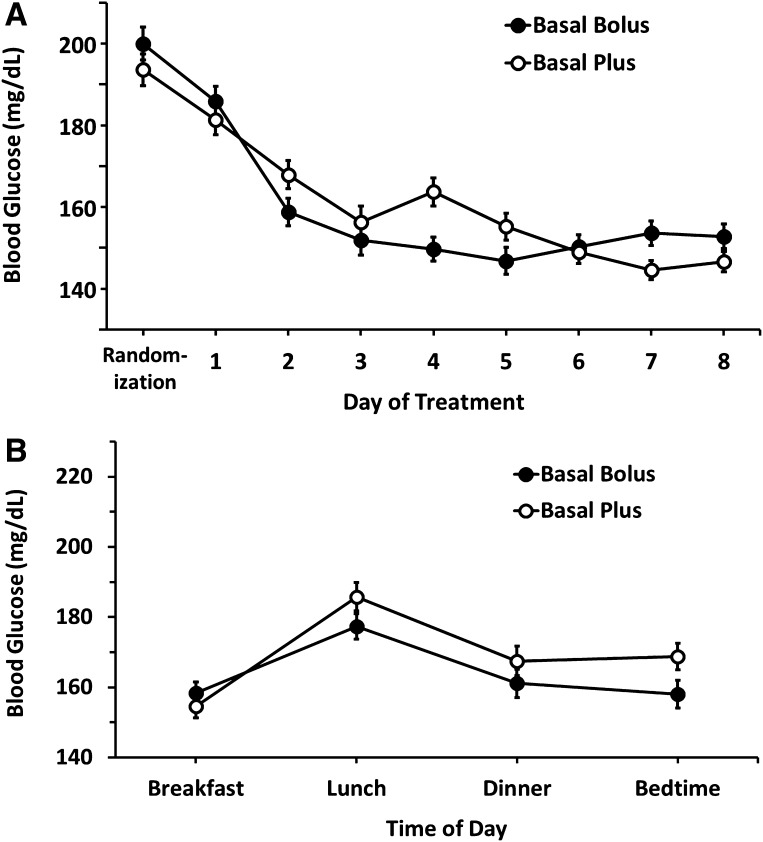
OBJECTIVE: Effective and easily implemented insulin regimens are needed to facilitate hospital glycemic control in general medical and surgical patients with type 2 diabetes (T2D). RESEARCH DESIGN AND METHODS: This multicenter trial randomized 375 patients with T2D treated with diet, oral antidiabetic agents, or low-dose insulin (≤0.4 units/kg/day) to receive a basal-bolus regimen with glargine once daily and glulisine before meals, a basal plus regimen with glargine once daily and supplemental doses of glulisine, and sliding scale regular insulin (SSI). RESULTS: Improvement in mean daily blood glucose (BG) after the first day of therapy was similar between basal-bolus and basal plus groups (P = 0.16), and both regimens resulted in a lower mean daily BG than did SSI (P = 0.04). In addition, treatment with basal-bolus and basal plus regimens resulted in less treatment failure (defined as >2 consecutive BG >240 mg/dL or a mean daily BG >240 mg/dL) than did treatment with SSI (0 vs. 2 vs. 19%, respectively; P < 0.001). A BG <70 mg/dL occurred in 16% of patients in the basal-bolus group, 13% in the basal plus group, and 3% in the SSI group (P = 0.02). There was no difference among the groups in the frequency of severe hypoglycemia (<40 mg/dL; P = 0.76). CONCLUSIONS: The use of a basal plus regimen with glargine once daily plus corrective doses with glulisine insulin before meals resulted in glycemic control similar to a standard basal-bolus regimen. The basal plus approach is an effective alternative to the use of a basal-bolus regimen in general medical and surgical patients with T2D.
Overview
The claims and statistics of this paper haven’t been checked yet.
Free: it reads the open-access text and checks the first 5 claims that cite a source we can check. Create a free account to check every claim.
Integrity signals
Registry
Cites
Statistics
Figures
Verification
Claims the paper makes
The claims and statistics of this paper haven’t been checked yet.
Free: it reads the open-access text and checks the first 5 claims that cite a source we can check. Create a free account to check every claim.
Claims other papers make about this one
Each is checked against this paper’s own text: does it say what the citing paper says it does?
The source backs part of the claim, not all of it — or backs it for a different population, condition or comparison.
In the citing paper
“Intensive targets result in hypoglycemia, which, in turn, results in higher complications.105,106”
From American Association of Clinical Endocrinology Clinical Practice Guideline: Developing a Diabetes Mellitus Comprehensive Care Plan-2022 Update. (2022) · cites this paper as [106]
Experimental — accuracy not yet measured
Self-check
Percentages, sums and reported differences re-computed from the paper’s own numbers.
The self-check needs the paper’s full text.
Citations
Cites
Intensive insulin therapy in critically ill patients.
Van den Berghe, G., Wouters, P., Weekers, F., Verwaest, C., Bruyninckx, F., Schetz, M., Vlasselaers, D., Ferdinande, P., Lauwers, P., & Bouillon, R. (2001) · New England Journal of Medicine · doi:10.1056/nejmoa011300 · Cited by 9,977
Intensive insulin therapy in the medical ICU
Van den Berghe, G., Wilmer, A., Hermans, G., Meersseman, W., Wouters, P. J., Milants, I., Van Wijngaerden, E., Bobbaers, H., & Bouillon, R. (2006) · New England Journal of Medicine · doi:10.1056/nejmoa052521 · Cited by 3,639
Standards of Medical Care in Diabetes—2012
(2012) · Diabetes Care · doi:10.2337/dc12-s011 · Cited by 2,240
Hyperglycemia: an independent marker of in-hospital mortality in patients with undiagnosed diabetes
Umpierrez, G. E., Isaacs, S. D., Bazargan, N., You, X., Thaler, L. M., & Kitabchi, A. E. (2002) · The Journal of Clinical Endocrinology & Metabolism · doi:10.1210/jcem.87.3.8341 · Cited by 2,195
Self-citationEarly versus late parenteral nutrition in critically ill adults
Casaer, M. P., Mesotten, D., Hermans, G., Wouters, P. J., Schetz, M., Meyfroidt, G., Van Cromphaut, S., Ingels, C., Meersseman, P., Muller, J., et al. (2011) · New England Journal of Medicine · doi:10.1056/nejmoa1102662 · Cited by 1,696 · cited 1×
“It is possible that increasing the starting insulin dose and increasing insulin titration will result in better glycemic control; however, it may also increase the risk of hypoglycemic events (28).”
BackgroundMoghissi, E. S., Korytkowski, M. T., DiNardo, M., Einhorn, D., Hellman, R., Hirsch, I. B., Inzucchi, S. E., Ismail-Beigi, F., Kirkman, M. S., & Umpierrez, G. E. (2009) · Diabetes Care · doi:10.2337/dc09-9029 · Cited by 1,444
Self-citationManagement of diabetes and hyperglycemia in hospitals.
Clement, S., Braithwaite, S. S., Magee, M. F., Ahmann, A., Smith, E. P., Schafer, R. G., Hirsch, I. B., & on behalf of the Diabetes in Hospitals Writing Committee (2004) · Diabetes Care · doi:10.2337/diacare.27.2.553 · Cited by 1,266 · cited 1×
“Insulin with oral agents 9 (6) 10 (8) 5 (7)”
Krinsley, J. S. (2003) · Mayo Clinic Proceedings · doi:10.4065/78.12.1471 · Cited by 1,165
Furnary, A. P., Gao, G., Grunkemeier, G. L., Wu, Y., Zerr, K. J., Bookin, S. O., Floten, H. S., & Starr, A. (2003) · The Journal of Thoracic and Cardiovascular Surgery · doi:10.1067/mtc.2003.181 · Cited by 1,130 · cited 2×
“The association between hyperglycemia and increased risk of hospital complications is well established in both ICU and non-ICU patients (3,4,6,8,21 – 23).”
BackgroundUmpierrez, G. E., Hellman, R., Korytkowski, M. T., Kosiborod, M., Maynard, G. A., Montori, V. M., Seley, J. J., & Van den Berghe, G. (2012) · The Journal of Clinical Endocrinology & Metabolism · doi:10.1210/jc.2011-2098 · Cited by 1,126
Self-citation
Cited by
Items 201–221 of 221
Managing the complex insulin needs of patients during care transitions
(2014) · Pharmacy Today · doi:10.1016/s1042-0991(15)30720-9
Diabetes Mellitus: Diagnosis and Care
Giangola, J. (2016) · Springer eBooks · doi:10.1007/978-3-319-20789-6_12-1
Signo, M. (2019) · San José State University ScholarWorks (San Jose State University) · doi:10.31979/etd.ecat-qcw3
Diabetes Mellitus: Diagnosis and Care
Giangola, J. (2016) · Springer eBooks · doi:10.1007/978-3-319-20789-6_12-2
The mechanisms of hyperglycemia and its management in new coronavirus infection
Петров, В. И., Shatalova, O. V., & Glazova, G. M. (2023) · Сибирский журнал клинической и экспериментальной медицины · doi:10.29001/2073-8552-2022-37-4-22-30
Choudhary, R. K., & Singh, B. K. (2022) · Journal of Diabetes Metabolic Disorders & Control · doi:10.15406/jdmdc.2022.09.00234
Inpatient Management of Diabetes and Hyperglycemia
Horton, W. B. (2023) · Springer eBooks · doi:10.1007/978-3-031-25519-9_46 · Cited by 1
Zhang, X., Yan, D., Du, T., Zhao, Y., Zhang, J., Zhang, T., Lin, M., Li, Y., & Li, W. (2023) · Diabetology & Metabolic Syndrome · doi:10.1186/s13098-023-01193-9 · Cited by 1
“Many studies simplified the insulin administration regimen, for example, by using basal plus [7], reducing correction insulin administration [8, 9], using premixed insulin [10], or only using basal insulin [11].”
BackgroundThe History of Inpatient Diabetes
Brooks, D., Schulman‐Rosenbaum, R., Galindo, R. J., & Umpierrez, G. E. (2023) · Contemporary Endocrinology · doi:10.1007/978-3-031-44648-1_1
Self-citationPrinciples of Care in the Diabetic Surgical Patient
Khazai, N. B., & Hamdy, O. (2024) · Contemporary diabetes · doi:10.1007/978-3-031-55715-6_6 · Cited by 1
Chiang, H.-H., Kahn, S. E., & Hirsch, I. B. (2024) · Diabetes Technology & Therapeutics · doi:10.1089/dia.2024.0120
Perioperative Blood Glucose Optimization in Orthopaedic Trauma Patients
Segal, K., Okewunmi, J. O., Mujahid, N., Tong, I. L., Fernandes, A., & Evans, A. R. (2024) · Operative Techniques in Orthopaedics · doi:10.1016/j.oto.2024.101128
Sanjeevani, M., Alex, M., Sreedharan, D. P., Vinay, B. C., Supriya, P. S., Bhandari, R., & Kolar, R. (2024) · International Journal of Diabetes in Developing Countries · doi:10.1007/s13410-024-01397-3
Hypoglycemia in the Patient with Diabetes
Hudson, M. (2025) · Springer eBooks · doi:10.1007/978-3-031-86099-7_23
Passarella, P., & Gosmanov, A. R. (2025) · Medical Clinics of North America · doi:10.1016/j.mcna.2025.11.001 · Cited by 1
Seth, S., & Pandya, R. (2025) · Medical Clinics of North America · doi:10.1016/j.mcna.2025.11.002
Chawla, M. S., Viswanathan, V., Agarwal, S., Maheshwari, A., Sahay, R. K., Jethwani, P., Ghosh, S. K., Gupta, S., Kanodia, N., Unnikrishnan, A. G., et al. (2026) · International Journal of Diabetes in Developing Countries · doi:10.1007/s13410-026-01634-x · Cited by 1
Low‐value glucose monitoring in noncritically ill hospitalized patients
Latifi, N., Mathioudakis, N. N., Abusamaan, M. S., Tschudy, M. M., Ma, J., Olson, S., Jouaneh, T. M. M., Yang, A., & Brotman, D. J. (2026) · Journal of Hospital Medicine · doi:10.1002/jhm.70319
Aberer, F., Hochfellner, D. A., BAUMANN, P. M., Höll, B., Beck, P., Pieber, T. R., & Mader, J. K. (2026) · Biosensors · doi:10.3390/bios16050289
“…per participant, with a power of 80% and a 5% level of significance in order to test whether the mean percentage of capillary BG measurements in the chosen target range of 3.9–7.8 mmol/L (primary outcome) was exceeding the recent best-practice trial with the criterion threshold of 42% [22].”
InfluentialStress-Induced Hyperglycemia in General Surgery
Zaino, J., Diaz-Sarmiento, V. S., Idrees, T., & Umpierrez, G. E. (2026) · Clinics in Perioperative Nursing Care · doi:10.1016/j.pernc.2026.05.005
Self-citationBahru, Y. D., Berha, A. B., Ahmed, A., & Chelkeba, L. (2026) · Research Square · doi:10.21203/rs.3.rs-10815003/v1
Metadata
- Authors
- Umpierrez, G. E., Smiley, D., Hermayer, K., Khan, A., Olson, D. E., Newton, C., Jacobs, S., Rizzo, M., Peng, L., Reyes, D., Pinzon, I., Fereira, M. E., Hunt, V., Gore, A., Toyoshima, M. T., & Fonseca, V. A.
- Affiliations
- Emory University (US)
- Medical University of South Carolina (US)
- Tulane Medical Center (US)
- Corresponding author
- Umpierrez, Guillermo E.
- ORCID
- Venue
- Diabetes Care
- Publisher
- American Diabetes Association
- Published
- 2013-07-11
- Volume
- 36
- Issue
- 8
- Pages
- 2169-2174
- ISSN
- 0149-5992 (ISSN-L)
- 1935-5548
- PMC
- PMC3714500
- OpenAlex
- W2113123801
- Cited by
- 222
- References
- 29
- Citations by year
- 2026: 9 · 2025: 15 · 2024: 11 · 2023: 13 · 2022: 15 · 2021: 19 · 2020: 18 · 2019: 17 · 2018: 20 · 2017: 17 · 2016: 27 · 2015: 23 · 2014: 14 · 2013: 4
- FWCI
- 17.83
- Type
- journal article
- Language
- en
- Open access
- hybrid
- doi.org
- Licence
- Locations
- Diabetes Care (publishedVersion, cc-by-nc-nd)
- PubMed Central (publishedVersion, cc-by-nc-nd)
- PubMed (publishedVersion)
- Funders
- National Institutes of Health (UL1TR000454)
- National Institute of General Medical Sciences (U54GM104940)
- National Center for Research Resources (UL1RR025008)
- National Center for Advancing Translational Sciences
- Topics
- Health Sciences › Medicine › Endocrinology, Diabetes and Metabolism › Hyperglycemia and glycemic control in critically ill and hospitalized patients
- Health Sciences › Medicine › Endocrinology, Diabetes and Metabolism › Diabetes Treatment and Management
- Health Sciences › Medicine › Endocrinology, Diabetes and Metabolism › Diabetes Management and Research
- Keywords
- type 2 diabetes, multiple daily insulin injections, glargine, glulisine, sliding scale insulin, hypoglycemia, hyperglycemia, surgical patients, medical patients
- MeSH terms
- Insulin Glargine, Adult, Aged, Blood Glucose, Diabetes Mellitus, Type 2, Female, Hospitalization, Humans, Hypoglycemic Agents, Insulin, Male, Middle Aged, Surgical Procedures, Operative, Treatment Outcome, Insulin, Long-Acting, Meals
About these checks
Registry, retraction, Cites and statistics results are computed, not judged, with one exception: a printed reference that no index lists is read once by a model before it counts as a citation error. Claims are extracted by a model and kept only when their quote appears verbatim in the text; each cited source is then checked, with a model’s help, for whether it says what the claim relies on. Those verdicts can be wrong — read the claim’s quote and the cited source before relying on one.
Statistics and arithmetic are recomputed, not judged.
Confidence bands are shown only for fields calibrated on our annotated test set. None is calibrated yet, so no band is shown.
What counts as a claim ›How we measure confidence ›How we check this ›
Are you an author, or do you see a problem with this page? Request a review
Data sources
Bibliographic data: Semantic Scholar, OpenAlex, Crossref.
Contains information from the Semantic Scholar Academic Graph Datasets, made available under the ODC Attribution License (ODC-BY 1.0).
Semantic Scholar’s data is described in: Kinney, R., et al. (2023). The Semantic Scholar Open Data Platform. arXiv:2301.10140.
