

False Positive Risk in AI Detection of L2 Academic Writing: A Case Study
Open accessThe DOI matches its Crossref record; 82 of the 82 references it cites were found in a registry or an index; none of the 78 sources its claims cite is checked for support yet.
Abstract
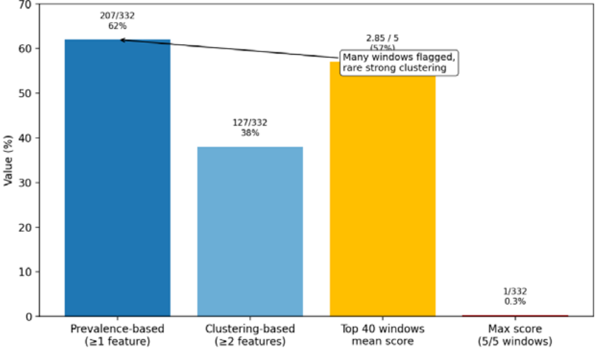
AI -text detectors are increasingly used in education and scholarly publishing. While these tools are meant to protect academic integrity, they may also create new inequities for multilingual writers. This exploratory case study investigates why legitimate second language (L2) academic prose can be misclassified as AI -generated. We start from the premise that L2 academic writing functions as a distinct register whose recurrent linguistic features create predictability, which is one of the main metrics to detect AI -generated text. Using a single -author corpus repeatedly flagged as machine--generated, we develop a detector -inspired simulation capturing five proxies of high predictability: low perplexity, low burstiness, high formulaic language, consistent formality, and low lexical diversity. We simulated two common detection models: a prevalence model (flagging frequent proxies) and a cluster--based model (flagging co -occurrence of features). Prevalence -based detection flagged 62% of the sample manuscripts, while cluster -based detection flagged 38% with three or more co -occurring proxies. Although dense clustering (four to five proxies) was uncommon (7.8%), our sample was repeatedly flagged by both logics. These findings do not establish equivalence with commercial detection systems, but they suggest that highly conventionalized L2 academic prose may face a heightened risk of false positive AI flagging. We term this phenomenon the “detection paradox”.
Overview
CoChat Summary
TL;DR
This exploratory single-author case study uses a transparent detector-inspired simulator to test whether legitimate L2 academic prose is misclassified as AI-generated. It finds that prevalence-based logic flags 62% of windows and clustering-based logic flags 38% with three or more co-occurring proxies, while dense clustering is rare, suggesting conventionalized L2 academic writing may face heightened false-positive risk.
Key findings
- The simulator flagged 202 of 332 windows (60.8%) at the baseline 2+ flag threshold; under a prevalence model, 62% of windows (207/332) would be treated as at risk, and under a clustering model requiring at least two features in the same 200-word span, 38% (127/332) were flagged.
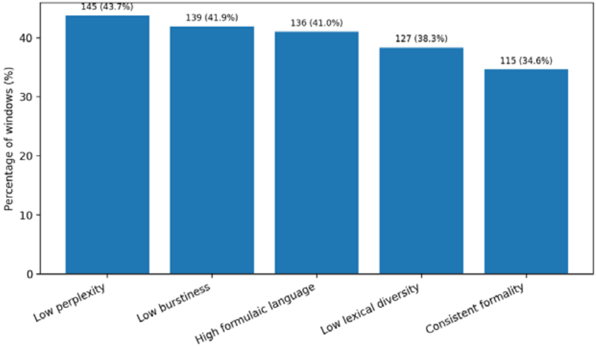
- Individual proxies occurred at comparable rates: low perplexity in 145 windows (43.7%), low burstiness in 139 (41.9%), high formulaic language in 136 (41.0%), low lexical diversity in 127 (38.3%), and consistent formality in 115 (34.6%).
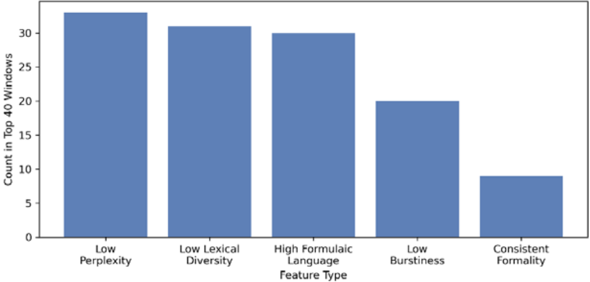
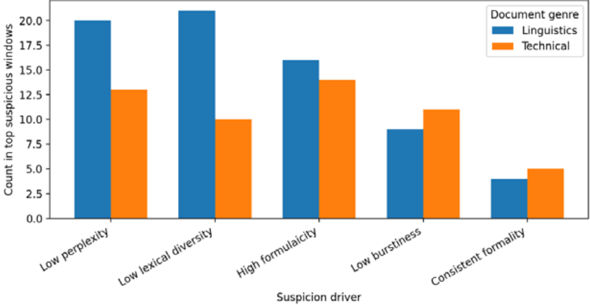
- Among the 40 most suspicious windows, low perplexity appeared in 33 (82.5%), low lexical diversity in 31 (77.5%), high formulaic language in 30 (75.0%), low burstiness in 20 (50.0%), and consistent formality in 16 (40.0%).
- Suspicious windows concentrated in Methods and, to a lesser extent, Results—especially procedural descriptions, stepwise enumerations, parameter or variable listings, and standardized statistical reporting—while Discussions contained relatively few suspicious windows.
Methods
- Single-author corpus of four research articles (approximately 28,000 words; 25,627 tokens, 3,350 distinct word types, 404 paragraphs, 1,690 sentences, average sentence length 15 words) written by the first author between 2022 and 2024; all four were rejected by peer-reviewed journals on suspicion of AI generation and flagged by commercial detection tools despite only minimal generative AI use for grammatical checking. Two articles address applied statistics and two address applied linguistics, each following IMRD structure.
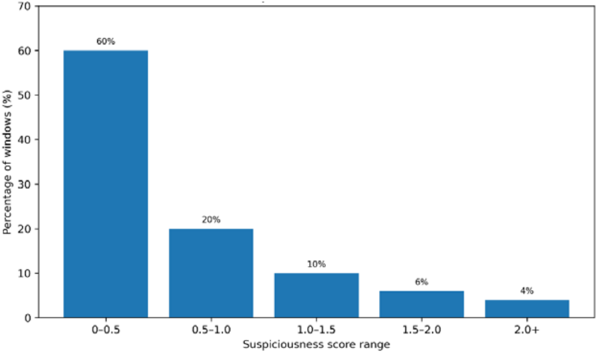
- Each article was split into overlapping 200-word windows, yielding 332 analyzable windows. Five computational proxies were coded: low perplexity (GPT-2 perplexity ≤25th percentile), low burstiness (variance of GPT-2 log probabilities ≤25th percentile), high formulaic language (3–5 gram bundle coverage ≥75th percentile), consistent formality (variance of Heylighen–Dewaele formality scores ≤25th percentile), and low lexical diversity (HD-D ≤25th percentile). Each window received a suspicious score from 0 to 5; 2+ flags marked moderate suspicion, 3+ high suspicion, and 4+ very high suspicion.
- The simulator operationalized two detection logics: a prevalence model (flagging frequent proxies individually) and a cluster-based model (flagging co-occurrence of multiple proxies). The authors did not benchmark proprietary commercial tools because their opacity precludes inference about why texts are flagged.
Limitations
- The paper states that conclusions are constrained by the small, personal nature of the corpus, the focus on a single L1 background and disciplinary area, and the use of a simulator rather than direct access to commercial detectors; analyses are cross-sectional and observational and cannot establish causal relationships between textual properties and detector behaviour.
- The text makes evident some internal inconsistencies: the methodology reports 334 analyzable segments while the results report 332 analyzable windows; the abstract reports 62% prevalence and 38% clustering, while the results first report 202 windows (60.8%) at baseline and later report 62% (207/332) and 38% (127/332).
- The single-author design controls for inter-author stylistic variation but limits generalizability across L2 populations, and the simulation approach does not directly test commercial detectors or compare false-positive rates across tools.
Model-written summary. Check it against the paper before relying on it.
Integrity signals
Registry
Cites
Statistics
Figures
Verification
Claims the paper makes
0 Valid · 2 Not valid · 50 Not checked · 97 Own results and interpretations
A result the paper reports from its own data — it cites no other source for it, so there is none to check. The quote shows it is in the paper.
In the paper
“Across this corpus, the AI detection simulator flagged 202 windows (60.8%) as suspicious at the baseline threshold (two or more flags), meaning they displayed at least some convergence of the five AI--like features.”
§ False Positive Risk in AI Detection of L2 Academic Writing: A Case Study 38 > Results
plain- Asserted: passes — The authors put it forward as true.
- Checkable: passes — It can be checked against evidence.
- Load-bearing: passes — The paper’s conclusions depend on it.
- Based: passes — The paper gives a reason why it holds.
A result the paper reports from its own data — it cites no other source for it, so there is none to check. The quote shows it is in the paper.
In the paper
“These sections are where low perplexity and low burstiness co -occur with high formulaic reuse, especially in procedural descriptions, stepwise enumerations, and parameter or variable listings.”
§ False Positive Risk in AI Detection of L2 Academic Writing: A Case Study 38 > Results by section
plainstates an association- Asserted: passes — The authors put it forward as true.
- Checkable: passes — It can be checked against evidence.
- Load-bearing: passes — The paper’s conclusions depend on it.
- Based: passes — The paper gives a reason why it holds.
A result the paper reports from its own data — it cites no other source for it, so there is none to check. The quote shows it is in the paper.
In the paper
“In this corpus, Methods sections, and to a lesser extent Results, most frequently cross the suspicious thresholds.”
§ False Positive Risk in AI Detection of L2 Academic Writing: A Case Study 38 > Results by section
plainstates an association- Asserted: passes — The authors put it forward as true.
- Checkable: passes — It can be checked against evidence.
- Load-bearing: passes — The paper’s conclusions depend on it.
- Based: passes — The paper gives a reason why it holds.
A result the paper reports from its own data — it cites no other source for it, so there is none to check. The quote shows it is in the paper.
In the paper
“Prevalence -based detection flagged 62% of the sample manuscripts, while cluster -based detection flagged 38% with three or more co -occurring proxies.”
§ False Positive Risk in AI Detection of L2 Academic Writing: A Case Study 38 > Abstract
plain- Asserted: passes — The authors put it forward as true.
- Checkable: passes — It can be checked against evidence.
- Load-bearing: passes — The paper’s conclusions depend on it.
- Based: passes — The paper gives a reason why it holds.
A result the paper reports from its own data — it cites no other source for it, so there is none to check. The quote shows it is in the paper.
In the paper
“while cluster -based detection flagged 38% with three or more co -occurring proxies.”
§ False Positive Risk in AI Detection of L2 Academic Writing: A Case Study 38 > Abstract
plainSingle case- Asserted: passes — The authors put it forward as true.
- Checkable: passes — It can be checked against evidence.
- Load-bearing: passes — The paper’s conclusions depend on it.
- Based: passes — The paper gives a reason why it holds.
67 more claims
Create a free account to see all 149 claims and to verify the 60 references still open.
- Probably not a substantial claim. 42
- It may state two separate claims as one. 57
- The quote only partly states this claim. 1
Self-check
Percentages, sums and reported differences re-computed from the paper’s own numbers.
Each contradiction between two passages listed here was confirmed by an independent check.
Rated major: it would touch a result — a value a result rests on, reported and recomputed p-values on opposite sides of the significance level, two passages that conflict with no sign which is right, or a cited work retracted before this paper was published.
In the paper
§ False Positive Risk in AI Detection of L2 Academic Writing: A Case Study 38 > Results
“the AI detection simulator flagged 202 windows (60.8%) as suspicious at the baseline threshold (two or more flags)”
§ False Positive Risk in AI Detection of L2 Academic Writing: A Case Study 38 > Additional information
“When we require at least two features in the same 200 -word span, the clustering -based model still flags 38% of windows (127/332).”
Rated major: it would touch a result — a value a result rests on, reported and recomputed p-values on opposite sides of the significance level, two passages that conflict with no sign which is right, or a cited work retracted before this paper was published.
In the paper
§ False Positive Risk in AI Detection of L2 Academic Writing: A Case Study 38 > Additional information
“Even within the 40 highest -scoring windows, the mean suspicious score is only 2.85 out of 5”
§ False Positive Risk in AI Detection of L2 Academic Writing: A Case Study 38 > Composition of high -scoring windows (clustering model)
“Low perplexity is present in 33 of 40 windows (82.5%), low lexical diversity appears in 31 windows (77.5%), and high formulaic language appears in 30 windows (75.0%).In contrast, low burstiness appears in 20 windows (50.0%), and consistent formality appears in 16 windows (40.0%).”
Rated major: it would touch a result — a value a result rests on, reported and recomputed p-values on opposite sides of the significance level, two passages that conflict with no sign which is right, or a cited work retracted before this paper was published.
In the paper
§ False Positive Risk in AI Detection of L2 Academic Writing: A Case Study 38 > The AI detection simulator
“2) Low burstiness: uniform sentence-length distribution, captured by the coefficient of variation.”
§ False Positive Risk in AI Detection of L2 Academic Writing: A Case Study 38 > Additional information
“F2: Low Burstiness Uniformity of word probability Variance of GPT--2 log probabilities ≤ 25 th percentile”
Rated major: it would touch a result — a value a result rests on, reported and recomputed p-values on opposite sides of the significance level, two passages that conflict with no sign which is right, or a cited work retracted before this paper was published.
In the paper
§ False Positive Risk in AI Detection of L2 Academic Writing: A Case Study 38 > Abstract
“cluster -based detection flagged 38% with three or more co -occurring proxies”
§ False Positive Risk in AI Detection of L2 Academic Writing: A Case Study 38 > Additional information
“When we require at least two features in the same 200 -word span, the clustering -based model still flags 38% of windows (127/332).”
Rated minor: it would not touch a result — a value no result rests on, a p-value that stays on the same side of the significance level, or a conflict that is clerical, resolved elsewhere in the paper, or outside its own findings.
In the paper
§ False Positive Risk in AI Detection of L2 Academic Writing: A Case Study 38 > Abstract
“Prevalence -based detection flagged 62% of the sample manuscripts”
§ False Positive Risk in AI Detection of L2 Academic Writing: A Case Study 38 > Additional information
“Under a prevalence -based model, which flags any window where at least one proxy exceeds its threshold, 62% of windows (207/332) would be treated as at risk.”
3 more findings
Create a free account to see every finding of this check.
Citations
Cites
An Introduction to Functional Grammar
Halliday, M. A. K., Matthiessen, C. M. I. M., Halliday, M., & Matthiessen, C. (2014) · doi:10.4324/9780203783771 · Cited by 9,662
On the Dangers of Stochastic Parrots: Can Language Models Be Too Big? 🦜
Bender, E. M., Gebru, T., McMillan-Major, A., & Shmitchell, S. (2021) · Proceedings of the 2021 ACM Conference on Fairness, Accountability, and Transparency · doi:10.1145/3442188.3445922 · Cited by 6,988
Lambrecht, K. (1994) · Cambridge University Press eBooks · doi:10.1017/cbo9780511620607 · Cited by 3,053
Halliday's Introduction to Functional Grammar
Halliday, M. A. K., & Matthiessen, C. M. I. M. (2013) · Routledge eBooks · doi:10.4324/9780203431269 · Cited by 2,042
Crosslinguistic Influence in Language and Cognition
Jarvis, S., & Pavlenko, A. (2008) · Routledge eBooks · doi:10.4324/9780203935927 · Cited by 1,372
Technology acceptance model in educational context: A systematic literature review
Granić, A., & Marangunić, N. (2019) · British Journal of Educational Technology · doi:10.1111/bjet.12864 · Cited by 1,204
Gao, C. A., Howard, F. M., Markov, N. S., Dyer, E. C., Ramesh, S., Luo, Y., & Pearson, A. T. (2023) · npj Digital Medicine · doi:10.1038/s41746-023-00819-6 · Cited by 1,099
A Geopolitics Of Academic Writing
Canagarajah, A. S. (2002) · University of Pittsburgh Press eBooks · doi:10.2307/j.ctt5hjn6c · Cited by 813
LU, X. (2011) · TESOL Quarterly · doi:10.5054/tq.2011.240859 · Cited by 744
GPT detectors are biased against non-native English writers
Liang, W., Yuksekgonul, M., Mao, Y., Wu, E., & Zou, J. (2023) · Patterns · doi:10.1016/j.patter.2023.100779 · Cited by 673
Research works printed but not linked: 2
- Ajideh, P., Zohrabi, M., & Ohbatalab, R. (2025). Stance markers in academic writing: Native vs. non -native (Iranian) authorship in hard and soft sciences research articles. Critical Literary Studies, 7(2). DOI: 10.22034/cls.2025.63772. · doi:10.22034/cls.2025.63772
- Lillis, T. M., & Curry, M. J. (2010). Academic writing in global context. Routledge. False Positive Risk in AI Detection of L2 Academic Writing: A Case Study
Cited by
Abad, E. G. L., Vélez, W. A. Z., Solórzano, R. J. P., Sanmartín, R. E. N., Zavala, G. A. S., & Mendoza, E. F. H. (2026) · Journal of Education and Training Studies · doi:10.11114/jets.v15i1.9451
Wieczorek, K., & Kaczmarski, D. (2026) · Applied Sciences · doi:10.3390/app162110958
Metadata
- Authors
- Za’rour, R., & Altakhaineh, A. R. M.
- Affiliations
- University of Jordan (JO)
- Venue
- Discourses on Culture
- Publisher
- Walter de Gruyter GmbH
- Published
- 2026-06-01
- Volume
- 25
- Issue
- 1
- Pages
- 37-78
- ISSN
- 2450-0402 (ISSN-L)
- OpenAlex
- W7167721676
- Semantic Scholar
- 332e46f912224528179a38f9eb240fb85e57f8b7
- Cited by
- 2
- References
- 76
- Citations by year
- 2026: 2
- FWCI
- 6.49
- Type
- journal article
- Language
- en
- Open access
- diamond
- doi.org
- Licence
- Locations
- Discourses on Culture (publishedVersion, cc-by-nc-nd)
- Topics
- Social Sciences › Education › Academic integrity and plagiarism
- Physical Sciences › Computer Science › Artificial Intelligence › Authorship Attribution and Profiling
- Social Sciences › Linguistics and Language › Discourse Analysis in Language Studies
- Keywords
- AI-generated text detection, second language academic writing, false positive risk, multilingual writers, academic integrity, formulaic language, lexical diversity, perplexity, burstiness, formality, cluster-based detection, AI-generated text
About these checks
Registry, retraction, Cites and statistics results are computed, not judged, with one exception: a printed reference that no index lists is read once by a model before it counts as a citation error. Claims are extracted by a model and kept only when their quote appears verbatim in the text; each cited source is then checked, with a model’s help, for whether it says what the claim relies on. Those verdicts can be wrong — read the claim’s quote and the cited source before relying on one.
A language model drew the claims from the paper on 2026-11-24, under version 3 of the claim definition (model deepseek-v4.1-flash, prompt extract-v3).
A second model labelled each claim on 2026-11-24 (model jev-1.13-20260917, definition revision gold-guideline-v0.2).
Statistics and arithmetic are recomputed, not judged.
Confidence bands are shown only for fields calibrated on our annotated test set. None is calibrated yet, so no band is shown.
What counts as a claim ›How we measure confidence ›How we check this ›
Are you an author, or do you see a problem with this page? Request a review
How to cite
Cite CoChat for the checks on this page, and the paper for its own findings.
- This page
- CoChat. (2026). Citation check: False Positive Risk in AI Detection of L2 Academic Writing: A Case Study. https://app.cochat.ai/papers/10.2478/doc-2026-0003
- The paper
- Za’rour, R., & Altakhaineh, A. R. M. (2026). False Positive Risk in AI Detection of L2 Academic Writing: A Case Study. Discourses on Culture. https://doi.org/10.2478/doc-2026-0003
Data sources
Bibliographic data: Semantic Scholar, OpenAlex, Crossref.
Contains information from the Semantic Scholar Academic Graph Datasets, made available under the ODC Attribution License (ODC-BY 1.0).
Semantic Scholar’s data is described in: Kinney, R., et al. (2023). The Semantic Scholar Open Data Platform. arXiv:2301.10140.
