

Tracking Changes in Maximal Oxygen Consumption with the Heart Rate Index in Female Collegiate Soccer Players
Open accessThe DOI matches its Crossref record; 35 of the 36 references it cites were found in a registry or an index; 6 of the 37 sources its claims cite were checked for support.
Abstract
The purpose of this study was to determine if the HRindex Method (VO2max = [6 x HRindex - 5] x 3.5, where HRindex = HRmax/HRrest) was accurate for tracking changes in VO2max following 8-weeks of endurance training among collegiate female soccer players. Predicted VO2max via the HRindex Method and observed VO2max from a maximal exercise test on a treadmill were determined for a group of female soccer athletes (n = 15) before and following an 8-week endurance training protocol. The predicted (pVO2max) and observed (aVO2max) values were compared at baseline and within 1-week post-training. Change values (i.e., the difference between pre to post) for each variable were also determined and compared. There was a significant difference between aVO2max before (43.2 ± 2.8 ml·kg·min(-1)) and following (46.2 ± 2.1 ml·kg·min(-1)) the 8-week training program (p < 0.05). However, pVO2max did not significantly change following training (pre = 43.4 ± 4.6 ml·kg·min(-1), post = 42.9 ± 4.1 ml·kg·min(-1), p = 0.53). Furthermore, the correlation between the change in aVO2max and the change in pVO2max was trivial and non-significant (r = 0.30, p = 0.28). The HRindex Method does not appear to be suitable for predicting changes in VO2max following 8-weeks of endurance training in female collegiate soccer players.
Overview
CoChat Summary
TL;DR
The HRindex method did not track changes in VO₂max after 8 weeks of endurance training in female collegiate soccer players. Observed VO₂max increased by 3 ml·kg⁻¹·min⁻¹, but predicted VO₂max did not change and showed wide individual error.
Key findings
- The 8-week training program increased observed VO₂max by 3 ml·kg⁻¹·min⁻¹ (7%, p < 0.05, Cohen’s d = 1.21), while predicted VO₂max did not significantly change (p = 0.53, Cohen’s d = 0.11).
- Predicted and observed VO₂max were not significantly different at baseline (p = 0.81, Cohen’s d = 0.05) but were significantly different post-training (p < 0.05, Cohen’s d = 0.78); correlations were non-significant at pre (r = 0.48, p = 0.08), post (r = 0.30, p = 0.27), and for change scores (r = 0.30, p = 0.28).
- SEE increased from 3.81 ml·kg⁻¹·min⁻¹ (8.9% of observed VO₂max) pre-training to 4.86 ml·kg⁻¹·min⁻¹ (10.5%) post-training; Bland-Altman 95% limits of agreement were wide at pre (−7.7 to +8.3 ml·kg⁻¹·min⁻¹ around a mean difference of 0.3) and post (−11.0 to +4.6 around a mean difference of −3.2), with significant trends (r = 0.50 and r = 0.60, p < 0.05).
- HRrest, HRmax, and HRindex did not change significantly from pre to post (p = 0.76, p = 0.50, and p = 0.52, respectively), so the HRindex did not reflect the training-induced increase in observed VO₂max.
Methods
- Fifteen female NAIA soccer players (age = 21.5 ± 1.8 years; height = 167.2 ± 6.0 cm; body mass = 64.2 ± 7.4 kg) completed baseline and post-training laboratory testing.
- Each performed a maximal graded exercise test using the Bruce protocol on a treadmill with a metabolic cart; HR was measured with a Polar F11 monitor, HRrest was the lowest supine HR during the last minute of a 5-minute rest, and HRmax was the HR corresponding to VO₂max. Predicted VO₂max was calculated using the HRindex equation: pVO₂max = [(HRindex · 6) − 5] · 3.5 ml·kg⁻¹·min⁻¹, where HRindex = HRabsolute / HRrest.
- The 8-week endurance program was designed by the team’s coach, consisted of an unstructured mixture of high-intensity interval and continuous aerobic exercise for approximately 1 hour per session at least 4 days per week; analysis used a 2 × 2 mixed-design ANOVA, Fisher’s LSD post-hoc test, Cohen’s d, bias, zero-order correlations, SEE, and Bland-Altman plots.
Limitations
- The paper states that the investigators did not control the training program and could not quantify training load, making it difficult to examine the exercise program’s effects on VO₂max changes; it also states that blood gases were not analyzed, so the peripheral oxygen extraction explanation is speculative, and that no accepted standard exists for recording HRrest, with only 12 of 60 studies reviewed by Wicks et al. documenting HRrest.
- Evident from the text: the sample was small (n = 15), there was no control group, participants were all female NAIA collegiate soccer players, and the training program was unstructured and coach-designed, which limits generalizability and causal inference.
Model-written summary. Check it against the paper before relying on it.
Integrity signals
Registry
Cites
Statistics
Figures
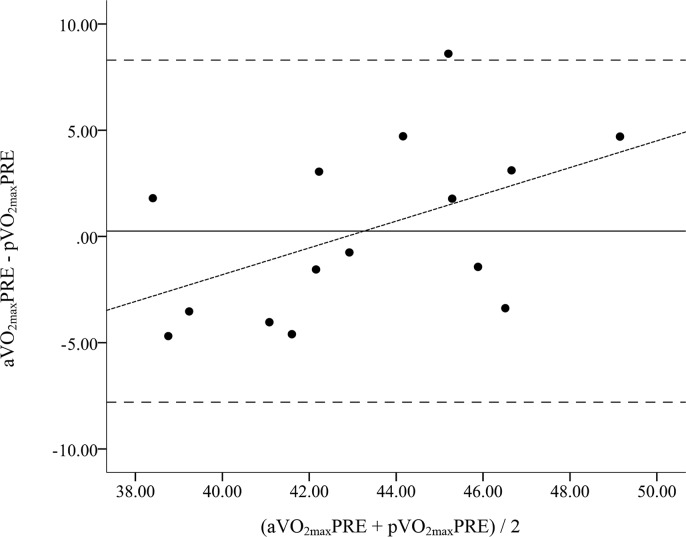
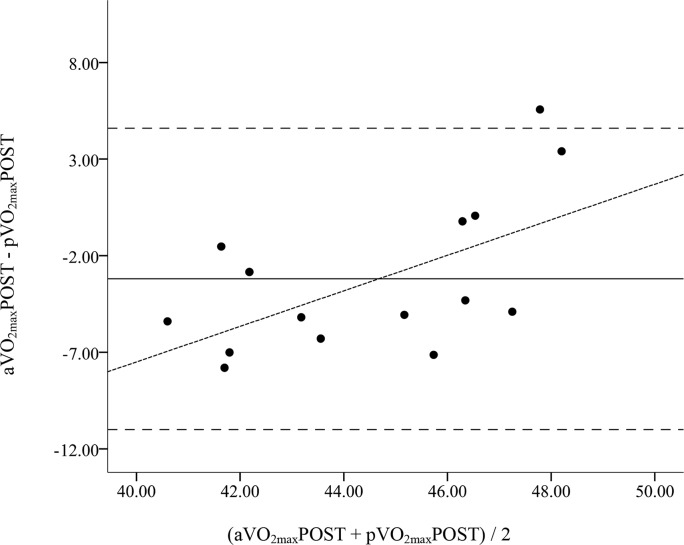
Verification
Claims the paper makes
6 Valid · 0 Not valid · 20 Not checked · 24 Own results and interpretations
The cited sources support only part of this claim — read each source’s verdict below.
In the paper
“Two studies have shown that the HRindex Method resulted in a wide-range of individual error in untrained men ( Esco et al., 2011 ; Haller et al., 2013 ).”
What the sources say
- Not matchedcites Esco et al., 2011
We don’t have this paper’s reference list.
- Partly supportedcites Haller et al., 2013 matched to “Use of the HR index to predict maximal oxygen uptake during different exercise protocols” (2013) sourceExperimental — accuracy not yet measured
The Discussion reports a wide range of individual prediction errors with the HRindex model across all protocols. But the study tested aerobically fit, college-aged men, not untrained men; that population qualifier is unsupported by this source. (LLM, conf=0.90)
plainstates a cause- Asserted: passes — The authors put it forward as true.
- Checkable: passes — It can be checked against evidence.
- Load-bearing: passes — The paper’s conclusions depend on it.
- Based: passes — The paper gives a reason why it holds.
- Not matched
A result the paper reports from its own data — it cites no other source for it, so there is none to check. The quote shows it is in the paper.
In the paper
“but were significantly different at follow-up testing (p < 0.05, Cohen’s d = 0.78, Table 1 ).”
plain- Asserted: passes — The authors put it forward as true.
- Checkable: passes — It can be checked against evidence.
- Load-bearing: passes — The paper’s conclusions depend on it.
- Based: passes — The paper gives a reason why it holds.
A result the paper reports from its own data — it cites no other source for it, so there is none to check. The quote shows it is in the paper.
In the paper
“a trivial non-significant relationship between aVO 2max POST and pVO 2max POST (r = 0.30, p = 0.27)”
plainstates an association- Asserted: passes — The authors put it forward as true.
- Checkable: passes — It can be checked against evidence.
- Load-bearing: passes — The paper’s conclusions depend on it.
- Based: passes — The paper gives a reason why it holds.
A result the paper reports from its own data — it cites no other source for it, so there is none to check. The quote shows it is in the paper.
In the paper
“Zero-order correlation procedures found a moderate non-significant relationship between aVO 2max PRE and pVO 2max PRE (r = 0.48, p = 0.08)”
plainstates an association- Asserted: passes — The authors put it forward as true.
- Checkable: passes — It can be checked against evidence.
- Load-bearing: unclear — It is unclear whether the paper’s conclusions depend on it.
- Based: passes — The paper gives a reason why it holds.
A result the paper reports from its own data — it cites no other source for it, so there is none to check. The quote shows it is in the paper.
In the paper
“and a trivial non-significant relationship between ΔaVO 2max and ΔpVO 2max (r = 0.30, p = 0.28).”
plain- Asserted: passes — The authors put it forward as true.
- Checkable: passes — It can be checked against evidence.
- Load-bearing: passes — The paper’s conclusions depend on it.
- Based: passes — The paper gives a reason why it holds.
13 more claims
Create a free account to see all 50 claims and every source verdict.
- Probably not a substantial claim. 15
- It may state two separate claims as one. 18
- The quote only partly states this claim. 2
Self-check
Percentages, sums and reported differences re-computed from the paper’s own numbers.
Each contradiction between two passages listed here was confirmed by an independent check.
Rated minor: it would not touch a result — a value no result rests on, a p-value that stays on the same side of the significance level, or a conflict that is clerical, resolved elsewhere in the paper, or outside its own findings.
In the paper
“a larger HRindex (i.e., HR max – HR rest )”
“HR index = HR absolute / HR rest Where HR absolute = HR max recorded during the GXT;”
Citations
Cites
Statistical Power Analysis for the Behavioral Sciences
Muller, K. (1989) · Technometrics · doi:10.1080/00401706.1989.10488618 · Cited by 99,167
Statistical power analysis for the behavioral sciences
(1990) · Computers, Environment and Urban Systems · doi:10.1016/0198-9715(90)90050-4 · Cited by 65,269
Statistical Power Analysis for the Behavioral Sciences (2nd ed.).
Lachenbruch, P. A., & Cohen, J. (1989) · Journal of the American Statistical Association · doi:10.2307/2290095 · Cited by 37,395
Bangsbo, J., Iaia, F. M., & Krustrup, P. (2008) · Sports Medicine · doi:10.2165/00007256-200838010-00004 · Cited by 1,463
The Yo-Yo Intermittent Recovery Test: Physiological Response, Reliability, and Validity
KRUSTRUP, P., MOHR, M., AMSTRUP, T., RYSGAARD, T., JOHANSEN, J., STEENSBERG, A., PEDERSEN, P. K., & BANGSBO, J. (2003) · Medicine & Science in Sports & Exercise · doi:10.1249/01.mss.0000058441.94520.32 · Cited by 1,293
Physical and metabolic demands of training and match-play in the elite football player
Bangsbo, J., Mohr, M., & Krustrup, P. (2006) · Journal of Sports Sciences · doi:10.1080/02640410500482529 · Cited by 1,229
Aerobic endurance training improves soccer performance
HELGERUD, J., ENGEN, L. C., WISL??FF, U., & HOFF, J. (2001) · Medicine and Science in Sports and Exercise · doi:10.1097/00005768-200111000-00019 · Cited by 1,186
Resting Heart Rate in Cardiovascular Disease
Fox, K., Borer, J. S., Camm, A. J., Danchin, N., Ferrari, R., Lopez Sendon, J. L., Steg, P. G., Tardif, J.-C., Tavazzi, L., & Tendera, M. (2007) · Journal of the American College of Cardiology · doi:10.1016/j.jacc.2007.04.079 · Cited by 1,062
Exercise Physiology: Theory and Application to Fitness and Performance
Powers, S. K., & Howley, E. T. (1990) · Cited by 856
Strength and endurance of elite soccer players
WISL??FF, U., HELGERUD, J., & HOFF, J. (1998) · Medicine & Science in Sports & Exercise · doi:10.1097/00005768-199803000-00019 · Cited by 494
Energy demands in competitive soccer
Bangsbo, J. (1994) · Journal of Sports Sciences · doi:10.1080/02640414.1994.12059272 · Cited by 425
(2002) · QUT ePrints (Queensland University of Technology) · Cited by 282
Cornelissen, V. A., Verheyden, B., Aubert, A. E., & Fagard, R. H. (2010) · Journal of Human Hypertension · doi:10.1038/jhh.2009.51 · Cited by 252
The surprising history of "HRmax=220-age" equation
Robert, A. (2002) · Medical Entomology and Zoology · Cited by 241
(1968) · PubMed · Cited by 203
Seasonal Changes in Physical Performance and Heart Rate Variability in High Level Futsal Players
Oliveira, R. S., Leicht, A. S., Bishop, D. J., Álvarez, J. C. B., & Nakamura, F. Y. (2012) · International Journal of Sports Medicine · doi:10.1055/s-0032-1323720 · Cited by 186
Faulkner, J., Parfitt, G., & Eston, R. G. (2007) · European Journal of Applied Physiology · doi:10.1007/s00421-007-0508-6 · Cited by 165
A Review of the Concept of the Heart Rate Deflection Point
Bodner, M. E., & Rhodes, E. C. (2000) · Sports Medicine · doi:10.2165/00007256-200030010-00004 · Cited by 123
Physical and metabolic demands of training and match-play in the elite football player
Maughan, R. (2006) · Routledge eBooks · doi:10.4324/9780203967430-8 · Cited by 101
Uusitalo, A., Uusitalo, A., & Rusko, H. (1998) · International Journal of Sports Medicine · doi:10.1055/s-2007-971956 · Cited by 93
(2001) · PubMed · Cited by 89
McMahon, S., & Wenger, H. A. (1998) · Journal of Science and Medicine in Sport · doi:10.1016/s1440-2440(09)60005-0 · Cited by 86
HR Index-A Simple Method for the Prediction of Oxygen Uptake
WICKS, J. R., OLDRIDGE, N. B., NIELSEN, L. K., & VICKERS, C. E. (2011) · Medicine & Science in Sports & Exercise · doi:10.1249/mss.0b013e318217276e · Cited by 76
Relationship between Repeated Sprint Ability and Aerobic Capacity in Professional Soccer Players
Jones, R. M., Cook, C. C., Kilduff, L. P., Milanović, Z., James, N., Sporiš, G., Fiorentini, B., Fiorentini, F., Turner, A., & Vučković, G. (2013) · The Scientific World Journal · doi:10.1155/2013/952350 · Cited by 76
Long-term exercise training improves autonomic nervous system profile in professional runners.
Raczak, G., Daniłowicz‐Szymanowicz, L., Kobuszewska-Chwirot, M., Ratkowski, W., Figura-Chmielewska, M., & Szwoch, M. (2006) · PubMed · Cited by 59
Marsh, C. E. (2012) · Journal of Strength and Conditioning Research · doi:10.1519/jsc.0b013e318220d9a8 · Cited by 39
Heart rate and plasma catecholamines during 24 h of everyday life in trained and untrained men
Dela, F., Mikines, K. J., Von Linstow, M., & Galbo, H. (1992) · Journal of Applied Physiology · doi:10.1152/jappl.1992.73.6.2389 · Cited by 34
Green, M. S., Esco, M. R., Martin, T. D., PRITCHETT, R. C., McHugh, A. N., & Williford, H. N. (2012) · The Journal of Strength and Conditioning Research · doi:10.1519/jsc.0b013e318270fcc0 · Cited by 34
Self-citationEffects of Commercially Formulated Water on the Hydration Status of Dehydrated Collegiate Wrestlers
Valiente, J. S., Utter, A. C., Quindry, J. C., & Nieman, D. C. (2009) · The Journal of Strength and Conditioning Research · doi:10.1519/jsc.0b013e3181bac56e · Cited by 34
Use of the HR index to predict maximal oxygen uptake during different exercise protocols
Haller, J. M., Fehling, P. C., Barr, D. A., Storer, T. W., Cooper, C. B., & Smith, D. L. (2013) · Physiological Reports · doi:10.1002/phy2.124 · Cited by 14
(2007) · PubMed · Cited by 10
An, P., Rice, T., Rankinen, T., Leon, A. S., Skinner, J. S., Wilmore, J. H., Bouchard, C., & Rao, D. C. (2006) · International Journal of Sports Medicine · doi:10.1055/s-2005-837628 · Cited by 8
Boone, T., Astorino, T. A., Baker, J. S., Brock, S., Dalleck, L., Goulet, E. D. B., Gotshall, R. W., Hutchison, A. T., Knight-Maloney, M., Kravitz, L. R., et al. (2011) · Cited by 7
Self-citation(2005) · PubMed · Cited by 6
Prognostic role of heart rate in patients referred for coronary angiography: age and sex differences
Vassalle, C., Maffei, S., Bianchi, S. E., Landi, P., & Carpeggiani, C. (2013) · Climacteric · doi:10.3109/13697137.2013.819329 · Cited by 3
Cited by
Archiza, B., Andaku, D. K., Caruso, F., Bonjorno, J. C., de Oliveira, C. R., Ricci, P. A., Amaral, A. C., Mattiello, S. M., Libardi, C. A., Phillips, S. A., et al. (2017) · Journal of Sports Sciences · doi:10.1080/02640414.2017.1340659 · Cited by 115
Aerobic fitness and performance in elite female futsal players
Álvarez, J. C. B., Subiela, J. V., Vera, J. G., Castagna, C., Gómez, M., & Coso, J. D. (2015) · Biology of Sport · doi:10.5604/20831862.1189200 · Cited by 89
Costa, J. A., Figueiredo, P., Nakamura, F. Y., Rago, V., Rebelo, A., & Brito, J. (2019) · PLoS ONE · doi:10.1371/journal.pone.0218635 · Cited by 71
Costa, J. A., Figueiredo, P., Nakamura, F. Y., Rebelo, A., & Brito, J. (2021) · Frontiers in Physiology · doi:10.3389/fphys.2021.678462 · Cited by 53
Figueiredo, P., Costa, J. A., Lastella, M., Morais, J., & Brito, J. (2021) · International Journal of Environmental Research and Public Health · doi:10.3390/ijerph18042076 · Cited by 36
Metadata
- Authors
- Esco, M. R., Snarr, R. L., Flatt, A., Leatherwood, M., & Whittaker, A.
- Affiliations
- University of Alabama (US)
- Auburn University at Montgomery (US)
- Corresponding author
- Esco, Michael R.
- Venue
- Journal of Human Kinetics
- Publisher
- Termedia Sp. z.o.o.
- Published
- 2014-10-01
- Volume
- 42
- Issue
- 1
- Pages
- 103-111
- ISSN
- 1640-5544 (ISSN-L)
- 1899-7562
- PMC
- PMC4234749
- OpenAlex
- W2152115626
- Cited by
- 18
- References
- 36
- Citations by year
- 2025: 3 · 2024: 1 · 2022: 1 · 2021: 6 · 2020: 2 · 2019: 1 · 2018: 1 · 2017: 1 · 2015: 2
- FWCI
- 2.15
- Type
- journal article
- Language
- en
- Open access
- diamond
- doi.org
- Locations
- Journal of Human Kinetics (publishedVersion, cc-by)
- Europe PMC (PubMed Central) (publishedVersion, cc-by)
- PubMed Central (publishedVersion, cc-by)
- PubMed (publishedVersion)
- BearWorks (Missouri State University) (submittedVersion, cc-by-nc)
- DOAJ (DOAJ: Directory of Open Access Journals) (submittedVersion)
- Topics
- Health Sciences › Medicine › Physiology (medical) › Cardiovascular and exercise physiology
- Health Sciences › Medicine › Orthopedics and Sports Medicine › Sports Performance and Training
- Health Sciences › Medicine › Public Health, Environmental and Occupational Health › Physical Activity and Health
- Keywords
- VO2max, VO2max prediction, endurance training, female soccer players, collegiate athletes, training response, heart rate monitoring, cardiorespiratory fitness
About these checks
Registry, retraction, Cites and statistics results are computed, not judged, with one exception: a printed reference that no index lists is read once by a model before it counts as a citation error. Claims are extracted by a model and kept only when their quote appears verbatim in the text; each cited source is then checked, with a model’s help, for whether it says what the claim relies on. Those verdicts can be wrong — read the claim’s quote and the cited source before relying on one.
The claim verdicts this report counts are experimental: their accuracy is not yet measured.
A language model drew the claims from the paper on 2026-09-30, under version 3 of the claim definition (model deepseek-v4.1-flash, prompt extract-v3).
A second model labelled each claim on 2026-09-30 (model jev-1.13-20260917, definition revision gold-guideline-v0.2).
Cited sources are checked with a language model’s help (gpt-6-sol).
Statistics and arithmetic are recomputed, not judged.
Confidence bands are shown only for fields calibrated on our annotated test set. None is calibrated yet, so no band is shown.
What counts as a claim ›How we measure confidence ›How we check this ›
Are you an author, or do you see a problem with this page? Request a review
Data sources
Bibliographic data: Semantic Scholar, OpenAlex, Crossref.
Contains information from the Semantic Scholar Academic Graph Datasets, made available under the ODC Attribution License (ODC-BY 1.0).
Semantic Scholar’s data is described in: Kinney, R., et al. (2023). The Semantic Scholar Open Data Platform. arXiv:2301.10140.
