

Effects of flywheel resistance training on sport actions. A systematic review and meta-analysis.
Open accessThe DOI matches its Crossref record; 51 of the 51 references it cites were found in a registry or an index.
Abstract
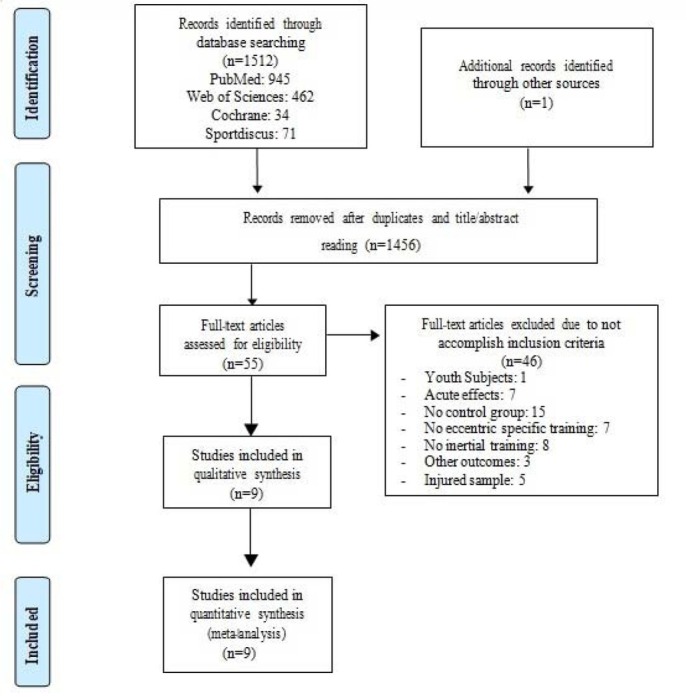
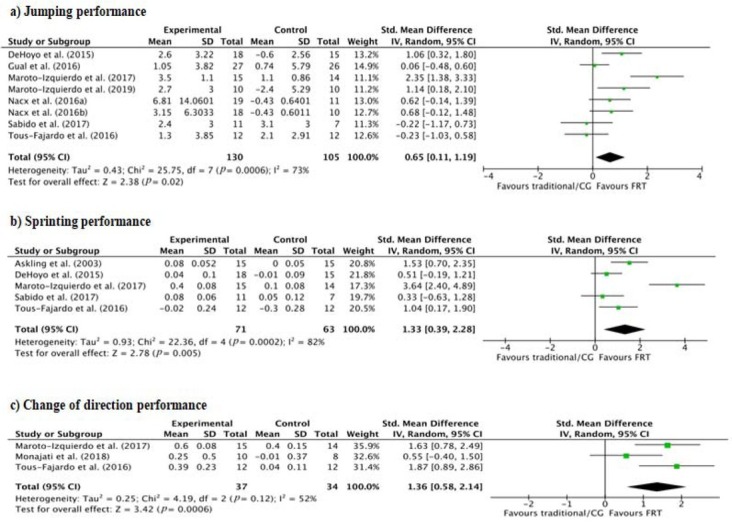
The purpose of the present meta-analysis was to examine the effect of flywheel resistance training (FRT) on main sport action (i.e., jumping performance, sprinting time and change of direction performance) improvements in athletes and healthy active people. A Boolean search strategy adapted for each of the databases employed was conducted to identify all studies measuring change in sport actions performance after FRT interventions up to July 2019. Outcomes were analysed using an average effect size (D+) and a 95% confidence interval (CI), which was calculated assuming a random-effects model. A total of 9 studies with 283 participants met the inclusion criteria and were selected for the analysis. The mean quality score (PEDro scale) of the articles included in the meta-analysis was 5.67. The meta-analysis showed significant positive effects on jumping performance (SMC 0.65; 95% CI, 0.11-1.19; p = 0.02), sprinting time (SMC 1.33; 95% CI, 0.39-2.28; p < 0.01) and change of direction performance (SMC 1.36; 95% CI, 0.58-2.14; p < 0.01) after FRT interventions compared to control/traditional resistance training groups. The results of the present meta-analysis provide evidence of the usefulness of FRT to improve variables related to sport performance in both athletes and healthy population.
Overview
The claims and statistics of this paper haven’t been checked yet.
Free: it reads the open-access text and checks the first 5 claims that cite a source we can check. Create a free account to check every claim.
Integrity signals
Registry
Cites
Statistics
Figures
Verification
Claims the paper makes
The claims and statistics of this paper haven’t been checked yet.
Free: it reads the open-access text and checks the first 5 claims that cite a source we can check. Create a free account to check every claim.
Claims other papers make about this one
Each is checked against this paper’s own text: does it say what the citing paper says it does?
The cited source doesn’t support the claim as written.
In the citing paper
“Compared with CTRL, there were insufficient data to determine whether standard RT (48,69,161), eccentric flywheel RT (162), and velocity-based RT (66) impacted running performance compared with CTRL.”
From American College of Sports Medicine Position Stand. Resistance Training Prescription for Muscle Function, Hypertrophy, and Physical Performance in Healthy Adults: An Overview of Reviews (2026) · cites this paper as [162]
Checked by a reasoning model — may be wrong.
Experimental — accuracy not yet measuredThe cited source doesn’t support the claim as written.
In the citing paper
“Compared with CTRL, there were insufficient data to determine whether standard RT (69) or eccentric flywheel RT (162) impacted the ability to change direction.”
From American College of Sports Medicine Position Stand. Resistance Training Prescription for Muscle Function, Hypertrophy, and Physical Performance in Healthy Adults: An Overview of Reviews (2026) · cites this paper as [162]
Checked by a reasoning model — may be wrong.
Experimental — accuracy not yet measuredThe source backs part of the claim, not all of it — or backs it for a different population, condition or comparison.
In the citing paper
“Compared with CTRL, jumping performance was impacted by eccentric flywheel RT (162) and velocity-based RT (66).”
From American College of Sports Medicine Position Stand. Resistance Training Prescription for Muscle Function, Hypertrophy, and Physical Performance in Healthy Adults: An Overview of Reviews (2026) · cites this paper as [162]
Experimental — accuracy not yet measured
Self-check
Percentages, sums and reported differences re-computed from the paper’s own numbers.
The self-check needs the paper’s full text.
Citations
Cites
Preferred Reporting Items for Systematic Reviews and Meta-Analyses: the PRISMA statement
Moher, D., Liberati, A., Tetzlaff, J., Altman, D. G., & for the PRISMA Group (2009) · BMJ · doi:10.1136/bmj.b2535 · Cited by 83,823
Preferred Reporting Items for Systematic Reviews and Meta-Analyses: The PRISMA Statement
Moher, D., Liberati, A., Tetzlaff, J., Altman, D. G., & The PRISMA Group (2009) · PLoS Medicine · doi:10.1371/journal.pmed.1000097 · Cited by 64,042 · cited 1×
“This meta-analysis was carried out following the recommendations and criteria established in the Preferred Reporting Items for Systematic Reviews and Meta-analysis (PRISMA) statement guidelines (Moher et al., 2009).”
MethodPreferred reporting items for systematic reviews and meta-analyses: the PRISMA Statement.
(2009) · PubMed Central · Cited by 44,859
Distribution Theory for Glass's Estimator of Effect Size and Related Estimators
Hedges, L. V. (1981) · Journal of Educational Statistics · doi:10.2307/1164588 · Cited by 5,695 · cited 1×
“Furthermore, a correction factor proposed by Hedges (1981) was employed in order to avoid an overestimated effect size.”
MethodMeta-Analytic Procedures for Social Research
Rosenthal, R. (1991) · doi:10.4135/9781412984997 · Cited by 4,635 · cited 1×
“When a study did not report the standard deviation of the changes, an r value equal to 0.7 was employed (Rosenthal, 1991).”
MethodInfluentialWisløff, U., Castagna, C., Helgerud, J., Jones, R., & Hoff, J. (2004) · British Journal of Sports Medicine · doi:10.1136/bjsm.2002.002071 · Cited by 1,125 · cited 1×
“The reasoning behind this is that some actions related to performance in sports (e.g. sprinting, jumping and change of direction [COD]) require high strength and power produced by the muscles of the lower limbs (Wisløff et al., 2004).”
BackgroundLipsey, M. W. (2009) · Victims & Offenders · doi:10.1080/15564880802612573 · Cited by 962 · cited 1×
“The moderator variables of the studies selected were coded and grouped into three categories according to Lipsey (2009) recommendations: substantive (participants, context and treatment), methodological and extrinsic variables.”
MethodThe importance of muscular strength: Training considerations
Suchomel, T. J., Nimphius, S., Bellon, C. R., & Stone, M. H. (2018) · Sports Medicine · doi:10.1007/s40279-018-0862-z · Cited by 940 · cited 1×
“…Kinetics - volume 77/2021 http://www.johk.pl stiffness), morphological changes (e.g. muscular hypertrophy), neuromuscular adaptations (e.g. motor unit firing frequency) and dynamic athletic performance due to the higher loads generated during the ECC phase of the movement (Suchomel et al., 2018).”
BackgroundCormie, P., McGuigan, M. R., & Newton, R. U. (2011) · Sports Medicine · doi:10.2165/11538500-000000000-00000 · Cited by 808
HÄKKINEN, K., ALÉN, M., & KOMI, P. V. (1985) · Acta Physiologica Scandinavica · doi:10.1111/j.1748-1716.1985.tb07759.x · Cited by 766
Cited by
CURRIER, B. S., D’SOUZA, A. C., SINGH, M. A. F., LOWISZ, C. V., RAWSON, E. S., SCHOENFELD, B. J., SMITH-RYAN, A. E., STEEN, J. P., THOMAS, G. A., TRIPLETT, N. T., et al. (2026) · Medicine & Science in Sports & Exercise · doi:10.1249/mss.0000000000003897 · Cited by 105
Beato, M., de Keijzer, K. L., Muñoz‐López, A., González, J. R., Pozzo, M., Alkner, B. A., Iacono, A. D., Vicens‐Bordas, J., Coratella, G., Maroto‐Izquierdo, S., et al. (2024) · Sports Medicine · doi:10.1007/s40279-023-01979-x · Cited by 74
“The present evidence may therefore inappropriately represent how flywheel training may elicit changes in jump and power performance with elite athletes [8, 43, 45].”
BackgroundMethodInfluentialSelf-citationBright, T. E., Handford, M. J., Mundy, P. D., Lake, J. P., Theis, N., & Hughes, J. D. (2023) · Sports Medicine · doi:10.1007/s40279-023-01843-y · Cited by 66
“That is, FIT appears particularly effective for simulating the repeated rapid braking and propulsive actions experienced when performing COD tasks, particularly when the overload is resisted during the final one- to two-thirds of the eccentric phase [45, 182, 188].”
Backgroundde Keijzer, K. L., González, J. R., & Beato, M. (2022) · PLoS ONE · doi:10.1371/journal.pone.0264375 · Cited by 66
“Favorably, such improvements in performance are seen after 5–10 weeks of training [40].”
BackgroundMethodInfluentialFlywheel Training Periodization in Team Sports
Beato, M., Maroto‐Izquierdo, S., Hernández‐Davó, J. L., & González, J. R. (2021) · Frontiers in Physiology · doi:10.3389/fphys.2021.732802 · Cited by 45
Self-citationChaabène, H., Markov, A., Prieske, O., Moran, J., Behrens, M., Negra, Y., Ramírez‐Campillo, R., Koch, U., & Mkaouer, B. (2022) · International Journal of Environmental Research and Public Health · doi:10.3390/ijerph19127061 · Cited by 34
“Additionally, for the comparator, the authors of the two previous meta-analysis [17,18] combined studies that included active control and a second intervention (e.”
Backgroundde Keijzer, K. L., McErlain‐Naylor, S. A., & Beato, M. (2022) · Frontiers in Sports and Active Living · doi:10.3389/fspor.2022.898649 · Cited by 20
Smajla, D., Spudić, D., Kozinc, Ž., & Šarabon, N. (2022) · Frontiers in Physiology · doi:10.3389/fphys.2022.828394 · Cited by 22
Spudić, D., Cvitkovič, R., & Šarabon, N. (2021) · Applied Sciences · doi:10.3390/app112210541 · Cited by 22
Effectiveness of Eccentric Overload Training in Basketball Players: A Systematic Review
Younes-Egaña, O., Mielgo‐Ayuso, J., Stojanović, M. D. M., Bird, S. P., & Calleja-González, J. (2023) · Journal of Human Kinetics · doi:10.5114/jhk/167469 · Cited by 23
“Both Raya-González et al. (2021) and Petré et al. (2017) support the use of flywheel inertial training over free weights, while VicensBordas et al. (2018) note that there are no additional benefits between both training methods.”
BackgroundInfluentialFlywheel Eccentric Training: How to Effectively Generate Eccentric Overload
Martínez‐Hernández, D. (2023) · Strength and conditioning journal · doi:10.1519/ssc.0000000000000795 · Cited by 14
Shimizu, T., Tsuchiya, Y., Ueda, H., Izumi, S., & Ochi, E. (2025) · European Journal of Sport Science · doi:10.1002/ejsc.12257 · Cited by 16
“…has been associated with improvements in muscle function, sprinting ability, change in direction performance, jump performance, muscle mass, and strength (Beato and Dello Iacono 2020; de Hoyo, de la Torre, et al. 2015; Maroto‐Izquierdo, García‐López, and de Paz 2017; Raya‐González et al. 2021).”
The chronic effects of eccentric exercise interventions in different populations: an umbrella review
Križaj, L., Kozinc, Ž., Löfler, S., & Šarabon, N. (2022) · European Journal of Translational Myology · doi:10.4081/ejtm.2022.10876 · Cited by 13
“46 Following training protocols using a flywheel device effectively increased both, concentric and eccentric isokinetic strength (of knee flexors).”
InfluentialRyan, S., Ramírez‐Campillo, R., Browne, D. T., Moody, J. A., & Byrne, P. J. (2023) · Sports · doi:10.3390/sports11060121 · Cited by 8
Mak, M. C. W., Bishop, C. J., & Beato, M. (2025) · The Journal of Strength and Conditioning Research · doi:10.1519/jsc.0000000000005146 · Cited by 9
Effects of flywheel resistance training using horizontal vs vertical exercises
Asencio, P., Hernández‐Davó, J. L., García-Valverde, A., & Sabido, R. (2022) · International Journal of Sports Science & Coaching · doi:10.1177/17479541221135372 · Cited by 6
Self-citationShimizu, T., Tsuchiya, Y., Ueda, H., Izumi, S., & Ochi, E. (2024) · BMC Sports Science Medicine and Rehabilitation · doi:10.1186/s13102-023-00785-2 · Cited by 8
“Several recent reviews have clearly shown the effectiveness of training using a fly-wheel (FW) [6–8].”
BackgroundFrom Theory to Practice: A Worldwide Cross-Sectional Survey About Flywheel Training in Basketball
Younes-Egaña, O., Bird, S. P., & Calleja-González, J. (2023) · International Journal of Sports Physiology and Performance · doi:10.1123/ijspp.2023-0202 · Cited by 5
Asencio, P., Hernández, F. J. M., Hernández‐Davó, J. L., & Sabido, R. (2024) · Frontiers in Physiology · doi:10.3389/fphys.2024.1375438 · Cited by 5
Self-citationInertial Flywheel Resistance Training in Tendinopathy Rehabilitation: A Scoping Review
Burton, I., & McCormack, A. (2022) · International Journal of Sports Physical Therapy · doi:10.26603/001c.36437 · Cited by 5
Illera-Domínguez, V., Font-Aragonés, X., Toro-Román, V., Díaz-Alejandre, S., Buxadé, C. P.-C., Albesa-Albiol, L., González-Millán, S., & Fernández-Valdés, B. (2024) · Applied Sciences · doi:10.3390/app14219832 · Cited by 5
Mariscal, S. L., Gómez, Á. R., Suarez-Arrones, L. J., & Ortega‐Becerra, M. (2023) · Sustainability · doi:10.3390/su151914575 · Cited by 4
Kędziorek, J., Błażkiewicz, M., Starczewski, M., Galas, S., Pluta, B., & Krzepota, J. (2025) · Applied Sciences · doi:10.3390/app152312680 · Cited by 3
Ryan, S., Ramírez‐Campillo, R., Browne, D. T., Moody, J. A., & Byrne, P. J. (2023) · Journal of Functional Morphology and Kinesiology · doi:10.3390/jfmk9010001 · Cited by 3
Neuendorf, T., Kaden, M., Wachler, E., Schumann, M., & Nitzsche, N. (2025) · Journal of Science in Sport and Exercise · doi:10.1007/s42978-025-00326-y · Cited by 3
“…has been introduced as a suitable alternative or addition to structured resistance training programs using traditional free weight and machine-based training to enhance sports performance [1, 6, 14, 24] or improving postural stability and pain management during rehabilitation settings [26, 30].”
Leg Press and Chest Press Power Normative Values by Half Decade in Older Women
Parrino, R. L., Martinez, K. J., Konlian, J. A., Conti, J. M., & Signorile, J. F. (2024) · The Journal of Strength and Conditioning Research · doi:10.1519/jsc.0000000000004704 · Cited by 2
“In contrast, flywheel resistance uses a rope or strap attached to the axel of spinning flywheel (8,39).”
BackgroundComparison of muscle activity between isokinetic and iso-inertial exercise
Phillips, T. H. T., Arachchige, R. S. S. S., & Cheung, R. T. H. (2025) · Journal of Electromyography and Kinesiology · doi:10.1016/j.jelekin.2025.103052 · Cited by 2
Zhu, Z., Chen, J., Sun, R., Wang, R., He, J., Zhang, W., Lin, W., & Li, D. (2025) · Frontiers in Public Health · doi:10.3389/fpubh.2025.1579291 · Cited by 2
“Flywheel inertia discs with varying moments of inertia differentially influence mechanical output: higher inertia may reduce power output but significantly enhance force production (10), whereas lower inertia may benefit individuals with “velocity deficits” (11).”
Araújo, D. P. D. S., Agostinho, P. A. G., Chaves, S. F. N., Ferreira, R. D. F., Valente, J. S., de Oliveira, C. E. P., & Moreira, O. C. (2025) · Physiologia · doi:10.3390/physiologia5030026 · Cited by 2
Xue, J., Gao, W. D., Zhang, C., Peng, S., Chen, Z., Zou, R., Wu, W., Zhang, L., Tang, W., & Liu, W. (2025) · Journal of Sports Science and Medicine · doi:10.52082/jssm.2025.824 · Cited by 3
PAPE Effect in Female Footballers: Analyzing the Benefits of Different Flywheel Protocols
Asencio, P., Hernández‐Davó, J. L., Beato, M., & Sabido, R. (2025) · Sports · doi:10.3390/sports13110370 · Cited by 1
“Change of direction was tested at five meters of distance, consisting of two attempts of running and passing a line positioned 5 m away and performing a change of direction with the dominant leg turning 180 ◦ unilaterally (modified T-505), as typical in many sports [25].”
Self-citationPeng, W., Qu, W., Yan, R., Xu, J., Lin, H., Sun, J., & Li, D. (2025) · PLoS ONE · doi:10.1371/journal.pone.0335593 · Cited by 5
“This aligns with Asencio et al. [42], who reported a 7–10% improvement in the 505 agility test after flywheel training protocols involving 29 athletes, thereby highlighting the effectiveness of FET in enhancing COD performance.”
Qu, W., Lu, D., Sun, X., Sun, J., He, J., Song, W., & Li, D. (2026) · BMC Sports Science Medicine and Rehabilitation · doi:10.1186/s13102-025-01403-z · Cited by 2
“Meanwhile, another meta-analysis [22], although confirming the positive effects of FRT, did not systematically evaluate the dose–response effects of training modulating factors (training load, duration, and frequency) on vertical jump and linear sprint.”
InfluentialSpudić, D., Strojnik, V., Štirn, I., Pori, P., & Šarabon, N. (2024) · Journal of Sports Sciences · doi:10.1080/02640414.2024.2434285 · Cited by 2
Zhang, J., Liu, J., & Liu, R. (2025) · Research Square · doi:10.21203/rs.3.rs-7868842/v1 · Cited by 1
Ryan, S., Browne, D. T., Moody, J. A., Ramírez‐Campillo, R., & Byrne, P. J. (2025) · Journal of Sports Sciences · doi:10.1080/02640414.2025.2597718
Sari, I. N., Kumaat, N. A., Sudijandoko, A., & Wahyudi, H. (2026) · COMPETITOR Jurnal Pendidikan Kepelatihan Olahraga · doi:10.26858/cpjok.v18i1.617
Movement Configuration Elements in Football Players: Beyond Dynamic Correspondence Principles
Gonzalo‐Skok, Ó., & Tous‐Fajardo, J. (2026) · Sports Medicine - Open · doi:10.1186/s40798-026-01093-y
Ding, W., Li, B., & Ma, X. (2026) · Frontiers in Physiology · doi:10.3389/fphys.2026.1989504 · Cited by 1
Metadata
- Authors
- Raya-González, J., Prat-Luri, A., López-Valenciano, A., Sabido, R., & Hernández-Davó, J.
- Affiliations
- Universitat de Miguel Hernández d'Elx (ES)
- Corresponding author
- Prat-Luri, Amaya
- Venue
- Journal of Human Kinetics
- Publisher
- Termedia Sp. z.o.o.
- Published
- 2021-01-30
- Volume
- 77
- Pages
- 191-204
- ISSN
- 1640-5544 (ISSN-L)
- 1899-7562
- PMC
- PMC8008299
- OpenAlex
- W3156210219
- Cited by
- 38
- References
- 51
- Citations by year
- 2026: 4 · 2025: 12 · 2024: 6 · 2023: 7 · 2022: 7 · 2021: 2
- FWCI
- 1.17
- Type
- journal article
- Language
- en
- Open access
- diamond
- doi.org
- Licence
- cc-by
- creativecommons.org/licenses/by-nc-nd/3.0/ (vor)
- creativecommons.org/licenses/by-nc-nd/3.0/ (am)
- creativecommons.org/licenses/by-nc-nd/3.0/ (tdm)
- Locations
- Journal of Human Kinetics (publishedVersion, cc-by)
- PubMed Central (publishedVersion, cc-by-nc-nd)
- PubMed (publishedVersion)
- Funders
- Ministerio de Ciencia, Innovación y Universidades (PGC2018-098742-B-C33, PGC 2018)
- European Regional Development Fund (SPGC201800X098742CV0, PGC2018)
- Agencia Estatal de Investigación
- Topics
- Health Sciences › Medicine › Orthopedics and Sports Medicine › Sports Performance and Training
- Health Sciences › Health Professions › Physical Therapy, Sports Therapy and Rehabilitation › Physical Education and Training Studies
- Physical Sciences › Engineering › Biomedical Engineering › Sports Dynamics and Biomechanics
- Keywords
- flywheel resistance training, athletic performance, jump performance, change-of-direction performance, athletes, resistance training
About these checks
Registry, retraction, Cites and statistics results are computed, not judged, with one exception: a printed reference that no index lists is read once by a model before it counts as a citation error. Claims are extracted by a model and kept only when their quote appears verbatim in the text; each cited source is then checked, with a model’s help, for whether it says what the claim relies on. Those verdicts can be wrong — read the claim’s quote and the cited source before relying on one.
Statistics and arithmetic are recomputed, not judged.
Confidence bands are shown only for fields calibrated on our annotated test set. None is calibrated yet, so no band is shown.
What counts as a claim ›How we measure confidence ›How we check this ›
Are you an author, or do you see a problem with this page? Request a review
Data sources
Bibliographic data: Semantic Scholar, OpenAlex, Crossref.
Contains information from the Semantic Scholar Academic Graph Datasets, made available under the ODC Attribution License (ODC-BY 1.0).
Semantic Scholar’s data is described in: Kinney, R., et al. (2023). The Semantic Scholar Open Data Platform. arXiv:2301.10140.
