

Effects of flywheel resistance training on sport actions. A systematic review and meta-analysis.
Open accessThe DOI matches its Crossref record; 51 of the 51 references it cites were found in a registry or an index.
Abstract
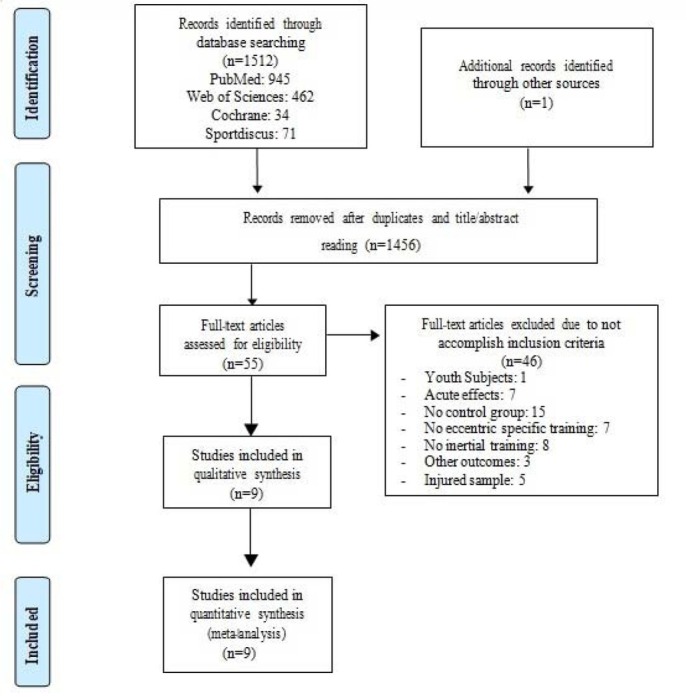
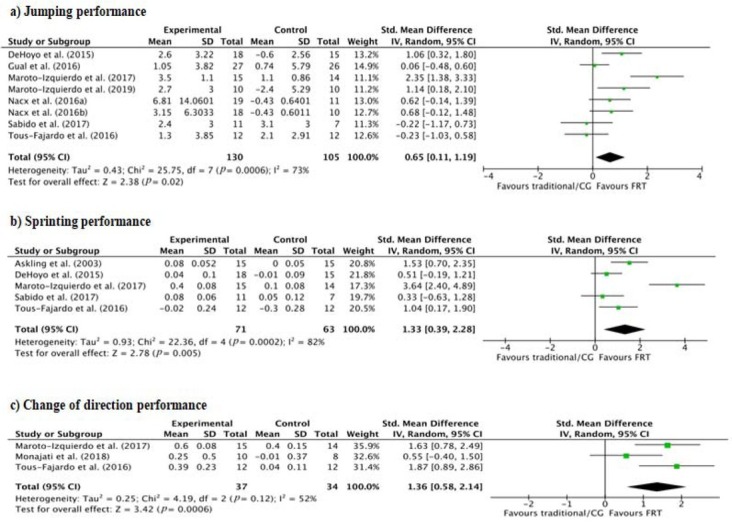
The purpose of the present meta-analysis was to examine the effect of flywheel resistance training (FRT) on main sport action (i.e., jumping performance, sprinting time and change of direction performance) improvements in athletes and healthy active people. A Boolean search strategy adapted for each of the databases employed was conducted to identify all studies measuring change in sport actions performance after FRT interventions up to July 2019. Outcomes were analysed using an average effect size (D+) and a 95% confidence interval (CI), which was calculated assuming a random-effects model. A total of 9 studies with 283 participants met the inclusion criteria and were selected for the analysis. The mean quality score (PEDro scale) of the articles included in the meta-analysis was 5.67. The meta-analysis showed significant positive effects on jumping performance (SMC 0.65; 95% CI, 0.11-1.19; p = 0.02), sprinting time (SMC 1.33; 95% CI, 0.39-2.28; p < 0.01) and change of direction performance (SMC 1.36; 95% CI, 0.58-2.14; p < 0.01) after FRT interventions compared to control/traditional resistance training groups. The results of the present meta-analysis provide evidence of the usefulness of FRT to improve variables related to sport performance in both athletes and healthy population.
Overview
The claims and statistics of this paper haven’t been checked yet.
Free: it reads the open-access text and checks the first 5 claims that cite a source we can check. Create a free account to check every claim.
Integrity signals
Registry
Cites
Statistics
Figures
Verification
Claims the paper makes
The claims and statistics of this paper haven’t been checked yet.
Free: it reads the open-access text and checks the first 5 claims that cite a source we can check. Create a free account to check every claim.
Claims other papers make about this one
Each is checked against this paper’s own text: does it say what the citing paper says it does?
The cited source doesn’t support the claim as written.
In the citing paper
“Compared with CTRL, there were insufficient data to determine whether standard RT (48,69,161), eccentric flywheel RT (162), and velocity-based RT (66) impacted running performance compared with CTRL.”
From American College of Sports Medicine Position Stand. Resistance Training Prescription for Muscle Function, Hypertrophy, and Physical Performance in Healthy Adults: An Overview of Reviews (2026) · cites this paper as [162]
Checked by a reasoning model — may be wrong.
Experimental — accuracy not yet measuredThe cited source doesn’t support the claim as written.
In the citing paper
“Compared with CTRL, there were insufficient data to determine whether standard RT (69) or eccentric flywheel RT (162) impacted the ability to change direction.”
From American College of Sports Medicine Position Stand. Resistance Training Prescription for Muscle Function, Hypertrophy, and Physical Performance in Healthy Adults: An Overview of Reviews (2026) · cites this paper as [162]
Checked by a reasoning model — may be wrong.
Experimental — accuracy not yet measuredThe source backs part of the claim, not all of it — or backs it for a different population, condition or comparison.
In the citing paper
“Compared with CTRL, jumping performance was impacted by eccentric flywheel RT (162) and velocity-based RT (66).”
From American College of Sports Medicine Position Stand. Resistance Training Prescription for Muscle Function, Hypertrophy, and Physical Performance in Healthy Adults: An Overview of Reviews (2026) · cites this paper as [162]
Experimental — accuracy not yet measured
Self-check
Percentages, sums and reported differences re-computed from the paper’s own numbers.
The self-check needs the paper’s full text.
Citations
Cites
Preferred Reporting Items for Systematic Reviews and Meta-Analyses: the PRISMA statement
Moher, D., Liberati, A., Tetzlaff, J., Altman, D. G., & for the PRISMA Group (2009) · BMJ · doi:10.1136/bmj.b2535 · Cited by 83,823
Preferred Reporting Items for Systematic Reviews and Meta-Analyses: The PRISMA Statement
Moher, D., Liberati, A., Tetzlaff, J., Altman, D. G., & The PRISMA Group (2009) · PLoS Medicine · doi:10.1371/journal.pmed.1000097 · Cited by 64,042 · cited 1×
“This meta-analysis was carried out following the recommendations and criteria established in the Preferred Reporting Items for Systematic Reviews and Meta-analysis (PRISMA) statement guidelines (Moher et al., 2009).”
MethodPreferred reporting items for systematic reviews and meta-analyses: the PRISMA Statement.
(2009) · PubMed Central · Cited by 44,859
Distribution Theory for Glass's Estimator of Effect Size and Related Estimators
Hedges, L. V. (1981) · Journal of Educational Statistics · doi:10.2307/1164588 · Cited by 5,695 · cited 1×
“Furthermore, a correction factor proposed by Hedges (1981) was employed in order to avoid an overestimated effect size.”
MethodMeta-Analytic Procedures for Social Research
Rosenthal, R. (1991) · doi:10.4135/9781412984997 · Cited by 4,635 · cited 1×
“When a study did not report the standard deviation of the changes, an r value equal to 0.7 was employed (Rosenthal, 1991).”
MethodInfluentialWisløff, U., Castagna, C., Helgerud, J., Jones, R., & Hoff, J. (2004) · British Journal of Sports Medicine · doi:10.1136/bjsm.2002.002071 · Cited by 1,125 · cited 1×
“The reasoning behind this is that some actions related to performance in sports (e.g. sprinting, jumping and change of direction [COD]) require high strength and power produced by the muscles of the lower limbs (Wisløff et al., 2004).”
BackgroundLipsey, M. W. (2009) · Victims & Offenders · doi:10.1080/15564880802612573 · Cited by 962 · cited 1×
“The moderator variables of the studies selected were coded and grouped into three categories according to Lipsey (2009) recommendations: substantive (participants, context and treatment), methodological and extrinsic variables.”
MethodThe importance of muscular strength: Training considerations
Suchomel, T. J., Nimphius, S., Bellon, C. R., & Stone, M. H. (2018) · Sports Medicine · doi:10.1007/s40279-018-0862-z · Cited by 940 · cited 1×
“…Kinetics - volume 77/2021 http://www.johk.pl stiffness), morphological changes (e.g. muscular hypertrophy), neuromuscular adaptations (e.g. motor unit firing frequency) and dynamic athletic performance due to the higher loads generated during the ECC phase of the movement (Suchomel et al., 2018).”
BackgroundCormie, P., McGuigan, M. R., & Newton, R. U. (2011) · Sports Medicine · doi:10.2165/11538500-000000000-00000 · Cited by 808
HÄKKINEN, K., ALÉN, M., & KOMI, P. V. (1985) · Acta Physiologica Scandinavica · doi:10.1111/j.1748-1716.1985.tb07759.x · Cited by 766
Askling, C., Karlsson, J., & Thorstensson, A. (2003) · Scandinavian Journal of Medicine & Science in Sports · doi:10.1034/j.1600-0838.2003.00312.x · Cited by 724 · cited 6×
“Study 1 2 3 4 5 6 7 8 9 1 0 1 1 S c o r e Askling et al. (2003) + + - + - - - + + + + 6 De Hoyo et al. (2015) + + - + - - - + + + + 6 Gual et al. (2016) + + - + - - - + + + + 6 MarotoIzquierdo et al. (2017) + + - + - - - + + + + 6 Monajati et al., (2018) + + - + - - - + + + + 6 Naczk et al.…”
BackgroundMethodResultInfluentialRoig, M., O’Brien, K., Kirk, G., Murray, R., McKinnon, P., Shadgan, B., & Reid, W. D. (2009) · British Journal of Sports Medicine · doi:10.1136/bjsm.2008.051417 · Cited by 598 · cited 1×
“This EO may be an optimal stimulus for adaptations related to jumping ability, such as improvements in the stretch-shortening cycle and muscle-tendon unit stiffness (Roig et al., 2009).”
BackgroundUnderstanding Change of Direction Ability in Sport: A Review of Resistance Training Studies
Brughelli, M., Cronin, J., Levin, G., & Chaouachi, A. (2008) · Sports Medicine · doi:10.2165/00007256-200838120-00007 · Cited by 575 · cited 3×
“, Olympic weightlifting, plyometrics) failed to elicit COD improvements (Brughelli et al., 2008).”
BackgroundInfluentialPEDro. A database of randomized trials and systematic reviews in physiotherapy
Sherrington, C., Herbert, R. D., Maher, C. G., & Moseley, A. M. (2000) · Manual Therapy · doi:10.1054/math.2000.0372 · Cited by 508 · cited 1×
“The methodological quality of the studies selected was evaluated using the Physiotherapy Evidence Database Scale (PEDro) (Sherrington et al., 2000).”
MethodThe effects of preoperative exercise therapy on postoperative outcome: a systematic review
Valkenet, K., van de Port, I. G., Dronkers, J. J., de Vries, W. R., Lindeman, E., & Backx, F. J. (2011) · Clinical Rehabilitation · doi:10.1177/0269215510380830 · Cited by 441 · cited 1×
“The methodological quality of the study was categorized as follows: a score ranging from 6 to 10 was indicative of high quality; whereas scores of 4-5 indicated fair quality; and scores ≤ 3 indicated poor quality (Valkenet et al., 2011).”
BackgroundHÄKKUKINEN, K., KOMI, P. V., & ALÉN, M. (1985) · Acta Physiologica Scandinavica · doi:10.1111/j.1748-1716.1985.tb07760.x · Cited by 295
CORMIE, P., McGUIGAN, M. R., & NEWTON, R. U. (2010) · Medicine & Science in Sports & Exercise · doi:10.1249/mss.0b013e3181d392e8 · Cited by 254 · cited 2×
“In addition, it can be hypothesized that FRT entails specific adaptations in the ECC phase (e.g., greater eccentric velocities) (de Hoyo et al., 2016), and these specific changes in the movement pattern are related to subsequent improvements in the CON action (Cormie et al., 2010).”
BackgroundResistance training using eccentric overload induces early adaptations in skeletal muscle size
Norrbrand, L., Fluckey, J. D., Pozzo, M., & Tesch, P. A. (2007) · European Journal of Applied Physiology · doi:10.1007/s00421-007-0583-8 · Cited by 253 · cited 3×
“, 2011), strength gains (Norrbrand et al., 2008), and early muscular hypertrophy (Tesch et al.”
BackgroundResultConfidence intervals for the overall effect size in random-effects meta-analysis.
Sánchez-Meca, J., & Marín-Martínez, F. (2008) · Psychological Methods · doi:10.1037/1082-989x.13.1.31 · Cited by 242
de Hoyo, M., Pozzo, M., Sañudo, B., Carrasco, L., Gonzalo-Skok, O., Domínguez-Cobo, S., & Morán-Camacho, E. (2015) · International Journal of Sports Physiology and Performance · doi:10.1123/ijspp.2013-0547 · Cited by 231 · cited 8×
“Study 1 2 3 4 5 6 7 8 9 1 0 1 1 S c o r e Askling et al. (2003) + + - + - - - + + + + 6 De Hoyo et al. (2015) + + - + - - - + + + + 6 Gual et al. (2016) + + - + - - - + + + + 6 MarotoIzquierdo et al. (2017) + + - + - - - + + + + 6 Monajati et al., (2018) + + - + - - - + + + + 6 Naczk et al.…”
BackgroundMethodResultInfluentialEstimation of Effect Size From a Series of Experiments Involving Paired Comparisons
Gibbons, R. D., Hedeker, D. R., & Davis, J. M. (1993) · Journal of Educational Statistics · doi:10.3102/10769986018003271 · Cited by 230 · cited 1×
“Statistical analysis For each of the three outcome measures (jumping performance, sprinting time and COD performance), an effect size was calculated using the standardized mean change (Gibbons et al., 1993) employing the standard deviation of the changes in the algorithm denominator.”
MethodEffect of strength on plant foot kinetics and kinematics during a change of direction task
Spiteri, T., Cochrane, J. L., Hart, N. H., Haff, G. G., & Nimphius, S. (2013) · European Journal of Sport Science · doi:10.1080/17461391.2013.774053 · Cited by 222 · cited 1×
“As previous research has identified the ECC phase as a key point to improve the subsequent acceleration phase (Spiteri et al., 2013), changes in the braking action could positively influence the subsequent propulsive phase, being potentially responsible for COD performance improvements.”
ResultMaroto-Izquierdo, S., García-López, D., Fernandez-Gonzalo, R., Moreira, O. C., González-Gallego, J., & de Paz, J. A. (2017) · Journal of Science and Medicine in Sport · doi:10.1016/j.jsams.2017.03.004 · Cited by 209 · cited 9×
“Change of direction Change of direction was evaluated in three studies (Maroto-Izquierdo et al., 2017; Monajati et al., 2018; Tous-Fajardo et al., 2016), one through a T-test, one through a V-cut test and one through a 4 x 7.5m shuttle sprint test.”
BackgroundMethodResultInfluentialA gravity-independent ergometer to be used for resistance training in space.
Berg, H. E., & Tesch, A. (1994) · PubMed · Cited by 200
Determinants Analysis of Change-of-Direction Ability in Elite Soccer Players
Chaouachi, A., Manzi, V., Chaalali, A., Wong, D. P., Chamari, K., & Castagna, C. (2012) · Journal of Strength and Conditioning Research · doi:10.1519/jsc.0b013e318242f97a · Cited by 196
Tous-Fajardo, J., Gonzalo-Skok, O., Arjol-Serrano, J. L., & Tesch, P. (2016) · International Journal of Sports Physiology and Performance · doi:10.1123/ijspp.2015-0010 · Cited by 188 · cited 10×
“Change of direction Change of direction was evaluated in three studies (Maroto-Izquierdo et al., 2017; Monajati et al., 2018; Tous-Fajardo et al., 2016), one through a T-test, one through a V-cut test and one through a 4 x 7.5m shuttle sprint test.”
BackgroundMethodInfluentialMuscle damage responses and adaptations to eccentric-overload resistance exercise in men and women
Fernandez‐Gonzalo, R., Lundberg, T. R., Álvarez-Álvarez, L., & Fernández, J. A. D. P. (2014) · European Journal of Applied Physiology · doi:10.1007/s00421-014-2836-7 · Cited by 187 · cited 1×
“Traditionally, both in research and practice, the most common resistance training methodologies used entail a predominant incidence in the concentric (CON) phase, such as free weights and weight stack machines (Fernandez-Gonzalo et al., 2014).”
BackgroundEffects of strength training with eccentric overload on muscle adaptation in male athletes
Friedmann-Bette, B., Bauer, T., Kinscherf, R., Vorwald, S., Klute, K., Bischoff, D., Müller, H., Weber, M.-A., Metz, J., Kauczor, H.-U., et al. (2010) · European Journal of Applied Physiology · doi:10.1007/s00421-009-1292-2 · Cited by 185 · cited 2×
“Precisely, FRT interventions have shown to increase mRNA levels of type II fibers (Friedmann-Bette et al., 2010), potentially inducing a faster muscle phenotype, which favors explosive actions.”
BackgroundTesch, P. A., Ekberg, A., Lindquist, D. M., & Trieschmann, J. T. (2004) · Acta Physiologica Scandinavica · doi:10.1046/j.0001-6772.2003.01225.x · Cited by 176 · cited 1×
“…regard, several studies have obtained positive results in injury prevention programs (Askling et al., 2003; de Hoyo et al., 2015), rehabilitation processes after injuries (Romero-Rodriguez et al., 2011), strength gains (Norrbrand et al., 2008), and early muscular hypertrophy (Tesch et al., 2004).”
ResultLora, M. D. H., Gonzalo‐Skok, Ó., Sañudo, B., Carrascal, C., Plaza-Armas, J. R., Camacho-Candil, F., & Otero‐Esquina, C. (2016) · The Journal of Strength and Conditioning Research · doi:10.1519/jsc.0000000000001094 · Cited by 171 · cited 2×
“In addition, it can be hypothesized that FRT entails specific adaptations in the ECC phase (e.g., greater eccentric velocities) (de Hoyo et al., 2016), and these specific changes in the movement pattern are related to subsequent improvements in the CON action (Cormie et al., 2010).”
BackgroundAlkner, B. A., & Tesch, P. A. (2004) · Acta Physiologica Scandinavica · doi:10.1111/j.1365-201x.2004.01293.x · Cited by 160 · cited 1×
“Although flywheel devices were originally created to be used in microgravity situations in order to reduce muscle mass loss (Alkner and Tesch, 2004; Alkner et al., 2003), there has been an exponential increase of this training methodology in sport populations during the last few years.”
MethodEffects of Velocity-Based Resistance Training on Young Soccer Players of Different Ages
González‐Badillo, J. J., Pareja‐Blanco, F., Rodríguez‐Rosell, D., Abad-Herencia, J. L., del Ojo-López, J. J., & Sánchez‐Medina, L. (2014) · The Journal of Strength and Conditioning Research · doi:10.1519/jsc.0000000000000764 · Cited by 159 · cited 1×
“In this sense, a strong relationship between lower-limb power output and most of the above-mentioned typical sport actions has been reported (González-Badillo et al., 2015; Swinton et al., 2014).”
BackgroundGonzalo-Skok, O., Tous-Fajardo, J., Valero-Campo, C., Berzosa, C., Bataller, A. V., Arjol-Serrano, J. L., Moras, G., & Mendez-Villanueva, A. (2017) · International Journal of Sports Physiology and Performance · doi:10.1123/ijspp.2016-0251 · Cited by 145 · cited 2×
“…has shown performance improvements in sports that imply actions such as jumping (de Hoyo et al., 2015; Sabido et al., 2017; Tous-Fajardo et al., 2016), sprinting (de Hoyo, et al., 2015; Gonzalo-Skok et al., 2017) and COD (de Hoyo, et al., 2015; Núñez et al., 2018; Tous-Fajardo et al., 2016).”
BackgroundNuñez, F. J., Santalla, A., García, I. C., Asián-Clemente, J. A., Reina, J. I., & Suarez-Arrones, L. J. (2018) · PLoS ONE · doi:10.1371/journal.pone.0193841 · Cited by 137
Lora, M. D. H., Sañudo, B., Páez, L. C., Cortés, J. M., Domínguez‐Cobo, S., Fernandes, O., López, J. J. D. O., & Gonzalo‐Skok, Ó. (2016) · Journal of Sports Sciences · doi:10.1080/02640414.2016.1157624 · Cited by 135 · cited 2×
“In addition, it can be hypothesized that FRT entails specific adaptations in the ECC phase (e.g., greater eccentric velocities) (de Hoyo et al., 2016), and these specific changes in the movement pattern are related to subsequent improvements in the CON action (Cormie et al., 2010).”
BackgroundSabido, R., Hernández‐Davó, J. L., Botella, J., Navarro, A., & Tous‐Fajardo, J. (2017) · European Journal of Sport Science · doi:10.1080/17461391.2017.1282046 · Cited by 132 · cited 6×
“Sprinting time Sprinting time was evaluated in five studies (Askling et al., 2003; de Hoyo et al., 2015; Maroto-Izquierdo et al., 2017; Sabido et al., 2017; Tous-Fajardo et al., 2016), three by means of a 20 m test, one through a 30 m test and one through a flying 30 m test.”
BackgroundMethodInfluentialSelf-citationEffects of Eccentric Overload Bout on Change of Direction and Performance in Soccer Players
Lora, M. D. H., de la Torre, A., de la Fuente, F. P., Sañudo, B., Páez, L. C., Cortés, J. M., Domínguez‐Cobo, S., Fernandes, O., & Gonzalo‐Skok, Ó. (2014) · International Journal of Sports Medicine · doi:10.1055/s-0034-1395521 · Cited by 123 · cited 8×
“Study 1 2 3 4 5 6 7 8 9 1 0 1 1 S c o r e Askling et al. (2003) + + - + - - - + + + + 6 De Hoyo et al. (2015) + + - + - - - + + + + 6 Gual et al. (2016) + + - + - - - + + + + 6 MarotoIzquierdo et al. (2017) + + - + - - - + + + + 6 Monajati et al., (2018) + + - + - - - + + + + 6 Naczk et al.…”
BackgroundMethodResultInfluentialRomero‐Rodríguez, D., Gual, G., & Tesch, P. A. (2010) · Physical Therapy in Sport · doi:10.1016/j.ptsp.2010.10.003 · Cited by 116 · cited 1×
“…regard, several studies have obtained positive results in injury prevention programs (Askling et al., 2003; de Hoyo et al., 2015), rehabilitation processes after injuries (Romero-Rodriguez et al., 2011), strength gains (Norrbrand et al., 2008), and early muscular hypertrophy (Tesch et al., 2004).”
ResultVicens‐Bordas, J., Esteve, E., Vanmeerhaeghe, A. F., Bandholm, T., & Thorborg, K. (2017) · Journal of science and medicine in sport · doi:10.1016/j.jsams.2017.10.006 · Cited by 112 · cited 1×
“As a result of the increased interest regarding FRT interventions, some meta-analyses have been recently published (Nuñez and Sáez de Villarreal, 2017; Vicens-Bordas et al., 2018).”
BackgroundMaroto-Izquierdo, S., García-López, D., & de Paz, J. A. (2017) · Journal of Human Kinetics · doi:10.1515/hukin-2017-0096 · Cited by 110 · cited 14×
“Change of direction Change of direction was evaluated in three studies (Maroto-Izquierdo et al., 2017; Monajati et al., 2018; Tous-Fajardo et al., 2016), one through a T-test, one through a V-cut test and one through a 4 x 7.5m shuttle sprint test.”
BackgroundMethodResultInfluentialGual, G., Vanmeerhaeghe, A. F., Romero‐Rodríguez, D., & Tesch, P. A. (2015) · The Journal of Strength and Conditioning Research · doi:10.1519/jsc.0000000000001286 · Cited by 109 · cited 3×
“Effect sizes Jumping performance Jumping performance was evaluated in seven studies (de Hoyo et al., 2015; Gual et al., 2016; Maroto-Izquierdo et al., 2017; MarotoIzquierdo et al., 2019; Naczk et al., 2016; Sabido et al., 2017; Tous-Fajardo et al., 2016), all by means of the countermovement jump…”
MethodDoes flywheel paradigm training improve muscle volume and force? A meta-analysis.
Nuñez Sanchez, F. J., & Sáez de Villarreal, E. (2017) · Journal of Strength and Conditioning Research · doi:10.1519/jsc.0000000000002095 · Cited by 77
Regression Models of Sprint, Vertical Jump, and Change of Direction Performance
Swinton, P. A., Lloyd, R., Keogh, J. W. L., Agouris, I., & Stewart, A. D. (2014) · Journal of Strength and Conditioning Research · doi:10.1519/jsc.0000000000000348 · Cited by 74 · cited 1×
“In this sense, a strong relationship between lower-limb power output and most of the above-mentioned typical sport actions has been reported (González-Badillo et al., 2015; Swinton et al., 2014).”
Backgroundde Hoyo, M., Sañudo, B., Carrasco, L., Domínguez-Cobo, S., Mateo-Cortes, J., Cadenas-Sánchez, M. M., & Nimphius, S. (2015) · Journal of Human Kinetics · doi:10.1515/hukin-2015-0071 · Cited by 55 · cited 8×
“Study 1 2 3 4 5 6 7 8 9 1 0 1 1 S c o r e Askling et al. (2003) + + - + - - - + + + + 6 De Hoyo et al. (2015) + + - + - - - + + + + 6 Gual et al. (2016) + + - + - - - + + + + 6 MarotoIzquierdo et al. (2017) + + - + - - - + + + + 6 Monajati et al., (2018) + + - + - - - + + + + 6 Naczk et al.…”
BackgroundMethodResultInfluentialAlkner, B. A., Berg, H. E., Kozlovskaya, I. B., Sayenko, D. G., & Tesch, P. A. (2003) · European Journal of Applied Physiology · doi:10.1007/s00421-003-0850-2 · Cited by 54 · cited 1×
“Although flywheel devices were originally created to be used in microgravity situations in order to reduce muscle mass loss (Alkner and Tesch, 2004; Alkner et al., 2003), there has been an exponential increase of this training methodology in sport populations during the last few years.”
MethodMaroto‐Izquierdo, S., Fernandez‐Gonzalo, R., Magdi, H. R., Manzano‐Rodriguez, S., González‐Gallego, J., & Fernández, J. A. D. P. (2019) · European Journal of Sport Science · doi:10.1080/17461391.2019.1588920 · Cited by 48 · cited 1×
“Contrarily, those showing favorable results for FRT interventions used a schedule of 2-3 sessions per week (de Hoyo et al., 2015; Maroto-Izquierdo et al., 2017, 2019; Naczk et al., 2016).”
BackgroundImpact of Inertial Training on Strength and Power Performance in Young Active Men.
Naczk, M., Naczk, A., Brzenczek‐Owczarzak, W., Arlet, J., & Adach, Z. (2016) · PubMed · doi:10.1097/jsc.0000000000000217 · Cited by 40 · cited 4×
“…+ 6 Gual et al. (2016) + + - + - - - + + + + 6 MarotoIzquierdo et al. (2017) + + - + - - - + + + + 6 Monajati et al., (2018) + + - + - - - + + + + 6 Naczk et al. (2016) - + - + - - - + + + + 6 Sabido et al. (2017) + - - + - - - + + + + 5 Tous-Fajardo et al. (2016) + - - + - - - + + + +…”
BackgroundMethodInfluentialInjury Prevention Programs Based on Flywheel vs. Body Weight Resistance in Recreational Athletes
Monajati, A., Larumbe‐Zabala, E., Goss-Sampson, M. A., & Naclerio, F. (2018) · The Journal of Strength and Conditioning Research · doi:10.1519/jsc.0000000000002878 · Cited by 38 · cited 5×
“Change of direction Change of direction was evaluated in three studies (Maroto-Izquierdo et al., 2017; Monajati et al., 2018; Tous-Fajardo et al., 2016), one through a T-test, one through a V-cut test and one through a 4 x 7.5m shuttle sprint test.”
BackgroundMethodInfluentialThe High-Pull Exercise: A Comparison Between a VersaPulley Flywheel Device and the Free Weight
Nuñez, F. J., Suarez-Arrones, L. J., Cater, P., & Méndez-Villanueva, A. (2016) · International Journal of Sports Physiology and Performance · doi:10.1123/ijspp.2016-0059 · Cited by 33
González, J. R., Suarez-Arrones, L. J., Bretones, A. R., & de Villarreal, E. S. (2018) · Retos · doi:10.47197/retos.v0i33.53547 · Cited by 23
Impact of Inertial Training on Strength and Power Performance in Young Active Men
Naczk, M., Naczk, A., Brzenczek‐Owczarzak, W., Arlet, J., & Adach, Z. (2013) · The Journal of Strength and Conditioning Research · doi:10.1519/jsc.0b013e3182a993c2 · Cited by 12
Cited by
CURRIER, B. S., D’SOUZA, A. C., SINGH, M. A. F., LOWISZ, C. V., RAWSON, E. S., SCHOENFELD, B. J., SMITH-RYAN, A. E., STEEN, J. P., THOMAS, G. A., TRIPLETT, N. T., et al. (2026) · Medicine & Science in Sports & Exercise · doi:10.1249/mss.0000000000003897 · Cited by 105
Beato, M., de Keijzer, K. L., Muñoz‐López, A., González, J. R., Pozzo, M., Alkner, B. A., Iacono, A. D., Vicens‐Bordas, J., Coratella, G., Maroto‐Izquierdo, S., et al. (2024) · Sports Medicine · doi:10.1007/s40279-023-01979-x · Cited by 74
“The present evidence may therefore inappropriately represent how flywheel training may elicit changes in jump and power performance with elite athletes [8, 43, 45].”
BackgroundMethodInfluentialSelf-citationBright, T. E., Handford, M. J., Mundy, P. D., Lake, J. P., Theis, N., & Hughes, J. D. (2023) · Sports Medicine · doi:10.1007/s40279-023-01843-y · Cited by 66
“That is, FIT appears particularly effective for simulating the repeated rapid braking and propulsive actions experienced when performing COD tasks, particularly when the overload is resisted during the final one- to two-thirds of the eccentric phase [45, 182, 188].”
Backgroundde Keijzer, K. L., González, J. R., & Beato, M. (2022) · PLoS ONE · doi:10.1371/journal.pone.0264375 · Cited by 66
“Favorably, such improvements in performance are seen after 5–10 weeks of training [40].”
BackgroundMethodInfluentialFlywheel Training Periodization in Team Sports
Beato, M., Maroto‐Izquierdo, S., Hernández‐Davó, J. L., & González, J. R. (2021) · Frontiers in Physiology · doi:10.3389/fphys.2021.732802 · Cited by 45
Self-citation
Metadata
- Authors
- Raya-González, J., Prat-Luri, A., López-Valenciano, A., Sabido, R., & Hernández-Davó, J.
- Affiliations
- Universitat de Miguel Hernández d'Elx (ES)
- Corresponding author
- Prat-Luri, Amaya
- Venue
- Journal of Human Kinetics
- Publisher
- Termedia Sp. z.o.o.
- Published
- 2021-01-30
- Volume
- 77
- Pages
- 191-204
- ISSN
- 1640-5544 (ISSN-L)
- 1899-7562
- PMC
- PMC8008299
- OpenAlex
- W3156210219
- Cited by
- 38
- References
- 51
- Citations by year
- 2026: 4 · 2025: 12 · 2024: 6 · 2023: 7 · 2022: 7 · 2021: 2
- FWCI
- 1.17
- Type
- journal article
- Language
- en
- Open access
- diamond
- doi.org
- Licence
- cc-by
- creativecommons.org/licenses/by-nc-nd/3.0/ (vor)
- creativecommons.org/licenses/by-nc-nd/3.0/ (am)
- creativecommons.org/licenses/by-nc-nd/3.0/ (tdm)
- Locations
- Journal of Human Kinetics (publishedVersion, cc-by)
- PubMed Central (publishedVersion, cc-by-nc-nd)
- PubMed (publishedVersion)
- Funders
- Ministerio de Ciencia, Innovación y Universidades (PGC2018-098742-B-C33, PGC 2018)
- European Regional Development Fund (SPGC201800X098742CV0, PGC2018)
- Agencia Estatal de Investigación
- Topics
- Health Sciences › Medicine › Orthopedics and Sports Medicine › Sports Performance and Training
- Health Sciences › Health Professions › Physical Therapy, Sports Therapy and Rehabilitation › Physical Education and Training Studies
- Physical Sciences › Engineering › Biomedical Engineering › Sports Dynamics and Biomechanics
- Keywords
- flywheel resistance training, athletic performance, jump performance, change-of-direction performance, athletes, resistance training
About these checks
Registry, retraction, Cites and statistics results are computed, not judged, with one exception: a printed reference that no index lists is read once by a model before it counts as a citation error. Claims are extracted by a model and kept only when their quote appears verbatim in the text; each cited source is then checked, with a model’s help, for whether it says what the claim relies on. Those verdicts can be wrong — read the claim’s quote and the cited source before relying on one.
Statistics and arithmetic are recomputed, not judged.
Confidence bands are shown only for fields calibrated on our annotated test set. None is calibrated yet, so no band is shown.
What counts as a claim ›How we measure confidence ›How we check this ›
Are you an author, or do you see a problem with this page? Request a review
Data sources
Bibliographic data: Semantic Scholar, OpenAlex, Crossref.
Contains information from the Semantic Scholar Academic Graph Datasets, made available under the ODC Attribution License (ODC-BY 1.0).
Semantic Scholar’s data is described in: Kinney, R., et al. (2023). The Semantic Scholar Open Data Platform. arXiv:2301.10140.
