

Muscle Oxygen Saturation Breakpoints Reflect Ventilatory Thresholds in Both Cycling and Running
Open accessThe DOI matches its Crossref record; 33 of the 33 references it cites were found in a registry or an index; 4 of the 22 sources its claims cite were checked for support.
Abstract
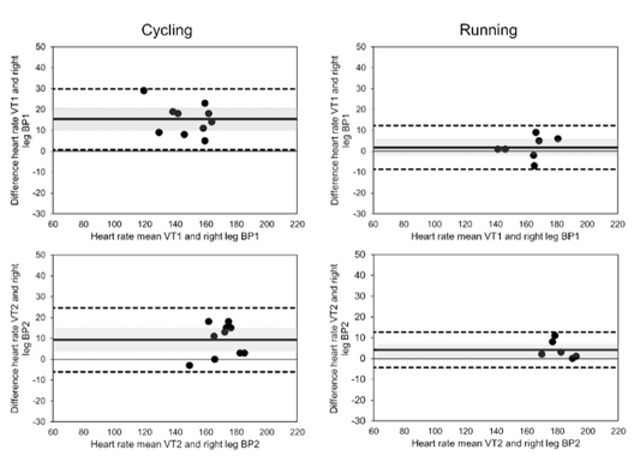
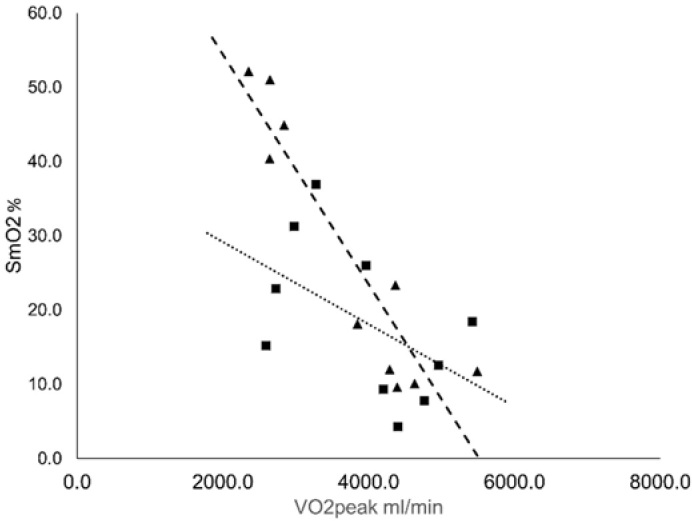
Pulmonary gas exchange analysis was compared to changes in muscle oxygen saturation as measured by near-infrared spectroscopy. First, ventilatory thresholds determined by common gas exchange analysis and breakpoints in muscle oxygen saturation were assessed for agreement during exercise with increasing intensity. Secondly, the relationship between muscle oxygen saturation as a surrogate for local oxygen extraction and peak oxygen uptake was assessed. In order to lend robustness to future NIRS testing on a broader scale, considering its potential for simple and cost-effective application, the question of a running versus a cycling modality was integrated into the design. Ten participants, of whom five were recreationally trained cyclists and five recreationally trained runners, were tested; each during a cycling test and a running test with increasing intensity to voluntary exhaustion. Muscle oxygen saturation and pulmonary gas exchange measurements were conducted. Bland-Altman analysis showed a moderate degree of agreement between both muscle oxygen saturation breakpoint 1 and muscle oxygen saturation breakpoint 2 and corresponding ventilatory threshold 1 and ventilatory threshold 2, for both cycling and running disciplines; generally speaking, muscle oxygen saturation breakpoints underestimated ventilatory thresholds. Additionally, a strong relationship could be seen between peak oxygen uptake and the minimally attained muscle oxygen saturation during cycling exercise. Muscle oxygen saturation measured using NIRS was determined to be a suitable method to assess ventilatory thresholds by finding breakpoints in muscle oxygen saturation, and muscle oxygen saturation minimum was linked to peak oxygen uptake.
Overview
CoChat Summary
TL;DR
NIRS-derived muscle oxygen saturation breakpoints showed moderate agreement with ventilatory thresholds during incremental cycling and running, generally underestimating VT1/VT2. SmO2min correlated strongly with VO2peak in cycling but weakly in running.
Key findings
- Bland-Altman showed moderate agreement between SmO2 BP1/BP2 and VT1/VT2 in both cycling and running; BPs generally underestimated VTs. BP1 cycling MB: 15.4 ± 7.4 bpm vs running MB: 1.8 ± 5.6 bpm; BP2 cycling MB: 9.3 ± 7.8 bpm, running MB: 4.2 ± 7.2 bpm.
- Time-point agreement: VT1 cycle MB: 70.6 ± 64.0 s, run MB: 10.4 ± 49.1 s; VT2 cycle MB: 5.8 ± 59.2 s, run MB: 5.0 ± 28.3 s; approximately one performance step in power/speed.
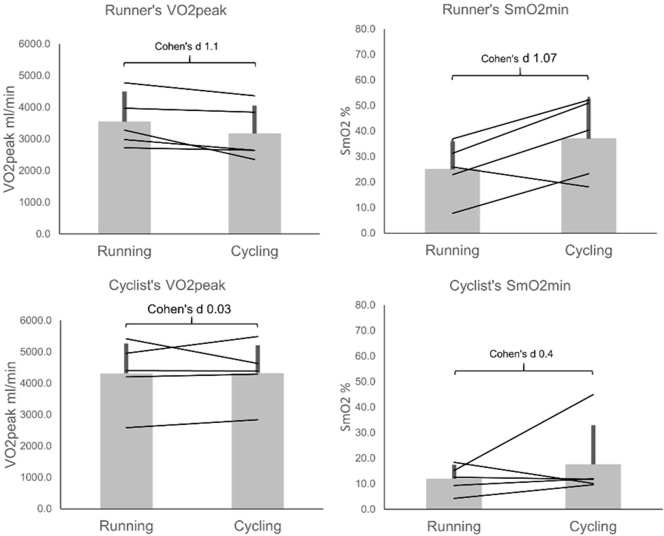
- VO2peak correlated with SmO2min at cessation: cycling R² = 0.8512; running R² = 0.266.
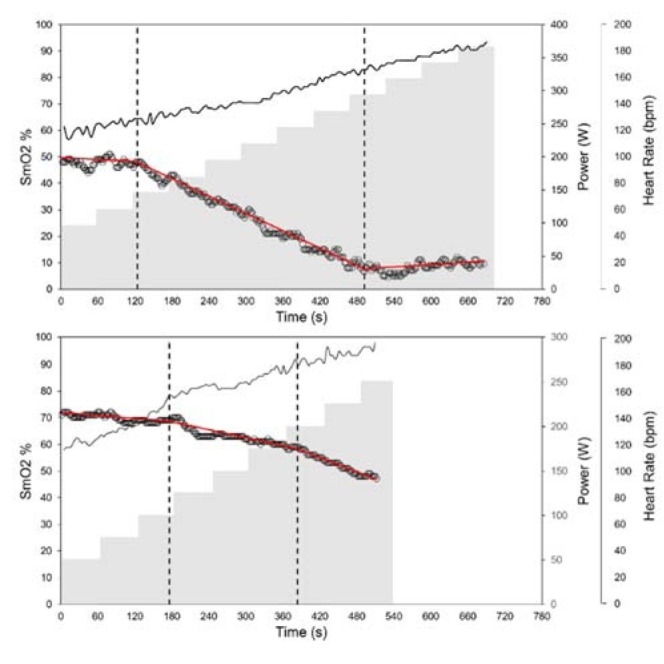
- BP2 inflection pattern varied: cycling positive in 7/10 and negative in 3/10; running positive in 2 and negative in 5; running had three tests with only one clear BP.
Methods
- Ten analyzed participants (six males, four females; five recreationally trained cyclists, five recreationally trained runners) after four of 14 were removed due to adipose tissue thickness; each completed a cycling and a running incremental test to voluntary exhaustion one week apart, randomized order.
- Gas exchange was measured breath-by-breath (Oxycon Jaeger); SmO2 was measured with NIRS (Moxy Monitor) on right and left vastus lateralis. Cycling: 60-s increments of 25 W; running: 30-s increments of 0.5 km/h at 7% incline.
- VT1/VT2 were determined by expert 9-panel CPET; BP1/BP2 by automated segmented regression on SmO2 (four knots, first 60 s excluded). Agreement assessed with Bland-Altman on heart rate; VO2peak–SmO2min relationship with Pearson correlation.
Limitations
- Stated: ATT is a source of concern and required excluding four participants; ATT differences between female and male groups were large and could confound apparent sex differences; muscle probe site and exercise discipline affect SmO2 measurements; protocol choice affects results; BP determination lacks standardization.
- Stated: no clear conclusion could be reached on SmO2 time-course patterns by biological sex and ATT, though there was a slight skew toward higher ATT yielding two negative deflection points; one athlete was an outlier with a large cycling-vs-running SmO2min difference.
- Evident from text: small analyzed sample (n=10) with uneven sex distribution across cyclist/runner groups; some running tests had only one clear BP and some VT2 could not be clearly identified; BP2 could be positive or negative, complicating automated threshold identification.
Model-written summary. Check it against the paper before relying on it.
Integrity signals
Registry
Cites
Statistics
Figures
Verification
Claims the paper makes
4 Valid · 0 Not valid · 11 Not checked · 24 Own results and interpretations
The cited sources support only part of this claim — read each source’s verdict below.
In the paper
“Racinais et al. (2014) using both oxy[heme] and deoxy[heme] signals found a moderate relationship between NIRS dynamics and VT.”
§ Muscle Oxygen Saturation Breakpoints Reflect Ventilatory Thresholds in Both Cycling and Running > Introduction
What the sources say
- Partly supportedcites Racinais et al., 2014 matched to “Breakpoints in ventilation, cerebral and muscle oxygenation, and muscle activity during an incremental cycling exercise” (2014) sourceExperimental — accuracy not yet measured
The Methods and Results (Deoxygenation responses; page unavailable) show that the study used both oxyhemoglobin and deoxyhemoglobin NIRS signals and compared their breakpoints with ventilatory thresholds. The Results report cerebral breakpoints near VT-1 and later than VT-2, but do not establish a ‘moderate relationship’ between NIRS dynamics and VT; ‘moderately’ describes the size of the difference from VT-2, not the strength of a relationship. (LLM, conf=0.86)
plainstates an association- Asserted: passes — The authors put it forward as true.
- Checkable: passes — It can be checked against evidence.
- Load-bearing: unclear — It is unclear whether the paper’s conclusions depend on it.
- Based: passes — The paper gives a reason why it holds.
- Partly supported
A result the paper reports from its own data — it cites no other source for it, so there is none to check. The quote shows it is in the paper.
In the paper
“BP1 for cycling appears to underestimate VT1 (Mean Bias (MB): 15.4 ± 7.4 bpm); this is not the case for running which shows a good agreement (MB: 1.8 ± 5.6 bpm).”
§ Muscle Oxygen Saturation Breakpoints Reflect Ventilatory Thresholds in Both Cycling and Running > Results
plainstates an association- Asserted: passes — The authors put it forward as true.
- Checkable: passes — It can be checked against evidence.
- Load-bearing: passes — The paper’s conclusions depend on it.
- Based: passes — The paper gives a reason why it holds.
A result the paper reports from its own data — it cites no other source for it, so there is none to check. The quote shows it is in the paper.
In the paper
“BP1 for cycling appears to underestimate VT1 (Mean Bias (MB): 15.4 ± 7.4 bpm); this is not the case for running which shows a good agreement (MB: 1.8 ± 5.6 bpm).”
§ Muscle Oxygen Saturation Breakpoints Reflect Ventilatory Thresholds in Both Cycling and Running > Results
hedged- Asserted: passes — The authors put it forward as true.
- Checkable: passes — It can be checked against evidence.
- Load-bearing: passes — The paper’s conclusions depend on it.
- Based: passes — The paper gives a reason why it holds.
A result the paper reports from its own data — it cites no other source for it, so there is none to check. The quote shows it is in the paper.
In the paper
“This was not the case for running, which showed a substantially weaker relationship (R2 = 0.266).”
§ Muscle Oxygen Saturation Breakpoints Reflect Ventilatory Thresholds in Both Cycling and Running > Results
plainstates an association- Asserted: passes — The authors put it forward as true.
- Checkable: passes — It can be checked against evidence.
- Load-bearing: unclear — It is unclear whether the paper’s conclusions depend on it.
- Based: passes — The paper gives a reason why it holds.
A result the paper reports from its own data — it cites no other source for it, so there is none to check. The quote shows it is in the paper.
In the paper
“BP2 and VT show a moderate degree of agreement for both cycling and running; in both cases, BP2 underestimates VT2 (cycle MB: 9.3 bpm ± 7.8, run MB: 4.2 bpm ± 7.2).”
§ Muscle Oxygen Saturation Breakpoints Reflect Ventilatory Thresholds in Both Cycling and Running > Results
plain- Asserted: passes — The authors put it forward as true.
- Checkable: passes — It can be checked against evidence.
- Load-bearing: unclear — It is unclear whether the paper’s conclusions depend on it.
- Based: passes — The paper gives a reason why it holds.
16 more claims
Create a free account to see all 39 claims and to verify the 1 reference still open.
- It may state two separate claims as one. 8
- Probably not a substantial claim. 10
Claims other papers make about this one
Each is checked against this paper’s own text: does it say what the citing paper says it does?
The cited source doesn’t support the claim as written.
In the citing paper
“However, the results of the first threshold were not clearly defined in the study by Feldmann et al. (2022), since both first thresholds are not correlated.”
From A comparative analysis of mathematical methods for detecting lactate thresholds using muscle oxygenation data during a graded cycling test (2023) · cites this paper as Feldmann et al., 2022
Checked by a reasoning model — may be wrong.
Experimental — accuracy not yet measuredThe source backs part of the claim, not all of it — or backs it for a different population, condition or comparison.
In the citing paper
“The studies of Feldmann et al.16 and Van der Zwaard et al.42 compared the VT1 and LT1 with MOT1 in cycling and found ICC values (ICC = 0.56–0.65).”
From Reliability of threshold determination using portable muscle oxygenation monitors during exercise testing: a systematic review and meta-analysis (2023) · cites this paper as [16]
Experimental — accuracy not yet measuredThe source backs part of the claim, not all of it — or backs it for a different population, condition or comparison.
In the citing paper
“Moreover, a fair ICC in running was shown (ICC = 0.23–0.49)16,44.”
From Reliability of threshold determination using portable muscle oxygenation monitors during exercise testing: a systematic review and meta-analysis (2023) · cites this paper as [16]
Experimental — accuracy not yet measuredThe source backs part of the claim, not all of it — or backs it for a different population, condition or comparison.
In the citing paper
“The second threshold was determined using the blood lactate concentration and muscle oxygenation in different sports such as cycling16,17,46–48, running44,45,49 and rowing26.”
From Reliability of threshold determination using portable muscle oxygenation monitors during exercise testing: a systematic review and meta-analysis (2023) · cites this paper as [16]
Experimental — accuracy not yet measuredThe source backs part of the claim, not all of it — or backs it for a different population, condition or comparison.
In the citing paper
“Vastus lateralis was the muscle most assessed16,25,26,40–44,46, although other muscles such as gastrocnemius44,45,47,49, rectus femoris17, biceps femoris44, lateral deltoid43 or intercostal39 were also evaluated.”
From Reliability of threshold determination using portable muscle oxygenation monitors during exercise testing: a systematic review and meta-analysis (2023) · cites this paper as [16]
Experimental — accuracy not yet measured
5 more claims about this paper
Create a free account to see every claim other papers make about this one.
Citations
Cites
STATISTICAL METHODS FOR ASSESSING AGREEMENT BETWEEN TWO METHODS OF CLINICAL MEASUREMENT
Martin Bland, J., & Altman, D. (1986) · The Lancet · doi:10.1016/s0140-6736(86)90837-8 · Cited by 47,965
Validation of near-infrared spectroscopy in humans
Mancini, D. M., Bolinger, L., Li, H., Kendrick, K., Chance, B., & Wilson, J. R. (1994) · Journal of Applied Physiology · doi:10.1152/jappl.1994.77.6.2740 · Cited by 669 · cited 1×
“Mechanistically this makes sense, as NIRS measurements have been shown to accurately reflect venous oxygen saturation (Mancini et al., 1994).”
BackgroundUnderstanding near infrared spectroscopy and its application to skeletal muscle research
Barstow, T. J. (2019) · Journal of Applied Physiology · doi:10.1152/japplphysiol.00166.2018 · Cited by 470 · cited 2×
“While in his review Barstow (2019) does identify this nomenclature as well and proposes to match both tissue oxygen saturation and muscle oxygen saturation under the common term StO2, we disagree and propose to leave the term as SmO2.”
BackgroundGrassi, B., Pogliaghi, S., Rampichini, S., Quaresima, V., Ferrari, M., Marconi, C., & Cerretelli, P. (2003) · Journal of Applied Physiology · doi:10.1152/japplphysiol.00695.2002 · Cited by 429
Grassi, B., & Quaresima, V. (2016) · Journal of Biomedical Optics · doi:10.1117/1.jbo.21.9.091313 · Cited by 345 · cited 2×
“Secondly, change in the NIRS derived muscle oxygenation signal has been directly tied to changes in local muscular oxygen extraction and utilization (Grassi and Quaresima, 2016) and therefore tightly linked to arterio-venous difference at rest and during exercise (Ferreira et al., 2005).”
BackgroundPhysiological Differences Between Cycling and Running: Lessons from Triathletes
Millet, G. P., Vleck, V. E., & Bentley, D. J. (2009) · Sports Medicine · doi:10.2165/00007256-200939030-00002 · Cited by 329
Blood lactate accumulation and muscle deoxygenation during incremental exercise
Grassi, B., Quaresima, V., Marconi, C., Ferrari, M., & Cerretelli, P. (1999) · Journal of Applied Physiology · doi:10.1152/jappl.1999.87.1.348 · Cited by 248 · cited 2×
“Numerous papers have identified BP to correspond with VT1 and or with lactate thresholds (Bhambhani et al., 1997; Grassi et al., 1999; Raleigh et al., 2018; van der Zwaard et al., 2016), whereas others indicated greater similarities between BP and VT2 (Fontana et al.”
ResultMuscle Oximetry in Sports Science: A Systematic Review
Perrey, S., & Ferrari, M. (2018) · Sports Medicine · doi:10.1007/s40279-017-0820-1 · Cited by 220 · cited 1×
“, continuous-wave (Perrey and Ferrari, 2018), provides arbitrary values for concentrations of oxyhemoglobin and oxymyoglobin, and deoxyhemoglobin and deoxymyoglobin, both of which are often identified with differing acronyms.”
BackgroundValidity and reliability of the Moxy oxygen monitor during incremental cycling exercise
Crum, E. M., O'Connor, W. J., Van Loo, L., Valckx, M., & Stannard, S. R. (2017) · European Journal of Sport Science · doi:10.1080/17461391.2017.1330899 · Cited by 206 · cited 1×
“The Moxy Monitor has been assessed for reliability and validity in a series of publications (Crum et al., 2017; Feldmann et al., 2019b).”
BackgroundMcManus, C. J., Collison, J., & Cooper, C. E. (2018) · Journal of Biomedical Optics · doi:10.1117/1.jbo.23.1.015007 · Cited by 205 · cited 1×
“As shown by McManus and colleagues (McManus et al., 2018), sex differences can be seen when using NIRS.”
Method
Research works printed but not linked: 1
- Kyrolainen H. Komi P. V. & Belli A. 1999 Changes in Muscle Activity Patterns and Kinetics With Increasing Running Speed The Journal of Strength and Conditioning Research 13 4 400 10.1519/1533-4287(1999)013<0400:CIMAPA>2.0.CO;2 · doi:10.1519/1533-4287(1999)013
Cited by
Muscle Oximetry in Sports Science: An Updated Systematic Review
Perrey, S., Quaresima, V., & Ferrari, M. (2024) · Sports Medicine · doi:10.1007/s40279-023-01987-x · Cited by 100
Sendra-Pérez, C., Sanchez-Jimenez, J. L., Marzano-Felisatti, J. M., Encarnación-Martínez, A., Salvador-Palmer, R., & Priego-Quesada, J. I. (2023) · Scientific Reports · doi:10.1038/s41598-023-39651-z · Cited by 52
Side differences and reproducibility of the Moxy muscle oximeter during cycling in trained men
Skotzke, P., Schwindling, S., & Meyer, T. (2024) · European Journal of Applied Physiology · doi:10.1007/s00421-024-05514-2 · Cited by 25
Sendra-Pérez, C., Encarnacion-Martinez, A., Salvador-Palmer, R., Murias, J. M., & Priego-Quesada, J. I. (2025) · European Journal of Applied Physiology · doi:10.1007/s00421-024-05593-1 · Cited by 16
Reinpõld, K., & Rannama, I. (2023) · Journal of Functional Morphology and Kinesiology · doi:10.3390/jfmk8020064 · Cited by 15
Metadata
- Authors
- Feldmann, A., Ammann, L., Gächter, F., Zibung, M., & Erlacher, D.
- Affiliations
- University of Bern (CH)
- Corresponding author
- Feldmann, Andri
- Venue
- Journal of Human Kinetics
- Publisher
- Termedia Sp. z.o.o.
- Published
- 2022-09-08
- Volume
- 83
- Pages
- 87-97
- ISSN
- 1640-5544 (ISSN-L)
- 1899-7562
- PMC
- PMC9465744
- OpenAlex
- W4294934500
- Semantic Scholar
- b1a1925f6a83f36c4d8a66d8752c9ce7d1adeadc
- Cited by
- 41
- References
- 32
- Citations by year
- 2026: 9 · 2025: 17 · 2024: 9 · 2023: 6
- FWCI
- 4.37
- Type
- journal article
- Language
- en
- Open access
- diamond
- doi.org
- Licence
- cc-by
- creativecommons.org/licenses/by/4.0/ (vor)
- creativecommons.org/licenses/by/4.0/ (am)
- creativecommons.org/licenses/by/4.0/ (tdm)
- Locations
- Journal of Human Kinetics (publishedVersion, cc-by)
- PubMed (publishedVersion)
- PubMed Central (publishedVersion, cc-by)
- Bern Open Repository and Information System (University of Bern) (submittedVersion, cc-by)
- Open Access CRIS of the University of Bern
- Topics
- Health Sciences › Medicine › Physiology (medical) › Cardiovascular and exercise physiology
- Health Sciences › Medicine › Orthopedics and Sports Medicine › Sports Performance and Training
- Health Sciences › Medicine › Physiology (medical) › Exercise and Physiological Responses
- Keywords
- muscle oxygen saturation, ventilatory threshold, near-infrared spectroscopy, pulmonary gas exchange, peak oxygen uptake, exercise intensity, cycling, running
About these checks
Registry, retraction, Cites and statistics results are computed, not judged, with one exception: a printed reference that no index lists is read once by a model before it counts as a citation error. Claims are extracted by a model and kept only when their quote appears verbatim in the text; each cited source is then checked, with a model’s help, for whether it says what the claim relies on. Those verdicts can be wrong — read the claim’s quote and the cited source before relying on one.
The claim verdicts this report counts are experimental: their accuracy is not yet measured.
A language model drew the claims from the paper on 2026-10-13, under version 3 of the claim definition (model deepseek-v4.1-flash, prompt extract-v3).
A second model labelled each claim on 2026-10-13 (model jev-1.13-20260917, definition revision gold-guideline-v0.2).
Cited sources are checked with a language model’s help (gpt-6-sol).
Statistics and arithmetic are recomputed, not judged.
Confidence bands are shown only for fields calibrated on our annotated test set. None is calibrated yet, so no band is shown.
What counts as a claim ›How we measure confidence ›How we check this ›
Are you an author, or do you see a problem with this page? Request a review
Data sources
Bibliographic data: Semantic Scholar, OpenAlex, Crossref.
Contains information from the Semantic Scholar Academic Graph Datasets, made available under the ODC Attribution License (ODC-BY 1.0).
Semantic Scholar’s data is described in: Kinney, R., et al. (2023). The Semantic Scholar Open Data Platform. arXiv:2301.10140.
