

Effectiveness of occupational safety and health management systems in reducing industrial accidents and disasters: A systematic review
Open accessThe DOI matches its Crossref record; 17 of the 17 references it cites were found in a registry or an index; none of the 47 sources its claims cite is checked for support yet.
Abstract
Occupational Safety and Health Management Systems (OSHMSs) are standards, actions, and mechanisms that help minimize industrial accidents and disasters. The objective of this review was to evaluate the effectiveness of OSHMS in reducing occupational accidents and disasters across various industrial sectors. To achieve this, a detailed literature search was conducted using Google Scholar, PubMed, Scopus, and Web of Science, employing Boolean operators to refine search terms. The inclusion criteria for the study were articles published within the last 12 years that had specific findings on accident reduction after the implementation of OSHMS frameworks. Articles published older than 12 years and did not correspond with the inclusion criteria were excluded from the study. Eleven peer-reviewed articles were used for the study. The study’s findings revealed that the effective enforcement and application of OSHMS helped minimize industrial accidents and disasters, with improvements ranging from 10.3% to 90% across various industries. The adoption of OSHMS frameworks helped minimize accidents, such as falls, machinery-related injuries, fires, chemical spills, and explosions, across the industries examined . However, some studies have revealed a moderately strong and significant negative relationship between Occupational Health and Safety Management Frameworks (OHSMFs) and the occurrence of workplace accidents and occupational injuries, suggesting that the existing OHSMFs may be ineffective or lack adequate safety standards to control hazard exposures in the industry. However, the majority of the studies presented positive responses. Therefore, this review emphasizes the importance of ongoing safety training, effective regulatory enforcement, and employee engagement in optimizing OSHMS efficiency and minimizing industrial accidents and disasters.
Overview
CoChat Summary
TL;DR
This systematic review of 11 peer-reviewed studies found that occupational safety and health management systems (OSHMS) generally reduce industrial accidents and disasters, with reported improvements ranging from 10.3% to 90% across sectors. Effectiveness varied, and some evidence indicated existing frameworks may be inadequate or poorly enforced without training, worker engagement, and regulatory enforcement.
Key findings
- Across manufacturing, construction, oil and gas, chemical, beverage, electromechanical, and multi-industry settings, OSHMS implementation was associated with reduced accidents and injuries; the abstract reports improvements from 10.3% to 90% across industries.
- Specific reductions included: construction KOSHA 18001 certification associated with a 67% reduction in average annual general accident rate and a 10.3% decrease in fatal accident rate versus non-certified companies (2006–2011); a Harare beverage case showed a 28% drop in accident rates post-OSHMS, though no significant association was found between accidents and OSHMS audits (Chi-square P > 0.05); an electromechanical company reduced occupational accidents by approximately 87.5% (from eight accidents to one).
- Some negative or inconsistent findings were reported: in Ghana’s oil and gas sector, a moderately strong and significant negative relationship was found between OHSMF and workplace accidents/occupational injuries, suggesting the existing OHSMF may be insufficient or ineffective; Yoo and Shim found 36% of analyzed accidents occurred in SMEs with <100 employees and 67% in companies with inadequate M-grade PSM levels.
- Worker engagement significantly predicted lower accident rates and mediated the relationship between safety management systems and safety performance; common positive factors included proactive hazard assessment, training, audits, and compliance monitoring, while barriers included lack of management commitment, financial constraints, and resistance to change.
Methods
- Systematic review with searches in Google Scholar, PubMed, Scopus, and Web of Science using Boolean operators; inclusion criteria required studies published in the past 12 years (2013–2025) with specific findings on accident reduction after OSHMS/PSM implementation.
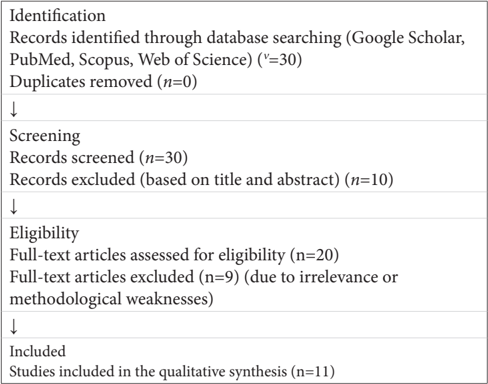
- Screening identified 30 records, excluded 10 by title/abstract, assessed 20 full texts, excluded 9, and included 11 studies; a PRISMA flow diagram is described, and all selection, screening, and synthesis were conducted independently by the author.
- Data were extracted into a structured table covering authors/year, study type, industry, OSHMS interventions, and accident-reduction findings; results were synthesized qualitatively rather than through quantitative meta-analysis.
Limitations
- Stated in the paper: barriers to full OSHMS implementation include lack of management commitment, financial constraints, and resistance to change; some studies found OHSMS/OHSMF may be ineffective or lack adequate safety standards; the mere presence of safety management systems does not automatically improve outcomes unless effectively implemented, regularly evaluated, and supported by a strong safety culture.
- Evident from the text: the final synthesis included only 11 studies; no quantitative meta-analysis or pooled effect estimate was performed; no formal risk-of-bias or quality appraisal is described; screening and synthesis were conducted by a single author; and the search was limited to four databases and a 12-year window.
Model-written summary. Check it against the paper before relying on it.
Integrity signals
Registry
Cites
Statistics
Figures


Verification
Claims the paper makes
0 Valid · 0 Not valid · 48 Not checked · 24 Own results and interpretations
In the paper
“Similarly, an analysis of major industrial accidents in South Korea's oil and gas sector highlighted that companies with a well-established PSM System had significantly fewer catastrophic events compared to those with weak safety structures.”
§ Effectiveness of occupational safety and health management systems in reducing industrial accidents and disasters: A systematic review > Chemical industry
What the sources say
- Check pendingcites [11] Yoo BT, Shim WS. Evaluating the efficiency of the process safety management system through analysis of major industrial accidents in South Korea. Processes 2023;11:2022. source
plainstates an association- Asserted: passes — The authors put it forward as true.
- Checkable: passes — It can be checked against evidence.
- Load-bearing: passes — The paper’s conclusions depend on it.
- Based: passes — The paper gives a reason why it holds.
In the paper
“These findings also indicate that a onecriterion increase in OSH application compliance will result in a 12-case decrease in work accidents.”
§ Effectiveness of occupational safety and health management systems in reducing industrial accidents and disasters: A systematic review > Manufacturing industry
What the sources say
- Check pendingcites [8] Abidin AU, Nurmaya EM, Hariyono W, Sutomo AH. Implementation of occupational safety and health management system (OSHMS) on work-related accident rate in the manufacturing industry, Indonesia. IOP Conf Ser Earth Environ Sci 2021;933:012037. source
hedgedstates a cause- Asserted: passes — The authors put it forward as true.
- Checkable: passes — It can be checked against evidence.
- Load-bearing: unclear — It is unclear whether the paper’s conclusions depend on it.
- Based: passes — The paper gives a reason why it holds.
In the paper
“The study's findings indicate a significant correlation between PSM assessment scores and the frequency of significant industrial mishaps.”
§ Effectiveness of occupational safety and health management systems in reducing industrial accidents and disasters: A systematic review > Chemical industry
What the sources say
- Check pendingcites [11] Yoo BT, Shim WS. Evaluating the efficiency of the process safety management system through analysis of major industrial accidents in South Korea. Processes 2023;11:2022. source
hedgedstates an association- Asserted: passes — The authors put it forward as true.
- Checkable: passes — It can be checked against evidence.
- Load-bearing: passes — The paper’s conclusions depend on it.
- Based: passes — The paper gives a reason why it holds.
A result the paper states — it cites no source for it, so there is none to check. The quote shows it is in the paper.
In the paper
“However, some studies have revealed a moderately strong and significant negative relationship between Occupational Health and Safety Management Frameworks (OHSMFs) and the occurrence of workplace accidents and occupational injuries”
§ Effectiveness of occupational safety and health management systems in reducing industrial accidents and disasters: A systematic review > Abstract
plainstates an association- Asserted: passes — The authors put it forward as true.
- Checkable: passes — It can be checked against evidence.
- Load-bearing: passes — The paper’s conclusions depend on it.
- Based: passes — The paper gives a reason why it holds.
In the paper
“Companies that actively applied these OHS components experienced a notable decrease in workplace hazards.”
§ Effectiveness of occupational safety and health management systems in reducing industrial accidents and disasters: A systematic review > Manufacturing industry
What the sources say
- Check pendingcites [9] Kessy SS, Raymond R. The roles of occupational health and safety management system in reducing workplace hazards in Tanzania manufacturing industries. Univ Dares Salaam Libr J 2021;16:70-88. source
plainstates a cause- Asserted: passes — The authors put it forward as true.
- Checkable: passes — It can be checked against evidence.
- Load-bearing: passes — The paper’s conclusions depend on it.
- Based: passes — The paper gives a reason why it holds.
35 more claims
Create a free account to see all 72 claims and to verify the 47 references still open.
- It may state two separate claims as one. 20
- Probably not a substantial claim. 17
Citations
Cites
Knowledge management, decision-making style and organizational performance
Abubakar, A. M., Elrehail, H., Alatailat, M. A., & Elçi, A. (2019) · Journal of Innovation & Knowledge · doi:10.1016/j.jik.2017.07.003 · Cited by 856
Normal Accidents: Living with High Risk Technologies - Updated Edition
PERROW, C. (2011) · Princeton University Press eBooks · doi:10.2307/j.ctt7srgf · Cited by 289
Wachter, J. K., & Yorio, P. L. (2014) · Accident Analysis & Prevention · doi:10.1016/j.aap.2013.07.029 · Cited by 280
Factors influencing the implementation of a safety management system for construction sites
Ismail, Z., Doostdar, S., & Harun, Z. (2012) · Safety Science · doi:10.1016/j.ssci.2011.10.001 · Cited by 257
Zhou, Q., Fang, D., & Wang, X. (2008) · Safety Science · doi:10.1016/j.ssci.2007.10.005 · Cited by 256
Safety management system: Development and validation of a multidimensional scale
Fernández-Muñiz, B., Montes-Peón, J. M., & Vázquez-Ordás, C. J. (2007) · Journal of Loss Prevention in the Process Industries · doi:10.1016/j.jlp.2006.10.002 · Cited by 248
Yoon, S. J., Lin, H. K., Chen, G., Yi, S., Choi, J., & Rui, Z. (2013) · Safety and Health at Work · doi:10.1016/j.shaw.2013.10.002 · Cited by 122
Liu, S., Nkrumah, E. N. K., Akoto, L. S., Gyabeng, E., & Nkrumah, E. (2020) · BioMed Research International · doi:10.1155/2020/6354895 · Cited by 40
Musungwa, T., & Kowe, P. (2022) · Cogent Engineering · doi:10.1080/23311916.2022.2124638 · Cited by 27
Perceived organizational support: An African perspective
Gyekye, S. A., & Salminen, S. (2009) · Journal of Applied Social Psychology · doi:10.1111/j.1559-1816.2009.00542.x · Cited by 25
Research works printed but not linked: 2
- Goetsch DL. Occupational safety and health for technologists, engineers, and managers. 9 th edition. Pearson; 2019. p. 5.
- Grandez P, López Padilla RD, Benites-Alfaro E. Reduction of the rate of accidents at work through the implementation of an occupational safety and health management system in the industrial electromechanical industry. Chem Eng Transact 2022;91:319-24.
Cited by
Mohmed, A. A., Chandrarin, G., Supriadi, B., & Risfandini, A. (2026) · International Journal of Management and Economics Invention · doi:10.47191/ijmei/v12i6.09
Rafiuddin, A. M., Jam’an, A., & Anggoro, M. Y. A. R. (2026) · Journal Social Society. · doi:10.54065/jss.6.3.2026.1384
“Occupational Safety and Health (OSH) is a fundamental component of industrial operations, particularly in high-risk sectors such as mining (Akpan et al., 2025).”
Metadata
- Authors
- Akpan, M. I., Okon, A. J., Agbiji, N. N., Eda, A. U., Akpan, A. I., Inah, A. S., Akpabio, F. S., & Ekpenyong, G. M.
- Affiliations
- University of Calabar (NG)
- University of Cross River State (NG)
- Department of Public Health, University of Calabar, Calabar, Nigeria,
- Corresponding author
- Ekpenyong, Glory Maurice
- Venue
- Calabar Journal of Health Sciences
- Publisher
- Scientific Scholar
- Published
- 2025-10-17
- Volume
- 0
- Pages
- 1-11
- ISSN
- 2636-4786 (ISSN-L)
- 2756-4185
- OpenAlex
- W4415298630
- Cited by
- 2
- References
- 17
- Citations by year
- 2026: 2
- FWCI
- 0.22
- Type
- journal article
- Language
- en
- Open access
- hybrid
- doi.org
- Licence
- cc-by-nc-sa
- Locations
- Calabar Journal of Health Sciences (publishedVersion, cc-by-nc-sa)
- Topics
- Social Sciences › Safety Research › Occupational Health and Safety Research
- Health Sciences › Medicine › Public Health, Environmental and Occupational Health › Occupational Health and Safety in Workplaces
- Health Sciences › Health Professions › Occupational Therapy › Occupational Health and Safety Management
- Keywords
- occupational health and safety management system, industrial accidents, occupational injuries, accident prevention, safety management framework, falls, machinery injuries, fire, chemical spills, explosion, safety training, regulatory enforcement, employee engagement, hazard exposure
About these checks
Registry, retraction, Cites and statistics results are computed, not judged, with one exception: a printed reference that no index lists is read once by a model before it counts as a citation error. Claims are extracted by a model and kept only when their quote appears verbatim in the text; each cited source is then checked, with a model’s help, for whether it says what the claim relies on. Those verdicts can be wrong — read the claim’s quote and the cited source before relying on one.
A language model drew the claims from the paper on 2026-11-25, under version 3 of the claim definition (model deepseek-v4.1-flash, prompt extract-v3).
A second model labelled each claim on 2026-11-25 (model jev-1.13-20260917, definition revision gold-guideline-v0.2).
Statistics and arithmetic are recomputed, not judged.
Confidence bands are shown only for fields calibrated on our annotated test set. None is calibrated yet, so no band is shown.
What counts as a claim ›How we measure confidence ›How we check this ›
Are you an author, or do you see a problem with this page? Request a review
How to cite
Cite CoChat for the checks on this page, and the paper for its own findings.
- This page
- CoChat. (2026). Citation check: Effectiveness of occupational safety and health management systems in reducing industrial accidents and disasters: A systematic review. https://app.cochat.ai/papers/10.25259/cjhs_4_2025
- The paper
- Akpan, M. I., Okon, A. J., Agbiji, N. N., Eda, A. U., Akpan, A. I., Inah, A. S., Akpabio, F. S., & Ekpenyong, G. M. (2025). Effectiveness of occupational safety and health management systems in reducing industrial accidents and disasters: A systematic review. Calabar Journal of Health Sciences. https://doi.org/10.25259/cjhs_4_2025
Data sources
Bibliographic data: Semantic Scholar, OpenAlex, Crossref.
Contains information from the Semantic Scholar Academic Graph Datasets, made available under the ODC Attribution License (ODC-BY 1.0).
Semantic Scholar’s data is described in: Kinney, R., et al. (2023). The Semantic Scholar Open Data Platform. arXiv:2301.10140.
