

Reconsolidation Behavioral Updating of Human Emotional Memory: A Comprehensive Review and Unified Analysis to Identify the Causes of Replication Failures, the Role of Prediction Error, and Optimal Clinical Translation
Open accessPublished version of a preprint
The DOI matches its Crossref record; 191 of the 192 references it cites were found in a registry or an index, and 1 are not checked yet; none of the 366 sources its claims cite is checked for support yet.
Abstract
Memory reconsolidation (MR) has been recruited via behavioral updating procedures to achieve full annulment of a human emotional memory in over 20 studies since first reported in 2010. However, at least 14 studies have reported non-replication, the cause(s) of which have remained unclear despite extensive speculation and experimental investigation. This review examines 20 successful and 14 unsuccessful studies in detail, in an attempt to identify (a) the specific probable causes of non-replication, (b) the role of prediction error (PE), and (c) optimal clinical translation. A set of criteria is defined for principled identification of specific moments of PE and of latent cause transition in experimental procedures. Applying these criteria, a failure to induce PE is identified in every non-replication study, in most cases due to a previously overlooked element of experimental procedure. For each non-replication study, I identify a simple change of procedure that is predicted to produce PE and result in successful replication. The emerging, advanced account of PE phenomenology explains how MR produces a wide range of experimental observations, including the success of both retrieval-extinction and extinction-retrieval in driving behavioral updating. A well-defined process of unlearning and annulment of emotional memory emerges from the 20 successful studies, and the clinical translation of this potent process is illustrated by a real psychotherapy case. Lastly, this review’s compendium of empirical findings is applied to evaluating previously proposed frameworks of memory reconsolidation in psychotherapy, exposing significant departures from scientific fidelity.
Checked 2026-11-28 · 1 reference not checked yet
Overview
CoChat Summary
TL;DR
This review argues that human emotional memory can be fully annulled through behavioral updating when procedures create three invariant experiences—reactivated target memory, prediction error (PE), and counter-learning—collectively termed the EIPA. It proposes that all 14 non-replications failed because no PE was created, often due to how the transition to the 10-min break was communicated, and outlines clinical translation.
Key findings
- Across 20 successful human behavioral annulment studies (Table 1), concrete procedures varied widely, but each produced the same three experiences: target memory in a reactivated state, a PE experience during reactivation, and a counter-learning experience contradicting the target memory’s knowledge/expectations; the review names this set the EIPA.
- Of 34 reviewed studies, 14 failed to replicate annulment (Table 2). The review concludes absence of PE is the probable cause in all: 13 of 14 non-replications used partial reinforcement, and in 11 of those 13 subjects were probably or definitely led to view the 10-min period as a “break” outside the study, inducing a latent-cause change and preventing PE; one 100% reinforcement study had a too-weak mismatch, and one had a too-long reactivation mismatch inducing a new latent cause.
- Annulment was prompt and long-lasting, with persistence shown out to 18 months in some studies; one study found fear could return before, but not after, one period of sleep. A clinical case describes a woman in her 50s whose long-term depression and sexual aversion lifted after the schema “The rest of my life as a woman is ruined. I’ll never marry. I’ll never have children” was disconfirmed and nullified, with changes maintained over another 14 months and 20 therapy sessions.
- The review critiques three proposed psychotherapy frameworks of memory reconsolidation—Lane et al. (2015), Stevens (2019), and Welling (2012)—for omitting the PE requirement and for characterizing therapeutic MR as emotion-centric, conjoining, or requiring extended “working through,” rather than the EIPA’s prompt annulment process.
Methods
- Qualitative, phenomenological review, explicitly “not a formal systematic review” and not concerned with effect sizes or statistical analyses; it compares concrete procedures and the subjective experiences those procedures induce.
- Studies were identified by combing behavioral-updating review articles since 2016 and searching PsycINFO on 2021-09-01 with specified terms; human behavioral updating studies through September 2021 were included. Table 1 includes 20 studies only if data unambiguously showed full annulment—return-of-response statistically indistinguishable from zero at least one day after manipulation, in spontaneous recovery and/or reinstatement, with manipulation at least one day after acquisition. Table 2 lists 14 non-replication studies.
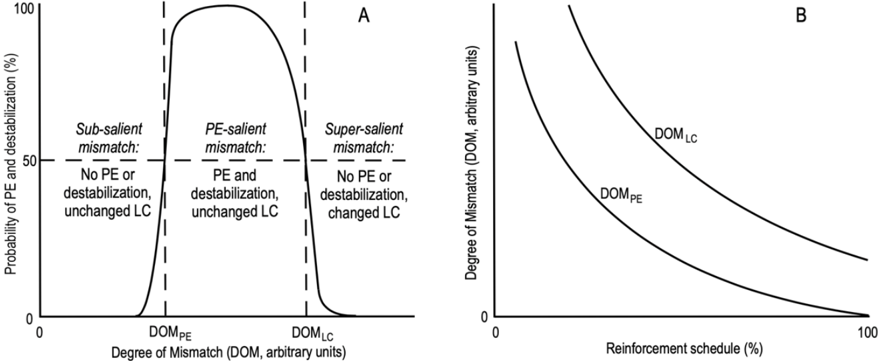
- A provisional PE evaluation framework was applied uniformly: PE is necessary for destabilization/updating; PE is relative to the entirety of target memory contents; mismatch is an external procedural feature while PE is a subjective experience; sub-salient and super-salient mismatches do not create PE; and PE specificity destabilizes specific memory components. Each study’s procedure and induced experiences were analyzed, including the transition from reactivation to the 10-min interval.
Limitations
- The paper states it is not a formal systematic review, uses a qualitative approach, and does not analyze effect sizes or statistics; the PE evaluation framework is described as “principled but provisional” and may need revision as research continues.
- The paper states that PE analyses range from confident to speculative because studies varied widely in procedural detail; some key information, such as transition details or 10-min interval content, was often missing. It also notes the review is limited to human behavioral updating and does not cover pharmacological propranolol studies, which it identifies as a desirable future extension.
- The author reports a conflict: he is unpaid co-director of a clinical training institute providing training in the clinical methodology described. Evident from the text: some PE conclusions rely on reverse-engineering from successful annulment, the clinical case is a single vignette and “does not represent a general template,” and direct detection of human engram nullification is not yet available.
Model-written summary of a shortened version of the paper’s full text (it is longer than we read). Check it against the paper before relying on it.
Integrity signals
Registry
Cites
Statistics
Figures
Verification
Claims the paper makes
0 Valid · 3 Not valid · 243 Not checked · 285 Own results and interpretations
A result the paper states — it cites no source for it, so there is none to check. The quote shows it is in the paper.
In the paper
“However, fourteen studies have reported non-replication, the cause(s) of which remain unclear.”
§ Reconsolidation behavioral updating of human emotional memory: A comprehensive review and unified analysis of successes, replication failures, and clinical translation > Abstract
plain- Asserted: passes — The authors put it forward as true.
- Checkable: passes — It can be checked against evidence.
- Load-bearing: passes — The paper’s conclusions depend on it.
- Based: passes — The paper gives a reason why it holds.
A result the paper states — it cites no source for it, so there is none to check. The quote shows it is in the paper.
In the paper
“Memory reconsolidation has been recruited via behavioral updating procedures to achieve full annulment of a human emotional memory in over twenty studies since first reported in 2010.”
§ Reconsolidation behavioral updating of human emotional memory: A comprehensive review and unified analysis of successes, replication failures, and clinical translation > Abstract
plainstates a cause- Asserted: passes — The authors put it forward as true.
- Checkable: passes — It can be checked against evidence.
- Load-bearing: passes — The paper’s conclusions depend on it.
- Based: passes — The paper gives a reason why it holds.
A result the paper states — it cites no source for it, so there is none to check. The quote shows it is in the paper.
In the paper
“(In the case of 100% reinforcement in acquisition, as used by three studies in Table 1, the single unreinforced CS+ at Day 2 reactivation does reliably create a PE experience.)”
§ Reconsolidation behavioral updating of human emotional memory: A comprehensive review and unified analysis of successes, replication failures, and clinical translation > Reconsolidation behavioral updating of human emotional memory: A comprehensive review and unified analysis 30 of 187
boostedstates a cause- Asserted: passes — The authors put it forward as true.
- Checkable: passes — It can be checked against evidence.
- Load-bearing: passes — The paper’s conclusions depend on it.
- Based: unclear — It is unclear why the paper says it holds.
In the paper
“Therefore the 10-min interval is present in all subsequent human studies of behavioral updating of emotional memory (with significant variations of other parameters), i.e., all of the studies in Tables 1 and 2 except Pine et al. (2014).”
§ Reconsolidation behavioral updating of human emotional memory: A comprehensive review and unified analysis of successes, replication failures, and clinical translation > 3.3. PE evaluation framework applied to the retrieval-extinction protocol
What the sources say
- Not checked yetcites Pine et al. (2014) matched to “Unconscious learning of likes and dislikes is persistent, resilient, and reconsolidates” (2014) source
plain- Asserted: passes — The authors put it forward as true.
- Checkable: passes — It can be checked against evidence.
- Load-bearing: unclear — It is unclear whether the paper’s conclusions depend on it.
- Based: passes — The paper gives a reason why it holds.
A result the paper reports from its own data — it cites no other source for it, so there is none to check. The quote shows it is in the paper.
In the paper
“This transition is in that way found to be a serious candidate cause of nonreplication in 11 of the 14 non-replication studies, as indicated in Table 2.”
§ Reconsolidation behavioral updating of human emotional memory: A comprehensive review and unified analysis of successes, replication failures, and clinical translation > Reconsolidation behavioral updating of human emotional memory: A comprehensive review and unified analysis 30 of 187
plainstates a possible cause- Asserted: passes — The authors put it forward as true.
- Checkable: passes — It can be checked against evidence.
- Load-bearing: passes — The paper’s conclusions depend on it.
- Based: passes — The paper gives a reason why it holds.
219 more claims
Create a free account to see all 531 claims and to verify the 313 references still open.
- Probably not a substantial claim. 113
- It may state two separate claims as one. 238
- The quote only partly states this claim. 4
Self-check
Percentages, sums and reported differences re-computed from the paper’s own numbers.
Each contradiction between two passages listed here was confirmed by an independent check.
Rated minor: it would not touch a result — a value no result rests on, a p-value that stays on the same side of the significance level, or a conflict that is clerical, resolved elsewhere in the paper, or outside its own findings.
In the paper
§ Reconsolidation behavioral updating of human emotional memory: A comprehensive review and unified analysis of successes, replication failures, and clinical translation > 5. Significant patterns in unsuccessful human behavioral annulment studies
“In all of the non-replication studies in Table 2, the target threat memory was created using 50 to 100% reinforcement”
§ Reconsolidation behavioral updating of human emotional memory: A comprehensive review and unified analysis of successes, replication failures, and clinical translation > B.4. Meir Drexler et al. (2014): "Effects of postretrieval-extinction learning on return of contextually controlled cued fear"
“All other parameters duplicated those of Schiller et al., including measurement of fear via SCR.”
Rated minor: it would not touch a result — a value no result rests on, a p-value that stays on the same side of the significance level, or a conflict that is clerical, resolved elsewhere in the paper, or outside its own findings.
In the paper
§ Reconsolidation behavioral updating of human emotional memory: A comprehensive review and unified analysis of successes, replication failures, and clinical translation > 5. Significant patterns in unsuccessful human behavioral annulment studies
“In these 13 partial reinforcement studies, whether or not a PE experience would occur on Day 2 was therefore determined entirely by the post-reactivation procedure immediately following reminder offset (disappearance), namely the transition to the 10-min interval between offset and the beginning of extinction training.”
§ Reconsolidation behavioral updating of human emotional memory: A comprehensive review and unified analysis of successes, replication failures, and clinical translation > 5. Significant patterns in unsuccessful human behavioral annulment studies
“In one study, the long duration of reactivation was very probably a too-large mismatch that induced a new latent cause rather than a PE experience (Meir Drexler et al., 2014, reviewed in Section B.4), a conclusion supported by direct comparison to one of the successful studies (Hu et al., 2018, reviewed in Section A.13).”
Citations
Cites
The cognitive control of emotion
OCHSNER, K., & GROSS, J. (2005) · Trends in Cognitive Sciences · doi:10.1016/j.tics.2005.03.010 · Cited by 4,495
Fear memories require protein synthesis in the amygdala for reconsolidation after retrieval
Nader, K., Schafe, G. E., & Le Doux, J. E. (2000) · Nature · doi:10.1038/35021052 · Cited by 2,706
Mediators and Mechanisms of Change in Psychotherapy Research
Kazdin, A. E. (2007) · Annual Review of Clinical Psychology · doi:10.1146/annurev.clinpsy.3.022806.091432 · Cited by 2,504
Meta-analysis of psychotherapy outcome studies.
Smith, M. L., & Glass, G. V. (1977) · American Psychologist · doi:10.1037/0003-066x.32.9.752 · Cited by 2,154
Context and Behavioral Processes in Extinction: Table 1.
Bouton, M. E. (2004) · Learning & Memory · doi:10.1101/lm.78804 · Cited by 1,808
The Great Psychotherapy Debate: The Evidence for What Makes Psychotherapy Work
Wampold, B. E. (2015) · doi:10.4324/9780203582015 · Cited by 1,773
Phelps, E. A., Delgado, M. R., Nearing, K. I., & LeDoux, J. E. (2004) · Neuron · doi:10.1016/j.neuron.2004.08.042 · Cited by 1,753
Preventing the return of fear in humans using reconsolidation update mechanisms
Schiller, D., Monfils, M.-H., Raio, C. M., Johnson, D. C., LeDoux, J. E., & Phelps, E. A. (2010) · Nature · doi:10.1038/nature08637 · Cited by 1,248
Memory Reconsolidation and Extinction Have Distinct Temporal and Biochemical Signatures
Suzuki, A., Josselyn, S. A., Frankland, P. W., Masushige, S., Silva, A. J., & Kida, S. (2004) · The Journal of Neuroscience · doi:10.1523/jneurosci.5491-03.2004 · Cited by 1,127
Dissociable stages of human memory consolidation and reconsolidation
Walker, M. P., Brakefield, T., Allan Hobson, J., & Stickgold, R. (2003) · Nature · doi:10.1038/nature01930 · Cited by 1,025
Research works printed but not linked: 5
- Reconsolidation behavioral updating of human emotional memory: A comprehensive review and unified analysis 180 of 187
- Jarome, T.J., Kwapis, J.L., Werner, C.T., Parsons, R.G., Gafford, G.M., Helmstetter, F.J., 2012b. The timing of multiple retrieval events can alter GluR1 phosphorylation and the requirement for protein synthesis in fear memory reconsolidation. Learn. Mem. 19, 300-306. https://doi.org/10.1101/lm.024901.111 · DOI · Paper page
- Meir Drexler, S., Wolf, O.T., 2018b. Behavioral disruption of memory reconsolidation: From bench to bedside and back again. Behav. Neurosci. 132, 13-22. https://doi.org/10.1037/bne0000231 · DOI
- Sevenster, D., Beckers, T., Kindt, M., 2014. Prediction error demarcates the transition from retrieval, to reconsolidation, to new learning. Learn. Mem. 21, 580-584. https://doi.org/10.1101/lm.035493.114 · DOI · Paper page
- Walker, M.P., Brakefield, T., Hobson, J.A., Stickgold, R., 2003. Dissociable stages of human memory consolidation and reconsolidation. Nature 425, 616-620. https://doi.org/10.1038/nature01930 · DOI · Paper page
Cited by
Face your fears: attenuating remote fear memories by reconsolidation-updating
Silva, B. A., & Gräff, J. (2023) · Trends in Cognitive Sciences · doi:10.1016/j.tics.2023.01.004 · Cited by 20
Bui, U. T. D., & Milton, A. L. (2023) · Neuroscience · doi:10.1016/j.neuroscience.2023.03.013 · Cited by 15
Reconsolidation: A paradigm shift
Schiller, D. (2022) · Brain Research Bulletin · doi:10.1016/j.brainresbull.2022.09.008 · Cited by 7
Kramer, U., Simonini, A., Rrustemi, E., Fellrath, R., Stucchi, K., Noseda, E., Martin-Söelch, C., Kolly, S., Machinea, J. B., Boritz, T. Z., et al. (2024) · Psychotherapy Research · doi:10.1080/10503307.2024.2406543 · Cited by 1
Exposing Narrative Exposure Therapy
Lord, J., Schroder, T., Sabin‐Farrell, R., & Naidoo, R. (2023) · Nottingham ePrints (University of Nottingham) · Cited by 1
Metadata
- Authors
- Ecker, B.
- Corresponding author
- Ecker, Bruce
- ORCID
- Ecker, Bruce
- Venue
- Journal of Psychiatry and Psychiatric Disorders
- Publisher
- Fortune Journals
- Published
- 2024
- Volume
- 8
- Issue
- 6
- ISSN
- 2572-519X (ISSN-L)
- OpenAlex
- W4404146484
- Semantic Scholar
- 47bf371d9466aafbd706f2e23295411d5d084261
- Cited by
- 9
- References
- 190
- Citations by year
- 2026: 4 · 2024: 1
- FWCI
- 0.74
- Type
- journal article
- Language
- en
- Open access
- hybrid
- doi.org
- Licence
- cc-by
- Locations
- Journal of Psychiatry and Psychiatric Disorders (publishedVersion, cc-by)
- PsyArXiv (OSF Preprints) (submittedVersion, cc-by)
- PsyArXiv (OSF Preprints) (submittedVersion)
- Topics
- Life Sciences › Neuroscience › Cognitive Neuroscience › Memory and Neural Mechanisms
- Life Sciences › Neuroscience › Cognitive Neuroscience › Memory Processes and Influences
- Social Sciences › Psychology › Clinical Psychology › Posttraumatic Stress Disorder Research
- Keywords
- memory reconsolidation, emotional memory, prediction error, replication failure, extinction retrieval, unlearning, psychotherapy, clinical translation
About these checks
Registry, retraction, Cites and statistics results are computed, not judged, with one exception: a printed reference that no index lists is read once by a model before it counts as a citation error. Claims are extracted by a model and kept only when their quote appears verbatim in the text; each cited source is then checked, with a model’s help, for whether it says what the claim relies on. Those verdicts can be wrong — read the claim’s quote and the cited source before relying on one.
A language model drew the claims from the paper on 2026-11-28, under version 3 of the claim definition (model deepseek-v4.1-flash, prompt extract-v3).
A second model labelled each claim on 2026-11-28 (model jev-1.13-20260917, definition revision gold-guideline-v0.2).
Statistics and arithmetic are recomputed, not judged.
Confidence bands are shown only for fields calibrated on our annotated test set. None is calibrated yet, so no band is shown.
What counts as a claim ›How we measure confidence ›How we check this ›
Are you an author, or do you see a problem with this page? Request a review
How to cite
Cite CoChat for the checks on this page, and the paper for its own findings.
- This page
- CoChat. (2026). Citation check: Reconsolidation Behavioral Updating of Human Emotional Memory: A Comprehensive Review and Unified Analysis to Identify the Causes of Replication Failures, the Role of Prediction Error, and Optimal Clinical Translation. https://app.cochat.ai/papers/10.26502/jppd.2572-519x0226
- The paper
- Ecker, B. (2024). Reconsolidation Behavioral Updating of Human Emotional Memory: A Comprehensive Review and Unified Analysis to Identify the Causes of Replication Failures, the Role of Prediction Error, and Optimal Clinical Translation. Journal of Psychiatry and Psychiatric Disorders. https://doi.org/10.26502/jppd.2572-519x0226
Data sources
Bibliographic data: Semantic Scholar, OpenAlex, Crossref.
Contains information from the Semantic Scholar Academic Graph Datasets, made available under the ODC Attribution License (ODC-BY 1.0).
Semantic Scholar’s data is described in: Kinney, R., et al. (2023). The Semantic Scholar Open Data Platform. arXiv:2301.10140.
