

The DOI matches its Crossref record; 4 of the 4 references it cites were found in a registry or an index.
N -6-methyladenosine (m6A) promotes the nuclear retention of mRNAs with intact 5′ splice site motifs
Published version of a preprint
Abstract
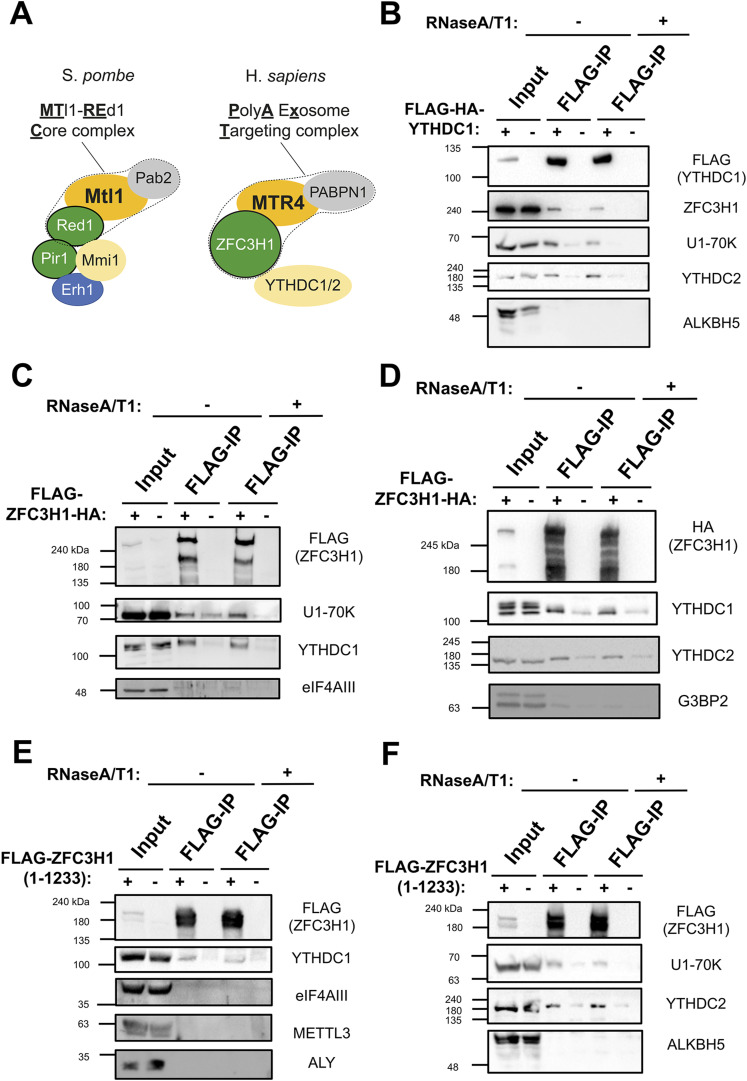
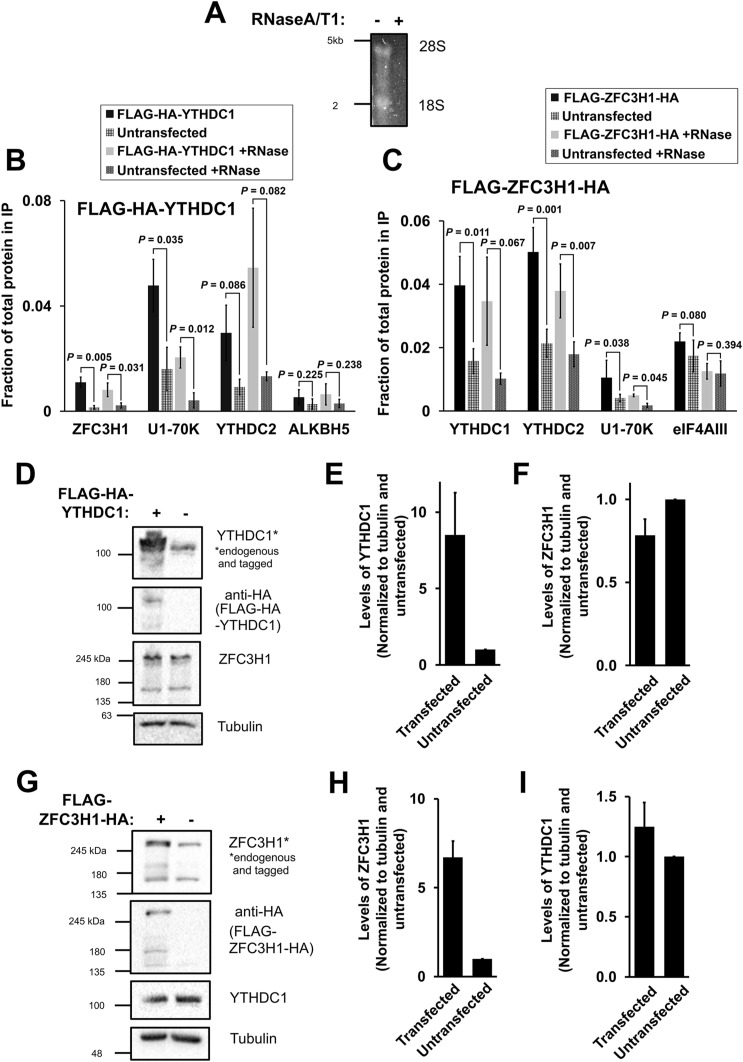
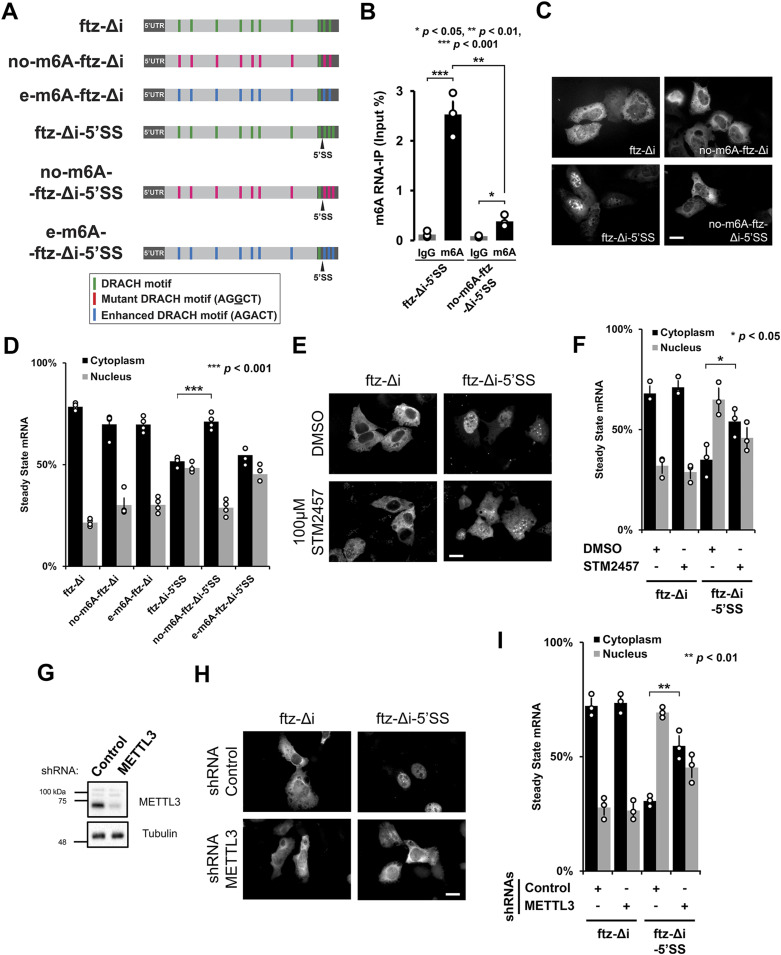
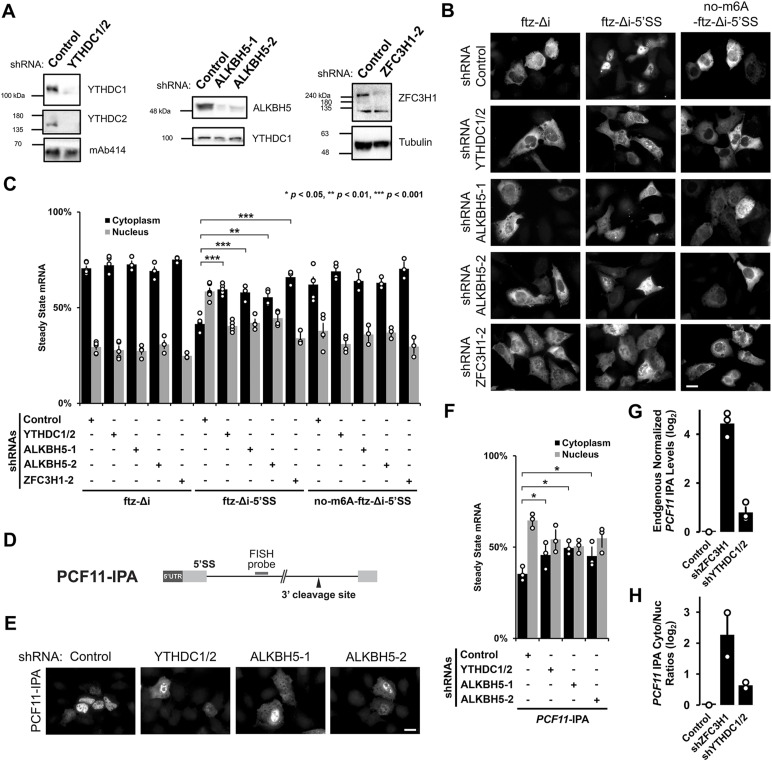
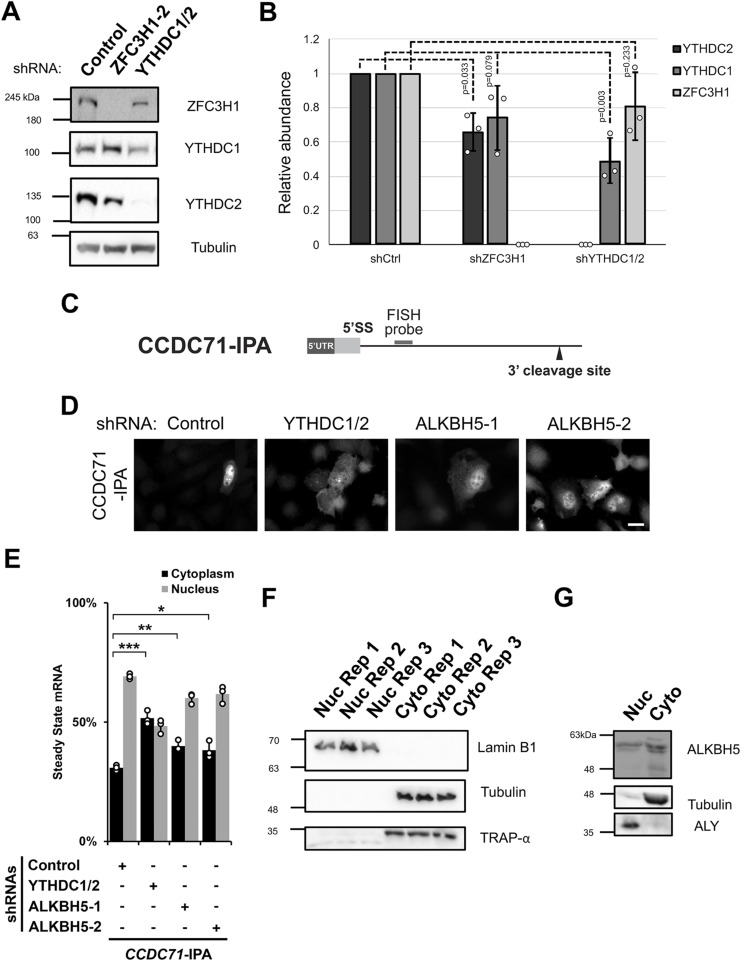
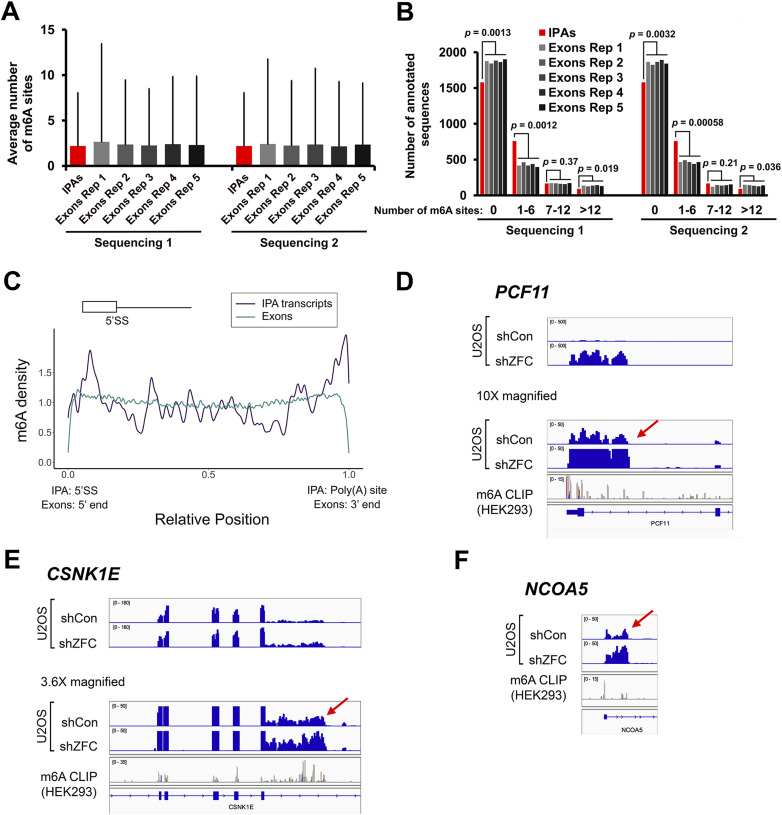
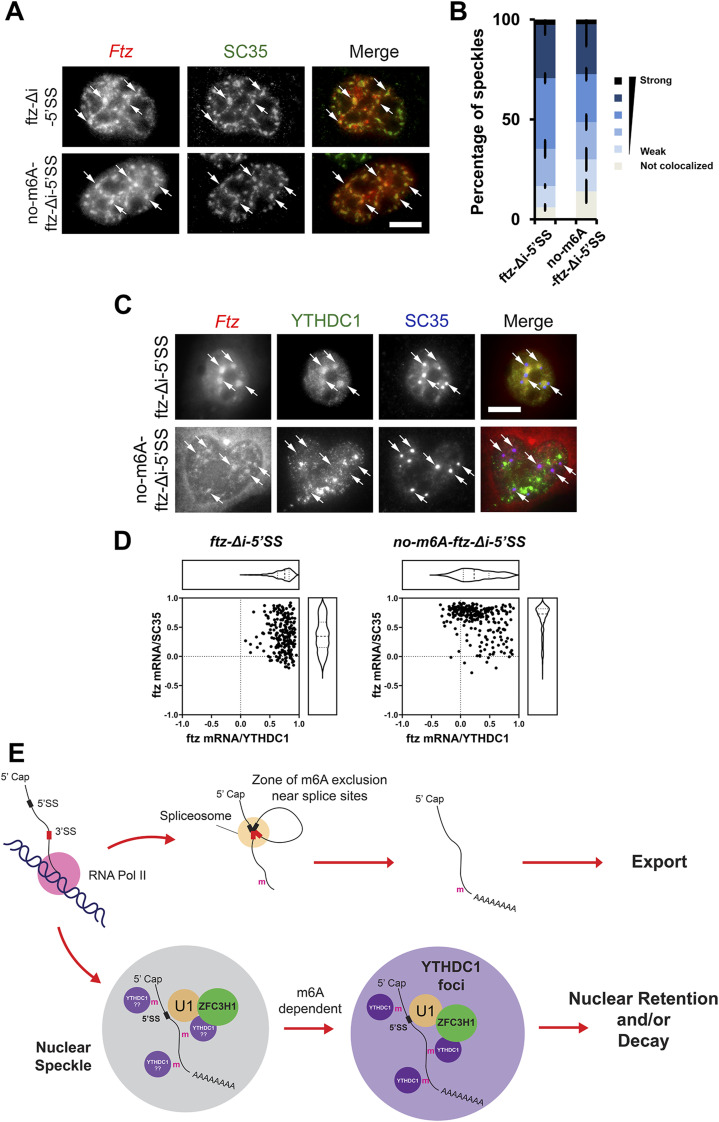
In humans, misprocessed mRNAs containing intact 5′ Splice Site (5′SS) motifs are nuclear retained and targeted for decay by ZFC3H1, a component of the Poly(A) Exosome Targeting complex, and U1-70K, a component of the U1 snRNP. In S. pombe , the ZFC3H1 homolog, Red1, binds to the YTH domain–containing protein Mmi1 and targets certain RNA transcripts to nuclear foci for nuclear retention and decay. Here we show that YTHDC1 and YTHDC2, two YTH domain-containing proteins that bind to N -6-methyladenosine (m6A) modified RNAs, interact with ZFC3H1 and U1-70K, and are required for the nuclear retention of mRNAs with intact 5′SS motifs. Disruption of m6A deposition inhibits both the nuclear retention of these transcripts and their accumulation in YTHDC1-enriched foci that are adjacent to nuclear speckles. Endogenous RNAs with intact 5′SS motifs, such as intronic poly-adenylated transcripts, tend to be m6A-modified at low levels. Thus, the m6A modification acts on a conserved quality control mechanism that targets misprocessed mRNAs for nuclear retention and decay.
Overview
The claims and statistics of this paper haven’t been checked yet.
Run the check — free, no account needed. It reads the open-access text and checks the sources it cites.
Integrity signals
Registry
Cites
Statistics
Figures
Verification
Claims the paper makes
The claims and statistics of this paper haven’t been checked yet.
Run the check — free, no account needed. It reads the open-access text and checks the sources it cites.
Claims other papers make about this one
Each is checked against this paper’s own text: does it say what the citing paper says it does?
In the citing paper
“Interestingly, m 6 A and YTHDC1, the other m 6 A-reader protein identified in the CRISPRi screen, are directly implicated in nuclear retention and mechanisms of nuclear RNA surveillance 45 .”
From Tau is an m 6 A-associated RNA binding protein that causes RNA dysregulation in disease (2026) · cites this paper as [45]
Self-check
Percentages, sums and reported differences re-computed from the paper’s own numbers.
The self-check needs the paper’s full text.
Citations
Cites
Single-nucleotide-resolution mapping of m6A and m6Am throughout the transcriptome
Linder, B., Grozhik, A. V., Olarerin-George, A. O., Meydan, C., Mason, C. E., & Jaffrey, S. R. (2015) · Nature Methods · doi:10.1038/nmeth.3453 · Cited by 1,569
YTHDC1 mediates nuclear export of N6-methyladenosine methylated mRNAs
Roundtree, I. A., Luo, G.-Z., Zhang, Z., Wang, X., Zhou, T., Cui, Y., Sha, J., Huang, X., Guerrero, L., Xie, P., et al. (2017) · eLife · doi:10.7554/elife.31311 · Cited by 1,256
U1 snRNP protects pre-mRNAs from premature cleavage and polyadenylation
Kaida, D., Berg, M. G., Younis, I., Kasim, M., Singh, L. N., Wan, L., & Dreyfuss, G. (2010) · Nature · doi:10.1038/nature09479 · Cited by 638
The RNA m6A reader YTHDC1 silences retrotransposons and guards ES cell identity
Liu, J., Gao, M., He, J., Wu, K., Lin, S., Jin, L., Chen, Y., Liu, H., Shi, J., Wang, X., et al. (2021) · Nature · doi:10.1038/s41586-021-03313-9 · Cited by 365
Research works printed but not linked: 69
- 10.1093/nar/gkn068 · DOI
- 10.4161/nucl.26052 · DOI
- 10.1093/bioinformatics/btu170 · DOI · Paper page
- 10.1016/j.celrep.2022.110861 · DOI
- 10.1371/journal.pone.0026804 · DOI
- 10.1007/s13238-021-00837-8 · DOI
- 10.1016/j.ccell.2021.04.017 · DOI
- 10.1093/gigascience/giab008 · DOI
- 10.1093/bioinformatics/bts635 · DOI · Paper page
- 10.1038/nature11112 · DOI · Paper page
- 10.1038/ncomms12626 · DOI
- 10.1073/pnas.1332669100 · DOI
- 10.1002/wrna.1572 · DOI
- 10.1038/nbt.1525 · DOI
- 10.1083/jcb.111.6.2283 · DOI
- 10.3791/2387 · DOI
- 10.1126/science.abj9090 · DOI
- 10.1038/s41467-021-23457-6 · DOI
- 10.1038/nchembio.687 · DOI · Paper page
- 10.1093/bioinformatics/btp328 · DOI
- 10.1371/journal.pone.0122743 · DOI
- 10.1093/nar/gkaa919 · DOI
- 10.1261/rna.079104.122 · DOI
- 10.1016/0092-8674(89)90127-X · DOI
- 10.1016/j.bbagrm.2018.09.008 · DOI
- 10.1038/s41598-018-32310-8 · DOI
- 10.1038/nchembio.1432 · DOI · Paper page
- 10.1126/science.aay6018 · DOI · Paper page
- 10.1038/s41467-023-39897-1 · DOI
- 10.1038/s41556-021-00725-7 · DOI
- 10.1016/j.molcel.2016.09.025 · DOI · Paper page
- 10.1016/j.cell.2012.05.003 · DOI · Paper page
- 10.21769/BioProtoc.4688 · DOI
- 10.1016/j.molcel.2024.08.037 · DOI
- 10.1083/jcb.150.5.949 · DOI
- 10.1080/15384101.2017.1377501 · DOI
- 10.1101/gad.302604.117 · DOI
- 10.3389/fgene.2018.00440 · DOI
- 10.1371/journal.pbio.0050322 · DOI
- 10.1080/15476286.2023.2293339 · DOI
- 10.1093/bioinformatics/btw653 · DOI
- 10.7554/eLife.32155 · DOI
- 10.1371/journal.pgen.1008598 · DOI
- 10.1016/j.celrep.2018.04.061 · DOI
- 10.1093/nar/gkz1238 · DOI
- 10.1101/2022.08.21.504696 · DOI · Paper page
- 10.1016/j.molcel.2022.06.031 · DOI
- 10.1002/j.1460-2075.1991.tb04911.x · DOI
- 10.1038/emboj.2011.32 · DOI
- 10.1016/j.molcel.2016.01.029 · DOI
- 10.1016/j.molcel.2024.07.017 · DOI
- 10.1101/gr.5532707 · DOI
- 10.1093/bioinformatics/btp120 · DOI
- 10.1038/srep42271 · DOI
- 10.1016/j.molcel.2022.12.026 · DOI
- 10.1105/tpc.107.055053 · DOI
- 10.1016/j.celrep.2019.05.107 · DOI
- 10.1038/nature12730 · DOI · Paper page
- 10.1093/nar/gkv1382 · DOI
- 10.1093/nar/gkab774 · DOI
- 10.1038/s41556-021-00631-y · DOI
- Wickham H (2009) Ggplot2: Elegant Graphics for Data Analysis. New York: Springer. · DOI · Paper page
- 10.1038/nchembio.1654 · DOI
- 10.3389/fonc.2021.629560 · DOI
- 10.1038/s41467-022-35643-1 · DOI
- 10.1038/s41586-021-03536-w · DOI
- 10.1016/j.molcel.2012.10.015 · DOI · Paper page
- 10.1038/35030160 · DOI
- 10.1038/ncomms8050 · DOI
Cited by
Tau is an m 6 A-associated RNA binding protein that causes RNA dysregulation in disease
Dixon, G., Keys, A., Rothamel, K., McKetney, J., Jiang, Y. X., Gordon, L. A., Page, M. L., Liu, C., Hou, K., Flanagan, K., et al. (2026) · doi:10.64898/2026.10.26.762095
Metadata
- Authors
- Lee, E. S., Smith, H. W., Wang, Y. E., Ihn, S. S., Scalize de Oliveira, L., Kejiou, N. S., Liang, Y. L., Nabeel-Shah, S., Jomphe, R. Y., Pu, S., Greenblatt, J. F., & Palazzo, A. F.
- Venue
- Life Science Alliance
- Publisher
- Life Science Alliance, LLC
- Published
- 2024-12-03
- Volume
- 8
- Issue
- 2
- Pages
- e202403142
- ISSN
- 2575-1077
- PMC
- PMC11629677
- Cited by
- 15
- References
- 4
- Language
- en
- Funders
- Canadian Government | Natural Sciences and Engineering Research Council of Canada (FN 492860)
About these checks
Registry, retraction, Cites and statistics results are computed, not judged, with one exception: a printed reference that no index lists is read once by a model before it counts as a citation error. Claims are extracted by a model and kept only when their quote appears verbatim in the text; each cited source is then checked, with a model’s help, for whether it says what the claim relies on. Those verdicts can be wrong — read the claim’s quote and the cited source before relying on one.
Statistics and arithmetic are recomputed, not judged.
Confidence bands are shown only for fields calibrated on our annotated test set. None is calibrated yet, so no band is shown.
What counts as a claim ›How we measure confidence ›How we check this ›
Are you an author, or do you see a problem with this page? Request a review
Data sources
Bibliographic data: Semantic Scholar, OpenAlex, Crossref.
Contains information from the Semantic Scholar Academic Graph Datasets, made available under the ODC Attribution License (ODC-BY 1.0).
Semantic Scholar’s data is described in: Kinney, R., et al. (2023). The Semantic Scholar Open Data Platform. arXiv:2301.10140.
