

A Fairness-Enhanced Intelligent MAC Scheme Using Q-Learning-Based Bidirectional Backoff for Distributed Vehicular Communication Networks
Open accessThe DOI matches its Crossref record; 22 of the 23 references it cites were found in a registry or an index.
Abstract
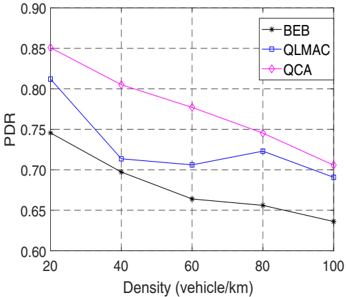
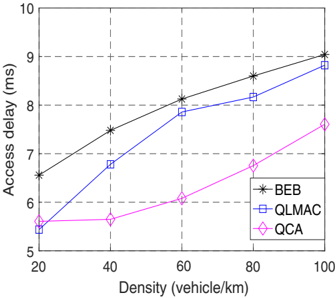
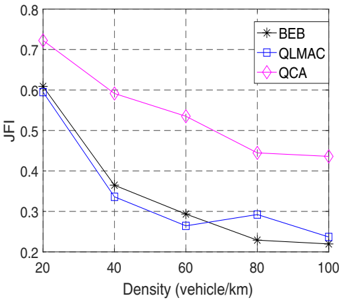
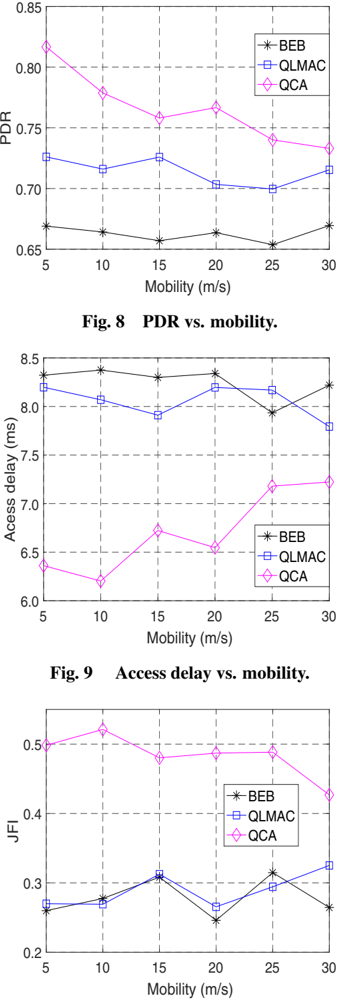
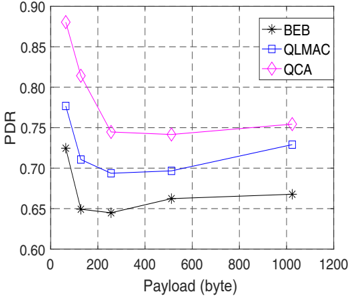
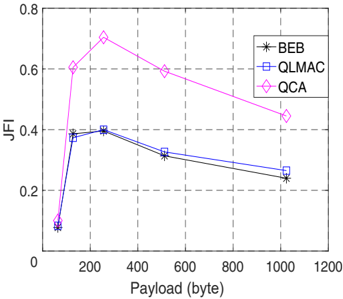
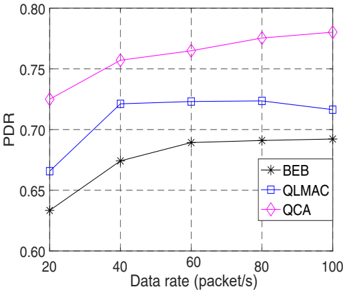
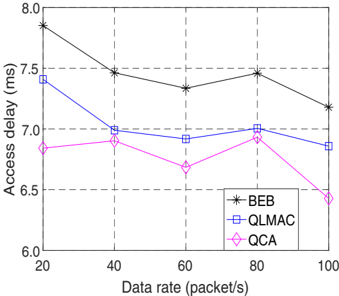
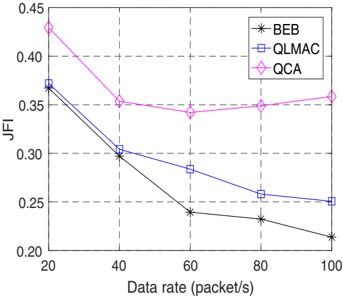
With the increasing attention to front-edge vehicular communication applications, distributed resource allocation is beneficial to the direct communications between vehicle nodes. However, in highly dynamic distributed vehicular networks, quality of service (QoS) of the systems would degrade dramatically because of serious packet collisions in the absence of sufficient link knowledge. Focusing on the fairness optimization, a Q-learning-based collision avoidance (QCA) scheme, which is characterized by an ingenious bidirectional backoff reward model RQCAcorresponding to arbitrary backoff stage transitions, has been proposed in an intelligent distributed media access control protocol. In QCA, an intelligent bidirectional backoff agent based on the Markov decision process model can actively motivate each vehicle agent to update itself toward an optimal backoff sub-intervel BSIoptthrough either positive or negative bidirectional transition individually, resulting in the distinct fair communication with a proper balance of the resource allocation. According to the reinforcement learning theory, the problem of goodness evaluation on the backoff stage self-selection policy is equal to the problem of maximizing Q function of the vehicle in the current environment. The final decision on BSIoptrelated to an optimal contention window range was solved through maximizing the Q value or$Q_{\max}$. The ε-qreedy algorithm was used to keep a reasonable convergence of the$Q_{\max}$solution. For the fairness evaluation of QCA, four kinds of dynamic impacts on the vehicular networks were investigated: mobility, density, payload size, and data rate with a network simulator NS2. Consequently, QCA can achieve fair communication efficiently and robustly, with advantages of superior Jain's fairness index, relatively high packet delivery ratio, and low time delay.
Overview
The claims and statistics of this paper haven’t been checked yet.
Free: it reads the open-access text and checks the first 5 claims that cite a source we can check. Create a free account to check every claim.
Integrity signals
Registry
Cites
Statistics
Figures


Verification
Claims the paper makes
The claims and statistics of this paper haven’t been checked yet.
Free: it reads the open-access text and checks the first 5 claims that cite a source we can check. Create a free account to check every claim.
Self-check
Percentages, sums and reported differences re-computed from the paper’s own numbers.
The self-check needs the paper’s full text.
Citations
Cites
5G for Vehicular Communications
Shah, S. A. A., Ahmed, E., Imran, M., & Zeadally, S. (2018) · IEEE Communications Magazine · doi:10.1109/mcom.2018.1700467 · Cited by 363
Han, G., Gong, A., Wang, H., Martínez-García, M., & Peng, Y. (2021) · IEEE Transactions on Vehicular Technology · doi:10.1109/tvt.2021.3097084 · Cited by 115
Zhao, D., Qin, H., Song, B., Zhang, Y., Du, X., & Guizani, M. (2020) · IEEE Transactions on Cognitive Communications and Networking · doi:10.1109/tccn.2020.2983170 · Cited by 91
Reinforcement Learning Based MAC Protocol (UW-ALOHA-Q) for Underwater Acoustic Sensor Networks
Park, S. H., Mitchell, P., & Grace, D. (2019) · IEEE Access · doi:10.1109/access.2019.2953801 · Cited by 81
Jeon, Y., Kuk, S., & Kim, H. (2018) · Sensors · doi:10.3390/s18124388 · Cited by 59
Application-Level Performance of IEEE 802.11p in Safety-Related V2X Field Trials
Klapez, M., Grazia, C. A., & Casoni, M. (2020) · IEEE Internet of Things Journal · doi:10.1109/jiot.2020.2967649 · Cited by 46
A backoff algorithm based on self-adaptive contention window update factor for IEEE 802.11 DCF
Zhang, C., Chen, P., Ren, J., Wang, X., & Vasilakos, A. V. (2016) · Wireless Networks · doi:10.1007/s11276-015-1184-9 · Cited by 40
Guo, C., Sheng, M., Wang, X., & Zhang, Y. (2014) · IEEE Transactions on Communications · doi:10.1109/tcomm.2014.050714.130759 · Cited by 37
Wireless recommendations for Internet of vehicles: Recent advances, challenges, and opportunities
Li, T. K., Li, C., Luo, J., & Song, L. (2020) · Intelligent and Converged Networks · doi:10.23919/icn.2020.0005 · Cited by 30
Efficient Scheduling and Resource Allocation for D2D-based LTE-V2X Communications
Masmoudi, A., Feki, S., Mnif, K., & Zarai, F. (2019) · International Wireless Communications and Mobile Computing Conference (IWCMC) · doi:10.1109/iwcmc.2019.8766682 · Cited by 24
Cited by
Weighted fair energy transfer in a UAV network: A multi-agent deep reinforcement learning approach
Murshed, S., Nibir, A. S., Razzaque, M. A., Roy, P., Elhendi, A. Z., Hassan, M. R., & Hassan, M. M. (2024) · Energy · doi:10.1016/j.energy.2024.130527 · Cited by 18
Li, Z., Wang, P., Shen, Y., & Li, S. (2025) · Sensors · doi:10.3390/s25020302 · Cited by 15
Self-citationZhang, L., Zhou, Z., Yi, B., Wang, J., Chen, C., & Shi, C. (2024) · IEEE Internet of Things Journal · doi:10.1109/jiot.2024.3487538 · Cited by 15
“Recent advancements in vehicle–road cooperative systems have shown promising results in improving traffic management [24], [25], [26].”
Lv, J., Rani, S., & Li, K. (2025) · Computers & Industrial Engineering · doi:10.1016/j.cie.2025.111451 · Cited by 12
Lv, J., Li, K., Słowik, A., & Jiang, H. (2025) · IEEE Internet of Things Journal · doi:10.1109/jiot.2024.3516947 · Cited by 12
“However, developing effective in-vehicle medical emergency response systems faces numerous challenges in the highly dynamic IoV environment, particularly in data processing, privacy preservation, and timely decision-making [6], [7], [8].”
An Overview of Medium Access Control and Radio Duty Cycling Protocols for Internet of Things
Amin, F., Abbasi, R., Khan, S., & Abid, M. A. (2022) · Electronics · doi:10.3390/electronics11233873 · Cited by 11
A DQN-Based Edge Offloading Method for Smart City Pollution Control
Xu, J., Xiang, H., Zang, S., Bilal, M., Khan, M., & Cui, G. (2025) · Tsinghua Science & Technology · doi:10.26599/tst.2024.9010105 · Cited by 11
Leveraging Generative AI for Essential Predictive Maintenance in Industrial Consumer Electronics
Zhu, H., Jia, L., Xue, X., & Kim, B. (2024) · IEEE Transactions on Consumer Electronics · doi:10.1109/tce.2024.3510786 · Cited by 8
“Deep learning has demonstrated valuable contributions across various domains [19], [20], including its successful application in mechanical equipment fault prediction.”
Redondo, J., Aslam, N., Zhang, J., & Yuan, Z. (2024) · IEEE Transactions on Network Science and Engineering · doi:10.1109/tnse.2024.3514744 · Cited by 8
“11 by proposing approaches such as Markov model for varying CW [32], game theory [15], AI/ML reinforcement learning Q-learning [9], [33], [34], policy gradient [10], deep RL [15], [18].”
Tu, Y.-H., Lin, E.-C., Ke, C., & Ma, Y. (2024) · Computer Networks · doi:10.1016/j.comnet.2024.110690 · Cited by 6
A Systematic Literature Review in Distributed Resource Allocation for C-V2X
Al-Najjar, A. N., Rasid, M. F. A., Hashim, F., Ahmad, F. A., & Jamalipour, A. (2024) · Ingénierie des systèmes d information · doi:10.18280/isi.290301 · Cited by 8
“Recently, Wang and Wang [95] Implemented the Q-learning principle into the contention-based resource allocation strategy in distributed media access control when there is insufficient connection information available.”
Tu, Y.-H., & Ma, Y. (2025) · ICT Express · doi:10.1016/j.icte.2025.01.010 · Cited by 7
Smart Medical Rescue via Efficient Vehicle Road Cooperation: AIoT Framework
Lyu, X., Rani, S., Manimurugan, S., & Feng, Y. (2024) · IEEE Internet of Things Journal · doi:10.1109/jiot.2024.3479244 · Cited by 4
Khaleel, M. I. (2025) · Engineering Applications of Artificial Intelligence · doi:10.1016/j.engappai.2025.111108 · Cited by 5
Distributed Driver Emotion Prediction for Intelligent 6G Internet of Vehicles
Zhu, H., Jia, L., Jian, W., & Xue, X. (2025) · IEEE Transactions on Intelligent Transportation Systems · doi:10.1109/tits.2025.3558305 · Cited by 4
“By leveraging distributed AI and machine learning techniques [9], vehicles can monitor and analyze the emotional state of drivers and adjust their operation accordingly.”
6G-Enabled Intelligent Healthcare Transport Systems: Framework and Resource Allocation Strategy
Wang, C., Divakarachari, P. B., & Jiang, H. (2025) · IEEE Transactions on Intelligent Transportation Systems · doi:10.1109/tits.2025.3563926 · Cited by 3
“However, the dynamic nature of vehicular networks and the unpredictable channel conditions in urban environments make it extraordinarily difficult to guarantee consistent performance for these mission-critical applications [11], [12].”
Expanding LPWAN Concurrency: Combating Collisions Through Orthogonal Transmissions
Xie, P., Li, Y., Xu, Z., Chen, Q., Liu, Y., & Wang, J. (2025) · IEEE Transactions on Networking · doi:10.1109/ton.2025.3578187 · Cited by 3
“Existing wireless channel multiple access techniques [22], [23], [24], [25], [26], [27], [28], [29], and [30] are often inadequate for handling large-scale collisions commonly encountered in LPWAN environments [31], [32].”
Lyu, X., Taneja, A., Rani, S., & Feng, Y. (2024) · IEEE Internet of Things Journal · doi:10.1109/jiot.2024.3510805 · Cited by 2
“The vehicle-to-vehicle (V2V) communication enables the vehicles to connect for sharing information like location, speed, etc. [1].”
Spatially Coupled Codes via Bidirectional Block Markov Superposition Transmission
Li, G., Zhao, S., Chen, H., & Wen, J. (2023) · Tsinghua Science & Technology · doi:10.26599/tst.2023.9010038 · Cited by 2
Shen, X., Li, H., Li, Y., Zhang, W., Alenazi, M. J. F., & Agarwal, K. (2024) · IEEE Transactions on Consumer Electronics · doi:10.1109/tce.2024.3510726 · Cited by 2
“To address the privacy issues, researchers have turned to federated learning (FL) [9], [10], [11], [12] as a feasible solution for privacy-sensitive applications in consumer electronics and vehicular consumer electronics [13].”
Lv, J., Li, K., & Hu, S. (2025) · IEEE Transactions on Consumer Electronics · doi:10.1109/tce.2025.3624448 · Cited by 1
“These applications impose stringent latency requirements; for instance, real-time electrocardiogram (ECG) analysis requires continuous sensor monitoring and immediate processing to ensure patient safety [7].”
Adaptive Encryption Scheduling for Holographic Counterpart Communication in IoT Consumer Electronics
He, X., Zhang, L., Wang, J., & Zhang, H. (2025) · IEEE Transactions on Consumer Electronics · doi:10.1109/tce.2025.3625227 · Cited by 1
“…decomposes the joint policy into independent decisions over each edge, similar to distributed Q-learning approaches for resource allocation in communication networks [33]: 3) Transition Function and Reward Design: In the encryption policy allocation problem, the state transition is deterministic.”
Shen, Y., Wang, P., Huang, C.-J., Kuang, S., Li, S., & Li, Z. (2025) · Journal of Network and Computer Applications · doi:10.1016/j.jnca.2025.104330 · Cited by 1
Self-citationDigital Twin for Industry 5.0: A Reinforcement Learning Model for Backoff Optimization
Tarozzi, A., Ahmed, M., Bernhard, H.-P., & Verdone, R. (2026) · IEEE Internet of Things Journal · doi:10.1109/jiot.2026.3660208 · Cited by 1
“The selection of BO has been partially explored, employing both mathematical approaches [28], [29] and AI algorithms [27], [30], [31], [32], [33], [34], [35].”
Channel Access Control Instead of Random Backoff Algorithm
Imanaka, T., Ohta, M., & Taromaru, M. (2023) · International Conference on Artificial Intelligence in Information and Communication (ICAIIC) · doi:10.1109/icaiic57133.2023.10067055 · Cited by 1
Gu, X., Zhang, Z., Zhang, J., Zhu, L., & Dong, F. (2023) · Journal of King Saud University - Computer and Information Sciences · doi:10.1016/j.jksuci.2023.101813 · Cited by 1
“In Wang and Wang (2023), the author introduces the Q-learning principle to the contention-based resource allocation policy in distributed media access control in the absence of sufficient link information.”
Kuang, S., Wang, P., Shen, Y., & Li, Z. (2023) · International Conference on Communication, Image and Signal Processing (CCISP) · doi:10.1109/ccisp59915.2023.10355839 · Cited by 5
Self-citationZhu, H., Xu, H., Xue, X., Kim, B., & Xu, M. (2024) · IEEE Transactions on Intelligent Transportation Systems · doi:10.1109/tits.2024.3506631
“For example, a CCSL constraint like a precedes b by [5], [10]’ specifies that event b must occur between 5-and 10-time units after event a.”
Machine learning-based efficient audio production separation method
Zhang, W., & Kim, B. (2025) · International Journal of Machine Learning and Cybernetics · doi:10.1007/s13042-025-02542-y
“In recent years, deep learning-based approaches have shown promising results for audio separation [1, 8, 9].”
EdgeRIC-Enabled RL-Based MAC Scheduling for srsRAN-Based Open RAN System
Annu, Kathat, S., Abhilash, S., & Rajalakshmi, P. (2025) · IEEE Vehicular Technology Conference · doi:10.1109/vtc2025-fall65116.2025.11310299
Shan, W., Dou, Z., Zhou, S., & Han, Y. (2026) · Lecture notes in electrical engineering · doi:10.1007/978-981-95-5021-0_18
Babu, D. V., Somasekar, M., & Sahoo, P. K. (2025) · International Conference on Mathematics, Actuarial Science, Computer Science and Statistics (MACS) · doi:10.1109/macs68476.2025.11453361
“The NS2 experiments tested [7] the system's effectiveness at different levels of mobility and density and under different payload sizes and data rates through the application of ε-greedy algorithms for Q-value convergence.”
Annu, & Sharma, D. (2026) · IEEE International Black Sea Conference on Communications and Networking · doi:10.1109/blackseacom69760.2026.11598495
QL-STCG: A Q-Learning-Based Spatio-Temporal Conflict Graph MAC Protocol for UWSN
Wei, Q., Lv, P., & Zhou, L. (2026) · International Conference on Electrical, Control and Information Technology (ECITech) · doi:10.1109/ecitech69277.2026.11601928
“Although RL-based [7] [8] [9] schemes show promise, they fail to model ST conflicts explicitly and encounter convergence difficulties.”
Metadata
- Authors
- Wang, P., & Wang, S.
- Affiliations
- Donghua University (CN)
- Venue
- Tsinghua Science and Technology
- Publisher
- Tsinghua University Press
- Published
- 2023-04
- Volume
- 28
- Issue
- 2
- Pages
- 258-268
- ISSN
- 1007-0214 (ISSN-L)
- OpenAlex
- W4297985134
- Semantic Scholar
- ef1d766c07d63dce7ec267b5a97b71b8b8388398
- Cited by
- 32
- References
- 23
- Citations by year
- 2026: 3 · 2025: 15 · 2024: 9 · 2023: 4
- FWCI
- 1.99
- Type
- journal article
- Language
- en
- Open access
- diamond
- doi.org
- Licence
- cc-by
- Locations
- Tsinghua Science & Technology (publishedVersion, cc-by)
- DOAJ (DOAJ: Directory of Open Access Journals) (submittedVersion)
- Topics
- Physical Sciences › Engineering › Electrical and Electronic Engineering › Vehicular Ad Hoc Networks (VANETs)
- Physical Sciences › Engineering › Control and Systems Engineering › Traffic control and management
- Physical Sciences › Computer Science › Computer Networks and Communications › Wireless Networks and Protocols
- Keywords
- vehicular networks, Q-learning, collision avoidance, fairness, reinforcement learning, contention window, Markov decision process, epsilon-greedy, vehicle-to-vehicle communication, packet collisions, Jain's fairness index
About these checks
Registry, retraction, Cites and statistics results are computed, not judged, with one exception: a printed reference that no index lists is read once by a model before it counts as a citation error. Claims are extracted by a model and kept only when their quote appears verbatim in the text; each cited source is then checked, with a model’s help, for whether it says what the claim relies on. Those verdicts can be wrong — read the claim’s quote and the cited source before relying on one.
Statistics and arithmetic are recomputed, not judged.
Confidence bands are shown only for fields calibrated on our annotated test set. None is calibrated yet, so no band is shown.
What counts as a claim ›How we measure confidence ›How we check this ›
Are you an author, or do you see a problem with this page? Request a review
Data sources
Bibliographic data: Semantic Scholar, OpenAlex, Crossref.
Contains information from the Semantic Scholar Academic Graph Datasets, made available under the ODC Attribution License (ODC-BY 1.0).
Semantic Scholar’s data is described in: Kinney, R., et al. (2023). The Semantic Scholar Open Data Platform. arXiv:2301.10140.
