

A Fairness-Enhanced Intelligent MAC Scheme Using Q-Learning-Based Bidirectional Backoff for Distributed Vehicular Communication Networks
Open accessThe DOI matches its Crossref record; 22 of the 23 references it cites were found in a registry or an index.
Abstract
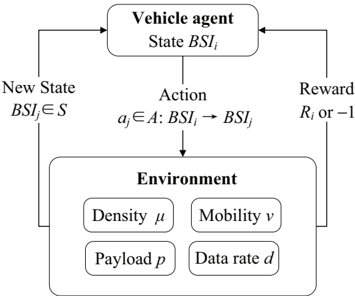
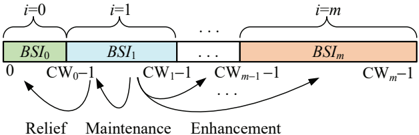
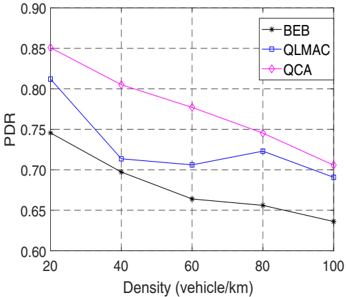
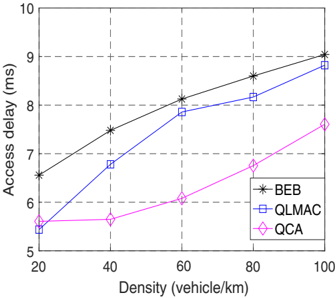
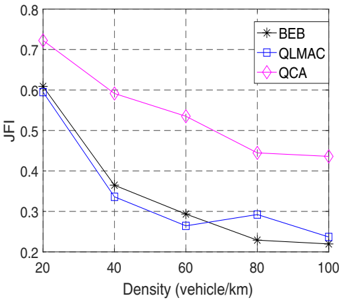
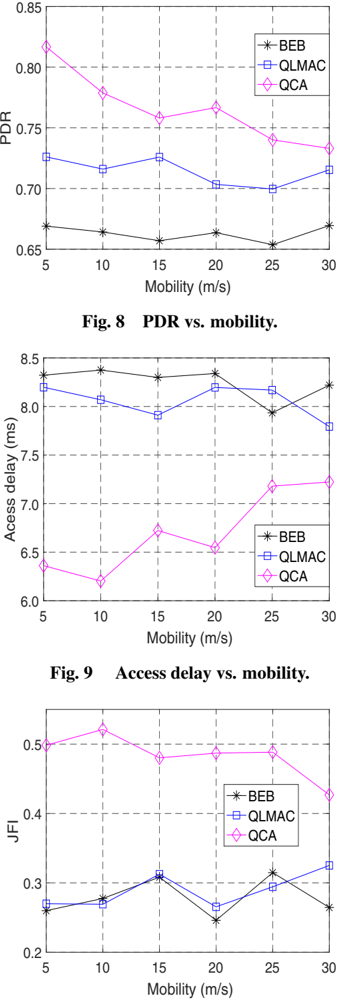
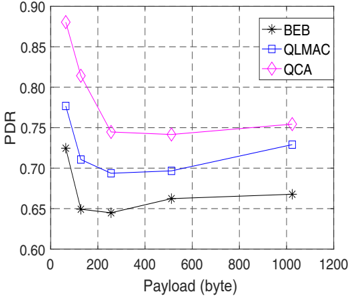
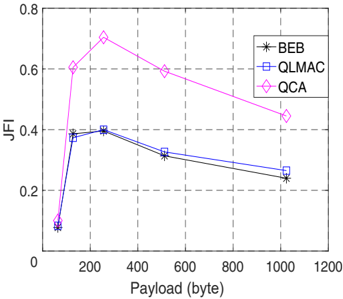
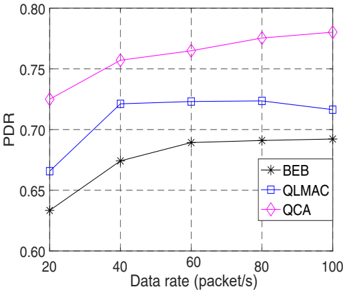
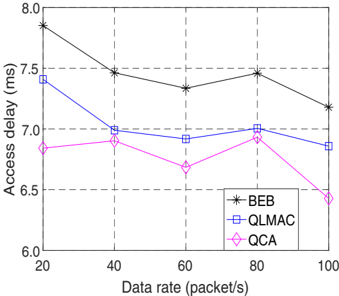
With the increasing attention to front-edge vehicular communication applications, distributed resource allocation is beneficial to the direct communications between vehicle nodes. However, in highly dynamic distributed vehicular networks, quality of service (QoS) of the systems would degrade dramatically because of serious packet collisions in the absence of sufficient link knowledge. Focusing on the fairness optimization, a Q-learning-based collision avoidance (QCA) scheme, which is characterized by an ingenious bidirectional backoff reward model RQCAcorresponding to arbitrary backoff stage transitions, has been proposed in an intelligent distributed media access control protocol. In QCA, an intelligent bidirectional backoff agent based on the Markov decision process model can actively motivate each vehicle agent to update itself toward an optimal backoff sub-intervel BSIoptthrough either positive or negative bidirectional transition individually, resulting in the distinct fair communication with a proper balance of the resource allocation. According to the reinforcement learning theory, the problem of goodness evaluation on the backoff stage self-selection policy is equal to the problem of maximizing Q function of the vehicle in the current environment. The final decision on BSIoptrelated to an optimal contention window range was solved through maximizing the Q value or$Q_{\max}$. The ε-qreedy algorithm was used to keep a reasonable convergence of the$Q_{\max}$solution. For the fairness evaluation of QCA, four kinds of dynamic impacts on the vehicular networks were investigated: mobility, density, payload size, and data rate with a network simulator NS2. Consequently, QCA can achieve fair communication efficiently and robustly, with advantages of superior Jain's fairness index, relatively high packet delivery ratio, and low time delay.
Overview
The claims and statistics of this paper haven’t been checked yet.
Free: it reads the open-access text and checks the first 5 claims that cite a source we can check. Create a free account to check every claim.
Integrity signals
Registry
Cites
Statistics
Figures



Verification
Claims the paper makes
The claims and statistics of this paper haven’t been checked yet.
Free: it reads the open-access text and checks the first 5 claims that cite a source we can check. Create a free account to check every claim.
Self-check
Percentages, sums and reported differences re-computed from the paper’s own numbers.
The self-check needs the paper’s full text.
Citations
Cites
5G for Vehicular Communications
Shah, S. A. A., Ahmed, E., Imran, M., & Zeadally, S. (2018) · IEEE Communications Magazine · doi:10.1109/mcom.2018.1700467 · Cited by 363
Han, G., Gong, A., Wang, H., Martínez-García, M., & Peng, Y. (2021) · IEEE Transactions on Vehicular Technology · doi:10.1109/tvt.2021.3097084 · Cited by 115
Zhao, D., Qin, H., Song, B., Zhang, Y., Du, X., & Guizani, M. (2020) · IEEE Transactions on Cognitive Communications and Networking · doi:10.1109/tccn.2020.2983170 · Cited by 91
Reinforcement Learning Based MAC Protocol (UW-ALOHA-Q) for Underwater Acoustic Sensor Networks
Park, S. H., Mitchell, P., & Grace, D. (2019) · IEEE Access · doi:10.1109/access.2019.2953801 · Cited by 81
Jeon, Y., Kuk, S., & Kim, H. (2018) · Sensors · doi:10.3390/s18124388 · Cited by 59
Application-Level Performance of IEEE 802.11p in Safety-Related V2X Field Trials
Klapez, M., Grazia, C. A., & Casoni, M. (2020) · IEEE Internet of Things Journal · doi:10.1109/jiot.2020.2967649 · Cited by 46
A backoff algorithm based on self-adaptive contention window update factor for IEEE 802.11 DCF
Zhang, C., Chen, P., Ren, J., Wang, X., & Vasilakos, A. V. (2016) · Wireless Networks · doi:10.1007/s11276-015-1184-9 · Cited by 40
Guo, C., Sheng, M., Wang, X., & Zhang, Y. (2014) · IEEE Transactions on Communications · doi:10.1109/tcomm.2014.050714.130759 · Cited by 37
Wireless recommendations for Internet of vehicles: Recent advances, challenges, and opportunities
Li, T. K., Li, C., Luo, J., & Song, L. (2020) · Intelligent and Converged Networks · doi:10.23919/icn.2020.0005 · Cited by 30
Efficient Scheduling and Resource Allocation for D2D-based LTE-V2X Communications
Masmoudi, A., Feki, S., Mnif, K., & Zarai, F. (2019) · International Wireless Communications and Mobile Computing Conference (IWCMC) · doi:10.1109/iwcmc.2019.8766682 · Cited by 24
A MAC protocol for delay-sensitive VANET applications with self-learning contention scheme
Wu, C., Ohzahata, S., Ji, Y., & Kato, T. (2014) · IEEE Consumer Communications and Networking Conference · doi:10.1109/ccnc.2014.6866607 · Cited by 23
Wu, G., & Xu, P. (2017) · IEEE Access · doi:10.1109/access.2017.2783909 · Cited by 21
Dynamic Scheduling Algorithm based on Priority Assignment for LTE-V2X vehicular Networks
Trabelsi, A. D., Marouane, H., Zarai, F., & Meddeb-Makhlouf, A. (2019) · International Wireless Communications and Mobile Computing Conference (IWCMC) · doi:10.1109/iwcmc.2019.8766632 · Cited by 12
Analysis of IEEE 802.11p MAC Protocol for Safety Message Broadcast in V2V Communication
Wael, C. B. A., Armi, N., Mitayani, A., Kurniawan, D., Satyawan, A. S., & Subekti, A. (2020) · International Conference on Radar, Antenna, Microwave, Electronics, and Telecommunications (ICRAMET) · doi:10.1109/icramet51080.2020.9298654 · Cited by 10
A Q-learning based SPS Resource Scheduling Algorithm for Reliable C-V2X Communication
Lu, Y., Wang, P., Wang, S., & Yao, W. (2021) · 2021 5th International Conference on Digital Signal Processing · doi:10.1145/3458380.3458415 · Cited by 10
Self-citationA novel collision supervision and avoidance algorithm for scalable MAC of vehicular networks
Shuai, W., Yan, L., Jie, Z., & Ping, W. (2021) · Chinese Journal of Electronics · doi:10.1049/cje.2020.12.001 · Cited by 9
Modeling and optimization of CSMA/CA in VANET
Giang, A. T., Busson, A., & Renzo, M. D. (2014) · Annals of Operations Research · doi:10.1007/s10479-014-1610-x · Cited by 8
Balador, A., Calafate, C. T., Cano, J., & Manzoni, P. (2016) · International Journal of Ad Hoc and Ubiquitous Computing · doi:10.1504/ijahuc.2017.080913 · Cited by 8
Modeling and simulation of packet delivery rate in LTE-V network based on Markov chain
Shi, M., Tang, Y., Zhang, X., Zhang, Y., & Xu, J. (2019) · Tsinghua Science & Technology · doi:10.26599/tst.2018.9010142 · Cited by 7
Meet-cloud for secure and accurate distribution of negative messages in vehicular Ad hoc network
Huang, B., Cheng, X., Huang, C., & Cheng, W. (2018) · Tsinghua Science & Technology · doi:10.26599/tst.2018.9010016 · Cited by 5
MAC design on real 802.11 devices: From exponential to Moderated Backoff
Tinnirello, I., Wentink, M., Garlisi, D., Giuliano, F., & Bianchi, G. (2016) · IEEE International Symposium on a World of Wireless, Mobile and Multimedia Networks (WoWMoM) · doi:10.1109/wowmom.2016.7523503 · Cited by 4
QoS-assurance-and-mobility-based EDCA mechanism for vehicular network access
Yang, B. F., Wang, S., Shi, X., & Han, W. (2016) · IEEE International Conference on Computer and Communications (ICCC) · doi:10.1109/compcomm.2016.7925092 · Cited by 4
Self-citation
Cited by
Weighted fair energy transfer in a UAV network: A multi-agent deep reinforcement learning approach
Murshed, S., Nibir, A. S., Razzaque, M. A., Roy, P., Elhendi, A. Z., Hassan, M. R., & Hassan, M. M. (2024) · Energy · doi:10.1016/j.energy.2024.130527 · Cited by 18
Li, Z., Wang, P., Shen, Y., & Li, S. (2025) · Sensors · doi:10.3390/s25020302 · Cited by 15
Self-citationZhang, L., Zhou, Z., Yi, B., Wang, J., Chen, C., & Shi, C. (2024) · IEEE Internet of Things Journal · doi:10.1109/jiot.2024.3487538 · Cited by 15
“Recent advancements in vehicle–road cooperative systems have shown promising results in improving traffic management [24], [25], [26].”
Lv, J., Rani, S., & Li, K. (2025) · Computers & Industrial Engineering · doi:10.1016/j.cie.2025.111451 · Cited by 12
Lv, J., Li, K., Słowik, A., & Jiang, H. (2025) · IEEE Internet of Things Journal · doi:10.1109/jiot.2024.3516947 · Cited by 12
“However, developing effective in-vehicle medical emergency response systems faces numerous challenges in the highly dynamic IoV environment, particularly in data processing, privacy preservation, and timely decision-making [6], [7], [8].”
Metadata
- Authors
- Wang, P., & Wang, S.
- Affiliations
- Donghua University (CN)
- Venue
- Tsinghua Science and Technology
- Publisher
- Tsinghua University Press
- Published
- 2023-04
- Volume
- 28
- Issue
- 2
- Pages
- 258-268
- ISSN
- 1007-0214 (ISSN-L)
- OpenAlex
- W4297985134
- Semantic Scholar
- ef1d766c07d63dce7ec267b5a97b71b8b8388398
- Cited by
- 32
- References
- 23
- Citations by year
- 2026: 3 · 2025: 15 · 2024: 9 · 2023: 4
- FWCI
- 1.99
- Type
- journal article
- Language
- en
- Open access
- diamond
- doi.org
- Licence
- cc-by
- Locations
- Tsinghua Science & Technology (publishedVersion, cc-by)
- DOAJ (DOAJ: Directory of Open Access Journals) (submittedVersion)
- Topics
- Physical Sciences › Engineering › Electrical and Electronic Engineering › Vehicular Ad Hoc Networks (VANETs)
- Physical Sciences › Engineering › Control and Systems Engineering › Traffic control and management
- Physical Sciences › Computer Science › Computer Networks and Communications › Wireless Networks and Protocols
- Keywords
- vehicular networks, Q-learning, collision avoidance, fairness, reinforcement learning, contention window, Markov decision process, epsilon-greedy, vehicle-to-vehicle communication, packet collisions, Jain's fairness index
About these checks
Registry, retraction, Cites and statistics results are computed, not judged, with one exception: a printed reference that no index lists is read once by a model before it counts as a citation error. Claims are extracted by a model and kept only when their quote appears verbatim in the text; each cited source is then checked, with a model’s help, for whether it says what the claim relies on. Those verdicts can be wrong — read the claim’s quote and the cited source before relying on one.
Statistics and arithmetic are recomputed, not judged.
Confidence bands are shown only for fields calibrated on our annotated test set. None is calibrated yet, so no band is shown.
What counts as a claim ›How we measure confidence ›How we check this ›
Are you an author, or do you see a problem with this page? Request a review
Data sources
Bibliographic data: Semantic Scholar, OpenAlex, Crossref.
Contains information from the Semantic Scholar Academic Graph Datasets, made available under the ODC Attribution License (ODC-BY 1.0).
Semantic Scholar’s data is described in: Kinney, R., et al. (2023). The Semantic Scholar Open Data Platform. arXiv:2301.10140.
