

Reducing Message Collisions in Sensing-Based Semi-Persistent Scheduling (SPS) by Using Reselection Lookaheads in Cellular V2X
Open accessThe DOI matches its Crossref record; 22 of the 22 references it cites were found in a registry or an index.
Abstract
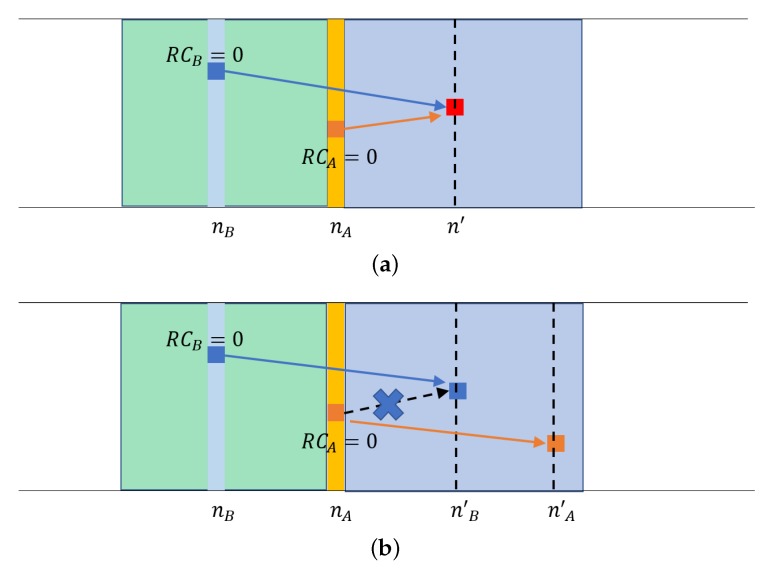
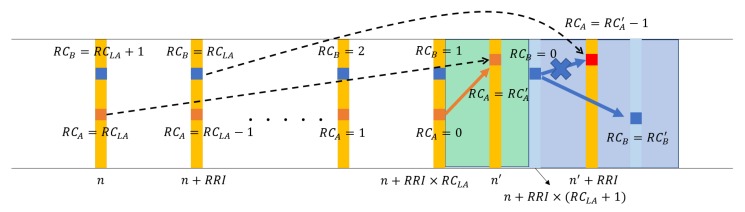
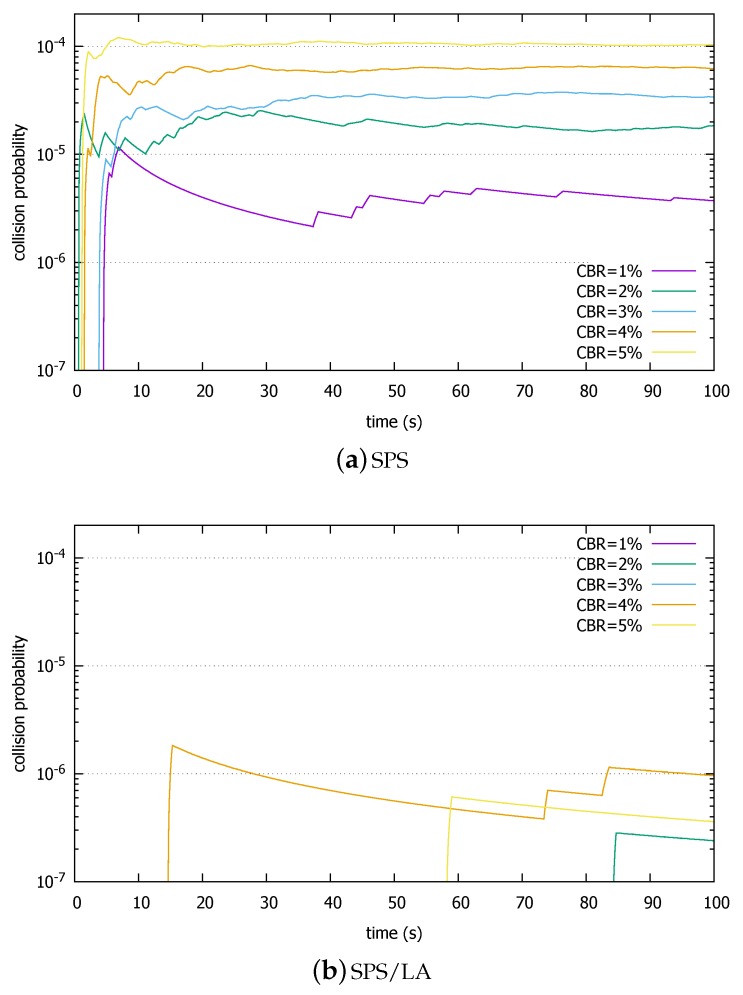
In the C-V2X sidelink Mode 4 communication, the sensing-based semi-persistent scheduling (SPS) implements a message collision avoidance algorithm to cope with the undesirable effects of wireless channel congestion. Still, the current standard mechanism produces a high number of packet collisions, which may hinder the high-reliability communications required in future C-V2X applications such as autonomous driving. In this paper, we show that by drastically reducing the uncertainties in the choice of the resource to use for SPS, we can significantly reduce the message collisions in the C-V2X sidelink Mode 4. Specifically, we propose the use of the “lookahead”, which contains the next starting resource location in the time-frequency plane. By exchanging the lookahead information piggybacked on the periodic safety message, vehicular user equipment (UEs) can eliminate most message collisions arising from the ignorance of other UEs’ internal decisions. Although the proposed scheme would require the inclusion of the lookahead in the control part of the packet, the benefit may outweigh the bandwidth cost, considering the stringent reliability requirement in future C-V2X applications.
Overview
The claims and statistics of this paper haven’t been checked yet.
Free: it reads the open-access text and checks the first 5 claims that cite a source we can check. Create a free account to check every claim.
Integrity signals
Registry
Cites
Statistics
Figures





Verification
Claims the paper makes
The claims and statistics of this paper haven’t been checked yet.
Free: it reads the open-access text and checks the first 5 claims that cite a source we can check. Create a free account to check every claim.
Claims other papers make about this one
Each is checked against this paper’s own text: does it say what the citing paper says it does?
The cited source says what the claim attributes to it.
In the citing paper
“SB-SPS is widely used for sidelink resource allocation due to its better reliability and latency [6].”
From Reinforcement Learning-Based Resource Allocation Scheme of NR-V2X Sidelink for Joint Communication and Sensing (2025) · cites this paper as [6]
Self-check
Percentages, sums and reported differences re-computed from the paper’s own numbers.
The self-check needs the paper’s full text.
Citations
Cites
Vehicle-to-Everything (v2x) Services Supported by LTE-Based Systems and 5G
Chen, S., Hu, J., Shi, Y., Peng, Y., Fang, J., Zhao, R., & Zhao, L. (2017) · IEEE Communications Standards Magazine · doi:10.1109/mcomstd.2017.1700015 · Cited by 921 · cited 1×
“vantages over DSRC [10–13]. Although DSRC is a mature technology and does not require a coordinating network infrastructure or bulky signaling procedures, it has weaknesses in the spectral efficiency [14] and the capability to deal with congestion and hidden terminal problem at scale [15]. Typically, C-V2X is consider…”
BackgroundMolina-Masegosa, R., & Gozalvez, J. (2017) · IEEE Vehicular Technology Magazine · doi:10.1109/mvt.2017.2752798 · Cited by 755
LTE and IEEE 802.11p for vehicular networking: a performance evaluation
Hameed Mir, Z., & Filali, F. (2014) · EURASIP Journal on Wireless Communications and Networking · doi:10.1186/1687-1499-2014-89 · Cited by 375 · cited 1×
“Although some argue that cellular V2X (C-V2X) is not as ready, has compatibility problems between different 3GPP Releases, and has exaggerated coverage when measured in reality [9], proponents of the C-V2X argue that the cellular alternative has multiple advantages over DSRC [10–13].”
BackgroundOn the Performance of IEEE 802.11p and LTE-V2V for the Cooperative Awareness of Connected Vehicles
Bazzi, A., Masini, B. M., Zanella, A., & Thibault, I. (2017) · IEEE Transactions on Vehicular Technology · doi:10.1109/tvt.2017.2750803 · Cited by 350 · cited 2×
“n performance of C-V2X over DSRC is highly affected by the modulation and channel coding scheme (MCS) [18], and the capacity can be lower than DSRC under very high vehicle density and short distances [16]. Therefore, C-V2X must be less reliant on the cellular infrastructure for efficiency, by leveraging the sidelink c…”
BackgroundVinel, A. (2012) · IEEE Wireless Communications Letters · doi:10.1109/wcl.2012.022012.120073 · Cited by 277 · cited 1×
“Although some argue that cellular V2X (C-V2X) is not as ready, has compatibility problems between different 3GPP Releases, and has exaggerated coverage when measured in reality [9], proponents of the C-V2X argue that the cellular alternative has multiple advantages over DSRC [10–13].”
BackgroundRadio Resource Management for D2D-Based V2V Communication
Sun, W., Strom, E. G., Brannstrom, F., Sou, K. C., & Sui, Y. (2016) · IEEE Transactions on Vehicular Technology · doi:10.1109/tvt.2015.2479248 · Cited by 274 · cited 1×
“n the context of C-V2X, radio resource management is an actively studied topic. Recent works in this topic are classified into network-controlled and autonomous approaches. For the former, Sun et al. [22] transformed the latency and reliability constraints of C-V2X into optimization constraints that are computable usi…”
BackgroundStandards for vehicular communication—from IEEE 802.11p to 5G
Festag, A. (2015) · e+i Elektrotechnik und Informationstechnik · doi:10.1007/s00502-015-0343-0 · Cited by 191 · cited 2×
“Although DSRC is a mature technology and does not require a coordinating network infrastructure or bulky signaling procedures, it has weaknesses in the spectral efficiency [14] and the capability to deal with congestion and hidden terminal problem at scale [15].”
BackgroundStudy of the Impact of PHY and MAC Parameters in 3GPP C-V2V Mode 4
Bazzi, A., Cecchini, G., Zanella, A., & Masini, B. M. (2018) · IEEE Access · doi:10.1109/access.2018.2883401 · Cited by 143
Masini, B. M., Bazzi, A., & Zanella, A. (2018) · Sensors · doi:10.3390/s18072207 · Cited by 109 · cited 3×
“However, the sensing-based SPS should not be considered a fully-fledged congestion control algorithm, which would use various available means such as power control, MCS control, retransmission control, or packet drop [20,36].”
BackgroundInfluentialPerformance Analysis of Sensing-Based Semi-Persistent Scheduling in C-V2X Networks
Nabil, A., Kaur, K., Dietrich, C., & Marojevic, V. (2018) · 2018 IEEE 88th Vehicular Technology Conference (VTC-Fall) · doi:10.1109/vtcfall.2018.8690600 · Cited by 92
Research works printed but not linked: 4
- IEEE Std 802.11p-2010 (2010). Part 11: Wireless LAN Medium Access Control (MAC) and Physical Layer (PHY) Specifications, Amendment 6: Wireless Access in Vehicular Environments, Institute of Electrical and Electronics Engineers (IEEE).
- IEEE Std 1609.2-2013 (2013). IEEE Standard for Wireless Access in Vehicular Environments (WAVE)—Security Services for Applications and Management Messages, Institute of Electrical and Electronics Engineers (IEEE).
- IEEE Std 1609.3-2010 (2010). IEEE Standard for Wireless Access in Vehicular Environments (WAVE)—Networking Services, Institute of Electrical and Electronics Engineers (IEEE).
- IEEE Std 1609.4-2010 (2010). IEEE Standard for Wireless Access in Vehicular Environments (WAVE)—Multi-Channel Operation, Institute of Electrical and Electronics Engineers (IEEE).
Cited by
Geo-Based Scheduling for C-V2X Networks
Molina-Masegosa, R., Sepulcre, M., & Gozalvez, J. (2019) · IEEE Transactions on Vehicular Technology · doi:10.1109/tvt.2019.2924698 · Cited by 59
“[12][15] propose modifications or extensions to the SPS algorithm but maintain most of its functionality.”
BackgroundHaider, A., & Hwang, S. (2019) · Electronics · doi:10.3390/electronics8080846 · Cited by 53
Performance Analysis and Optimization for Semi-Persistent Scheduling in C-V2X
Gu, X., Peng, J., Cai, L., Cheng, Y., Zhang, X., Liu, W., & Huang, Z. (2022) · IEEE Transactions on Vehicular Technology · doi:10.1109/tvt.2022.3223414 · Cited by 51
“(SPS) algorithm was developed for distributed resource reservation in the C-V2X MAC layer [7], which is beneficial for periodical transmissions of packets with constant sizes [8].”
MethodWijesiri, G. P., Haapola, J., & Samarasinghe, T. (2020) · IEEE Transactions on Communications · doi:10.1109/tcomm.2020.3044340 · Cited by 51
“Since our primary focus is on the MAC layer performance, [22]–[24] can be considered to be the most related to our work.”
BackgroundMethodInfluentialH-V2X Mode 4 Adaptive Semipersistent Scheduling Control for Cooperative Internet of Vehicles
Heo, S., Yoo, W., Jang, H., & Chung, J. (2021) · IEEE Internet of Things Journal · doi:10.1109/jiot.2020.3048993 · Cited by 50
“In [25], a new method to reduce the collision probability of CAMs in C-V2X mode 4 is proposed, where vehicles carry out the resource reselection process early such that information can be shared in advance with other vehicles.”
BackgroundMethod
Metadata
- Authors
- Jeon, Y., Kuk, S., & Kim, H.
- Affiliations
- Korea University (KR)
- Corresponding author
- Kim, Hyogon
- Venue
- Sensors
- Publisher
- MDPI AG
- Published
- 2018-12-11
- Volume
- 18
- Issue
- 12
- Pages
- 4388
- ISSN
- 1424-8220 (ISSN-L)
- PMC
- PMC6308456
- OpenAlex
- W2963889250
- Semantic Scholar
- d494f51945d885d8fe3acf104f12b4dcb3e50dc1
- Cited by
- 59
- References
- 22
- Citations by year
- 2026: 3 · 2025: 6 · 2024: 8 · 2023: 8 · 2022: 11 · 2021: 10 · 2020: 8 · 2019: 5
- FWCI
- 2.20
- Type
- journal article
- Language
- en
- Open access
- gold
- dx.doi.org
- Licence
- Locations
- Sensors (publishedVersion, cc-by)
- Europe PMC (PubMed Central) (publishedVersion, other-oa)
- PubMed Central (publishedVersion, cc-by)
- PubMed (publishedVersion)
- arXiv (Cornell University) (submittedVersion)
- DOAJ (DOAJ: Directory of Open Access Journals) (submittedVersion, cc-by-sa)
- arXiv (Cornell University)
- Funders
- Ministry of Land, Infrastructure and Transport
- Topics
- Physical Sciences › Engineering › Electrical and Electronic Engineering › Vehicular Ad Hoc Networks (VANETs)
- Physical Sciences › Engineering › Control and Systems Engineering › Traffic control and management
- Physical Sciences › Engineering › Civil and Structural Engineering › Road Transport and Highway Systems
- Keywords
- C-V2X, sidelink communication, Mode 4, semi-persistent scheduling, lookahead, resource selection, autonomous driving, channel congestion, time-frequency resource allocation
About these checks
Registry, retraction, Cites and statistics results are computed, not judged, with one exception: a printed reference that no index lists is read once by a model before it counts as a citation error. Claims are extracted by a model and kept only when their quote appears verbatim in the text; each cited source is then checked, with a model’s help, for whether it says what the claim relies on. Those verdicts can be wrong — read the claim’s quote and the cited source before relying on one.
Statistics and arithmetic are recomputed, not judged.
Confidence bands are shown only for fields calibrated on our annotated test set. None is calibrated yet, so no band is shown.
What counts as a claim ›How we measure confidence ›How we check this ›
Are you an author, or do you see a problem with this page? Request a review
How to cite
Cite CoChat for the checks on this page, and the paper for its own findings.
- This page
- CoChat. (2026). Citation check: Reducing Message Collisions in Sensing-Based Semi-Persistent Scheduling (SPS) by Using Reselection Lookaheads in Cellular V2X. https://app.cochat.ai/papers/10.3390/s18124388
- The paper
- Jeon, Y., Kuk, S., & Kim, H. (2018). Reducing Message Collisions in Sensing-Based Semi-Persistent Scheduling (SPS) by Using Reselection Lookaheads in Cellular V2X. Sensors. https://doi.org/10.3390/s18124388
Data sources
Bibliographic data: Semantic Scholar, OpenAlex, Crossref.
Contains information from the Semantic Scholar Academic Graph Datasets, made available under the ODC Attribution License (ODC-BY 1.0).
Semantic Scholar’s data is described in: Kinney, R., et al. (2023). The Semantic Scholar Open Data Platform. arXiv:2301.10140.
