

Cannabis Use and Academic Performance in College Students: The Role of Procrastination
Open accessThe DOI matches its Crossref record; 44 of the 44 references it cites were found in a registry or an index; 2 of the 14 sources its claims cite were checked for support.
Abstract
This study investigated procrastination as a moderator of the association between cannabis use and college GPA among 220 college students ages 18–24. Lifetime cannabis use and procrastination predicted lower cumulative GPA, and the association between lifetime cannabis use and cumulative GPA strengthened as procrastination increased.
Overview
CoChat Summary
TL;DR
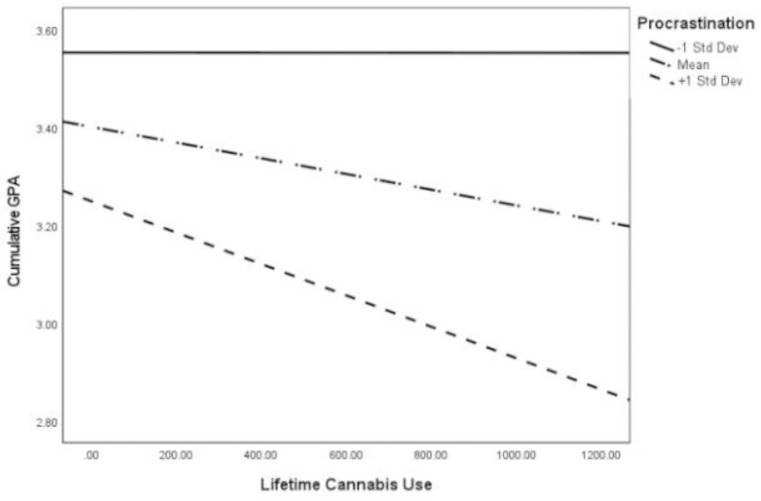
This cross-sectional study of 220 college students found that procrastination was associated with lower GPA and moderated the link between cannabis use and cumulative GPA. Lifetime cannabis use predicted lower cumulative GPA only for students with average or high procrastination, not for those low in procrastination.
Key findings
- In the term GPA model, procrastination had a significant main effect: higher procrastination predicted lower term GPA (β = −0.29, t = −4.41, p < .001), but past month cannabis use (β = −0.04, p = .549) and its interaction with procrastination (β = −0.09, p = .152) were not significant.
- For cumulative GPA, lifetime cannabis use (β = −0.26, t = −3.20, p = .002), procrastination (β = −0.31, t = −4.57, p < .001), and their interaction (β = −0.19, t = −2.55, p = .012) were significant.
- Simple slopes showed lifetime cannabis use predicted lower cumulative GPA when procrastination was high (+1 SD, B = −0.0003, p = .002) or average, B = −0.0002, p = .002, but not when procrastination was low (−1 SD, B = 0.0000, p = .995).
- Covariates explained 19.2% of variance in term GPA and 14.2% in cumulative GPA; adding cannabis use, procrastination, and their interaction explained an additional 7.8% and 10.8%, respectively.
Methods
- Cross-sectional online survey study of 220 college students ages 18–24 (71.8% female; 79.1% White) at a university in the Pacific Northwest, registered for Fall 2021 classes.
- Measures included demographics, substance use history, the Beck Anxiety Inventory, the CES-D, and a 10-item procrastination scale; official term and cumulative GPA were obtained from the registrar.
- Main analyses used hierarchical multiple linear regressions with covariates entered first and cannabis use, procrastination, and their interaction entered second; simple slopes were tested with PROCESS.
Limitations
- The paper states the sample was primarily White and female, limiting generalizability, and that 50% were first-year students, so lifetime cannabis use may largely reflect adolescent rather than college use.
- The study is cross-sectional, so causality and directionality cannot be determined.
- The text also notes likely limitations in self-reported cannabis use due to response bias and difficulty recalling lifetime use, and in GPA as an outcome because it may not capture withdrawals, pass/fail, incomplete grades, or more fine-grained academic performance; these are explicitly stated limitations.
Model-written summary. Check it against the paper before relying on it.
Integrity signals
Registry
Cites
Statistics
Figures
Verification
Claims the paper makes
1 Valid · 0 Not valid · 12 Not checked · 52 Own results and interpretations
A result the paper reports from its own data — it cites no other source for it, so there is none to check. The quote shows it is in the paper.
In the paper
“A regression model indicated that procrastination moderated the association between lifetime cannabis use and cumulative college GPA,”
- Also stated in: § Results: · plain
“A regression model indicated that procrastination moderated the association between lifetime cannabis use and cumulative college GPA, whereas this moderation was not present when examining the relationship between past month cannabis use and term GPA.”
- Also stated in: § DISCUSSION In the present study, there was a main effect of procrastination, but no significant effects of recent cannabis use or interaction between recent cannabis use and procrastination on term GPA. There was also a main effect of lifetime cannabis use, a main effect of procrastination, as well as a significant interaction between lifetime cannabis use and procrastination on cumulative GPA. As hypothesized, more frequent cannabis use was related to lower GPA for students with higher levels of procrastination, but not for students with lower levels of procrastination. These results provide partial support for the hypothesized role of procrastination as a moderator between cannabis use and academic performance, and suggest that the strength of the association between lifetime cannabis use and cumulative GPA varies with the level of procrastination, and that students with higher levels of procrastination may be particularly vulnerable to poorer academic performance at higher levels of lifetime cannabis, relative to students with lower levels of procrastination. Accordingly, it is possible that interventions designed to address procrastination behavior (e.g., time-management strategies, keeping a daily schedule, etc.) may be particularly beneficial for students who frequently use cannabis. Helpful interventions for procrastination generally focus on training self-regulatory skills, building self-esteem, and increasing social support (Schouwenburg, 2004). Research suggests that cognitive behavioral therapy can be particularly effective for reducing procrastination behavior (van Eerde & Klingsieck, 2018). These interventions can help patients recognize patterns in their procrastination behavior and the irrational thoughts that may be contributing to their procrastination, then focus on correcting those irrational thoughts and changing subsequent behavior by enhancing self-regulation (e.g., setting goals, self-monitoring, managing priorities, time-management, etc.). However, therapeutic interventions can be prohibitively expensive, are often time-consuming, and are typically reactive in nature – treatment is often sought only after problematic behavior becomes apparent. A different approach is to incorporate procrastination intervention/prevention into the curriculum itself with the help of instructors/teachers. Classroom techniques that have been shown to reduce academic procrastination include incorporating pop quizzes to encourage regular study habits, meeting with students who have late or missing assignments to develop a written plan for completing the work, assigning larger projects in more manageable chunks with frequent check-ins, and regular communications reminding students what they should be working on (Zacks & Hen, 2018). Nevertheless, classroom-based interventions for procrastination remain understudied and further research is needed to identify any potential academic benefits of these strategies for students who procrastinate and frequently use cannabis. The present study also found negative associations between procrastination and both term and cumulative GPA. These findings are in line with previous research suggesting a negative association exists between procrastination and multiple indices of academic performance in college, including quiz and exam scores, course grades, and GPA (Kim & Seo, 2015). However, it is unclear why a significant interaction was found between cannabis use and procrastination when examining lifetime cannabis use and cumulative GPA, but not when examining past month cannabis use and term GPA. For example, it is possible that the term GPA collected could have been influenced by history effects. After all, the Fall 2021 term marked the return to in-person instruction for many students after more than a year of remote learning during the height of the COVID-19 pandemic. However, the term and cumulative GPA scores collected in the present study were very strongly correlated (r = 0.90, p < .001), whereas the correlation between past month and lifetime cannabis use was more moderate (r = 0.48, p < .001). Therefore, it is more likely that lifetime cannabis use exhibits an association with cumulative academic performance because it reflects the residual and chronic effects of cannabis use on academic achievement. However, past month cannabis use may only provide a limited assessment of cannabis use characteristics that may change over the course of adolescence and young adulthood. Indeed, research suggests that long-term cannabis users perform significantly worse on tests of memory and attention compared to short-term users, and long-term use is also associated with impaired learning, retention, and retrieval on learning tasks (Solowij et al., 2002). It is interesting to note that in the current study lifetime cannabis use was associated with lower cumulative GPA at both high and average levels of procrastination, but not at low levels of procrastination. Thus, the current findings suggest that being low on this trait may be interpreted as protective for cannabis users in the long run. Given more variance in the measure of lifetime cannabis use vs. past 30-day cannabis use, as indicated in Table 1, it is possible that this relatively stable personality trait is more likely to moderate the relationship between a variable measuring a longer history of cannabis use and cumulative GPA. Future investigations into the impact of cannabis use on academic performance should employ measures that can capture long-term cannabis use patterns, such as lifetime cannabis use, as opposed to only examining cannabis use in the past month. · plain
“There was also a main effect of lifetime cannabis use, a main effect of procrastination, as well as a significant interaction between lifetime cannabis use and procrastination on cumulative GPA.”
- Also stated in: § Conclusion · plain
“In summary, the current study found that procrastination moderates the association between lifetime cannabis use and cumulative college GPA.”
§ Cannabis Use and Academic Performance in College Students: The Role of Procrastination > Abstract > Results:
plainstates an association- Asserted: passes — The authors put it forward as true.
- Checkable: passes — It can be checked against evidence.
- Load-bearing: passes — The paper’s conclusions depend on it.
- Based: passes — The paper gives a reason why it holds.
- Also stated in: § Results: · plain
A result the paper reports from its own data — it cites no other source for it, so there is none to check. The quote shows it is in the paper.
In the paper
“A regression model indicated that procrastination moderated the association between lifetime cannabis use and cumulative college GPA, whereas this moderation was not present when examining the relationship between past month cannabis use and term GPA.”
- Also stated in: § Procrastination & Term GPA · plain
“However, neither Past Month Cannabis Use (β = −0.04, p = .549) nor the interaction term (β = −0.09, p = .152) were significant predictors of Term GPA.”
- Also stated in: § DISCUSSION In the present study, there was a main effect of procrastination, but no significant effects of recent cannabis use or interaction between recent cannabis use and procrastination on term GPA. There was also a main effect of lifetime cannabis use, a main effect of procrastination, as well as a significant interaction between lifetime cannabis use and procrastination on cumulative GPA. As hypothesized, more frequent cannabis use was related to lower GPA for students with higher levels of procrastination, but not for students with lower levels of procrastination. These results provide partial support for the hypothesized role of procrastination as a moderator between cannabis use and academic performance, and suggest that the strength of the association between lifetime cannabis use and cumulative GPA varies with the level of procrastination, and that students with higher levels of procrastination may be particularly vulnerable to poorer academic performance at higher levels of lifetime cannabis, relative to students with lower levels of procrastination. Accordingly, it is possible that interventions designed to address procrastination behavior (e.g., time-management strategies, keeping a daily schedule, etc.) may be particularly beneficial for students who frequently use cannabis. Helpful interventions for procrastination generally focus on training self-regulatory skills, building self-esteem, and increasing social support (Schouwenburg, 2004). Research suggests that cognitive behavioral therapy can be particularly effective for reducing procrastination behavior (van Eerde & Klingsieck, 2018). These interventions can help patients recognize patterns in their procrastination behavior and the irrational thoughts that may be contributing to their procrastination, then focus on correcting those irrational thoughts and changing subsequent behavior by enhancing self-regulation (e.g., setting goals, self-monitoring, managing priorities, time-management, etc.). However, therapeutic interventions can be prohibitively expensive, are often time-consuming, and are typically reactive in nature – treatment is often sought only after problematic behavior becomes apparent. A different approach is to incorporate procrastination intervention/prevention into the curriculum itself with the help of instructors/teachers. Classroom techniques that have been shown to reduce academic procrastination include incorporating pop quizzes to encourage regular study habits, meeting with students who have late or missing assignments to develop a written plan for completing the work, assigning larger projects in more manageable chunks with frequent check-ins, and regular communications reminding students what they should be working on (Zacks & Hen, 2018). Nevertheless, classroom-based interventions for procrastination remain understudied and further research is needed to identify any potential academic benefits of these strategies for students who procrastinate and frequently use cannabis. The present study also found negative associations between procrastination and both term and cumulative GPA. These findings are in line with previous research suggesting a negative association exists between procrastination and multiple indices of academic performance in college, including quiz and exam scores, course grades, and GPA (Kim & Seo, 2015). However, it is unclear why a significant interaction was found between cannabis use and procrastination when examining lifetime cannabis use and cumulative GPA, but not when examining past month cannabis use and term GPA. For example, it is possible that the term GPA collected could have been influenced by history effects. After all, the Fall 2021 term marked the return to in-person instruction for many students after more than a year of remote learning during the height of the COVID-19 pandemic. However, the term and cumulative GPA scores collected in the present study were very strongly correlated (r = 0.90, p < .001), whereas the correlation between past month and lifetime cannabis use was more moderate (r = 0.48, p < .001). Therefore, it is more likely that lifetime cannabis use exhibits an association with cumulative academic performance because it reflects the residual and chronic effects of cannabis use on academic achievement. However, past month cannabis use may only provide a limited assessment of cannabis use characteristics that may change over the course of adolescence and young adulthood. Indeed, research suggests that long-term cannabis users perform significantly worse on tests of memory and attention compared to short-term users, and long-term use is also associated with impaired learning, retention, and retrieval on learning tasks (Solowij et al., 2002). It is interesting to note that in the current study lifetime cannabis use was associated with lower cumulative GPA at both high and average levels of procrastination, but not at low levels of procrastination. Thus, the current findings suggest that being low on this trait may be interpreted as protective for cannabis users in the long run. Given more variance in the measure of lifetime cannabis use vs. past 30-day cannabis use, as indicated in Table 1, it is possible that this relatively stable personality trait is more likely to moderate the relationship between a variable measuring a longer history of cannabis use and cumulative GPA. Future investigations into the impact of cannabis use on academic performance should employ measures that can capture long-term cannabis use patterns, such as lifetime cannabis use, as opposed to only examining cannabis use in the past month. · plain
“In the present study, there was a main effect of procrastination, but no significant effects of recent cannabis use or interaction between recent cannabis use and procrastination on term GPA.”
§ Cannabis Use and Academic Performance in College Students: The Role of Procrastination > Abstract > Results:
plain- Asserted: passes — The authors put it forward as true.
- Checkable: passes — It can be checked against evidence.
- Load-bearing: passes — The paper’s conclusions depend on it.
- Based: passes — The paper gives a reason why it holds.
- Also stated in: § Procrastination & Term GPA · plain
A result the paper reports from its own data — it cites no other source for it, so there is none to check. The quote shows it is in the paper.
In the paper
“The analysis showed a main effect for Procrastination, β = −0.29, t = −4.41, p < .001, such that greater Procrastination scores predicted lower Term GPA.”
§ Cannabis Use and Academic Performance in College Students: The Role of Procrastination > RESULTS > Procrastination & Term GPA
plainstates a cause- Asserted: passes — The authors put it forward as true.
- Checkable: passes — It can be checked against evidence.
- Load-bearing: passes — The paper’s conclusions depend on it.
- Based: passes — The paper gives a reason why it holds.
A result the paper reports from its own data — it cites no other source for it, so there is none to check. The quote shows it is in the paper.
In the paper
“However, the term and cumulative GPA scores collected in the present study were very strongly correlated (r = 0.90, p < .001), whereas the correlation between past month and lifetime cannabis use was more moderate (r = 0.48, p < .001).”
§ Cannabis Use and Academic Performance in College Students: The Role of Procrastination > DISCUSSION In the present study, there was a main effect of procrastination, but no significant effects of recent cannabis use or interaction between recent cannabis use and procrastination on term GPA. There was also a main effect of lifetime cannabis use, a main effect of procrastination, as well as a significant interaction between lifetime cannabis use and procrastination on cumulative GPA. As hypothesized, more frequent cannabis use was related to lower GPA for students with higher levels of procrastination, but not for students with lower levels of procrastination. These results provide partial support for the hypothesized role of procrastination as a moderator between cannabis use and academic performance, and suggest that the strength of the association between lifetime cannabis use and cumulative GPA varies with the level of procrastination, and that students with higher levels of procrastination may be particularly vulnerable to poorer academic performance at higher levels of lifetime cannabis, relative to students with lower levels of procrastination. Accordingly, it is possible that interventions designed to address procrastination behavior (e.g., time-management strategies, keeping a daily schedule, etc.) may be particularly beneficial for students who frequently use cannabis. Helpful interventions for procrastination generally focus on training self-regulatory skills, building self-esteem, and increasing social support (Schouwenburg, 2004). Research suggests that cognitive behavioral therapy can be particularly effective for reducing procrastination behavior (van Eerde & Klingsieck, 2018). These interventions can help patients recognize patterns in their procrastination behavior and the irrational thoughts that may be contributing to their procrastination, then focus on correcting those irrational thoughts and changing subsequent behavior by enhancing self-regulation (e.g., setting goals, self-monitoring, managing priorities, time-management, etc.). However, therapeutic interventions can be prohibitively expensive, are often time-consuming, and are typically reactive in nature – treatment is often sought only after problematic behavior becomes apparent. A different approach is to incorporate procrastination intervention/prevention into the curriculum itself with the help of instructors/teachers. Classroom techniques that have been shown to reduce academic procrastination include incorporating pop quizzes to encourage regular study habits, meeting with students who have late or missing assignments to develop a written plan for completing the work, assigning larger projects in more manageable chunks with frequent check-ins, and regular communications reminding students what they should be working on (Zacks & Hen, 2018). Nevertheless, classroom-based interventions for procrastination remain understudied and further research is needed to identify any potential academic benefits of these strategies for students who procrastinate and frequently use cannabis. The present study also found negative associations between procrastination and both term and cumulative GPA. These findings are in line with previous research suggesting a negative association exists between procrastination and multiple indices of academic performance in college, including quiz and exam scores, course grades, and GPA (Kim & Seo, 2015). However, it is unclear why a significant interaction was found between cannabis use and procrastination when examining lifetime cannabis use and cumulative GPA, but not when examining past month cannabis use and term GPA. For example, it is possible that the term GPA collected could have been influenced by history effects. After all, the Fall 2021 term marked the return to in-person instruction for many students after more than a year of remote learning during the height of the COVID-19 pandemic. However, the term and cumulative GPA scores collected in the present study were very strongly correlated (r = 0.90, p < .001), whereas the correlation between past month and lifetime cannabis use was more moderate (r = 0.48, p < .001). Therefore, it is more likely that lifetime cannabis use exhibits an association with cumulative academic performance because it reflects the residual and chronic effects of cannabis use on academic achievement. However, past month cannabis use may only provide a limited assessment of cannabis use characteristics that may change over the course of adolescence and young adulthood. Indeed, research suggests that long-term cannabis users perform significantly worse on tests of memory and attention compared to short-term users, and long-term use is also associated with impaired learning, retention, and retrieval on learning tasks (Solowij et al., 2002). It is interesting to note that in the current study lifetime cannabis use was associated with lower cumulative GPA at both high and average levels of procrastination, but not at low levels of procrastination. Thus, the current findings suggest that being low on this trait may be interpreted as protective for cannabis users in the long run. Given more variance in the measure of lifetime cannabis use vs. past 30-day cannabis use, as indicated in Table 1, it is possible that this relatively stable personality trait is more likely to moderate the relationship between a variable measuring a longer history of cannabis use and cumulative GPA. Future investigations into the impact of cannabis use on academic performance should employ measures that can capture long-term cannabis use patterns, such as lifetime cannabis use, as opposed to only examining cannabis use in the past month.
plainstates an association- Asserted: passes — The authors put it forward as true.
- Checkable: passes — It can be checked against evidence.
- Load-bearing: passes — The paper’s conclusions depend on it.
- Based: passes — The paper gives a reason why it holds.
A result the paper reports from its own data — it cites no other source for it, so there is none to check. The quote shows it is in the paper.
In the paper
“In addition, the interaction term was significant, β = −0.19, t = −2.55, p = .012, indicating that the association between Lifetime Cannabis Use and Cumulative GPA varied with the level of Procrastination.”
§ Cannabis Use and Academic Performance in College Students: The Role of Procrastination > RESULTS > Procrastination & Cumulative GPA A second hierarchical multiple linear regression examined whether Lifetime Cannabis Use, Procrastination, and their interaction predicted Cumulative GPA after controlling for covariates. As Table 3 shows, Model 1 was significant, F(9,210) = 3.87, p < .001, and the covariates explained 14.2% of the variance in Cumulative GPA, with Sex and Parent Education Level emerging as positive predictors of Cumulative GPA, and past 30-day nicotine use emerging as a negative predictor of Cumulative GPA. In Model 2, adding Lifetime Cannabis Use, Procrastination, and their interaction improved the model, ΔF(3,207) = 9.98, p < .001, and it explained an additional 10.8% of the variance in Cumulative GPA. The analysis indicated significant main effects for Lifetime Cannabis Use, β = −0.26, t = −3.20, p = .002, and Procrastination, β = −0.31, t = −4.57, p < .001. In addition, the interaction term was significant, β = −0.19, t = −2.55, p = .012, indicating that the association between Lifetime Cannabis Use and Cumulative GPA varied with the level of Procrastination. A simple slopes analysis (Figure 1) showed that Lifetime Cannabis Use predicted lower Cumulative GPA when Procrastination scores were high (+1 SD), B = −0.0003, p = .002, or Procrastination scores were average, B = −0.0002, p = .002, but not when Procrastination scores were low (-1 SD), B = 0.0000, p = .995. In other words, the association between Lifetime Cannabis Use and Cumulative GPA strengthened as Procrastination scores increased, and greater cannabis use predicted lower grades for students with higher levels of procrastination, but not for students with lower levels of procrastination.
hedgedstates an association- Asserted: passes — The authors put it forward as true.
- Checkable: passes — It can be checked against evidence.
- Load-bearing: passes — The paper’s conclusions depend on it.
- Based: passes — The paper gives a reason why it holds.
31 more claims
Create a free account to see all 65 claims and to verify the 3 references still open.
- Probably not a substantial claim. 16
- It may state two separate claims as one. 14
- The quote only partly states this claim. 1
Statistics recomputed
Every reported test result, recomputed from its test statistic and degrees of freedom. A result shows as not adding up only once an independent check has confirmed it.
- ConsistentF(9, 210) = 5.56reported p < .001 · recomputed p < .001
“F(9,210) = 5.56, p < .001”
- ConsistentF(3, 207) = 7.34reported p < .001 · recomputed p < .001
“F(3,207) = 7.34, p < .001”
- ConsistentF(9, 210) = 3.87reported p < .001 · recomputed p < .001
“F(9,210) = 3.87, p < .001”
- ConsistentF(3, 207) = 9.98reported p < .001 · recomputed p < .001
“F(3,207) = 9.98, p < .001”
Self-check
Percentages, sums and reported differences re-computed from the paper’s own numbers.
Self-check results appear here once an independent check has confirmed them.
Citations
Cites
The CES-D Scale: A Self-Report Depression Scale for Research in the General Population
Radloff, L. S. (1977) · Applied Psychological Measurement · doi:10.1177/014662167700100306 · Cited by 53,267 · cited 3×
“The survey then generated a random ID number to protect confidentiality, and a second survey was automatically opened to record the participants’ responses to survey measures, including the demographics/substance use history questionnaires, the Procrastination Scale, the BAI, and the CES-D.”
An inventory for measuring clinical anxiety: Psychometric properties.
Beck, A. T., Epstein, N., Brown, G., & Steer, R. A. (1988) · Journal of Consulting and Clinical Psychology · doi:10.1037/0022-006x.56.6.893 · Cited by 14,407
The use of the Center for Epidemiologic Studies Depression Scale in adolescents and young adults
Radloff, L. S. (1991) · Journal of Youth and Adolescence · doi:10.1007/bf01537606 · Cited by 1,997 · cited 1×
“This measure has been found to be a reliable (α = 0.87) and valid measure of depression in college samples in the past (Radloff, 1991), and was also found reliable in the current sample (α = 0.91).”
ResultInfluentialWang, X., Hegde, S., Son, C., Keller, B., Smith, A., & Sasangohar, F. (2020) · Journal of Medical Internet Research · doi:10.2196/22817 · Cited by 1,463 · cited 1×
“A recent survey of college students indicates that 48% report moderate-to-severe levels of depression and 38% report moderate-to-severe levels of anxiety (Wang et al., 2020).”
Cognitive Functioning of Long-term Heavy Cannabis Users Seeking Treatment
Solowij, N. (2002) · JAMA · doi:10.1001/jama.287.9.1123 · Cited by 798
The relationship between procrastination and academic performance: A meta-analysis
Kim, K. R., & Seo, E. H. (2015) · Personality and Individual Differences · doi:10.1016/j.paid.2015.02.038 · Cited by 786 · cited 3×
“These findings are in line with previous research suggesting a negative association exists between procrastination and multiple indices of academic performance in college, including quiz and exam scores, course grades, and GPA (Kim & Seo, 2015).”
Acute and Chronic Effects of Cannabinoids on Human Cognition—A Systematic Review
Broyd, S. J., van Hell, H. H., Beale, C., Yücel, M., & Solowij, N. (2016) · Biological Psychiatry · doi:10.1016/j.biopsych.2015.12.002 · Cited by 674 · cited 1×
“Laboratory studies have repeatedly found that cannabis negatively impacts brain development, cognition, memory, and executive functioning in adolescent and young adult populations (Ashtari et al., 2009; Broyd et al., 2016; Burggren et al., 2019; Fontes et al., 2011).”
Macleod, J., Oakes, R., Copello, A., Crome, I., Egger, M., Hickman, M., Oppenkowski, T., Stokes-Lampard, H., & Smith, G. D. (2004) · The Lancet · doi:10.1016/s0140-6736(04)16200-4 · Cited by 639 · cited 1×
“…(including educational attainment) revealed a consistent association between cannabis use and reduced educational attainment, but the strength of the association varied considerably between studies and was substantially reduced after adjusting for potential confounds (Macleod et al., 2004).”
BackgroundThe effects of adolescent cannabis use on educational attainment: a review
Lynskey, M., & Hall, W. (2000) · Addiction · doi:10.1046/j.1360-0443.2000.951116213.x · Cited by 571 · cited 1×
“For example, prior research suggests that academic performance is negatively affected by a culture surrounding cannabis use that includes delinquency and educational disengagement, rather than actual cognitive deficits (Fergusson et al., 2003; Lynskey & Hall, 2000).”
Cuttler, C., & Spradlin, A. (2017) · PLOS ONE · doi:10.1371/journal.pone.0178194 · Cited by 318 · cited 2×
“Lifetime Cannabis Use was assessed using two items: (Which of the following best captures the number of times you have used cannabis in your entire life?) with 10 ordinal categories estimating the number of lifetime cannabis uses: (1 – 5; 6 – 10; 11 – 50; 51 – 100; 101 – 500; 501 – 1000; 1001 – 2000; 2001 – 5000; 5001…”
Cannabis and educational achievement
Fergusson, D. M., Horwood, L. J., & Beautrais, A. L. (2003) · Addiction · doi:10.1111/j.1360-0443.2003.00573.x · Cited by 302 · cited 1×
“For example, prior research suggests that academic performance is negatively affected by a culture surrounding cannabis use that includes delinquency and educational disengagement, rather than actual cognitive deficits (Fergusson et al., 2003; Lynskey & Hall, 2000).”
Cannabis use before age 15 and subsequent executive functioning
Fontes, M. A., Bolla, K. I., Cunha, P. J., Almeida, P. P., Jungerman, F., Laranjeira, R. R., Bressan, R. A., & Lacerda, A. L. T. (2011) · British Journal of Psychiatry · doi:10.1192/bjp.bp.110.077479 · Cited by 300 · cited 1×
“Laboratory studies have repeatedly found that cannabis negatively impacts brain development, cognition, memory, and executive functioning in adolescent and young adult populations (Ashtari et al., 2009; Broyd et al., 2016; Burggren et al., 2019; Fontes et al., 2011).”
BackgroundThe Beck Anxiety Inventory: Reexamination of factor structure and psychometric properties
Osman, A., Kopper, B. A., Barrios, F. X., Osman, J. R., & Wade, T. (1997) · Journal of Clinical Psychology · doi:10.1002/(sici)1097-4679(199701)53:1<7::aid-jclp2>3.0.co;2-s · Cited by 294
Counseling the procrastinator in academic settings.
(2004) · American Psychological Association eBooks · doi:10.1037/10808-000 · Cited by 279 · cited 1×
“Procrastination is quite common in college, with some studies reporting that up to 70% of college students are procrastinators (Schouwenburg et al., 2004).”
BackgroundOvercoming procrastination? A meta-analysis of intervention studies
van Eerde, W., & Klingsieck, K. B. (2018) · Educational Research Review · doi:10.1016/j.edurev.2018.09.002 · Cited by 257 · cited 1×
“Research suggests that cognitive behavioral therapy can be particularly effective for reducing procrastination behavior (van Eerde & Klingsieck, 2018).”
Wood, D., Harms, P. D., Lowman, G. H., & DeSimone, J. A. (2017) · Social Psychological and Personality Science · doi:10.1177/1948550617703168 · Cited by 243 · cited 1×
“Finally, Wood et al. (2017) recommend excluding participants from online samples if they respond faster than a rate of 1 second per item.”
The academic consequences of marijuana use during college.
Arria, A. M., Caldeira, K. M., Bugbee, B. A., Vincent, K. B., & O'Grady, K. E. (2015) · Psychology of Addictive Behaviors · doi:10.1037/adb0000108 · Cited by 240 · cited 1×
“For instance, several studies have concluded that cannabis use is related to increased rates of absenteeism, which then negatively impacts GPA (Arria et al., 2015; Caldeira et al., 2008).”
Caldeira, K. M., Arria, A. M., O'Grady, K. E., Vincent, K. B., & Wish, E. D. (2008) · Addictive Behaviors · doi:10.1016/j.addbeh.2007.10.001 · Cited by 222 · cited 1×
“For instance, several studies have concluded that cannabis use is related to increased rates of absenteeism, which then negatively impacts GPA (Arria et al., 2015; Caldeira et al., 2008).”
Patrick, M., Schulenberg, J., Miech, R., Johnston, L., O'Malley, P., & Bachman, J. (2022) · doi:10.7826/isr-um.06.585140.002.07.0001.2022 · Cited by 201 · cited 1×
“The nationwide prevalence of cannabis use among young adults (ages 19-30) reached new heights in 2021, with 42.6% reporting cannabis use in the past 12 months and 28.5% reporting use in the past 30 days, representing the highest levels recorded since the late 1980s (Patrick et al., 2022).”
BackgroundInfluentialAcademic interventions for academic procrastination: A review of the literature
Zacks, S., & Hen, M. (2018) · Journal of Prevention & Intervention in the Community · doi:10.1080/10852352.2016.1198154 · Cited by 169 · cited 1×
“…study habits, meeting with students who have late or missing assignments to develop a written plan for completing the work, assigning larger projects in more manageable chunks with frequent check-ins, and regular communications reminding students what they should be working on (Zacks & Hen, 2018).”
Marijuana use trajectories and academic outcomes among college students
Suerken, C. K., Reboussin, B. A., Egan, K. L., Sutfin, E. L., Wagoner, K. G., Spangler, J., & Wolfson, M. (2016) · Drug and Alcohol Dependence · doi:10.1016/j.drugalcdep.2016.02.041 · Cited by 167 · cited 1×
“…only certain patterns of cannabis use, such as younger age of initial cannabis use or increasingly frequent use, are associated with reduced educational attainment, higher dropout rates, and lower GPA among college students and young adults in general (Suerken et al., 2016; Thompson et al., 2019).”
Diffusion abnormalities in adolescents and young adults with a history of heavy cannabis use
Ashtari, M., Cervellione, K., Cottone, J., Ardekani, B. A., & Kumra, S. (2009) · Journal of Psychiatric Research · doi:10.1016/j.jpsychires.2008.12.002 · Cited by 159 · cited 1×
“Laboratory studies have repeatedly found that cannabis negatively impacts brain development, cognition, memory, and executive functioning in adolescent and young adult populations (Ashtari et al., 2009; Broyd et al., 2016; Burggren et al., 2019; Fontes et al., 2011).”
Mental health problems and interest in marijuana treatment among marijuana-using college students
Buckner, J. D., Ecker, A. H., & Cohen, A. S. (2010) · Addictive Behaviors · doi:10.1016/j.addbeh.2010.04.001 · Cited by 147 · cited 1×
“Buckner et al. (2010) found that over 67% of frequent cannabis users identified as procrastinators, and that over 80% of cannabis users seeking treatment endorse procrastination as a problem.”
Burggren, A. C., Shirazi, A., Ginder, N., & London, E. D. (2019) · The American Journal of Drug and Alcohol Abuse · doi:10.1080/00952990.2019.1634086 · Cited by 144 · cited 1×
“Laboratory studies have repeatedly found that cannabis negatively impacts brain development, cognition, memory, and executive functioning in adolescent and young adult populations (Ashtari et al., 2009; Broyd et al., 2016; Burggren et al., 2019; Fontes et al., 2011).”
Gonzalez, R., Schuster, R. M., Mermelstein, R. J., Vassileva, J., Martin, E. M., & Diviak, K. R. (2012) · Journal of Clinical and Experimental Neuropsychology · doi:10.1080/13803395.2012.703642 · Cited by 137 · cited 1×
“Similar items querying estimates of lifetime number of cannabis use occasions (O'Donnell et al., 2021), lifetime number of joints (Gonzalez et al., 2012; Verdejo-Garcia et al., 2013), and lifetime number of cannabis use days (Pacheco-Colón et al., 2019) have been used to estimate lifetime cannabis…”
Bae, H. T., & Kerr, D. (2020) · Addiction · doi:10.1111/add.14939 · Cited by 122 · cited 1×
“Research suggests that cannabis use rates increased more among college students in Oregon following recreational cannabis legalization than in states where recreational cannabis use remains prohibited (Bae & Kerr, 2020; Kerr et al., 2018).”
Chow, H. P. H. (2011) · Alberta Journal of Educational Research · doi:10.55016/ojs/ajer.v57i2.55479 · Cited by 120
Quantifying cannabis: A field study of marijuana quantity estimation.
Prince, M. A., Conner, B. T., & Pearson, M. R. (2018) · Psychology of Addictive Behaviors · doi:10.1037/adb0000370 · Cited by 117 · cited 1×
“Research suggests that participants have difficulty estimating the quantity of cannabis they are using and consistently overestimate quantities, even when the estimation is done immediately after preparation (Prince et al., 2018).”
Meier, M. H., Hill, M. L., Small, P. J., & Luthar, S. S. (2015) · Drug and Alcohol Dependence · doi:10.1016/j.drugalcdep.2015.09.010 · Cited by 116 · cited 2×
“Conversely, Meier et al. (2015) examined the association between cannabis use and academic performance in a high socioeconomic status population and found that cannabis use was associated with lower test scores and GPA.”
Asher BlackDeer, M., Patterson Silver Wolf, P., Maguin, P., & Beeler-Stinn, P. (2023) · Journal of American College Health · doi:10.1080/07448481.2021.1920954 · Cited by 85 · cited 1×
“As increased levels of anxiety and depression have also been linked to lower GPAs among college students (Asher BlackDeer et al., 2023), investigations of the association between cannabis use and academic performance also need to account for these internalizing symptoms.”
BackgroundChow, H. P. H. (2011) · Alberta Journal of Educational Research · doi:10.11575/ajer.v57i2.55479 · Cited by 83
Evidence for Sex Convergence in Prevalence of Cannabis Use: A Systematic Review and Meta-Regression
Chapman, C., Slade, T., Swift, W., Keyes, K., Tonks, Z., & Teesson, M. (2017) · Journal of Studies on Alcohol and Drugs · doi:10.15288/jsad.2017.78.344 · Cited by 80 · cited 1×
“…some evidence suggests the gender gap has been closing in recent years, historically cannabis use has been more prevalent in males than females (Chapman et al., 2017), and the results of the current study also indicated that sex was a significant predictor of college GPA, with males earning…”
Thompson, K., Leadbeater, B., Ames, M., & Merrin, G. J. (2019) · Prevention Science · doi:10.1007/s11121-018-0904-7 · Cited by 78 · cited 1×
“…only certain patterns of cannabis use, such as younger age of initial cannabis use or increasingly frequent use, are associated with reduced educational attainment, higher dropout rates, and lower GPA among college students and young adults in general (Suerken et al., 2016; Thompson et al., 2019).”
Kerr, D. C. R., Bae, H., & Koval, A. L. (2018) · Psychology of Addictive Behaviors · doi:10.1037/adb0000385 · Cited by 75 · cited 1×
“Research suggests that cannabis use rates increased more among college students in Oregon following recreational cannabis legalization than in states where recreational cannabis use remains prohibited (Bae & Kerr, 2020; Kerr et al., 2018).”
Alcohol and illicit drug use are important factors for school-related problems among adolescents
Heradstveit, O., Skogen, J. C., Hetland, J., & Hysing, M. (2017) · Frontiers in Psychology · doi:10.3389/fpsyg.2017.01023 · Cited by 64 · cited 1×
“Other researchers have also found an association between the simultaneous use of cannabis with alcohol/tobacco and lower GPA, indicating that subsequent research into the effects of cannabis use must also account for polysubstance use (Heradstveit et al., 2017; Hernandez-Serrano et al., 2018).”
Hernández-Serrano, O., Pérez, M. E. G., & Font‐Mayolas, S. (2018) · Behavioral Sciences · doi:10.3390/bs8030031 · Cited by 57 · cited 1×
“Other researchers have also found an association between the simultaneous use of cannabis with alcohol/tobacco and lower GPA, indicating that subsequent research into the effects of cannabis use must also account for polysubstance use (Heradstveit et al., 2017; Hernandez-Serrano et al., 2018).”
COMT val158met and 5-HTTLPR Genetic Polymorphisms Moderate Executive Control in Cannabis Users
Verdejo-García, A., Fagundo, A. B., Cuenca, A., Rodriguez, J., Cuyás, E., Langohr, K., de Sola Llopis, S., Civit, E., Farré, M., Peña-Casanova, J., et al. (2013) · Neuropsychopharmacology · doi:10.1038/npp.2013.59 · Cited by 53 · cited 1×
“…items querying estimates of lifetime number of cannabis use occasions (O'Donnell et al., 2021), lifetime number of joints (Gonzalez et al., 2012; Verdejo-Garcia et al., 2013), and lifetime number of cannabis use days (Pacheco-Colón et al., 2019) have been used to estimate lifetime cannabis…”
Fernández, M. F. P., Cadaveira, F., Tinajero, C., & González, M. S. R. (2020) · International Journal of Environmental Research and Public Health · doi:10.3390/ijerph17020542 · Cited by 42 · cited 1×
“On the contrary, Páramo et al. (2020) found that co-consumption of alcohol and cannabis together had a greater negative impact on college GPA than binge-drinking alone, suggesting cannabis use may impact academic performance above and beyond alcohol use.”
Decision Making and Impulsivity in Young Adult Cannabis Users
O'Donnell, B. F., Skosnik, P. D., Hetrick, W. P., & Fridberg, D. J. (2021) · Frontiers in Psychology · doi:10.3389/fpsyg.2021.679904 · Cited by 41 · cited 1×
“Similar items querying estimates of lifetime number of cannabis use occasions (O'Donnell et al., 2021), lifetime number of joints (Gonzalez et al., 2012; Verdejo-Garcia et al., 2013), and lifetime number of cannabis use days (Pacheco-Colón et al., 2019) have been used to estimate lifetime cannabis…”
Stormshak, E. A., Caruthers, A. S., Gau, J. M., & Winter, C. (2019) · Psychology of Addictive Behaviors · doi:10.1037/adb0000508 · Cited by 35 · cited 1×
“In fact, a recent study in Oregon found 51% of young adults (ages 22-24) reported cannabis use in the past 30 days, whereas only 33% of respondents reported past 30-day use in a sample taken from the same schools 10 years prior, when recreational cannabis use was illegal (Stormshak et al., 2019).”
How Robustly Does Cannabis Use Associate to College Grades? Findings From Two Cohorts
Martinez, J. A., Roth, M. G., Johnson, D. N., & Jones, J. A. (2015) · Journal of Drug Education · doi:10.1177/0047237915596606 · Cited by 28 · cited 1×
“Cannabis use among young adults on this scale is even more troubling in light of research suggesting a link between cannabis use and lower college grade point average (GPA), while also underscoring that the mechanisms behind this association are not well understood (Martinez et al., 2015).”
Borodovsky, J. T., Hasin, D. S., Shmulewitz, D., Walsh, C. A., Livne, O., Aharonovich, E., Struble, C. A., Habib, M. I., & Budney, A. J. (2022) · Cannabis and Cannabinoid Research · doi:10.1089/can.2022.0237 · Cited by 27 · cited 1×
“More recent surveys are being developed to improve quantity estimates, but have mostly been examined in samples with a high percentage of daily cannabis consumers (Borodovsky et al., 2022).”
Perspectives on Counseling the Procrastinator.
Schouwenburg, H. C. (2004) · American Psychological Association eBooks · doi:10.1037/10808-014 · Cited by 25 · cited 3×
“Procrastination is quite common in college, with some studies reporting that up to 70% of college students are procrastinators (Schouwenburg et al., 2004).”
BackgroundPacheco‐Colón, I., Hawes, S. W., Duperrouzel, J. C., Lopez‐Quintero, C., & González, R. (2019) · Journal of the International Neuropsychological Society · doi:10.1017/s1355617719000341 · Cited by 14 · cited 1×
“…lifetime number of cannabis use occasions (O'Donnell et al., 2021), lifetime number of joints (Gonzalez et al., 2012; Verdejo-Garcia et al., 2013), and lifetime number of cannabis use days (Pacheco-Colón et al., 2019) have been used to estimate lifetime cannabis consumption in young adult samples.”
Method
Research works printed but not linked: 2
- DeCamp, W., & Daly, K. (2019). Measuring the impact of substance use on standardized test score averages. Journal of Articles in Support of the Null Hypothesis, 15(2), 81– 96.
- Hayes, A. F. (2022). Introduction to mediation, moderation, and conditional process analysis: A regression-based approach (3rd ed.). Guilford Press.
Cited by
Buckner, J. D., Vargo, L. A., & Thomas, K. L. (2024) · Journal of Substance Use and Addiction Treatment · doi:10.1016/j.josat.2024.209462 · Cited by 4
Richardson, T. T., Cain, D. S., & Cheatham, L. P. (2025) · Social Work in Public Health · doi:10.1080/19371918.2025.2475035 · Cited by 2
“According to a study by Mullin and Cservenka (2024), students who reported using marijuana had lower academic performance compared to non-users.”
Cognitive Effects of Adolescent and Young Adult Regular Cannabis Use
Lisdahl, K. M. (2025) · Springer eBooks · doi:10.1007/978-3-031-87990-6_12
Çınaroğlu, M., & Yılmazer, E. (2026) · Frontiers in Public Health · doi:10.3389/fpubh.2026.1799686
Substance use recovery among college students in the US: data from the Healthy Minds Study 2021–2024
Silverman, A., Bell, J., Lipson, S. K., Freibott, C. E., & Vest, N. A. (2026) · Journal of American College Health · doi:10.1080/07448481.2026.2733871
Metadata
- Authors
- Mullin, C., & Cservenka, A.
- Affiliations
- Oregon State University (US)
- Corresponding author
- Cservenka, Anita
- ORCID
- Cservenka, Anita
- Venue
- Cannabis
- Publisher
- Research Society on Marijuana
- Published
- 2024-01-08
- Volume
- 7
- Issue
- 2
- Pages
- 108-122
- ISSN
- 2578-0026 (ISSN-L)
- PMC
- PMC11225980
- OpenAlex
- W4390675779
- Semantic Scholar
- 8c72007c3ad3efd8af86acdbb42bb537351b8ba0
- Cited by
- 5
- References
- 43
- Citations by year
- 2026: 2 · 2025: 2 · 2024: 1
- FWCI
- 1.41
- Type
- journal article
- Language
- en
- Open access
- diamond
- doi.org
- Licence
- cc-by-nc-nd
- Locations
- Cannabis (publishedVersion, cc-by-nc-nd)
- PubMed Central (publishedVersion, cc-by-nc-nd)
- PubMed (publishedVersion)
- Topics
- Health Sciences › Medicine › Pharmacology (medical) › Cannabis and Cannabinoid Research
- Social Sciences › Psychology › Clinical Psychology › Perfectionism, Procrastination, Anxiety Studies
- Social Sciences › Education › Educational Outcomes and Influences
- Keywords
- cannabis use, procrastination, academic performance, university students, grade point average, moderation, lifetime cannabis use
About these checks
Registry, retraction, Cites and statistics results are computed, not judged, with one exception: a printed reference that no index lists is read once by a model before it counts as a citation error. Claims are extracted by a model and kept only when their quote appears verbatim in the text; each cited source is then checked, with a model’s help, for whether it says what the claim relies on. Those verdicts can be wrong — read the claim’s quote and the cited source before relying on one.
The claim verdicts this report counts are experimental: their accuracy is not yet measured.
A language model drew the claims from the paper on 2026-10-10, under version 3 of the claim definition (model deepseek-v4.1-flash, prompt extract-v3).
A second model labelled each claim on 2026-10-10 (model jev-1.13-20260917, definition revision gold-guideline-v0.2).
Statistics and arithmetic are recomputed, not judged.
Confidence bands are shown only for fields calibrated on our annotated test set. None is calibrated yet, so no band is shown.
What counts as a claim ›How we measure confidence ›How we check this ›
Are you an author, or do you see a problem with this page? Request a review
Data sources
Bibliographic data: Semantic Scholar, OpenAlex, Crossref.
Contains information from the Semantic Scholar Academic Graph Datasets, made available under the ODC Attribution License (ODC-BY 1.0).
Semantic Scholar’s data is described in: Kinney, R., et al. (2023). The Semantic Scholar Open Data Platform. arXiv:2301.10140.
