

The DOI matches its Crossref record; 51 of the 51 references it cites were found in a registry or an index.
The impact of unplanned school closure on children’s social contact: rapid evidence review
Open accessPublished version of a preprint
Abstract
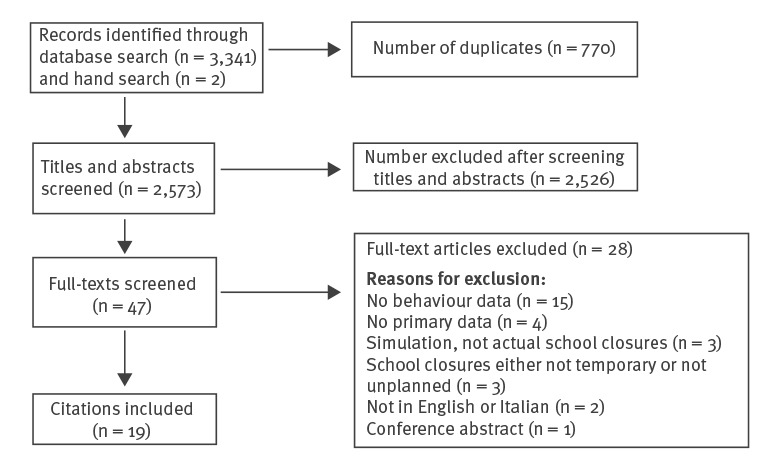
Background: Emergency school closures are often used as public health interventions during infectious disease outbreaks to minimise the spread of infection. However, if children continue mixing with others outside the home during closures, the effect of these measures may be limited. Aim: This review aimed to summarise existing literature on children’s activities and contacts made outside the home during unplanned school closures. Methods: In February 2020, we searched four databases, MEDLINE, PsycInfo, Embase and Web of Science, from inception to 5 February 2020 for papers published in English or Italian in peer-reviewed journals reporting on primary research exploring children’s social activities during unplanned school closures. Main findings were extracted. Results: A total of 3,343 citations were screened and 19 included in the review. Activities and social contacts appeared to decrease during closures, but contact remained common. All studies reported children leaving the home or being cared for by non-household members. There was some evidence that older child age (two studies) and parental disagreement (two studies) with closure were predictive of children leaving the home, and mixed evidence regarding the relationship between infection status and such. Parental agreement with closure was generally high, but some disagreed because of perceived low risk of infection and issues regarding childcare and financial impact. Conclusion: Evidence suggests that many children continue to leave home and mix with others during school closures despite public health recommendations to avoid social contact. This review of behaviour during unplanned school closures could be used to improve infectious disease modelling.
Overview
The claims and statistics of this paper haven’t been checked yet.
Run the check — free, no account needed. It reads the open-access text and checks the sources it cites.
Integrity signals
Registry
Cites
Statistics
Figures
Verification
Claims the paper makes
The claims and statistics of this paper haven’t been checked yet.
Run the check — free, no account needed. It reads the open-access text and checks the sources it cites.
Claims other papers make about this one
Each is checked against this paper’s own text: does it say what the citing paper says it does?
The source backs part of the claim, not all of it — or backs it for a different population, condition or comparison.
In the citing paper
“The responses of children and adolescents to a crisis situation depends upon their prior exposure to emergency situations, physical and mental health issues, the socioeconomic circumstances of the family, and their cultural background [1,3].”
From Mental Health of Children and Adolescents Amidst COVID-19 and Past Pandemics: A Rapid Systematic Review (2021) · cites this paper as [1]
Experimental — accuracy not yet measuredThe check wasn’t confident either way, so it gives no verdict — never disputed.
In the citing paper
“For children and adolescents with mental health issues, school closures mean a lack of access to the resources that they usually have through schools [1].”
From Mental Health of Children and Adolescents Amidst COVID-19 and Past Pandemics: A Rapid Systematic Review (2021) · cites this paper as [1]
Experimental — accuracy not yet measuredIn the citing paper
“Four review articles have identified negative implications of quarantine affecting public mental health and access to education.9–12”
From Social consequences of mass quarantine during epidemics: a systematic review with implications for the COVID-19 response (2020) · cites this paper as [11]
Self-check
Percentages, sums and reported differences re-computed from the paper’s own numbers.
The self-check needs the paper’s full text.
Citations
Cites
Preferred Reporting Items for Systematic Reviews and Meta-Analyses: the PRISMA statement
Moher, D., Liberati, A., Tetzlaff, J., Altman, D. G., & for the PRISMA Group (2009) · BMJ · doi:10.1136/bmj.b2535 · Cited by 83,823
Preferred Reporting Items for Systematic Reviews and Meta-Analyses: The PRISMA Statement
Moher, D., Liberati, A., Tetzlaff, J., Altman, D. G., & The PRISMA Group (2009) · PLoS Medicine · doi:10.1371/journal.pmed.1000097 · Cited by 64,042 · cited 1×
“However, the only Preferred Reporting Items for Systematic Reviews and Meta-Analyses (PRISMA) [16] checklist items that this study lacks relate to the analysis of risk of bias in individual studies; because of time constraints, a quality assessment of each paper was not conducted.”
Preferred reporting items for systematic reviews and meta-analyses: the PRISMA Statement.
(2009) · PubMed Central · Cited by 44,859
Wang, G., Ma, R., Qiao, G., Wada, K., Aizawa, Y., & Satoh, T. (2015) · Integrative Medicine International · doi:10.1159/000368408 · Cited by 18,762
The Psychological Impact of Quarantine and How to Reduce It: Rapid Review of the Evidence
Brooks, S. K., Webster, R. K., Smith, L. E., Woodland, L., Wessely, S., Greenberg, N., & Rubin, G. J. (2020) · doi:10.2139/ssrn.3532534 · Cited by 16,394
Self-citationThe psychological impact of quarantine and how to reduce it: Rapid review of the evidence
Brooks, S. K., Webster, R. K., Smith, L. E., Woodland, L., Wessely, S., Greenberg, N., & Rubin, G. J. (2020) · The Lancet · doi:10.1016/s0140-6736(20)30460-8 · Cited by 16,378 · cited 1×
“Even for adults, self-isolation can be difficult [35] and stressful [36], and children often have wider social circles and feel more social pressure to interact.”
Self-citationDemographic and attitudinal determinants of protective behaviours during a pandemic: A review
Bish, A., & Michie, S. (2010) · British Journal of Health Psychology · doi:10.1348/135910710x485826 · Cited by 1,246
Mitigation strategies for pandemic influenza in the United States
Germann, T. C., Kadau, K., Longini, I. M., & Macken, C. A. (2006) · Proceedings of the National Academy of Sciences · doi:10.1073/pnas.0601266103 · Cited by 1,047 · cited 1×
“The optimum answer from an epidemiological perspective is that children remain in their homes for the duration of the closure, never coming into contact with another person [12,13].”
Estimating the impact of school closure on influenza transmission from Sentinel data
Cauchemez, S., Valleron, A., Boëlle, P., Flahault, A., & Ferguson, N. M. (2008) · Nature · doi:10.1038/nature06732 · Cited by 688 · cited 1×
“Several studies have also examined illness transmission rates during planned school closures, reporting a reduction in illness during school holidays [6-8] and teacher strikes [9].”
Modeling targeted layered containment of an influenza pandemic in the United States
Halloran, M. E., Ferguson, N. M., Eubank, S., Longini, I. M., Cummings, D. A. T., Lewis, B. L., Xu, S., Fraser, C., Vullikanti, A. K. S., Germann, T. C., et al. (2008) · Proceedings of the National Academy of Sciences · doi:10.1073/pnas.0706849105 · Cited by 660 · cited 1×
“The optimum answer from an epidemiological perspective is that children remain in their homes for the duration of the closure, never coming into contact with another person [12,13].”
Cited by
Sorted by citations
Viner, R. M., Russell, S. J., Croker, H., Packer, J., Ward, J., Stansfield, C., Mytton, O., Bonell, C., & Booy, R. (2020) · The Lancet Child & Adolescent Health · doi:10.1016/s2352-4642(20)30095-x · Cited by 2,213
“[4] [5] [6] [7] The evidence for the effectiveness of school closures and other school social distancing measures comes almost entirely from influenza outbreaks, for which transmission of the virus tends to be driven by children.”
BackgroundLearning loss due to school closures during the COVID-19 pandemic
Engzell, P., Frey, A., & Verhagen, M. D. (2021) · Proceedings of the National Academy of Sciences · doi:10.1073/pnas.2022376118 · Cited by 1,848
“To weigh the costs of school closures against public health benefits (3–6), it is crucial to know whether students are learning less in lockdown and whether disadvantaged students do so disproportionately.”
Meherali, S., Punjani, N., Louie-Poon, S., Abdul Rahim, K., Das, J. K., Salam, R. A., & Lassi, Z. S. (2021) · International Journal of Environmental Research and Public Health · doi:10.3390/ijerph18073432 · Cited by 900
“For children and adolescents with mental health issues, school closures mean a lack of access to the resources that they usually have through schools [1].”
BackgroundViner, R., Russell, S., Saulle, R., Croker, H. A., Stansfield, C., Packer, J., Nicholls, D., Goddings, A., Bonell, C. P., Hudson, L. D., et al. (2022) · Archives of Pediatrics and Adolescent Medicine · doi:10.1001/jamapediatrics.2021.5840 · Cited by 798
Learning loss due to school closures during the COVID-19 pandemic
Engzell, P., Frey, A., & Verhagen, M. D. (2020) · doi:10.31235/osf.io/ve4z7 · Cited by 1,739
Metadata
- Authors
- Brooks, S. K., Smith, L. E., Webster, R. K., Weston, D., Woodland, L., Hall, I., & Rubin, G. J.
- Affiliations
- King's College London (GB)
- Public Health England (GB)
- University of Manchester (GB)
- ORCID
- Venue
- Eurosurveillance
- Published
- 2020-04-02
- Volume
- 25
- Issue
- 13
- ISSN
- 1025-496X (ISSN-L)
- 1560-7917
- PMC
- PMC7140596
- OpenAlex
- W3013526633
- Cited by
- 159
- References
- 47
- Citations by year
- 2025: 7 · 2024: 17 · 2023: 40 · 2022: 29 · 2021: 44 · 2020: 22
- FWCI
- 1.35
- Type
- journal article
- Language
- en
- Open access
- diamond
- doi.org
- Locations
- Eurosurveillance (publishedVersion, cc-by)
- Europe PMC (PubMed Central) (publishedVersion, cc-by)
- PubMed Central (publishedVersion, cc-by)
- PubMed (publishedVersion)
- Research Explorer (The University of Manchester) (acceptedVersion, cc-by)
- Research Portal (King's College London) (submittedVersion, other-oa)
- Funders
- National Institute for Health Research Health Protection Research Unit
- National Institute for Health and Care Research (NIHR-INF-1658)
- Department of Health and Social Care
- University of East Anglia
- Imperial College London
- King's College London
- Newcastle University
- Public Health England
- Economic and Social Research Council (2317432)
- Topics
- Physical Sciences › Mathematics › Modeling and Simulation › COVID-19 epidemiological studies
- Social Sciences › Sociology and Political Science › COVID-19 Prevention and Impact
- Health Sciences › Medicine › Epidemiology › Influenza Virus Research Studies
- Keywords
- school closures, infectious disease outbreaks, public health interventions, child care, infectious disease transmission models, COVID-19 pandemic
- MeSH terms
- Adolescent, Adult, Child, Disease Outbreaks, Female, Humans, Parents, Public Health, Schools, Social Behavior, Students, Disease Transmission, Infectious, Pandemics
About these checks
Registry, retraction, Cites and statistics results are computed, not judged, with one exception: a printed reference that no index lists is read once by a model before it counts as a citation error. Claims are extracted by a model and kept only when their quote appears verbatim in the text; each cited source is then checked, with a model’s help, for whether it says what the claim relies on. Those verdicts can be wrong — read the claim’s quote and the cited source before relying on one.
Statistics and arithmetic are recomputed, not judged.
Confidence bands are shown only for fields calibrated on our annotated test set. None is calibrated yet, so no band is shown.
What counts as a claim ›How we measure confidence ›How we check this ›
Are you an author, or do you see a problem with this page? Request a review
