

In vivo evolution to echinocandin resistance and increasing clonal heterogeneity in Candida auris during a difficult-to-control hospital outbreak, Italy, 2019 to 2022
Open accessThe DOI matches its Crossref record; 15 of the 15 references it cites were found in a registry or an index.
Abstract
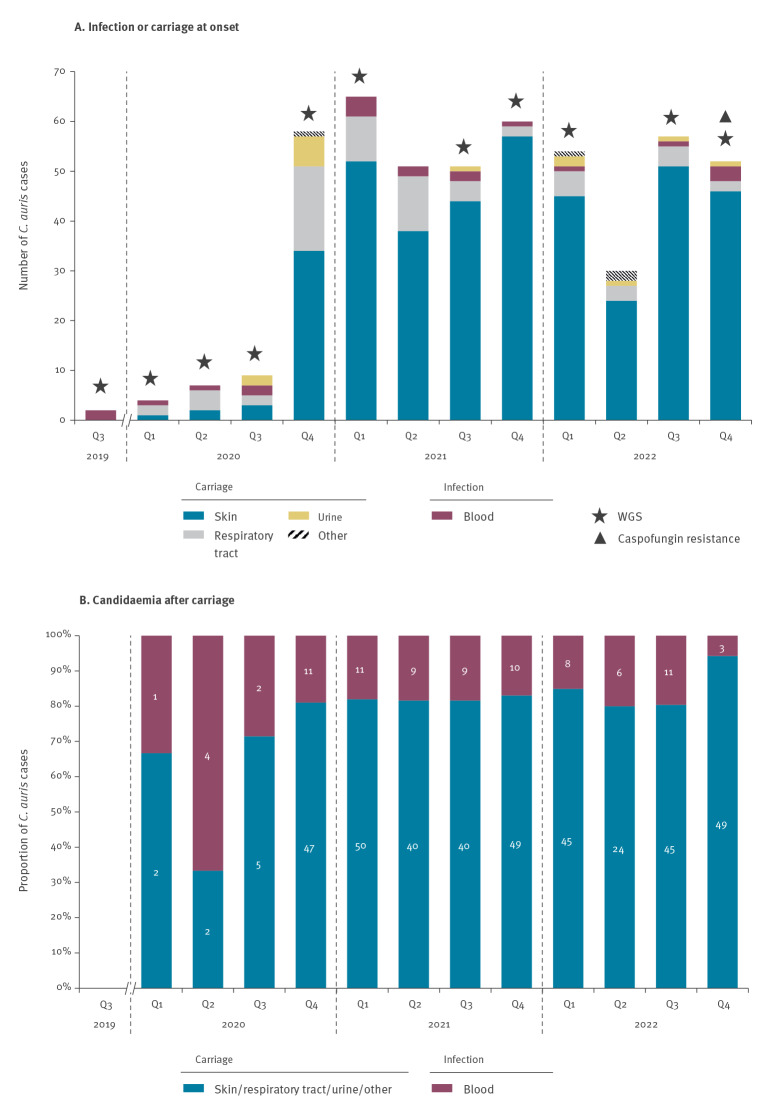
A difficult-to-control outbreak of Candida auris is ongoing in a large tertiary care hospital in Liguria, Italy, where it first emerged in 2019. In a retrospective analysis, 503 cases of C. auris carriage or infection were observed between July 2019 and December 2022. Genomic surveillance identified putative cases that no longer occurred as part of one defined outbreak and the emergence of echinocandin (pandrug) resistance following independent selection of FKS1 S639F and FKS1 F635Y mutants upon prolonged exposure to caspofungin and/or anidulafungin.
Overview
The claims and statistics of this paper haven’t been checked yet.
Free: it reads the open-access text and checks the first 5 claims that cite a source we can check. Create a free account to check every claim.
Integrity signals
Registry
Cites
Statistics
Figures
Verification
Claims the paper makes
The claims and statistics of this paper haven’t been checked yet.
Free: it reads the open-access text and checks the first 5 claims that cite a source we can check. Create a free account to check every claim.
Claims other papers make about this one
Each is checked against this paper’s own text: does it say what the citing paper says it does?
The source backs part of the claim, not all of it — or backs it for a different population, condition or comparison.
In the citing paper
“For instance, isolates from patients receiving caspofungin treatment have been shown to develop resistance to echinocandins19,20.”
From Targeting epigenetic regulators to overcome drug resistance in the emerging human fungal pathogen Candida auris (2025) · cites this paper as [19]
Experimental — accuracy not yet measuredThe cited source says what the claim attributes to it.
In the citing paper
“Furthermore, C. auris can rapidly acquire resistance under the selective pressure of antifungal treatments or other specific conditions16–19.”
From Targeting epigenetic regulators to overcome drug resistance in the emerging human fungal pathogen Candida auris (2025) · cites this paper as [19]
Self-check
Percentages, sums and reported differences re-computed from the paper’s own numbers.
The self-check needs the paper’s full text.
Citations
Cites
Chow, N. A., Gade, L., Tsay, S. V., Forsberg, K., Greenko, J. A., Southwick, K. L., Barrett, P. M., Kerins, J. L., Lockhart, S. R., Chiller, T. M., et al. (2018) · The Lancet Infectious Diseases · doi:10.1016/s1473-3099(18)30597-8 · Cited by 289 · cited 1×
“Determination of SNPs separating paired carriage and clinical isolates from the same patient proved useful to infer the baseline genetic diversity in this outbreak, strengthening data obtained from the few similar evaluations carried out on sporadic cases in Australia and on outbreak cases in the US [12,13].”
ResultWorsening Spread of Candida auris in the United States, 2019 to 2021
Lyman, M., Forsberg, K., Sexton, D. J., Chow, N. A., Lockhart, S. R., Jackson, B. R., & Chiller, T. (2023) · Annals of Internal Medicine · doi:10.7326/m22-3469 · Cited by 287 · cited 1×
“auris as a healthcare-associated pathogen in Europe, as in the epidemiological scenario in the US [15], have recently been raised by the ECDC [2].”
BackgroundReview on Antifungal Resistance Mechanisms in the Emerging Pathogen Candida auris
Chaabane, F., Graf, A., Jequier, L., & Coste, A. T. (2019) · Frontiers in Microbiology · doi:10.3389/fmicb.2019.02788 · Cited by 223
Briano, F., Magnasco, L., Sepulcri, C., Dettori, S., Dentone, C., Mikulska, M., Ball, L., Vena, A., Robba, C., Patroniti, N., et al. (2022) · Infectious Diseases and Therapy · doi:10.1007/s40121-022-00625-9 · Cited by 136 · cited 1×
“auris, leading to an increased risk of intrahospital transmission and development of candidaemia, which is considerably enhanced by the simultaneous colonisation of skin and other sites (multiple site colonisation) [11].”
BackgroundSelf-citationClade-specific chromosomal rearrangements and loss of subtelomeric adhesins in Candida auris
Muñoz, J. F., Welsh, R. M., Shea, T., Batra, D., Gade, L., Howard, D., Rowe, L. A., Meis, J. F., Litvintseva, A. P., & Cuomo, C. A. (2021) · Genetics · doi:10.1093/genetics/iyab029 · Cited by 125 · cited 2×
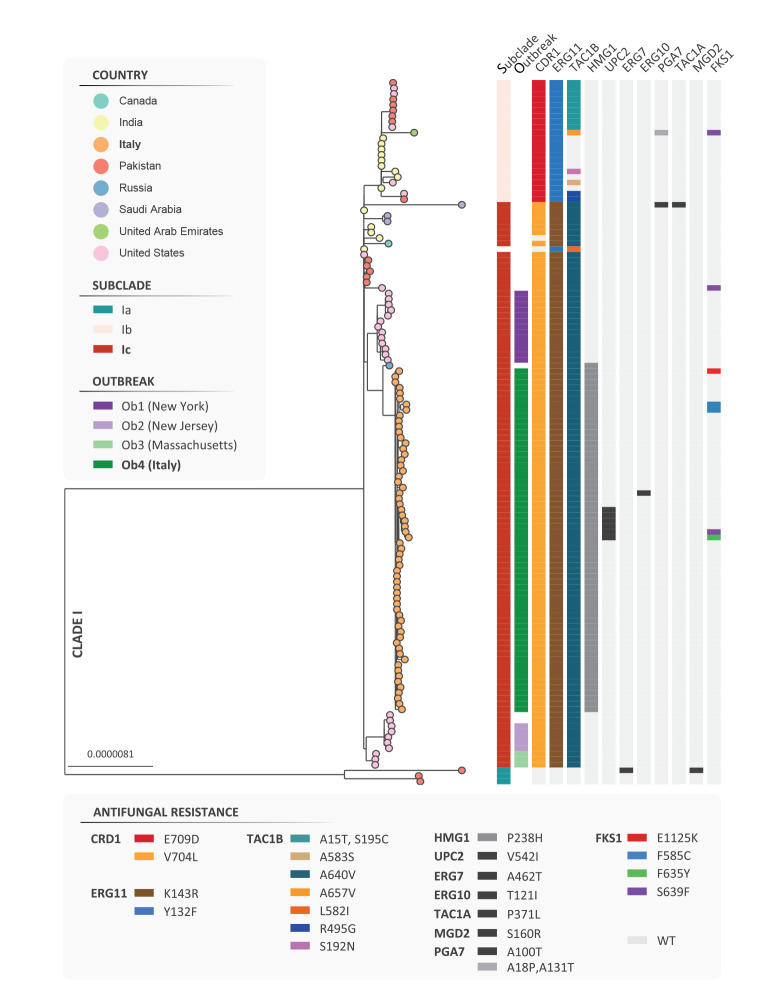
“Details about subclade designation [7,8], and genetic mutations associated with azoles (CDR1, ERG11, TAC1B, HMG, UPC, ERG7, ERG10, PGA7, TAC1A, MGD2) and echinocandins (FKS1) resistance are also provided.”
BackgroundRybak, J. M., Cuomo, C. A., & David Rogers, P. (2022) · Current Opinion in Microbiology · doi:10.1016/j.mib.2022.102208 · Cited by 113 · cited 1×
“auris that have so far been reported [16,17], FKS1 F635Y represents a novel genotype recently identified in two isolates in India [18].”
BackgroundIncreasing number of cases and outbreaks caused by Candida auris in the EU/EEA, 2020 to 2021
Kohlenberg, A., Monnet, D. L., Plachouras, D., & Candida auris survey collaborative group (2022) · Eurosurveillance · doi:10.2807/1560-7917.es.2022.27.46.2200846 · Cited by 108
Di Pilato, V., Codda, G., Ball, L., Giacobbe, D. R., Willison, E., Mikulska, M., Magnasco, L., Crea, F., Vena, A., Pelosi, P., et al. (2021) · Journal of Fungi · doi:10.3390/jof7020140 · Cited by 107 · cited 18×
“Furthermore, we identified a genetic signature uniquely represented in outbreak isolates from HSM (i.e. HMG1 P238H).”
BackgroundMethodResultInfluentialSelf-citationCandida auris as an Emergent Public Health Problem: A Current Update on European Outbreaks and Cases
Geremia, N., Brugnaro, P., Solinas, M. L., Scarparo, C., & Panese, S. (2023) · Healthcare · doi:10.3390/healthcare11030425 · Cited by 79
Sharma, D., Paul, R. A., Rudramurthy, S. M., Kashyap, N., Bhattacharya, S., Soman, R., Shankarnarayan, S. A., Chavan, D., Singh, S., Das, P., et al. (2022) · Antimicrobial Agents and Chemotherapy · doi:10.1128/aac.01652-21 · Cited by 60 · cited 5×
“4 www.eurosurveillance.org Figure 2 Maximum likelihood phylogeny of Candida auris outbreak isolates, Italy, 2019–2022 (n = 60) and from a benchmark dataset including cases (n = 64) from clade I (South Asian) Canada India Italy Pakistan Russia Saudi Arabia United Arab Emirates United States S O WT: wild type.”
BackgroundInfluential
Cited by
Spruijtenburg, B., Ahmad, S., Asadzadeh, M., Alfouzan, W., Al‐Obaid, I., Mokaddas, E., Meijer, E. F. J., Meis, J. F., & de Groot, T. (2023) · Mycoses · doi:10.1111/myc.13655 · Cited by 61
“17 In murine models, the development of C . auris echinocandin resistance in the gastrointestinal tract was shown to be a direct consequence of echinocandin therapy-induced FKS1 substitutions.”
BackgroundJones, C. R., Neill, C., Borman, A. M., Budd, E. L., Cummins, M. N., Fry, C., Guy, R. L., Jeffery, K. J., Johnson, E. M., Manuel, R. J., et al. (2024) · Journal of Medical Microbiology · doi:10.1099/jmm.0.001820 · Cited by 61
“The emergence of echinocandin resistance, detected by WGS and phenotypically, within an ongoing prolonged outbreak is concerning [96].”
Outbreaks of Fungal Infections in Hospitals: Epidemiology, Detection, and Management
Douglas, A. P., Stewart, A. G., Halliday, C. L., & Chen, S. C. ‐. (2023) · Journal of Fungi · doi:10.3390/jof9111059 · Cited by 59
“…of C. auris into multiple regions when it was recognized that this modern Candida species was capable of rapid patient-to-patient transmission, could colonize and persist in the hospital environment, and could cause invasive infection and be associated with antifungal drug resistance [89,92].”
BackgroundOliva, A., Rosa, F. G. D., Mikulska, M., Pea, F., Sanguinetti, M., Tascini, C., & Venditti, M. (2023) · Expert Review of Anti-infective Therapy · doi:10.1080/14787210.2023.2240956 · Cited by 52
Self-citationMeletiadis, J., Siopi, M., Spruijtenburg, B., Georgiou, P., Kostoula, M., Vourli, S., Frantzeskaki, F. G., Paramythiotou, E., Meis, J. F., Tsangaris, I., et al. (2024) · Eurosurveillance · doi:10.2807/1560-7917.es.2024.29.45.2400128 · Cited by 41
“Similar to our findings, echinocandin-resistant C. auris BSIs have been reported in patients previously tested positive for skin carriage who had experienced prolonged (19–74 days) echinocandin treatment [41].”
BackgroundResult
Metadata
- Authors
- Codda, G., Willison, E., Magnasco, L., Morici, P., Giacobbe, D. R., Mencacci, A., Marini, D., Mikulska, M., Bassetti, M., Marchese, A., & Di Pilato, V.
- Affiliations
- University of Genoa (IT)
- Ospedale Policlinico San Martino (IT)
- University of Perugia (IT)
- Department of Health Sciences (DISSAL), University of Genoa, Genoa, Italy
- Department of Surgical Sciences and Integrated Diagnostics (DISC), University of Genoa, Genoa, Italy
- ORCID
- Venue
- Eurosurveillance
- Published
- 2023-04-06
- Volume
- 28
- Issue
- 14
- ISSN
- 1025-496X (ISSN-L)
- 1560-7917
- PMC
- PMC10283462
- OpenAlex
- W4362657231
- Cited by
- 44
- References
- 15
- Citations by year
- 2026: 14 · 2025: 11 · 2024: 12 · 2023: 7
- FWCI
- 9.05
- Type
- journal article
- Language
- en
- Open access
- diamond
- doi.org
- Locations
- Eurosurveillance (publishedVersion, cc-by)
- PubMed Central (publishedVersion, cc-by)
- PubMed (publishedVersion)
- CINECA IRIS Institutial Research Information System (University of Genoa) (submittedVersion)
- Funders
- Gilead Sciences
- Topics
- Health Sciences › Medicine › Infectious Diseases › Antifungal resistance and susceptibility
- Life Sciences › Immunology and Microbiology › Microbiology › Yeasts and Rust Fungi Studies
- Health Sciences › Medicine › Infectious Diseases › Antimicrobial Resistance in Staphylococcus
- Keywords
- Candida auris, echinocandin resistance, pan-drug resistance, FKS1 mutations, caspofungin, anidulafungin, clonal heterogeneity, hospital outbreak, fungemia, antifungal resistance, genomic surveillance, Liguria
- MeSH terms
- Candida auris, Antifungal Agents, Candida, Disease Outbreaks, Humans, Microbial Sensitivity Tests, Retrospective Studies, Drug Resistance, Fungal, Echinocandins
About these checks
Registry, retraction, Cites and statistics results are computed, not judged, with one exception: a printed reference that no index lists is read once by a model before it counts as a citation error. Claims are extracted by a model and kept only when their quote appears verbatim in the text; each cited source is then checked, with a model’s help, for whether it says what the claim relies on. Those verdicts can be wrong — read the claim’s quote and the cited source before relying on one.
Statistics and arithmetic are recomputed, not judged.
Confidence bands are shown only for fields calibrated on our annotated test set. None is calibrated yet, so no band is shown.
What counts as a claim ›How we measure confidence ›How we check this ›
Are you an author, or do you see a problem with this page? Request a review
How to cite
Cite CoChat for the checks on this page, and the paper for its own findings.
- This page
- CoChat. (2026). Citation check: In vivo evolution to echinocandin resistance and increasing clonal heterogeneity in Candida auris during a difficult-to-control hospital outbreak, Italy, 2019 to 2022. https://app.cochat.ai/papers/10.2807/1560-7917.es.2023.28.14.2300161
- The paper
- Codda, G., Willison, E., Magnasco, L., Morici, P., Giacobbe, D. R., Mencacci, A., Marini, D., Mikulska, M., Bassetti, M., Marchese, A., & Di Pilato, V. (2023). In vivo evolution to echinocandin resistance and increasing clonal heterogeneity in Candida auris during a difficult-to-control hospital outbreak, Italy, 2019 to 2022. Eurosurveillance. https://doi.org/10.2807/1560-7917.es.2023.28.14.2300161
Data sources
Bibliographic data: Semantic Scholar, OpenAlex, Crossref.
Contains information from the Semantic Scholar Academic Graph Datasets, made available under the ODC Attribution License (ODC-BY 1.0).
Semantic Scholar’s data is described in: Kinney, R., et al. (2023). The Semantic Scholar Open Data Platform. arXiv:2301.10140.
