

ChatGPT in physics education: A pilot study on easy-to-implement activities
Open accessThe DOI matches its Crossref record; 36 of the 36 references it cites were found in a registry or an index.
Abstract
Large language models, such as ChatGPT, have great potential to enhance learning and support teachers, but they must be used with care to tackle limitations and biases. This paper presents two easy-to-implement examples of how ChatGPT can be used in physics classrooms to foster critical thinking skills at the secondary school level. A pilot study (n=53) examining the implementation of these examples found that the intervention had a positive impact on students’ perceptions of ChatGPT, with an increase in agreement with statements related to its benefits and incorporation into their daily lives.
Overview
The claims and statistics of this paper haven’t been checked yet.
Free: it reads the open-access text and checks the first 5 claims that cite a source we can check. Create a free account to check every claim.
Integrity signals
Registry
Cites
Statistics
Figures


Verification
Claims the paper makes
The claims and statistics of this paper haven’t been checked yet.
Free: it reads the open-access text and checks the first 5 claims that cite a source we can check. Create a free account to check every claim.
Claims other papers make about this one
Each is checked against this paper’s own text: does it say what the citing paper says it does?
The source backs part of the claim, not all of it — or backs it for a different population, condition or comparison.
In the citing paper
“More importantly , many studies report enhanced critical thinking [70,77,99,100,103,111,114,119,132,142,145,150], reflection, and problem-solving [70,128,141].”
From A Systematic Review of Generative AI in K–12: Mapping Goals, Activities, Roles, and Outcomes via the 3P Model (2025) · cites this paper as [100]
Experimental — accuracy not yet measuredThe source backs part of the claim, not all of it — or backs it for a different population, condition or comparison.
In the citing paper
“Additionally, enhancing students' critical thinking and real-world problem-solving practices remains a key objective. GenAI-supported interactive learning and analytical tasks are designed to promote critical analysis, logical reasoning, and the generative use of knowledge to authentic challenges in science and mathematics.”
From A Systematic Review of Generative AI in K–12: Mapping Goals, Activities, Roles, and Outcomes via the 3P Model (2025) · cites this paper as [100]
Experimental — accuracy not yet measuredThe source backs part of the claim, not all of it — or backs it for a different population, condition or comparison.
In the citing paper
“Several studies also require students to identify incorrect or fabricated AI outputs, which cultivates critical thinking and information discrimination skills [100,101,133].”
From A Systematic Review of Generative AI in K–12: Mapping Goals, Activities, Roles, and Outcomes via the 3P Model (2025) · cites this paper as [100]
Experimental — accuracy not yet measuredThe cited source says what the claim attributes to it.
In the citing paper
“Also, earlier studies among primary and secondary school pupils found that in general, pupils were positive about the use of ChatGPT as a contemporary learning environment tool belonging to generative AI [14,15].”
From Generative AI and ChatGPT in School Children’s Education: Evidence from a School Lesson (2023) · cites this paper as [15]
The cited source says what the claim attributes to it.
In the citing paper
“Concerns have been raised regarding the potential biases and limitations of large language models, emphasizing the need for careful and critical use to address these issues (Bitzenbauer, 2023).”
From Investigating the Use of chatGPT as a Tool for Enhancing Critical Thinking and Argumentation Skills in International Relations Debates among Undergraduate Students (2024) · cites this paper as Bitzenbauer, 2023
Self-check
Percentages, sums and reported differences re-computed from the paper’s own numbers.
The self-check needs the paper’s full text.
Citations
Cites
ChatGPT for Good? On Opportunities and Challenges of Large Language Models for Education
Kasneci, E., Seßler, K., Küchemann, S., Bannert, M., Dementieva, D., Fischer, F., Gasser, U., Groh, G., Günnemann, S., Hüllermeier, E., et al. (2023) · doi:10.35542/osf.io/5er8f · Cited by 7,552
ChatGPT for good? On opportunities and challenges of large language models for education
Kasneci, E., Sessler, K., Küchemann, S., Bannert, M., Dementieva, D., Fischer, F., Gasser, U., Groh, G., Günnemann, S., Hüllermeier, E., et al. (2023) · Learning and Individual Differences · doi:10.1016/j.lindif.2023.102274 · Cited by 7,326
BAİDOO-ANU, D., & OWUSU ANSAH, L. (2023) · Journal of AI · doi:10.61969/jai.1337500 · Cited by 3,939
Sallam, M. (2023) · Healthcare · doi:10.3390/healthcare11060887 · Cited by 3,126
Baidoo-Anu, D., & Owusu Ansah, L. (2023) · doi:10.2139/ssrn.4337484 · Cited by 3,004
GPT-3: Its Nature, Scope, Limits, and Consequences
Floridi, L., & Chiriatti, M. (2020) · Minds and Machines · doi:10.1007/s11023-020-09548-1 · Cited by 2,519 · cited 5×
“Generative pre-trained transformer (GPT) models, such as GPT-3 (Floridi & Chiriatti, 2020), use a “ large amount of publicly available digital content data ” (Baidoo-Anu & Ansah, 2023, p. 3) to perform “ a wide range of natural-language tasks ranging from translation to question answering, writing…”
BackgroundMethodInfluentialA SWOT analysis of ChatGPT: Implications for educational practice and research
Farrokhnia, M., Banihashem, S. K., Noroozi, O., & Wals, A. (2024) · Innovations in Education and Teaching International · doi:10.1080/14703297.2023.2195846 · Cited by 1,384 · cited 3×
“One particularly relevant limitation of AI tools is the lack of higher-order thinking skills as outlined by Farrokhnia et al. (2023).”
BackgroundInfluentialRevolutionizing education with AI: Exploring the transformative potential of ChatGPT
Adiguzel, T., Kaya, M. H., & Cansu, F. K. (2023) · Contemporary Educational Technology · doi:10.30935/cedtech/13152 · Cited by 975 · cited 1×
“…(Ahuja, 2019; Veloso et al., 2021) research investigating the implementation of chatbots into classroom practice is still in its infancy (Hwang & Chang, 2021), especially with respect to secondary schools (Adiguzel et al., 2023; Salas-Pilco & Yang, 2022; Salas-Pilco et al., 2022; Halaweh, 2023).”
BackgroundPavlik, J. V. (2023) · Journalism & Mass Communication Educator · doi:10.1177/10776958221149577 · Cited by 972 · cited 1×
“In the end, it is noteworthy that while ChatGPT can enrich classroom practice as shown in this paper, learning will always remain a social process that requires teachers ’ authority and guidance (Pavlik, 2023).”
BackgroundChatGPT User Experience: Implications for Education
Zhai, X. (2023) · doi:10.2139/ssrn.4312418 · Cited by 935
Rule of Law and Constitutional Democracy
(2015) · DergiPark (Istanbul University) · doi:10.2139/ssrn · Cited by 804
The impact of artificial intelligence in medicine on the future role of the physician
Ahuja, A. S. (2019) · PeerJ · doi:10.7717/peerj.7702 · Cited by 789 · cited 1×
“While the use of artificial intelligence (AI) and GPT models is already widespread in various industrial applications (Ahuja, 2019; Veloso et al., 2021) research investigating the implementation of chatbots into classroom practice is still in its infancy (Hwang & Chang, 2021), especially with…”
MethodChatGPT in education: Strategies for responsible implementation
Halaweh, M. (2023) · Contemporary Educational Technology · doi:10.30935/cedtech/13036 · Cited by 607 · cited 1×
“…(Ahuja, 2019; Veloso et al., 2021) research investigating the implementation of chatbots into classroom practice is still in its infancy (Hwang & Chang, 2021), especially with respect to secondary schools (Adiguzel et al., 2023; Salas-Pilco & Yang, 2022; Salas-Pilco et al., 2022; Halaweh, 2023).”
BackgroundA review of opportunities and challenges of chatbots in education
Hwang, G.-J., & Chang, C.-Y. (2023) · Interactive Learning Environments · doi:10.1080/10494820.2021.1952615 · Cited by 530 · cited 1×
“…(Ahuja, 2019; Veloso et al., 2021) research investigating the implementation of chatbots into classroom practice is still in its infancy (Hwang & Chang, 2021), especially with respect to secondary schools (Adiguzel et al., 2023; Salas-Pilco & Yang, 2022; Salas-Pilco et al., 2022;…”
BackgroundTeaching Critical Thinking: Some Lessons From Cognitive Science
Gelder, T. V. (2005) · College Teaching · doi:10.3200/ctch.53.1.41-48 · Cited by 527
Critical Thinking Dispositions: Their Nature and Assessability
Ennis, R. H. (1996) · Informal Logic · doi:10.22329/il.v18i2.2378 · Cited by 508 · cited 1×
“Various definitions for critical thinking prevalent in educational contexts (Ennis, 1996; Lipman, 1988) align in that (1) “ critical thinking involves drawing conclusions supported by evidence ” and (2) “ critical thinking involves making decisions and/or forming beliefs about a situation ” (Smith…”
BackgroundLecler, A., Duron, L., & Soyer, P. (2023) · Diagnostic and Interventional Imaging · doi:10.1016/j.diii.2023.02.003 · Cited by 385 · cited 1×
“Additionally, ChatGPT ’ s inability to assess the reliability of its training data (Lecler et al., 2023) may hinder its effectiveness in evaluating the accuracy of generated”
BackgroundArtificial intelligence applications in Latin American higher education: a systematic review
Salas-Pilco, S. Z., & Yang, Y. (2022) · International Journal of Educational Technology in Higher Education · doi:10.1186/s41239-022-00326-w · Cited by 330 · cited 1×
“…(Ahuja, 2019; Veloso et al., 2021) research investigating the implementation of chatbots into classroom practice is still in its infancy (Hwang & Chang, 2021), especially with respect to secondary schools (Adiguzel et al., 2023; Salas-Pilco & Yang, 2022; Salas-Pilco et al., 2022; Halaweh, 2023).”
BackgroundArtificial intelligence and learning analytics in teacher education: A systematic review
Salas-Pilco, S., Xiao, K., & Hu, X. (2022) · Education Sciences · doi:10.3390/educsci12080569 · Cited by 326 · cited 1×
“…(Ahuja, 2019; Veloso et al., 2021) research investigating the implementation of chatbots into classroom practice is still in its infancy (Hwang & Chang, 2021), especially with respect to secondary schools (Adiguzel et al., 2023; Salas-Pilco & Yang, 2022; Salas-Pilco et al., 2022; Halaweh, 2023).”
BackgroundSchreiner, C., & Sjøberg, S. (2004) · Duo Research Archive (University of Oslo) · Cited by 240
Chai, C. S., Wang, X., & Xu, C. (2020) · Mathematics · doi:10.3390/math8112089 · Cited by 226 · cited 1×
“Additionally, we used three items from Chai et al. (2020).”
Stadermann, H. K. E., van den Berg, E., & Goedhart, M. J. (2019) · Physical Review Physics Education Research · doi:10.1103/physrevphyseducres.15.010130 · Cited by 168 · cited 1×
“We have decided to stick with quantum physics – which is today part of most secondary school curricula across Europe as shown by Stadermann et al. (2019) – for these examples because • of quantum physics being highly abstract and • quantum physics is a prime example for the necessity of model…”
BackgroundChatGPT and the frustrated Socrates
Gregorcic, B., & Pendrill, A.-M. (2023) · Physics Education · doi:10.1088/1361-6552/acc299 · Cited by 125 · cited 2×
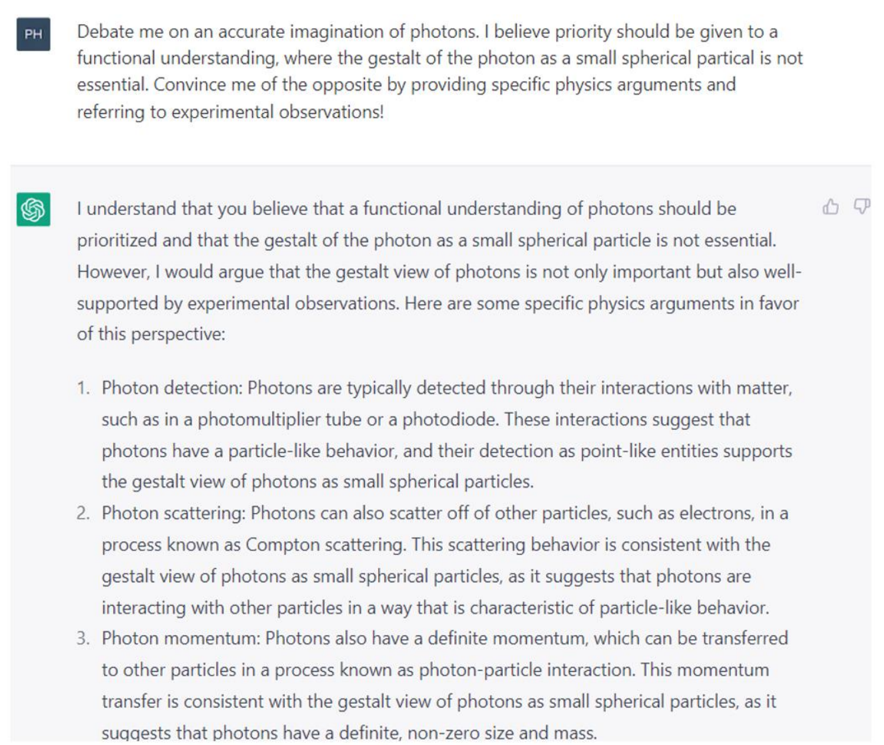
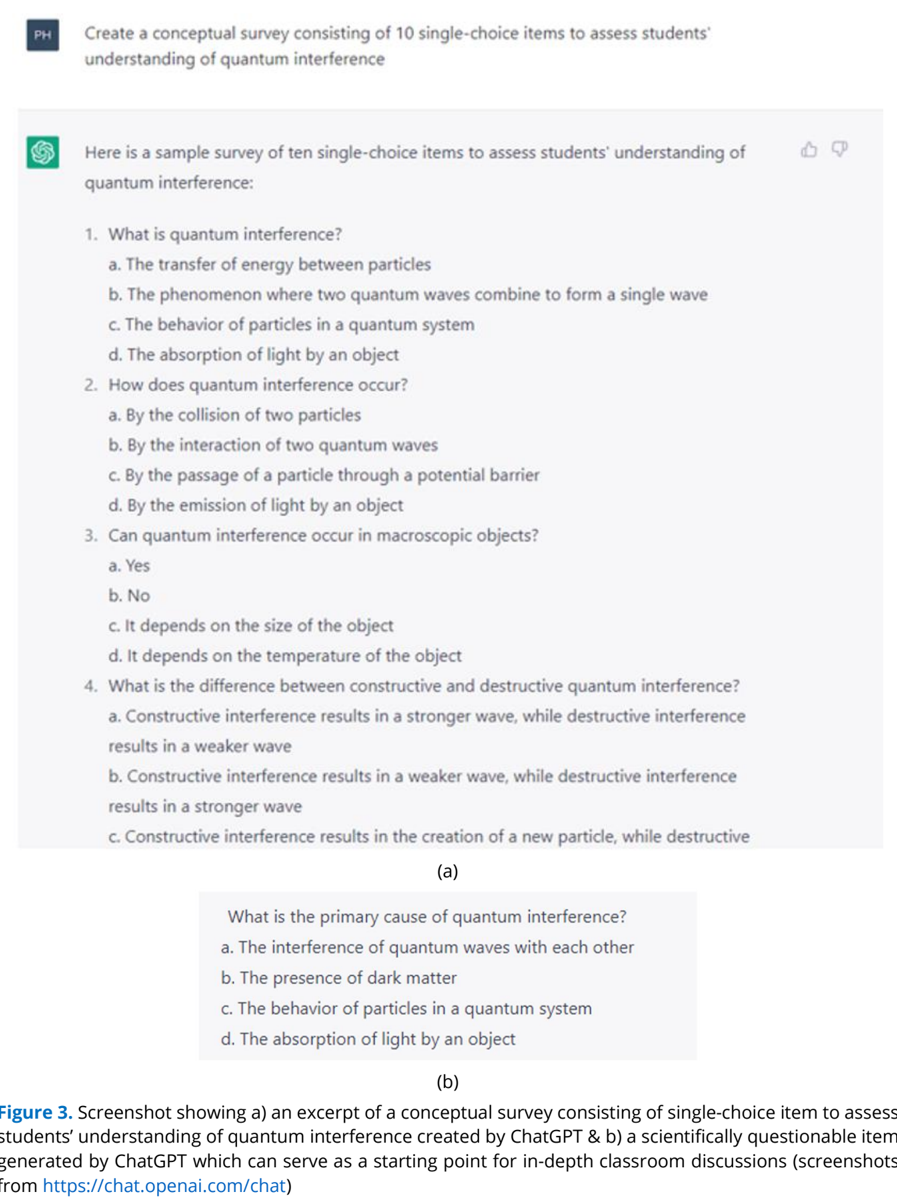
“…will produce items (or answers to these items) that are not (entirely) correct from a scientific point of view (part b in Figure 3 ) – for example, Gregorcic and Pendrill (2023) have found “ ChatGPT to be a reliable source of problematic and incorrect answers to conceptual physics questions ”…”
BackgroundThe Radicalization Risks of GPT-3 and Advanced Neural Language Models
McGuffie, K., & Newhouse, A. (2020) · arXiv · doi:10.48550/arxiv.2009.06807 · Cited by 86 · cited 1×
“For example, Floridi and Chiriatti (2020) warn that “ fake news and disinformation may [...] get a boost ” (p. 692) by tools like ChatGPT considering that it becomes easier to convincingly mislead with automatically generated texts (McGuffie & Newhouse, 2020).”
MethodExploring the Feasibility of ChatGPT for Event ExtractionPreprint
Gao, J., Zhao, H., Yu, C., & Xu, R. (2023) · arXiv (Cornell University) · doi:10.48550/arxiv.2303.03836 · Cited by 64 · cited 1×
“AI tools are highly dependent on the data they are trained on, and often lack a deep understanding of the textual outputs produced (Bogost, 2022; Gao et al., 2023) or the content context, which is essential for higher-order thinking (Dimitrov, 2023).”
BackgroundBest Practices for the Think-Pair-Share Active-Learning Technique
Prahl, K. (2016) · The American Biology Teacher · doi:10.1525/abt.2017.79.1.3 · Cited by 56
Bitzenbauer, P. (2021) · Physical Review Physics Education Research · doi:10.1103/physrevphyseducres.17.020103 · Cited by 50 · cited 1×
“…quantum physics – which is today part of most secondary school curricula across Europe as shown by Stadermann et al. (2019) – for these examples because • of quantum physics being highly abstract and • quantum physics is a prime example for the necessity of model descriptions (Bitzenbauer, 2021).”
BackgroundSelf-citationAlsmadi, M. A., Tabieh, A. A. S., Alsaifi, R. M., & Al–Nawaiseh, S. J. (2023) · European Journal of Educational Research · doi:10.12973/eu-jer.12.2.1123 · Cited by 45
Motivating Active Learning in Physical Education: Critical Thinking
Hidayat, C., Lengkana, A. S., Rohyana, A., Purwanto, D., Razali, R., & Rosalina, M. (2023) · European Journal of Educational Research · doi:10.12973/eu-jer.12.2.1137 · Cited by 40
Using artificial intelligence to create biology multiple choice questions for higher education
Nasution, N. E. A. (2023) · Agricultural and Environmental Education · doi:10.29333/agrenvedu/13071 · Cited by 38 · cited 1×
“ChatGPT is able to develop a conceptual survey (or single items) to assess students ’ understanding (Nasution, 2023), e.g., of basic quantum concepts (part a in Figure 3 ).”
BackgroundArtificial intelligence research in finance: discussion and examples
Veloso, M., Balch, T. R., Borrajo, D., Reddy, P. P., & Shah, S. (2021) · Oxford Review of Economic Policy · doi:10.1093/oxrep/grab019 · Cited by 36 · cited 1×
“While the use of artificial intelligence (AI) and GPT models is already widespread in various industrial applications (Ahuja, 2019; Veloso et al., 2021) research investigating the implementation of chatbots into classroom practice is still in its infancy (Hwang & Chang, 2021), especially with…”
MethodMoraga-Calderón, T. S., Buisman, H., & Cramer, J. (2020) · European Journal of Science and Mathematics Education · doi:10.30935/scimath/9545 · Cited by 32 · cited 2×
“To collect students ’ perceptions of the importance of AI in general, and ChatGPT in particular, we adapted items from a questionnaire on students ’ opinions about quantum science used in an earlier study by Moraga-Calderón et al. (2020).”
BackgroundMethodCritical Thinking and Education
Lipman, M. (1988) · Inquiry Critical Thinking Across the Disciplines · doi:10.5840/inquiryctnews19882252 · Cited by 31 · cited 1×
“Various definitions for critical thinking prevalent in educational contexts (Ennis, 1996; Lipman, 1988) align in that (1) “ critical thinking involves drawing conclusions supported by evidence ” and (2) “ critical thinking involves making decisions and/or forming beliefs about a situation ” (Smith…”
BackgroundEvaluating instructional labs’ use of deliberate practice to teach critical thinking skills
Smith, E. M., & Holmes, N. G. (2020) · Physical Review Physics Education Research · doi:10.1103/physrevphyseducres.16.020150 · Cited by 30 · cited 1×
“…critical thinking prevalent in educational contexts (Ennis, 1996; Lipman, 1988) align in that (1) “ critical thinking involves drawing conclusions supported by evidence ” and (2) “ critical thinking involves making decisions and/or forming beliefs about a situation ” (Smith & Holmes, 2020, p. 2).”
BackgroundWang, J. (2023) · American Journal of Physics · doi:10.1119/5.0145897 · Cited by 30 · cited 1×
“In any case, the “ physics education community is well-positioned to investigate the use and capabilities of ChatGPT and other AI systems ” (Wang, 2023).”
Background
Cited by
ChatGPT: A revolutionary tool for teaching and learning mathematics
Wardat, Y., Tashtoush, M. A., AlAli, R., & Jarrah, A. M. (2023) · Eurasia Journal of Mathematics, Science and Technology Education · doi:10.29333/ejmste/13272 · Cited by 470
“Secondly, it exacerbates the phenomenon known as the AI effect (Walker & Noorden, 2023), where the widespread use of AI-based products leads people to dismiss its behavior as not being true intelligence (Bitzenbauer, 2023).”
BackgroundThe Influence of ChatGPT on Student Engagement: A Systematic Review and Future Research Agenda
Lo, C. K., Hew, K. F., & Jong, M. S.-Y. (2024) · Computers & Education · doi:10.1016/j.compedu.2024.105100 · Cited by 392
Higher education students’ perceptions of ChatGPT: A global study of early reactions
Ravšelj, D., Keržič, D., Tomaževič, N., Umek, L., Brezovar, N., A. Iahad, N., Abdulla, A. A., Akopyan, A., Aldana Segura, M. W., AlHumaid, J., et al. (2025) · PLOS ONE · doi:10.1371/journal.pone.0315011 · Cited by 376
Wang, J., & Fan, W. (2025) · Humanities and Social Sciences Communications · doi:10.1057/s41599-025-04787-y · Cited by 322
“At the level of secondary education, scholars have primarily explored the use of ChatGPT to assist students in solving dif fi cult problems (Bitzenbauer, 2023; Levine et al. 2025; Yang et al. 2025) and support knowledge review (Wu et al. 2023).”
RetractedA systematic review of ChatGPT use in K‐12 education
Zhang, P., & Tur, G. (2024) · European Journal of Education · doi:10.1111/ejed.12599 · Cited by 280
Metadata
- Authors
- Bitzenbauer, P.
- Affiliations
- Leipzig University (DE)
- Corresponding author
- Bitzenbauer, Philipp
- ORCID
- Bitzenbauer, Philipp
- Venue
- Contemporary Educational Technology
- Publisher
- Bastas Publications
- Published
- 2023-07-01
- Volume
- 15
- Issue
- 3
- Pages
- ep430
- ISSN
- 1309-517X (ISSN-L)
- OpenAlex
- W4364377381
- Cited by
- 181
- References
- 32
- Citations by year
- 2026: 34 · 2025: 65 · 2024: 60 · 2023: 22
- FWCI
- 42.49
- Type
- journal article
- Language
- en
- Open access
- hybrid
- doi.org
- Licence
- cc-by
- Locations
- Contemporary Educational Technology (publishedVersion, cc-by)
- Topics
- Social Sciences › Education › Artificial Intelligence in Education
- Health Sciences › Medicine › Health Informatics › Artificial Intelligence in Healthcare and Education
- Physical Sciences › Computer Science › Artificial Intelligence › Intelligent Tutoring Systems and Adaptive Learning
- Keywords
- ChatGPT, large language models, physics education, high school students, critical thinking skills, student perceptions, AI in the classroom
About these checks
Registry, retraction, Cites and statistics results are computed, not judged, with one exception: a printed reference that no index lists is read once by a model before it counts as a citation error. Claims are extracted by a model and kept only when their quote appears verbatim in the text; each cited source is then checked, with a model’s help, for whether it says what the claim relies on. Those verdicts can be wrong — read the claim’s quote and the cited source before relying on one.
Statistics and arithmetic are recomputed, not judged.
Confidence bands are shown only for fields calibrated on our annotated test set. None is calibrated yet, so no band is shown.
What counts as a claim ›How we measure confidence ›How we check this ›
Are you an author, or do you see a problem with this page? Request a review
Data sources
Bibliographic data: Semantic Scholar, OpenAlex, Crossref.
Contains information from the Semantic Scholar Academic Graph Datasets, made available under the ODC Attribution License (ODC-BY 1.0).
Semantic Scholar’s data is described in: Kinney, R., et al. (2023). The Semantic Scholar Open Data Platform. arXiv:2301.10140.
