

Effective Dementia Education and Training for the Health and Social Care Workforce: A Systematic Review of the Literature
Open accessThe DOI matches its Crossref record; 108 of the 108 references it cites were found in a registry or an index.
Abstract
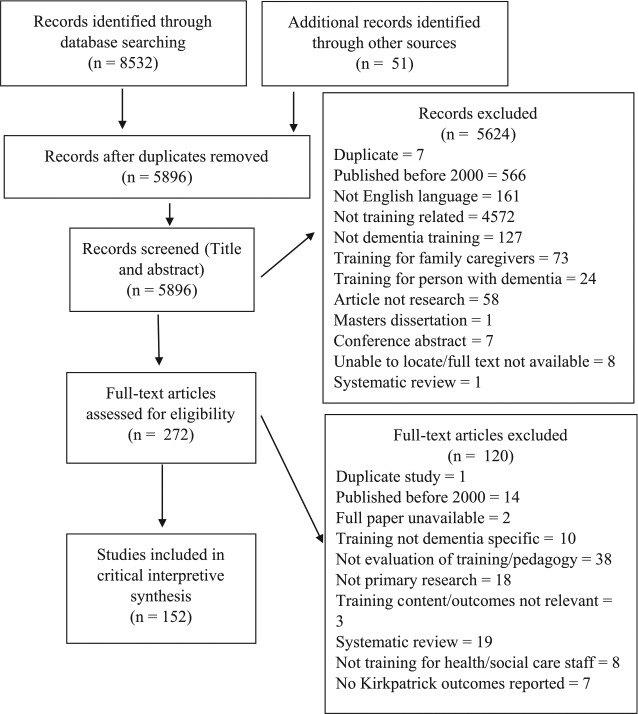
Ensuring an informed and effective dementia workforce is of international concern; however, there remains limited understanding of how this can be achieved. This review aimed to identify features of effective dementia educational programs. Critical interpretive synthesis underpinned by Kirkpatrick’s return on investment model was applied. One hundred and fifty-two papers of variable quality were included. Common features of more efficacious educational programs included the need for educational programs to be relevant to participants’ role and experience, involve active face-to-face participation, underpin practice-based learning with theory, be delivered by an experienced facilitator, have a total duration of at least 8 hours with individual sessions of 90 minutes or more, support application of learning in practice, and provide a structured tool or guideline to guide care practice. Further robust research is required to develop the evidence base; however, the findings of this review have relevance for all working in workforce education.
Overview
The claims and statistics of this paper haven’t been checked yet.
Free: it reads the open-access text and checks the first 5 claims that cite a source we can check. Create a free account to check every claim.
Integrity signals
Registry
Cites
Statistics
Figures
Verification
Claims the paper makes
The claims and statistics of this paper haven’t been checked yet.
Free: it reads the open-access text and checks the first 5 claims that cite a source we can check. Create a free account to check every claim.
Claims other papers make about this one
Each is checked against this paper’s own text: does it say what the citing paper says it does?
The source backs part of the claim, not all of it — or backs it for a different population, condition or comparison.
In the citing paper
“Effective strategies to increase awareness among healthcare professionals include educational programs with an interactive approach that provide tools to support the application of training into practice.39”
From Awareness of dementia risk reduction among current and future healthcare professionals: A survey study (2021) · cites this paper as [39]
Experimental — accuracy not yet measuredThe source backs part of the claim, not all of it — or backs it for a different population, condition or comparison.
In the citing paper
“All studies revealed that these programs improved healthcare workers' attitudes about caring for patients with dementia, as well as their overall knowledge.”
From Awareness of dementia risk factors among healthcare professionals at Hamad Medical Corporation, Qatar: a cross-sectional survey (2024) · cites this paper as [16]
Experimental — accuracy not yet measured
Self-check
Percentages, sums and reported differences re-computed from the paper’s own numbers.
The self-check needs the paper’s full text.
Citations
Cites
Active learning increases student performance in science, engineering, and mathematics
Freeman, S., Eddy, S. L., McDonough, M., Smith, M. K., Okoroafor, N., Jordt, H., & Wenderoth, M. P. (2014) · Proceedings of the National Academy of Sciences · doi:10.1073/pnas.1319030111 · Cited by 9,787 · cited 1×
“…practice, active learning approaches, advocated for in effective learning across the spectrum of educational research (Darling-Hammond et al., 2008; Freeman et al., 2014; Jensen, Kummer, & Godoy, 2014; Mansouri & Lockyer, 2007; Pulsford, Jackson, O’Brien, Yates, & Duxbury, 2013; Zaher &…”
The Adult Learner: The Definitive Classic in Adult Education and Human Resource Development
Knowles, M. S., Holton, E. F., Robinson, P. A., & Caraccioli, C. (2005) · Civil War Book Review · Cited by 2,860
Dixon-Woods, M., Cavers, D., Agarwal, S., Annandale, E., Arthur, A., Harvey, J., Hsu, R., Katbamna, S., Olsen, R., Smith, L., et al. (2006) · BMC Medical Research Methodology · doi:10.1186/1471-2288-6-35 · Cited by 2,289
Dementia: a public health priority
Acosta, D. M., Krishnamoorthy, E. S., Wortmann, M., Prince, M. J., & Saxena, S. (2012) · Cited by 1,955
Benner, P. (1982) · PubMed · Cited by 1,850
Conceptualizing Teacher Professional Learning
Opfer, V. D., & Pedder, D. (2011) · Review of Educational Research · doi:10.3102/0034654311413609 · Cited by 1,814 · cited 1×
“Opfer and Pedder (2011) have argued that teacher education must be conceptualized as a complex system, with various dynamics at the individual (teacher), meso (institutional), and macro (school system) levels at play in influencing under what conditions teachers learn, why, and how.”
The Modern practice of adult education : andragogy versus pedagogy /
Knowles, M. S. (1970) · Bibliothèque et Archives nationales du Québec (Québec government) · Cited by 1,533
Techniques for Evaluating Training Programs
Kirkpatrick, D. L. (1975) · Training and development journal · Cited by 1,234
Taylor, D. C. M., & Hamdy, H. (2013) · Medical Teacher · doi:10.3109/0142159x.2013.828153 · Cited by 1,176
Reframing Professional Development Through Understanding Authentic Professional Learning
Webster-Wright, A. (2009) · Review of Educational Research · doi:10.3102/0034654308330970 · Cited by 1,174 · cited 5×
“This finding mirrors that of the broader professional development literature, which advocates an educational model of ongoing, situated learning within a workplace context, as opposed to a “training” model of discrete sessions, decontextualized from real-world practice (Webster-Wright, 2009).”
Influential
Research works printed but not linked: 17
- Alzheimer’s Society. (2009). Counting the cost: Caring for people with dementia on hospital wards. London, England: Author.
- Caldwell K. Henshaw L. Taylor G. (2005). Developing a framework for critiquing health research. Journal of Health, Social and Environmental Issues, 6(1), 45– 54.
- Care Council for Wales. (2016). Good Work: A dementia learning and development framework for Wales. Cardiff, Wales: Author.
- Cervero R. M. Gaines J. K. (2014). Effectiveness of continuing medical education: Updated synthesis of systematic reviews. Chicago, IL: Accreditation Council for Continuing Medical Education.
- Department of Health. (2009). Living well with dementia: A national dementia strategy. London, England: Author.
- Department of Health. (2012). Prime Minister’s challenge on dementia: Delivering major improvements in dementia care and research by 2015. London, England: Author.
- Department of Health. (2013). Delivering high quality, effective, compassionate care: Developing the right people with the right skills and the right values: A mandate from the Government to Health Education England: April 2013 to March 2015. London, England: Author.
- Department of Health. (2014). Delivering high quality, effective, compassionate care: Developing the right people with the right skills and the right values: A mandate from the Government to Health Education England: April 2014 to March 2015. London, England: Author.
- Department of Health. (2016). Delivering high quality, effective, compassionate care: Developing the right people with the right skills and the right values: A mandate from the Government to Health Education England: April 2016 to March 2017. London, England: Author.
- Kirkpatrick D. L. (1984). Techniques for evaluating training programmes. Training and Development Journal, 32(9), 6– 9.
- Knapp M. Prince M. Albanese E. Banerjee S. Dhanasiri S. Fernandez J. L.... Stewart R. (2007). Dementia UK: Report to the Alzheimer’s Society. London, England: Alzheimer’s Society.
- Mitchell T. D. Richard F. D. Battistoni R. M. Rost-Banik C. Netz R. Zakoske C. (2015). Reflective practice that persists: Connections between reflection in service-learning programs and in current life. Michigan Journal of Community Service Learning, Spring, 49– 63.
- Royal College of Psychiatrists. (2011). Report of the national audit of dementia care in general hospitals. London, England: Healthcare Quality Improvement Partnership.
- Tamkin P. Yarnall J. Kerrin M. (2002). Kirkpatrick and beyond: A review of models of training evaluation. Brighton, England: Institute for Employment Studies.
- Traynor V. Cumming A. Britten N. (2015). Developing an inter-disciplinary cross-setting dementia care competency framework. Wollongong, New South Wales, Australia: University of Wollongong.
- Wilson J. H. (2014). Investing in English skills: The limited English proficient workforce in U.S. metropolitan areas. Washington, DC: Metropolitan Policy Programme at Brookings.
- Zientz J. Rackley A. Chapman S. B. Hopper T. Mahendra N. Kim E. S. Cleary S. (2007). Evidence-based practice recommendations for dementia: Educating caregivers on Alzheimer’s disease and training communication strategies. Journal of Medical Speech-Language Pathology, 15(1), liii– lxiv.
Cited by
Items 201–300 of 326
Greene, L., Allan, L. M., Bingham, A., Sharma, A. K., Whale, B., Barber, R., Fox, C., Goodwin, V. A., Gordon, A. L., Hall, A., et al. (2025) · Age and Ageing · doi:10.1093/ageing/afaf245 · Cited by 2
Wu, J., Igarashi, A., Takaoka, M., Kugai, H., Matsumoto, H., & Yamamoto‐Mitani, N. (2025) · Psychogeriatrics · doi:10.1111/psyg.70099 · Cited by 4
O’Sullivan, T., Foley, T., McVeigh, J. G., & Timmons, S. (2021) · HRB Open Research · doi:10.12688/hrbopenres.13219.2 · Cited by 2
Sutarto, J. (2020) · Proceedings of the Proceedings of the 5th International Conference on Science, Education and Technology, ISET 2019, 29th June 2019, Semarang, Central Java, Indonesia · doi:10.4108/eai.29-6-2019.2290414 · Cited by 2
“Training not only increases knowledge and skills but also develops talent, training correlates with improving the competency of trainees [10].”
BackgroundPostacute Care: A Guide for People With Dementia and Their Caregiver
Downer, B. G., Knox, S., Wong, D. C., Faieta, J. M., & Krishnan, S. (2021) · Archives of Physical Medicine and Rehabilitation · doi:10.1016/j.apmr.2021.01.065 · Cited by 2
Veerhuis, N., & Traynor, V. (2022) · Traffic Injury Prevention · doi:10.1080/15389588.2022.2079121 · Cited by 2
“For dementia education, an enhanced learning experience incorporates: a guide or tool, multimodal interactive approaches and skilled facilitators (Phillipson et al. 2016; Surr et al. 2017).”
BackgroundDouglas, J. W., Ferguson, C. C., & Nolan, B. A. D. (2022) · Gerontology & Geriatrics Education · doi:10.1080/02701960.2022.2105841 · Cited by 3
“In light of the recognized need for increased dementia care training for all healthcare professionals, previous studies have explored methods for training adult learners on dementia care (Low et al., 2015; Surr et al., 2017).”
BackgroundZhao, Y., Liu, L., Ding, Y., Song, Y., & Chan, H. Y. L. (2023) · Journal of Advanced Nursing · doi:10.1111/jan.15779 · Cited by 2
Measuring attitudes of those caring for people living with dementia: A quantitative survey
Vafeas, C., Jacob, E. R., & Jacob, A. M. (2020) · Contemporary Nurse · doi:10.1080/10376178.2021.1894958 · Cited by 2
“Through developing an understanding of the attitudes of healthcare workers towards people living with dementia, educational resources can be targeted to improve attitudes and hence improve quality of life for the people they care for (Surr et al., 2017).”
Backgrounde-Learning Tools for Informal Caregivers of Patients with Dementia—A Review Study
Klímová, B., & Pikhart, M. (2020) · Smart innovation, systems and technologies · doi:10.1007/978-981-15-5584-8_8 · Cited by 1
Understanding the key components of effective dementia education and training
Hill, J. E., Rahman‐Amin, M., & Harrison, J. (2022) · British Journal of Neuroscience Nursing · doi:10.12968/bjnn.2022.18.3.137 · Cited by 1
Barry, B. J., McConnell, E. S., Duea, S. R., & Blodgett, N. P. (2022) · Journal of Gerontological Nursing · doi:10.3928/00989134-20221003-07 · Cited by 1
Getting Connected: Experiential Dementia Skills Training
Compton-Dooley, P., Kyner, M., & Little, K. E. (2025) · Journal of Gerontological Nursing · doi:10.3928/00989134-20250505-02 · Cited by 1
Faraday, J., Abley, C., Crook, D., Exley, C., Patterson, J. M., & Moynihan, P. J. (2025) · Journal of Long-Term Care · doi:10.31389/jltc.362 · Cited by 1
Dementia Care Training Interventions for Residential Aged Care Workers: An Umbrella Review
Bruce, L. J., Woolford, M., Gulline, H., Berkovic, D. E., & Ayton, D. (2025) · Journal of the American Medical Directors Association · doi:10.1016/j.jamda.2025.105627 · Cited by 2
Levinson, A. J., Ayers, S., Clark, S., Gerantonis, P., Schneeberg, A., & Sztramko, R. (2025) · JMIR Aging · doi:10.2196/67889 · Cited by 2
“An extensive review by Surr et al [22] evaluated various features of dementia education programs for health care providers.”
Macaden, L., Muirhead, K., MacArthur, J., & Blair, S. (2025) · International Journal of Environmental Research and Public Health · doi:10.3390/ijerph22060860 · Cited by 3
“Asynchronous learning does not encompass interactive participation in real time, which is recommended as a core component of effective dementia education and training [20].”
Qian, K., Jia, H., Hai-yan, Y., Zhu, L. X., Li, Q. S., Shi, T., Xu, Y., & Ding, Y. (2025) · BMC Nursing · doi:10.1186/s12912-025-04013-9 · Cited by 1
“Surr et al. [41] found that higher dementia awareness was associated with greater engagement in learning activities, suggesting ‘attention’ may be both a prerequisite and a consequence of knowledge building.”
Jacob, N., Maden, M., Griffiths, A. W., Stokes, L., Shepherd, V., Hill, R. A., Scott, S., Prout, H., Gates, C., Jones, L., et al. (2025) · BMC Geriatrics · doi:10.1186/s12877-025-06476-6 · Cited by 1
“…optimal ways to provide dementia awareness training to social care staff, which found that staff generally dislike online-only formats, favouring face-to-face training that include practical application relevant to their daily work, such as demonstrating examples of good or poor practice [33].”
Self-citationLenoir, H., Dacunha, S., Blavette, L., Pino, M., & Rigaud, A. (2025) · BMC Geriatrics · doi:10.1186/s12877-025-06635-9 · Cited by 1
Development of a Rural and Remote Dementia Training Framework
Fitzgerald, K. W., Fyfe, K. P., & Thompson, S. (2025) · Australian Journal of Rural Health · doi:10.1111/ajr.70133 · Cited by 1
Njohjam, M. N., Tonga, E. M., Niakam, F. T., Ngoule, M. O., & Mondomobe, A. C. (2026) · BMC Neurology · doi:10.1186/s12883-025-04609-3 · Cited by 2
“…experiences of rural healthcare workers, involve active face-to-face participation, underpin experiential learning, be delivered by an experienced facilitator who knows local needs, support application of knowledge in practice, and provide context-informed guidelines to guide care practice [43].”
(631258), R. O., Theodosopoulou, D., Janes, M., Clark, R., Harwood, R., Papworth, A., Beeke, S., Bramley, L., Chivinge, A., Goldberg, S. E., et al. (2026) · Aging & Mental Health · doi:10.1080/13607863.2025.2609282 · Cited by 1
“Workshops included presentation and discussion of the current evidence base on impactful dementia training (Surr et al., 2017; 2020; Surr & Gates, 2017), the three core trainables of communication approaches identified in the phase one Conversation Analysis study (Pilnick et al., 2025),…”
Self-citationConway, A., Harkin, D., Ryan, A. A., & Slater, P. F. (2026) · Nursing Research and Practice · doi:10.1155/nrp/9845911 · Cited by 1
Mapping the evidence on virtual reality for dementia caregivers: a scoping review
Li, X., Li, Q., Sun, K., & Conklin, R. (2026) · Health Education Research · doi:10.1093/her/cyag003 · Cited by 1
“Research conducted by Surr et al. [14] found that online training programmes incorporating interactive elements such as images, videos, audio, and graphics were more effective than passive methods.”
Estenson, K., Digman, C., Reichelt, K., & James, I. A. (2026) · Journal of Mind and Medical Sciences · doi:10.3390/jmms13010006 · Cited by 1
“For example, under the theme “socio-cultural change enablers” participants mentioned the importance of having good role models, effective leadership and ongoing supervision [15].”
InfluentialCardona, M. I., Gakoudis, P. N., Macijauskienė, J., & Thyrian, J. R. (2026) · Frontiers in Medicine · doi:10.3389/fmed.2026.1774318 · Cited by 1
Atefi, G., Marshall, C. R., Cooper, C., Banerjee, S., Mukadam, N., & DeNPRU-QM (2026) · International Journal of Geriatric Psychiatry · doi:10.1002/gps.70238 · Cited by 1
“People from minority ethnic groups experience increased rates of cardiometabolic conditions such as diabetes, hyperlipidaemia, and hypertension [39, 40].”
Lee, D. A., Devanny, C., Russell, G. M., O’Connor, C. M. C., Hill, K., Swaffer, K., Cations, M., Laver, K., Low, L., Neves, B. B., et al. (2026) · International Journal of Geriatric Psychiatry · doi:10.1002/gps.70237 · Cited by 1
“Previous research showed that values‐based and experiential learning can positively influence attitudes and person‐centred care approaches in dementia care [30, 31].”
Dementia Care in Malta: Policy, Experiences and Narratives
Formosa, M. (2021) · Springer eBooks · doi:10.1007/978-981-16-3864-0_13 · Cited by 1
Admiral Nursing: supporting generalist nurses to work with families affected by dementia
Dening, K. H., Aldridge, Z., & Hayo, H. (2022) · Nursing Standard · doi:10.7748/ns.2022.e12006 · Cited by 1
Improving Dementia-Specific Referrals From the Acute Care Setting: A Quality Improvement Project
Vallee, L. L., Johnson, J. L., & Shade, K. (2023) · Professional Case Management · doi:10.1097/ncm.0000000000000635 · Cited by 1
“The components outlined as being successful were initially proposed for this quality improvement project (Surr et al., 2017).”
BackgroundBiesmans, J. M. A., Bolt, S., Zwakhalen, S. M. G., Janssen, D. J. A., & Meijers, J. M. M. (2025) · International Journal of Nursing Studies Advances · doi:10.1016/j.ijnsa.2025.100455 · Cited by 1
“Therefore, it is crucial that healthcare professionals receive adequate training and information to enhance their competencies and improve palliative care provision (Surr et al., 2017).”
Gitlin, L. N., & Hodgson, N. A. (2018) · Elsevier eBooks · doi:10.1016/b978-0-12-811928-0.00012-0 · Cited by 1
Harwood, R., O’Brien, R. F., Goldberg, S. E., Allwood, R., Pilnick, A., Beeke, S., Thomson, L., Murray, M., Parry, R. H., Kearney, F. C., et al. (2018) · Cited by 1
Murrill, J. (2018) · UCL Discovery (University College London)
Guidance for Care Homes - Implementing Namaste Care
Jacobson-Wright, N., Latham, I., & Frost, F. (2019) · Worcester Research and Publications (University of Worcester)
Respite services for people with dementia and their carers: perspectives of key stakeholders
O’Shea, E. (2020) · Dublin City University Open Access Institutional Repository (Dublin City University) · Cited by 1
Cognitive Impairment in Vascular Surgery Patients: An Underestimated Issue
Mughal, N. A., Gilder, F. J., Biram, R., & Coughlin, P. A. (2020) · European Journal of Vascular and Endovascular Surgery · doi:10.1016/j.ejvs.2020.10.001
The recognition and management of delirium superimposed on dementia
Robertson, M. (2021) · Working with Older People · doi:10.1108/wwop-03-2021-0012 · Cited by 1
Lin, S., Schneider, C., Bristol, A. A., Clancy, M., Sprague, S. A., Aldridge, M. D., Cortes, T., Goldfeld, K. S., Kutner, J. S., Mitchell, S. L., et al. (2020) · doi:10.21203/rs.3.rs-36527/v1
“Despite a growing evidence base for effective workforce training to improve dementia care practices (16), few studies have examined how to disseminate this research in an interprofessional manner, and none to our knowledge have been performed in hospice (16, 17).”
BackgroundDelivering Multidisciplinary and Cross-Cultural Education in Dementia Studies
McCabe, L., & Comstock, H. (2021) · Springer eBooks · doi:10.1007/978-981-16-3864-0_5
Developing and implementing dementia policy in ireland
(2019) · Human Rights Documents online · doi:10.1163/2210-7975_hrd-9978-20180002
“A major piece of research in the UK called, Dementia Education: What Works?, outline a number of aspects for the successful delivery of education programmes in dementia (Surr et al., 2017).”
BackgroundService evaluation of a dementia training and support package into care homes
Reading, L., & Appleyard, S. E. (2022) · FPOP Bulletin Psychology of Older People · doi:10.53841/bpsfpop.2022.1.158.75
Do we need specialist teams for behaviours that challenge in dementia care?
Bowie, G., Duffy, F., & Marshall, J. (2019) · FPOP Bulletin Psychology of Older People · doi:10.53841/bpsfpop.2019.1.148.37
Training and coaching of care home staff to develop person-centred skills with people with dementia
Fossey, J., & Duffy, F. (2019) · FPOP Bulletin Psychology of Older People · doi:10.53841/bpsfpop.2019.1.148.43
Marvanová, M., & Henkel, P. J. (2023) · The Senior Care Pharmacist · doi:10.4140/tcp.n.2023.95
The impact of office automation on service delivery : a case of uMshwathi Municipality
Mkhize, Y. M. (2022) · DUT Open Scholar (Durban University of Technology) · doi:10.51415/10321/4071
Nippak, P. M. D., Pirrie, L., Begum, H., Gray, C. S., & Seitz, D. P. (2023) · doi:10.2196/preprints.49192
Majd, S., Bizjak-Mikic, M., & Waters, D. (2023) · International Journal of Research Publication and Reviews · doi:10.55248/gengpi.4.623.46724
Optimalisasi Pengetahuan Ibu Balita tentang Stimulasi Kecerdasan Balita dengan Brain Gym
Astiti, N. K. E., Ariyani, N. W., & Erawati, N. L. P. S. (2023) · LOSARI Jurnal Pengabdian Kepada Masyarakat · doi:10.53860/losari.v5i2.166 · Cited by 4
“Setiap fasilitator memiliki cara menerapkan metode pembelajaran, yang didukung oleh pengetahuan serta pengalaman sehingga dapat memberikan hal-hal praktis untuk diajarkan kepada peserta edukasi secara holistik (Surr et al., 2017).”
BackgroundRecommendation: Dementia: A call for a paradigm shift in pre-registration nurse education — R3/PR14
Tuffour, I., & Ganga, G. (2023) · Cambridge Prisms Global Mental Health · doi:10.1017/gmh.2023.80.pr14
Decision: Dementia: A call for a paradigm shift in pre-registration nurse education — R2/PR12
Tuffour, I., & Ganga, G. (2023) · Cambridge Prisms Global Mental Health · doi:10.1017/gmh.2023.80.pr12
Author comment: Dementia: A call for a paradigm shift in pre-registration nurse education — R3/PR13
Tuffour, I. (2023) · Cambridge Prisms Global Mental Health · doi:10.1017/gmh.2023.80.pr13
Decision: Dementia: A call for a paradigm shift in pre-registration nurse education — R1/PR9
Tuffour, I., & Ganga, G. (2023) · Cambridge Prisms Global Mental Health · doi:10.1017/gmh.2023.80.pr9
Author comment: Dementia: A call for a paradigm shift in pre-registration nurse education — R2/PR10
Tuffour, I. (2023) · Cambridge Prisms Global Mental Health · doi:10.1017/gmh.2023.80.pr10
Recommendation: Dementia: A call for a paradigm shift in pre-registration nurse education — R1/PR8
Tuffour, I., & Ganga, G. (2023) · Cambridge Prisms Global Mental Health · doi:10.1017/gmh.2023.80.pr8
Review: Dementia: A call for a paradigm shift in pre-registration nurse education — R1/PR7
Tuffour, I., & Ganga, G. (2023) · Cambridge Prisms Global Mental Health · doi:10.1017/gmh.2023.80.pr7
Author comment: Dementia: A call for a paradigm shift in pre-registration nurse education — R1/PR6
Tuffour, I. (2023) · Cambridge Prisms Global Mental Health · doi:10.1017/gmh.2023.80.pr6
Decision: Dementia: A call for a paradigm shift in pre-registration nurse education — R0/PR5
Tuffour, I., & Ganga, G. (2023) · Cambridge Prisms Global Mental Health · doi:10.1017/gmh.2023.80.pr5
Recommendation: Dementia: A call for a paradigm shift in pre-registration nurse education — R0/PR4
Tuffour, I., & Ganga, G. (2023) · Cambridge Prisms Global Mental Health · doi:10.1017/gmh.2023.80.pr4
Review: Dementia: A call for a paradigm shift in pre-registration nurse education — R0/PR3
Tuffour, I., & Ganga, G. (2023) · Cambridge Prisms Global Mental Health · doi:10.1017/gmh.2023.80.pr3
Review: Dementia: A call for a paradigm shift in pre-registration nurse education — R0/PR2
Tuffour, I., & Ganga, G. (2023) · Cambridge Prisms Global Mental Health · doi:10.1017/gmh.2023.80.pr2
Author comment: Dementia: A call for a paradigm shift in pre-registration nurse education — R0/PR1
Tuffour, I. (2023) · Cambridge Prisms Global Mental Health · doi:10.1017/gmh.2023.80.pr1
Decision: Dementia: A call for a paradigm shift in pre-registration nurse education — R3/PR15
Tuffour, I., & Ganga, G. (2023) · Cambridge Prisms Global Mental Health · doi:10.1017/gmh.2023.80.pr15
Recommendation: Dementia: A call for a paradigm shift in pre-registration nurse education — R2/PR11
Tuffour, I., & Ganga, G. (2023) · Cambridge Prisms Global Mental Health · doi:10.1017/gmh.2023.80.pr11
Efeitos da capacitação de Agentes Comunitários de Saúde na demência: um estudo quase experimental
Coelho, A. C. R., Cruz, E. B. D. S., Radicchi, H. Z., Mattos, E. B. T., Novelli, M. M. P. C., de Souza, F. G., Goulart, R., & Ribeiro, C. L. (2024) · Revista Brasileira de Enfermagem · doi:10.1590/0034-7167-2023-0027pt · Cited by 2
Schou‐Juul, F., Skov, S. S., Kinch, S., & Lauridsen, S. (2024) · SSRN Electronic Journal · doi:10.2139/ssrn.4812598
Urgency Of Undergraduate Student Resilience To Mental Health: A Systematic Literatur Review
Meliala, A. K., & Ilfiandra, I. (2024) · G-Couns Jurnal Bimbingan dan Konseling · doi:10.31316/gcouns.v9i1.5921
“The method used to assess the quality of the article is a method adapted from the framework developed by Surr et al .”
MethodKaur, M., Hamilton, C. C., & Tearle, S. (2024) · Clinical Psychology Forum · doi:10.53841/bpscpf.2024.1.379.30
Çağlar, N. A., & Barmak, E. (2024) · Ergoterapi ve Rehabilitasyon Dergisi · doi:10.30720/ered.1427417
Implementing palliative and end of life care for people with dementia
Drain, D., Stone, L., & Daly, R. L. (2024) · Nursing Older People · doi:10.7748/nop.2024.e1479
Levinson, A. J., Ayers, S., Clark, S., Gerantonis, P., Schneeberg, A., & Sztramko, R. (2024) · doi:10.2196/preprints.67889
People Living With Dementia and Their Families as Educators for Social Justice
Mason, C., Barbosa, A., Jones, D., Andrews, M., & Capstick, A. (2025) · Health Expectations · doi:10.1111/hex.70244 · Cited by 2
Lai, Y. Y. R., Lim, S. M., Koh, H. J., Chin, A. L. M., Loh, E. H. C., & Nur, A. B. R. (2025) · The Journal of Mental Health Training Education and Practice · doi:10.1108/jmhtep-06-2024-0057
Pena, S. R., Hebditch, M., Daley, S., Norris, E. M., Jones, C., Banerjee, S., & Feeney, Y. (2025) · Journal of Human Nutrition and Dietetics · doi:10.1111/jhn.70069
Ikram, A., Parveen, S., & Vaportzis, E. (2025) · medRxiv · doi:10.1101/2025.06.16.25329690
Self-citationIdentifying risks in dementia care: Insights from a qualitative study with clinical pharmacists
Burnand, A., Kantilal, K., Woodward, A., Bhanu, C., Manthorpe, J., Orlu, M., Rait, G., Samsi, K., Sampson, L., Vickerstaff, V., et al. (2025) · PLoS ONE · doi:10.1371/journal.pone.0325472
O’Brien, R., Theodosopoulou, D., Janes, M., Clark, R., Harwood, R., Papworth, A., Beeke, S., Bramley, L., Chivinge, A., Goldberg, S., et al. (2025) · medRxiv · doi:10.1101/2025.07.02.25330714
Self-citationJagoda, T., & Rathnayake, S. (2025) · Frontiers of Nursing · doi:10.2478/fon-2025-0037
L’Heureux, T., Parmar, J., Nicholas, D. B., Charles, L. A., Pollard, C., Leslie, M., Shapkin, K., Saunders, S., Sim, C., Walker, P., et al. (2025) · International Journal of Environmental Research and Public Health · doi:10.3390/ijerph22101593
“They also align with broader workforce education programs where features such as modular design, reflective practice, and authentic scenarios support knowledge transfer [49–51].”
InfluentialGeneral Dementia Training for the Social Care Workforce: A Systematic Review
Giebel, C. M., Caprioli, T., Poole, M., Talbot, C. V., Cannon, J., Hanna, K. L., Robinson, L., Rozansky, D., Tetlow, H., Walpert, M., et al. (2025) · Journal of Advanced Nursing · doi:10.1111/jan.70288 · Cited by 4
“Including over 150 studies, Surr et al. (2017) reported that the most effective interventions included face- to-face participation, were designed with an underpinning theory, and lasted at least 8 h in total.”
Yinusa, G., Surr, C., Thomas, S., Fenge, L., Howdon, D., Major, J., Heward, M., Taylor, G. T., Knight, H. P., Townson, J., et al. (2025) · Pilot and Feasibility Studies · doi:10.1186/s40814-025-01722-5
“The intervention was adapted from our evidence-based care home resource [27, 28] and included dementia training for care staff, based on good practice and as identified in previous research [29], which addressed similar learning, development, and language needs of the workforce.”
Self-citationMuirhead, K., Macaden, L., Smyth, K., Chandler, C., Clarke, C. L., Polson, R., & O’Malley, C. (2021) · Figshare · doi:10.6084/m9.figshare.16655741
Coffey, A., Hartigan, I., Timmons, S., Buckley, C., Lehane, E. A., O’Loughlin, C., O’Connell, S., & Cornally, N. (2021) · Figshare · doi:10.6084/m9.figshare.17163231
Muirhead, K., Macaden, L., Smyth, K., Chandler, C., Clarke, C. L., Polson, R., & O’Malley, C. (2021) · Figshare · doi:10.6084/m9.figshare.16655750
Dodd, S., Carter, G., Christie, A., & Mitchell, G. (2022) · Figshare · doi:10.6084/m9.figshare.20652316
Wang, Y., Xiao, L. D., & Huang, R. (2020) · Figshare · doi:10.6084/m9.figshare.13245430
Muirhead, K., Macaden, L., Smyth, K., Chandler, C., Clarke, C. L., Polson, R., & O’Malley, C. (2021) · Figshare · doi:10.6084/m9.figshare.16655738
Wang, Y., Xiao, L. D., & Huang, R. (2020) · Figshare · doi:10.6084/m9.figshare.13245427
Coffey, A., Hartigan, I., Timmons, S., Buckley, C., Lehane, E. A., O’Loughlin, C., O’Connell, S., & Cornally, N. (2021) · Figshare · doi:10.6084/m9.figshare.17163234
Muirhead, K., Macaden, L., Smyth, K., Chandler, C., Clarke, C. L., Polson, R., & O’Malley, C. (2021) · Figshare · doi:10.6084/m9.figshare.16655735
Wang, Y., Xiao, L. D., & Huang, R. (2020) · Figshare · doi:10.6084/m9.figshare.13245433
Muirhead, K., Macaden, L., Smyth, K., Chandler, C., Clarke, C. L., Polson, R., & O’Malley, C. (2021) · Figshare · doi:10.6084/m9.figshare.16655744
Dodd, S., Carter, G., Christie, A., & Mitchell, G. (2022) · Figshare · doi:10.6084/m9.figshare.20652313
Muirhead, K., Macaden, L., Smyth, K., Chandler, C., Clarke, C. L., Polson, R., & O’Malley, C. (2021) · Figshare · doi:10.6084/m9.figshare.16655753
Dodd, S., Carter, G., Christie, A., & Mitchell, G. (2022) · Figshare · doi:10.6084/m9.figshare.20652322
Ghafri, R. A., Ghafari, M. A., Ghafri, M. A., Sofy, A. R., Mohammed, M., & Sinawi, H. A. (2026) · Middle East Current Psychiatry · doi:10.1186/s43045-025-00612-z · Cited by 1
“Moreover, a growing body of literature supports the integration of educational and structured training interventions alongside emotional and logistical support services [48].”
Verweij, L., Kanas, A., & Fenger, M. (2026) · International Journal of Public Administration · doi:10.1080/01900692.2025.2599373
Metadata
- Authors
- Surr, C. A., Gates, C., Irving, D., Oyebode, J., Smith, S. J., Parveen, S., Drury, M., & Dennison, A.
- Affiliations
- Leeds Beckett University
- University of Bradford (GB)
- Venue
- Review of Educational Research
- Published
- 2017-07-31
- Volume
- 87
- Issue
- 5
- Pages
- 966-1002
- ISSN
- 0034-6543 (ISSN-L)
- 1935-1046
- PMC
- PMC5613811
- OpenAlex
- W2748336417
- Cited by
- 327
- References
- 107
- Citations by year
- 2026: 37 · 2025: 38 · 2024: 28 · 2023: 46 · 2022: 40 · 2021: 47 · 2020: 46 · 2019: 26 · 2018: 17 · 2017: 2
- FWCI
- 4.05
- Type
- journal article
- Language
- en
- Open access
- hybrid
- doi.org
- Licence
- cc-by
- journals.sagepub.com/page/policies/text-and-data-mining-license (tdm)
- Locations
- Review of Educational Research (publishedVersion, cc-by)
- PubMed Central (publishedVersion, cc-by)
- PubMed (publishedVersion)
- Bradford Scholars (University of Bradford) (publishedVersion, other-oa)
- Leeds Beckett Repository (Leeds Beckett University) (acceptedVersion, other-oa)
- White Rose Research Online (University of Leeds, The University of Sheffield, University of York) (acceptedVersion)
- Topics
- Social Sciences › Education › Innovations in Medical Education
- Health Sciences › Medicine › Psychiatry and Mental health › Dementia and Cognitive Impairment Research
- Social Sciences › Psychology › Applied Psychology › Human Resource Development and Performance Evaluation
- Keywords
- dementia education, health and social care professionals, employee training, educational program effectiveness, Kirkpatrick model, hands-on learning, face-to-face training, care guidelines, return on investment
About these checks
Registry, retraction, Cites and statistics results are computed, not judged, with one exception: a printed reference that no index lists is read once by a model before it counts as a citation error. Claims are extracted by a model and kept only when their quote appears verbatim in the text; each cited source is then checked, with a model’s help, for whether it says what the claim relies on. Those verdicts can be wrong — read the claim’s quote and the cited source before relying on one.
Statistics and arithmetic are recomputed, not judged.
Confidence bands are shown only for fields calibrated on our annotated test set. None is calibrated yet, so no band is shown.
What counts as a claim ›How we measure confidence ›How we check this ›
Are you an author, or do you see a problem with this page? Request a review
Data sources
Bibliographic data: Semantic Scholar, OpenAlex, Crossref.
Contains information from the Semantic Scholar Academic Graph Datasets, made available under the ODC Attribution License (ODC-BY 1.0).
Semantic Scholar’s data is described in: Kinney, R., et al. (2023). The Semantic Scholar Open Data Platform. arXiv:2301.10140.
