

How Does Initial Teacher Education Research Frame the Challenge of Preparing Future Teachers for Student Diversity in Schools? A Systematic Review of Literature
Open accessThe DOI matches its Crossref record; 81 of the 82 references it cites were found in a registry or an index, and 1 are not checked yet.
Abstract
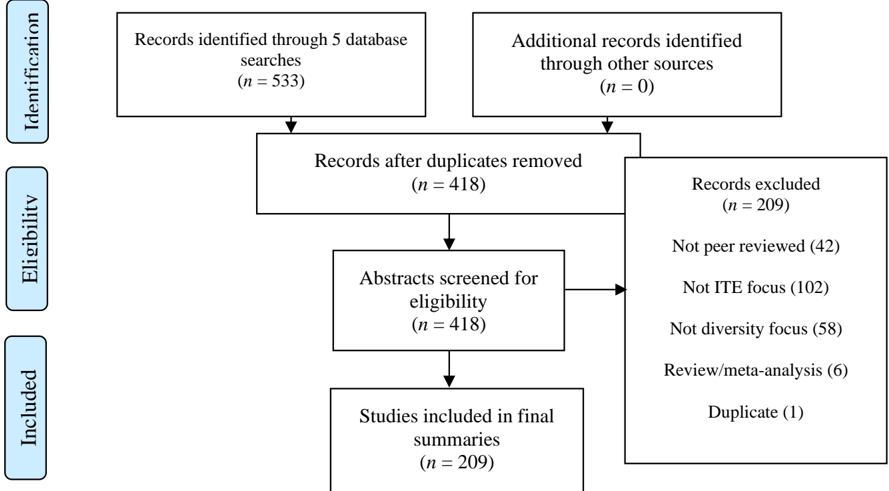
Teachers consistently identify working with “diverse learners” as challenging. This raises questions about how teacher educators conceptualize and enact preparation of teachers for heterogeneous populations. This article provides a systematic review of literature relating to both “teacher education” and “diverse learners,” to identify knowledge claims regarding the way this “problem” and possible “solutions” should be framed. Analyzing 209 peer-reviewed journal articles (2009–2019), the article identifies groups most frequently described as diverse, three qualitatively different clusters of claims regarding how teachers can be prepared for diversity, and factors identified as constraining preparation. Analysis reveals a literature broad in focus—referencing many groups—but shallow in depth. The majority describe strategies for teaching about or catering to diversity with only few considering teaching for diversity. There is also limited engagement with specialist literature relating to concepts such as gender or race and little attention to teacher educators’ own knowledge. The article concludes with implications for teacher educators, arguing for enhanced critical epistemic reflexivity.
Overview
The claims and statistics of this paper haven’t been checked yet.
Free: it reads the open-access text and checks the first 5 claims that cite a source we can check. Create a free account to check every claim.
Integrity signals
Registry
Cites
Statistics
Figures
Verification
Claims the paper makes
The claims and statistics of this paper haven’t been checked yet.
Free: it reads the open-access text and checks the first 5 claims that cite a source we can check. Create a free account to check every claim.
Claims other papers make about this one
Each is checked against this paper’s own text: does it say what the citing paper says it does?
The source backs part of the claim, not all of it — or backs it for a different population, condition or comparison.
In the citing paper
“For example, Rowan et al. (2021) systematic review of teacher education and diverse learners focused primarily on the literature on initial teacher education. This systematic review did not include studies that discussed broader issues such as education, schools, or school systems.”
From Screening Smarter, Not Harder: A Comparative Analysis of Machine Learning Screening Algorithms and Heuristic Stopping Criteria for Systematic Reviews in Educational Research (2024) · cites this paper as Rowan et al. (2021)
Experimental — accuracy not yet measured
Self-check
Percentages, sums and reported differences re-computed from the paper’s own numbers.
The self-check needs the paper’s full text.
Citations
Cites
Preferred Reporting Items for Systematic Reviews and Meta-Analyses: The PRISMA Statement
Moher, D., Liberati, A., Tetzlaff, J., Altman, D. G., & The PRISMA Group (2009) · PLoS Medicine · doi:10.1371/journal.pmed.1000097 · Cited by 64,042
PRISMA-P Group, Moher, D., Shamseer, L., Clarke, M., Ghersi, D., Liberati, A., Petticrew, M., Shekelle, P., & Stewart, L. A. (2015) · Systematic Reviews · doi:10.1186/2046-4053-4-1 · Cited by 26,223
Systematic reviews in the social sciences: a practical guide
(2006) · Choice Reviews Online · doi:10.5860/choice.43-5664 · Cited by 4,089
Preparing teachers for a changing world: what teachers should learn and be able to do
(2005) · Choice Reviews Online · doi:10.5860/choice.43-1083 · Cited by 3,754
Handbook of research on teacher education
(1990) · Choice Reviews Online · doi:10.5860/choice.28-1672 · Cited by 3,748
Pedagogy of Freedom: Ethics, Democracy, and Civic Courage
Freiré, P. (1998) · Bibliothèque et Archives nationales du Québec (Québec government) · Cited by 2,795
Teachers' attitudes towards integration / inclusion: a review of the literature
Avramidis, E., & Norwich, B. (2002) · European Journal of Special Needs Education · doi:10.1080/08856250210129056 · Cited by 2,026
Studying teacher education: the report of the AERA Panel on Research and Teacher Education
(2005) · Choice Reviews Online · doi:10.5860/choice.43-2338 · Cited by 1,560
Handbook of Research on Teacher Education: Enduring Questions in Changing Contexts
Cochran-Smith, M., Feiman-Nemser, S., McIntyre, J., & Demers, K. E. (2008) · Routledge eBooks · doi:10.4324/9780203938690 · Cited by 1,558
Regular primary schoolteachers’ attitudes towards inclusive education: a review of the literature
de Boer, A., Pijl, S. J., & Minnaert, A. (2011) · International Journal of Inclusive Education · doi:10.1080/13603110903030089 · Cited by 1,267
Research works printed but not linked: 27
- *Aronson B., 2013, Journal for Critical Education Policy Studies, 11, 244
- Assaf, L. C., Garza, R., & Battle, J. (2010). Multicultural teacher education: Examining the perceptions, practices, and coherence in one teacher preparation program. Teacher Education Quarterly, 37(2), 115-135.
- Berta-Avila, M. I., & William-White, L. (2010). A conscious agenda for cultivating future teachers' equity and social justice paradigms. Teacher Education & Practice, 23, 399- 425.
- Brooks, B. R., & Houston, S. (2015). Preservice teachers developing cultural competency: "We are more connected than we think". Global Education Journal (4), 114-138.
- Brown, T. M., & Rodriguez, L. F. (2017). Collaborating with urban youth to address gaps in teacher education. Teacher Education Quarterly, 44(3), 75-92.
- Burgess, C., & Berwick, C. (2009). Aboriginal peoples' perceptions and beliefs about quality teaching. Paper presented at the AARE annual conference, Canberra.
- Chang, I. S. (2008). Exploring and developing model of teacher curriculum for multicultural education. The Journal of Elementary Education, 21, 281-305.
- Choi W., 2011, Journal of Research in Health, Physical Education, Recreation, Sport & Dance, 6, 14
- Cobb, D. J. (2018). Placing the spotlight on open educational resources: Global phenomenon or cultural guise? International Education Journal: Comparative Perspectives, 17(3), 15-29.
- Dixon-Woods, M. (2016). Systematic reviews and qualitative studies. In D. Silverman (Ed.), Qualitative research (4th ed., pp. 379-394). Sage.
- Gilham, C. M., & Tompkins, J. (2016). Inclusion reconceptualized: Pre-service teacher education and disability studies in education. Canadian Journal of Education, 39(4), 1-25.
- Groundwater-Smith, S., Ewing, R., & Le Cornu, R. (2011). Teaching: Challenges and dilemmas. Cengage.
- Han, K. T., & Laughter, J. (Eds.). (2019). Critical Race Theory in Teacher Education: Informing Classroom Culture. Teachers College Press.
- Hytten, K., & Bettez, S. C. (2011). Understanding education for social justice. Educational Foundations, 25(1/2), 7-24.
- Lynskey, A. C. (2015). Countering the dominant narrative: In defense of critical coursework. Educational Foundations, 28(1), 73-86.
- Metcalf-Turner, P. (2009). Realizing the democratic ideal: A call for an integrative approach to inclusion of multicultural course content in teacher education programs. Teacher Education and Practice, 22, 464-467.
- Murdock, D., & Hamel, E. (2016). I would quit my job: Unpacking preservice teachers' perceptions of culture and diversity. International Journal of Critical Pedagogy, 7(2), 85- 106.
- Naraian, S., & Schlessinger, S. (2017). When theory meets the "reality of reality": Reviewing the sufficiency of the social model of disability as a foundation for teacher preparation for inclusive education. Teacher Education Quarterly, 44(1), 81-100.
- Pegg, J. E., & Reading, C. E. (2009). Embedding ICT in learning: Power in rural partnerships. In Society for the Provision of Education in Rural Australia 25th National Rural Education Conference Proceedings -Education in a Digital Present: Enriching Rural Communities (pp. 11-23).
- Rosiek, J., Schmitke, A., & Heffernan, J. (2017). Chapter 1: Queering teacher education curriculum: A case study of lessons learned in the transformation of a teacher education program. Curriculum & Teaching Dialogue, 19(1/2), 3-17.
- Rowan, L. (2018). Student diversity, education and social justice. In J. Allen & S. White (Eds.), Learning to teach in a new era (pp. 243-247). Cambridge Uni. Press.
- Ryan, J., Jones, M., Buchanan, M., Morris, P., Nuttall, M., & Smith, C. (2011). Effective preservice teacher education 'at a distance': An investigation of the multimodal delivery of a secondary preservice teacher education program --perceptions of preservice teachers, teachers and university lecturers. In C. F. Macteer (Ed.), Distance education (pp. 149-166).
- Saldaña, J. (2016). The coding manual for qualitative researchers (3rd ed.). Sage.
- Sleeter, C. (2008). Preparing White teachers for diverse students. In M. Cochran-Smith, S. Feiman-Nemser, & D. J. McIntyre (Eds.), Handbook of research on teacher education (3rd ed., pp. 559-582). Routledge.
- Smith, E. B. (2009). Approaches to multicultural education in preservice teacher education: Philosophical frameworks and models for teaching. Multicultural Education, 16(3), 45-50.
- Wonseok, C., & Chepyator-Thomson, R. (2011). Multiculturalism in teaching physical education: A review of U.S. based literature. Journal of Research in Health, Physical Education, Recreation, Sport & Dance, 6(2), 14-20.
- Zacko-Smith, J. D., & Smith, G. P. (2010). Recognizing and utilizing queer pedagogy: A call for teacher education to reconsider the knowledge base on sexual orientation for teacher education programs. Multicultural Education, 18(1), 2-9.
Cited by
Items 101–176 of 176
Ismail, N. C., & Rahman, M. M. (2025) · Studies in systems, decision and control · doi:10.1007/978-3-031-96530-2_45 · Cited by 1
Plant Knowledge in an Era of Limited Plant Awareness: A Consideration for Meaningful Change
Amprazis, A., & Παπαδοπούλου, Π. (2025) · Research in Science Education · doi:10.1007/s11165-025-10294-6 · Cited by 2
Silva, R., & Vescio, V. A. (2025) · Teachers and Teaching · doi:10.1080/13540602.2025.2582192 · Cited by 1
Teachers’ knowledge of adapting tasks for inclusive mathematics instruction
Frischemeier, D., Kortüm, L., Nührenbörger, M., Raßbach, A., Wember, F. B., Korten, L., & Selter, C. (2025) · Mathematics Education Research Journal · doi:10.1007/s13394-025-00540-5 · Cited by 4
Leading for All: Embracing Diversity, Equity, and Inclusion in Educational Leadership
Assefa, E. A. (2025) · The Journal of Quality in Education · doi:10.37870/joqie.v15i26.495 · Cited by 3
Campbell, A. B., & Spooner, N. (2025) · Springer international handbooks of education · doi:10.1007/978-3-031-56275-4_82-1 · Cited by 1
Nopas, D.-S. (2026) · International Journal of Inclusive Education · doi:10.1080/13603116.2026.2628746 · Cited by 7
Preservice teachers’ perceptions of AI- and human-generated feedback on lesson plans
Yang-Heim, G. Y. A., & Lin, X. Y. (2026) · Cogent Education · doi:10.1080/2331186x.2026.2624898 · Cited by 2
Gcabashe, N. B., & Meeran, S. (2026) · Discover Education · doi:10.1007/s44217-026-01438-5 · Cited by 1
Saenghong, N. (2026) · rEFLections · doi:10.61508/refl.v33i1.287699 · Cited by 1
Jang, E., & Chung, K. S. (2026) · Teachers College Record The Voice of Scholarship in Education · doi:10.1177/01614681261470141 · Cited by 1
Addressing Diversity in Language Teacher Education: Perspectives on Practicum
Taner, G., & Ataş, U. (2023) · Advances in educational technologies and instructional design book series · doi:10.4018/978-1-6684-3632-5.ch004 · Cited by 1
Xu, Q., & Wang, T. (2023) · Frontiers in Psychology · doi:10.3389/fpsyg.2023.1263552 · Cited by 1
Analysis of Student Learning Behavior Portrait Based on Big Data Technology
Zhang, Y., Jing, R., & Lan, L. (2024) · International Conference on New Media Development and Modernized Education (NMDME) · doi:10.4108/eai.13-10-2023.2341278 · Cited by 1
Individual Development in Increasing Teacher Professionalism at SMA Negeri 1 Cirebon City
Suklani, S., & Sibaweh, I. (2024) · QALAMUNA Jurnal Pendidikan Sosial dan Agama · doi:10.37680/qalamuna.v16i1.3695 · Cited by 1
“Ready for Change”: Pre-service Teacher Perspectives on Diversity Preparation in Rural Appalachia
McCardle, T., & Milford, Z. (2024) · International Journal of Multicultural Education · doi:10.18251/ijme.v26i2.3715 · Cited by 3
García-Jiménez, J., Lucas-Oliva, I., Rodríguez-Santero, J., & Gordillo, J. J. T. (2025) · European Journal of Special Needs Education · doi:10.1080/08856257.2025.2508032 · Cited by 1
Açar, A., & Toy, B. Y. (2022) · Uluslararası Eğitim Programları ve Öğretim Çalışmaları Dergisi · doi:10.31704/ijocis.2022.006 · Cited by 1
Examining Prospective Teachers' Ideological Beliefs and Preparation for Diversity
Açar, A., & Yüksel, S. (2022) · Uludağ Üniversitesi Eğitim Fakültesi Dergisi · doi:10.19171/uefad.1107999 · Cited by 1
Esquibel, J. S., & Darwin, T. K. (2022) · Advances in educational technologies and instructional design book series · doi:10.4018/978-1-6684-8407-4.ch013 · Cited by 3
A Comprehensive Analysis of Trainee Teachers’ Training and Evaluation in Digital AgePreprint
Tehlan, K. R., Gupta, R., Kumar, Y., Pandey, H., & Shah, R. R. (2025) · SSRN Electronic Journal · doi:10.2139/ssrn.5527611 · Cited by 1
Price-Richardson, C. L. (2021) · MOspace Institutional Repository (University of Missouri) · doi:10.32469/10355/90167
Initial Teacher Education and Social Justice
Mills, M., & Lingard, B. (2022) · Springer eBooks · doi:10.1007/978-3-030-59533-3_47-1 · Cited by 2
Price-Richardson, C. L., & Martin, B. N. (2022) · Advances in Social Sciences Research Journal · doi:10.14738/assrj.911.13367
Dampak Pembelajaran Daring Terhadap Siswa (Studi Kasus Orang Tua Berprofesi Petani dan PNS)
Santikawati, N. L., Riastini, P. N., & Sudarsana, G. N. (2022) · Jurnal Pedagogi dan Pembelajaran · doi:10.23887/jp2.v5i3.52553
Gormley, K. A., & McDermott, P. (2023) · Excelsior Leadership in Teaching and Learning · doi:10.14305/jn.19440413.2023.15.2.01
School procedures, as perceived by teachers and students from Poland, and the Czech Republic
Kowalski, M., & Śliwa, S. (2022) · Family Upbringing · doi:10.61905/wwr/170325
(2024) · Frontiers research topics · doi:10.3389/978-2-8325-4786-1 · Cited by 2
Lindblad, S., Samuelsson, K., & Nelhans, G. (2024) · Pedagogisk forskning i Sverige · doi:10.15626/pfs29.0102.06
Environmental Management in SD Alam Al Fath’s Bilingual Program: A Case Study
Failasofah, F., Pratama, F. A., Huda, R. F., & Kadir, S. M. D. A. (2024) · AL-ISHLAH Jurnal Pendidikan · doi:10.35445/alishlah.v16i2.5108
Drelick, A. M., & Cormier, K. K. (2024) · Advances in educational marketing, administration, and leadership book series · doi:10.4018/979-8-3693-1806-5.ch013
‘We need to do more’: Preparing teachers for diverse classrooms in England
Severiens, S. E., & Daly, C. (2024) · Equity in Education & Society · doi:10.1177/27526461241303173 · Cited by 2
Kumar, A., & Caron, J. (2024) · Culture, education and future. · doi:10.70116/2980274121
Exploring the Course “Foreign Language Teaching in Primary Schools”: Perspectives of Future Teachers
Amaç, Z. (2024) · Qualitative Inquiry in Education Theory & Practice · doi:10.59455/qietp.32
Preparedness of Nepalese Teachers to Implement Inclusive Pedagogy
Nepal, S. (2025) · Queensland University of Technology · doi:10.5204/thesis.eprints.256455
Assefa, E. A. (2025) · The Journal of Quality in Education · doi:10.37870/joqie.v15i25.456
Educating teachers for diversity – a Herculean task?
Gillespie, A., & Rinholm, H. (2025) · European Journal of Teacher Education · doi:10.1080/02619768.2025.2507341 · Cited by 1
Al‐Mahdy, Y. F. H., & Elwakil, F. R. (2025) · Education Sciences · doi:10.3390/educsci15050636 · Cited by 1
Bourke, T., Brownlee, J. L., Walker, S., Ryan, M. E., Rowan, L., & L’Estrange, L. (2025) · Australasian Journal of Early Childhood · doi:10.1177/18369391251349544
Self-citationFostering Inclusion: The Evolving Early Childhood Intervention and Inclusion Landscape in Singapore
Xie, H., Poon, K. K., & Lim, L. (2025) · Advancing inclusive and special education in the Asia-Pacific · doi:10.1007/978-981-96-5662-2_4
Lessons from Europe: Policy Innovations in Teacher Education and Professional Development
Abdallah, A. K., & Alkaabi, A. M. (2025) · IGI Global eBooks · doi:10.4018/979-8-3373-0837-1.ch005
Exploring student teacher professional agency across two universities in Brazil and Finland
Leite, L. O., Ouverney-King, J. R., Lustosa, F. G., Sointu, E. T., & Havu‐Nuutinen, S. (2025) · Journal of Curriculum Studies · doi:10.1080/00220272.2025.2536272 · Cited by 2
We are Not Neutral: Latinx Literacy Leaders Fostering a Circle of Hope
Mejia, M., Keisler, L., & Ordoñez–Jasis, R. (2025) · Journal of Latinos and Education · doi:10.1080/15348431.2025.2567645
Student diversity, education and social justice
Rowan, L. (2025) · Cambridge University Press eBooks · doi:10.1017/9781009528375.009
Self-citationKhosronejad, M., & Ryan, M. E. (2025) · Discourse Studies in the Cultural Politics of Education · doi:10.1080/01596306.2025.2574978
Self-citationBran, C., & Costa, J. (2025) · British Journal of Learning Disabilities · doi:10.1111/bld.70011
Stand Up, Speak Out: Stimulating Dissent in Social Justice Teacher Education
Hoondert, K., Munsters, M., van der Eng‐Özcan, K., Wansink, B., & Bronkhorst, L. H. (2025) · Future in Educational Research · doi:10.1002/fer3.70025 · Cited by 2
Amoroso, J. P., Tsivitanidou, O., Sarens, M., Christodoulides, E., Antoniou, K., Silva, D., Coelho, L., & Cools, W. (2025) · Frontiers in Virtual Reality · doi:10.3389/frvir.2025.1628684
Livers, S. D. (2025) · Emerald Group Publishing Limited eBooks · doi:10.1108/978-1-83708-512-520251004
From One-Size-Fits-All to Individualized Support: AI in the Inclusive Classroom
Kayyali, M. (2025) · Advances in computational intelligence and robotics book series · doi:10.4018/979-8-3373-2948-2.ch007
Yu, H. M. (2026) · Journal of Early Childhood Teacher Education · doi:10.1080/10901027.2026.2626944
Monobe, G., McCreight, J., & Viton, B. (2026) · Journal of Early Childhood Teacher Education · doi:10.1080/10901027.2026.2635522 · Cited by 1
Emmers, E., Jacobs, K., Saenen, L., Pirson, L., Casanova, M., Silveira-Maia, M., İnci, S., & Santos, M. (2026) · SSRN Electronic Journal · doi:10.2139/ssrn.6441780
Imagining Students: The Discursive Creation of Students in Urban Teacher Education Methods Courses
Jay, L. P. (2026) · American Journal of Education · doi:10.1086/740263
Heyder, A., Tometten, L., & Steinmayr, R. (2026) · Journal of Research in Special Educational Needs · doi:10.1111/1471-3802.70083 · Cited by 2
Thematic and Temporal Patterns in Mathematics Teacher Educator Research: A Topic Modeling Analysis
Özmantar, M. F., AGAÇ, G., & Gökdağ, K. (2026) · Review of Educational Research · doi:10.3102/00346543261426581 · Cited by 1
Procedural Democracy and Substantive Decline: Rethinking Democratic Quality in Post-Reform Indonesia
Hafifah, D. A., Rahbani, G., Gusman, H. W., & Santoso, R. (2026) · Journal of Islamic Law and Humanitarian Studies · doi:10.64268/jilhs.v1i3.118
Muliawan, P., & Muhajir, I. F. (2025) · Zawayatul Fikr Journal of Islamic Education · doi:10.67198/zafie.v1i1.9
Rojas, V. S., Faúndez-Casanova, C., & Fuentealba, L. F. (2026) · Education Sciences · doi:10.3390/educsci16060952
Young Carers’ Experiences in School: A Qualitative Systematic Review
Reupert, A., Foster, K., Chen, L., & Maybery, D. J. (2026) · Review of Educational Research · doi:10.3102/00346543261455292
Mathien, T., & Castillo, R. (2026) · Springer international handbooks of education · doi:10.1007/978-3-032-10711-4_53-1
Ngenge, R. T., Rofiah, K., Ainin, I. K., & Giyoh, J. C. (2026) · Teaching and Teacher Education · doi:10.1016/j.tate.2026.105734
Cinelli, R. L., Jones, M. M., & Gallagher, M. J. (2026) · Springer eBooks · doi:10.1007/978-3-032-17359-1_13
van Leent, L. (2026) · Emerald Group Publishing Limited eBooks · doi:10.1108/978-1-83708-268-120261023
Sapir, M., Cohen, A., Resnik, J., & Kolikant, Y. B. (2026) · European Journal of Teacher Education · doi:10.1080/02619768.2026.2705354
Belluzzo, M., Caceffo, S., Amodeo, A. L., Giaquinto, V., Borrelli, G., Tiscini, G., & Cervini, A. (2026) · Social Psychology of Education · doi:10.1007/s11218-026-10272-4 · Cited by 1
Sattin-Bajaj, C., & Romo-González, L. (2026) · The Teacher Educator · doi:10.1080/08878730.2026.2710127 · Cited by 1
Villahermosa, S. P., & Genton, E. A. (2026) · Psychology and Education A Multidisciplinary Journal · doi:10.70838/pemj.600704
Bright, D., Kostogriz, A., Fielding, R., Gamble, N., Wilkinson, J., & Sharma, U. (2026) · The Australian Educational Researcher · doi:10.1007/s13384-026-01013-9 · Cited by 1
Dursun, H. (2026) · European Journal of Teacher Education · doi:10.1080/02619768.2026.2724997
Bhupendra Kumar, K. C. (2026) · Frontiers in Education · doi:10.3389/feduc.2026.1931726
Highly inclusive teachers’ practices in responding to all students’ learning characteristics
Svojanovský, P., Obrovská, J., Sharma, U., Navrátilová, J., Kratochvílová, J., & Jurčík, M. (2026) · Learning and Instruction · doi:10.1016/j.learninstruc.2026.102479
Campbell, A. B., & Spooner, N. (2026) · Springer international handbooks of education · doi:10.1007/978-3-032-21359-4_82
Emmers, E., Jacobs, K., Saenen, L., Pirson, L., Casanova, M. L., Silveira-Maia, M., İnci, S., & Santos, M. (2026) · Social Sciences & Humanities Open · doi:10.1016/j.ssaho.2026.103747
Jang, E., Chung, K. S., & Jang, B. G. (2026) · The Teacher Educator · doi:10.1080/08878730.2026.2747199
Cultivating Pre-Service EFL Teachers' Social Justice
Kırmızı, Ö., Kızıldağ, A., & Keleş, U. (2026) · IGI Global eBooks · doi:10.4018/979-8-3373-6945-7.ch002
Metadata
- Authors
- Rowan, L., Bourke, T., L’Estrange, L., Lunn Brownlee, J., Ryan, M., Walker, S., & Churchward, P.
- Affiliations
- Griffith University (AU)
- Queensland University of Technology
- Macquarie University (AU)
- Queensland University of Technology (AU)
- Venue
- Review of Educational Research
- Published
- 2020-12-14
- Volume
- 91
- Issue
- 1
- Pages
- 112-158
- ISSN
- 0034-6543 (ISSN-L)
- 1935-1046
- OpenAlex
- W3111548785
- Cited by
- 176
- References
- 81
- Citations by year
- 2026: 33 · 2025: 51 · 2024: 38 · 2023: 30 · 2022: 19 · 2021: 4 · 2020: 1
- FWCI
- 4.31
- Type
- journal article
- Language
- en
- Open access
- green
- eprints.qut.edu.au
- Licence
- Locations
- Review of Educational Research (publishedVersion)
- QUT ePrints (Queensland University of Technology) (acceptedVersion, cc-by-nc)
- Griffith Research Online (submittedVersion)
- Funders
- Australian Research Council (DP180100160)
- Topics
- Social Sciences › Education › Teacher Education and Leadership Studies
- Social Sciences › Education › Global Education and Multiculturalism
- Social Sciences › Education › Education Pedagogy and Practices
- Keywords
- teacher professional development, student diversity, teacher preparation, heterogeneous classrooms, teaching for diversity, epistemic reflexivity, gender, race, knowledge claims
About these checks
Registry, retraction, Cites and statistics results are computed, not judged, with one exception: a printed reference that no index lists is read once by a model before it counts as a citation error. Claims are extracted by a model and kept only when their quote appears verbatim in the text; each cited source is then checked, with a model’s help, for whether it says what the claim relies on. Those verdicts can be wrong — read the claim’s quote and the cited source before relying on one.
Statistics and arithmetic are recomputed, not judged.
Confidence bands are shown only for fields calibrated on our annotated test set. None is calibrated yet, so no band is shown.
What counts as a claim ›How we measure confidence ›How we check this ›
Are you an author, or do you see a problem with this page? Request a review
Data sources
Bibliographic data: Semantic Scholar, OpenAlex, Crossref.
Contains information from the Semantic Scholar Academic Graph Datasets, made available under the ODC Attribution License (ODC-BY 1.0).
Semantic Scholar’s data is described in: Kinney, R., et al. (2023). The Semantic Scholar Open Data Platform. arXiv:2301.10140.
