

The effects of gratitude interventions: a systematic review and meta-analysis
Open accessThe DOI matches its Crossref record; 81 of the 91 references it cites were found in a registry or an index.
Abstract
INTRODUCTION: Gratitude has several implications. Over time, a logical relationship has been established between gratitude and well-being. In addition, researchers aimed to establish associations between gratitude and other factors of positive feelings using scientific methods. We conducted a systematic review and meta-analysis of interventions to develop gratitude and its benefits to human beings. OBJECTIVE: This study aimed to evaluate and quantify the available scientific evidence on interventions to acquire knowledge on gratitude as a quantifiable causal factor of benefit to human beings. METHODS: A systematic literature search was conducted to identify studies that investigated the effects of gratitude interventions. MEDLINE, Embase, and Central Cochrane databases were searched in addition to gray (Google Scholar) and manual search. Two authors independently evaluated the titles and abstracts, and selected the studies that met the inclusion criteria. The searches were conducted between January and July 2022. RESULTS: Sixty-four randomized clinical trials were included. The meta-analysis demonstrated that patients who underwent gratitude interventions experienced greater feelings of gratitude, better mental health, and fewer symptoms of anxiety and depression. Moreover, they experienced other benefits such as a more positive mood and emotions. CONCLUSION: The results demonstrate that acts of gratitude can be used as a therapeutic complement for treating anxiety and depression and can increase positive feelings and emotions in the general population. Prospero database registration: (www.crd.york.ac.uk/prospero) under the number CRD42021250799.
Overview
The claims and statistics of this paper haven’t been checked yet.
Free: it reads the open-access text and checks the first 5 claims that cite a source we can check. Create a free account to check every claim.
Integrity signals
Registry
Cites
Statistics
Figures




Verification
Claims the paper makes
The claims and statistics of this paper haven’t been checked yet.
Free: it reads the open-access text and checks the first 5 claims that cite a source we can check. Create a free account to check every claim.
Claims other papers make about this one
Each is checked against this paper’s own text: does it say what the citing paper says it does?
The source backs part of the claim, not all of it — or backs it for a different population, condition or comparison.
In the citing paper
“researchers have noted that acts of gratitude can serve as a valuable “therapeutic complement” to traditional mindfulness training for improving mental health [54].”
From The Effects of Mindfulness Techniques on Anxiety, Depression, and Stress, with an Emphasis on Gratitude: A Systematic Review and Meta-Analysis (2026) · cites this paper as [54]
Experimental — accuracy not yet measuredThe cited source says what the claim attributes to it.
In the citing paper
“Gratitude-focused interventions on their own confer only modest benefits.”
From The Effects of Mindfulness Techniques on Anxiety, Depression, and Stress, with an Emphasis on Gratitude: A Systematic Review and Meta-Analysis (2026) · cites this paper as [54]
The cited source says what the claim attributes to it.
In the citing paper
“a larger systematic review of 64 RCTs likewise reported that gratitude interventions lead to statistically fewer anxiety and depression symptoms than controls, but with only modest magnitude (e.g., ~7–8% reductions in symptom scores [54].”
From The Effects of Mindfulness Techniques on Anxiety, Depression, and Stress, with an Emphasis on Gratitude: A Systematic Review and Meta-Analysis (2026) · cites this paper as [54]
Self-check
Percentages, sums and reported differences re-computed from the paper’s own numbers.
The self-check needs the paper’s full text.
Citations
Cites
Preferred Reporting Items for Systematic Reviews and Meta-Analyses: the PRISMA statement
Moher, D., Liberati, A., Tetzlaff, J., Altman, D. G., & for the PRISMA Group (2009) · BMJ · doi:10.1136/bmj.b2535 · Cited by 83,823
Preferred Reporting Items for Systematic Reviews and Meta-Analyses: The PRISMA Statement
Moher, D., Liberati, A., Tetzlaff, J., Altman, D. G., & The PRISMA Group (2009) · PLoS Medicine · doi:10.1371/journal.pmed.1000097 · Cited by 64,042 · cited 1×
“This systematic review followed the Preferred Reporting Items for Systematic Reviews and Meta-Analyses (PRISMA) guidelines(5) and the details of the protocol”
The PHQ-9: Validity of a brief depression severity measure
Kroenke, K., Spitzer, R. L., & Williams, J. B. W. (2001) · Journal of General Internal Medicine · doi:10.1046/j.1525-1497.2001.016009606.x · Cited by 44,910 · cited 1×
“Depression Depression symptoms (n=525) were assessed in three articles using the Patient Health Questionnaire-9 (PHQ-9).(76) Analysis of the results showed that patients who underwent gratitude interventions had fewer symptoms of depression with 6.”
MethodThe Pittsburgh Sleep Quality Index: a new instrument for psychiatric practice and research
Buysse, D. J., Reynolds, C. F., Monk, T. H., Berman, S. R., & Kupfer, D. J. (1989) · Psychiatry Research · doi:10.1016/0165-1781(89)90047-4 · Cited by 35,234 · cited 2×
“The Pittsburgh Sleep Quality Index: a new instrument for psychiatric practice and research.”
ResultRoB 2: a revised tool for assessing risk of bias in randomised trials
Sterne, J. A. C., Savović, J., Page, M. J., Elbers, R. G., Blencowe, N. S., Boutron, I., Cates, C. J., Cheng, H.-Y., Corbett, M. S., Eldridge, S. M., et al. (2019) · BMJ · doi:10.1136/bmj.l4898 · Cited by 34,787 · cited 1×
“The risk of bias was assessed using the Risk of Bias 2 (RoB 2)(7) tool for interventional studies and was classified as low, high, or very high.”
MethodDevelopment and validation of brief measures of positive and negative affect: The PANAS scales.
Watson, D., Clark, L. A., & Tellegen, A. (1988) · Journal of Personality and Social Psychology · doi:10.1037/0022-3514.54.6.1063 · Cited by 32,433 · cited 1×
“Moreover, there was no significant difference in any positive and negative affect scores (Implicit Positive and Negative Affect Test,(82) Scale of Positive and Negative Experience,(73) Positive Affect Negative Affect Scale,(83) and a numerical scale of 1–5), except in the Affect Balance Scale(84) reported by Yang et a…”
BackgroundA Brief Measure for Assessing Generalized Anxiety Disorder: The GAD-7
Spitzer, R. L., Kroenke, K., Williams, J. B. W., & Löwe, B. (2006) · Archives of Internal Medicine · doi:10.1001/archinte.166.10.1092 · Cited by 31,765 · cited 3×
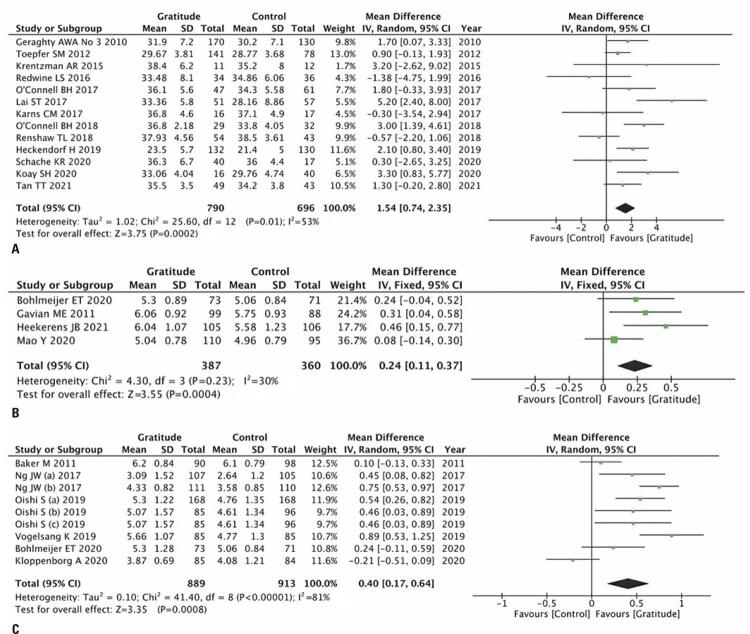
“The analysis of 579 patients in three articles showed that gratitude interventions led to fewer anxiety symptoms, with a 7.76% lower Generalized Anxiety Disorder (GAD-7)(75) score than that of the control group (MD= -1.63; 95%CI= -2.37, -0.89; p<0.0001; I2=27%, fixed effect; certainty: low) (Figure 5).”
BackgroundInfluentialWang, G., Ma, R., Qiao, G., Wada, K., Aizawa, Y., & Satoh, T. (2015) · Integrative Medicine International · doi:10.1159/000368408 · Cited by 18,657
Validation of the Insomnia Severity Index as an outcome measure for insomnia research
Bastien, C. (2001) · Sleep Medicine · doi:10.1016/s1389-9457(00)00065-4 · Cited by 8,067 · cited 2×
“When analyzing sleep-related outcomes, only the Insomnia Severity Index(80) showed a significant difference in favor of the gratitude group, whereas analysis of sleep quality and the Pittsburgh Sleep Quality Index(81) showed no difference.”
ResultPositive Psychology Progress: Empirical Validation of Interventions.
Seligman, M. E. P., Steen, T. A., Park, N., & Peterson, C. (2005) · American Psychologist · doi:10.1037/0003-066x.60.5.410 · Cited by 5,947 · cited 1×
“In the happiness outcome, two scores (Subjective Happiness Scale(78) and Authentic Happiness Inventory(79)) were not significantly different, while two numerical scales (1–5 and 1–7) showed benefits for the gratitude groups.”
Background
Research works printed but not linked: 5
- 8. The Cochrane Collaboration. Review Manager (RevMan). Version 5.4 [Computer program]. [cited 2020 June 1]. Available from: https://training.cochrane.org/online-learning/core-software-cochranereviews/revman The Cochrane Collaboration Review Manager (RevMan). Version 5.4 [Computer program] cited 2020 June 1 https://training.cochrane.org/online-learning/core-software-cochranereviews/revman
- 9. McMaster University. GRA- DEpro GDT: GRADEpro Guideline Development Tool [Soft-ware]. Canadá: McMaster University; 2020 [cited 2020 May 1]. Available from: https://gradepro.org McMaster University GRA- DEpro GDT: GRADEpro Guideline Development Tool [Soft-ware] Canadá McMaster University 2020 cited 2020 May 1 https://gradepro.org
- 35. Ki TP. Gratitude and Stress of Health Care Professionals in Hong Kong [thesis]. Hong Kong: University of Hong Kong; 2009 [cited 2020 July 1]. Available from: http://dspace.cityu.edu.hk/handle/2031/5812 Ki TP Gratitude and Stress of Health Care Professionals in Hong Kong thesis Hong Kong University of Hong Kong 2009 cited 2020 July 1 http://dspace.cityu.edu.hk/handle/2031/5812
- 39. Kobayashi F. Effects of Gratitude Savoring toward One’s Parents on Subjective Well-Being in Japanese Undergraduate Students. Comparative Culture J Miyazaki Intern College. 2016;21:15-36. Kobayashi F Effects of Gratitude Savoring toward One’s Parents on Subjective Well-Being in Japanese Undergraduate Students Comparative Culture J Miyazaki Intern College 2016 21 15 36
- 66. Tofangchi M, Kajbaf M, Ghamarani A. Effectiveness of gratitude training on happiness in mother of child with mental retardation. N Y Sci J. 2013;6(12):98-101. Tofangchi M Kajbaf M Ghamarani A Effectiveness of gratitude training on happiness in mother of child with mental retardation N Y Sci J 2013 6 12 98 101
Cited by
de Oliveira, W. A., Esteca, A. M. N., Wechsler, S. M., & Menesini, E. (2024) · International Journal of Environmental Research and Public Health · doi:10.3390/ijerph21070839 · Cited by 23
The efficacy of seven gratitude interventions for promoting subjective well-being
Dang, A., Coles, N. A., Oishi, S., & McCullough, M. E. (2025) · The Journal of Positive Psychology · doi:10.1080/17439760.2025.2502483 · Cited by 17
“However, there are certainly other interventions, such as drawing pictures of things one is grateful for (e.g. Diniz et al., 2023), which we could have included, but many of them were not easily administered by computer.”
Cullen, K., Murphy, M. F., Blasi, Z. D., & Bryant, F. B. (2024) · PLoS ONE · doi:10.1371/journal.pone.0302014 · Cited by 17
“…have previously been published which highlight the efficacy of particular savouring processes in improving participant levels of well-being in addition to reducing symptoms of psychological distress, for example when practising gratitude [35] or when imag-ining one’s “Best Possible Self” [36].”
BackgroundHaag, C., Bellinghausen, L., & Poirier, C. (2025) · Frontiers in Psychology · doi:10.3389/fpsyg.2025.1465774 · Cited by 12
“FEP exhibits and experiences greater gratitude, an emotion that helps individuals to deal with adversity, anxiety, and depression, and to build strong interpersonal relationships (Cunha et al., 2019; Diniz et al., 2023).”
The Effectiveness of Savouring Interventions in Adult Clinical Populations: A Systematic Review
Cullen, K., Murphy, M. F., Blasi, Z. D., & Bryant, F. B. (2024) · International Journal of Applied Positive Psychology · doi:10.1007/s41042-024-00182-1 · Cited by 10
“…reviews have highlighted the effectiveness of specific savour - ing processes in enhancing participant levels of well-being and in reducing symptoms of psychopathology—for example, when practising gratitude (Diniz et al., 2023 ) or when imagining one’s “Best Possible Self” (Carrillo et al., 2019).”
Hitl, M., Greb, N., & Babac, M. B. (2024) · Global Knowledge, Memory and Communication · doi:10.1108/gkmc-03-2024-0138 · Cited by 9
Gratitude as Predictor of Psychological Well-Being Among Secondary Students
Manalo, M. A., Molina, C., & Vergara, J. Q. (2024) · Journal of interdisciplinary perspectives · doi:10.69569/jip.2024.0559 · Cited by 9
Wube, T. B., Asgedom, S. G., Mengesha, A. G., Bekele, Y. A., & Gebrekirstos, L. G. (2025) · Health Science Reports · doi:10.1002/hsr2.70511 · Cited by 9
“To build on these findings, interventions such as structured counseling and peer support groups, as proposed by Diniz [30], could enhance the psychological benefits of gratitude by helping recipients process emotions and address potential feelings of guilt or anxiety.”
Cebolla, A., Navarro‐Siurana, J., Galante, J., Sarrión-Castelló, P., Vidal, J., Fernández‐Castilla, B., Lecuona, O. Z., Vázquez, C., & Baños, R. (2025) · Applied Psychology Health and Well-Being · doi:10.1111/aphw.70069 · Cited by 7
Lehr, D., Freund, H., Sieland, B., Kalon, L., Berking, M., Riper, H. M., & Ebert, D. D. (2024) · Internet Interventions · doi:10.1016/j.invent.2024.100787 · Cited by 6
“…is moderate evidence from meta-analyses supporting the efficacy of gratitude interventions against depressive symptoms (Cregg and Cheavens, 2021; Diniz et al., 2023); with randomized controlled trials (RCT) showing promising effects on outcomes related to repetitive negative thinking in terms…”
Pengaruh Gratitude dan Dukungan Sosial Terhadap Psychological Well Being: Sebuah Analisis Sistematis
Addini, N. A., & Eva, N. (2025) · Jurnal Psikologi · doi:10.47134/pjp.v2i2.3548 · Cited by 6
“Di sisi lain, rasa syukur juga diketahui dapat memengaruhi kesejahteraan psikologis individu (Komase et al., 2021), karena rasa syukur dapat dimaknai sebagai emosi, sikap, kebajikan moral, kebiasaan, ciri kepribadian, maupun respons penanggulangan (Diniz et al., 2023).”
Habibie, T. A., & Nashori, F. (2024) · Indigenous Jurnal Ilmiah Psikologi · doi:10.23917/indigenous.v9i3.6753 · Cited by 5
“…of life (Jung & Han, 2017) and psychological well-being (Rahman et al., 2022) which is linked to a decrease in depression rates in individuals (Diniz et al., 2023) because depression is also connected to cognitive structures that affect an individual's interpretation of the situation…”
Masyhuri, M., Sudirman, S. A., Fadhli, M. N., & Qaderi, S. G. (2025) · International Journal of Islamic Educational Psychology · doi:10.18196/ijiep.v6i1.25744 · Cited by 5
Almaraz, D., Baumann, K., Martín, F. M., Sánchez‐Iglesias, I., & Galdós, J. S. (2025) · BMC Psychology · doi:10.1186/s40359-025-03097-x · Cited by 5
“These interventions aim to improve physical health by reducing pain, physical symptoms, or insomnia [47], and to enhance mental health by decreasing negative emotions, anxiety, and depression [88].”
Rassool, G. H. (2024) · Springer eBooks · doi:10.1007/978-3-031-72724-5_11 · Cited by 6
Understanding Gratitude and Happiness: Psychology and Neuroscience behind Well-being
Halder, S., & Mahato, A. K. (2024) · Taiwanese Journal of Psychiatry · doi:10.4103/tpsy.tpsy_3_24 · Cited by 5
Shariatmadari, H., Taheri‐Kharameh, Z., Kamaliuon, N., Abadi, B. A. G. H., & Shokouhi-Tabar, M. (2025) · BMC Cancer · doi:10.1186/s12885-025-14492-3 · Cited by 4
“While both interventions have demonstrated potential for enhancing psychological well-being and improving mental health [10, 11], particularly within breast cancer populations [12], there is a paucity of research directly comparing their efficacy.”
Can Gratitude Ease the Burden of Fibromyalgia? A Systematic Review
Carneiro, B. D., Pozza, D. H., & Tavares, I. (2025) · Behavioral Sciences · doi:10.3390/bs15081079 · Cited by 4
“…can be used as a complementary therapeutic approach to treat anxiety and depression (Diniz et al., 2023) and gratitude increases positive feelings and emotions in the general population (Diniz et al., 2023) with positive impacts on mental and physical well-being (Wood et al., 2007, 2009b).”
Zhao, M., Miao, H., Zhu, L., Zhang, X.-H., & Zang, L.-W. (2025) · Frontiers in Pediatrics · doi:10.3389/fped.2025.1626249 · Cited by 4
“…adolescents are consistently linked to greater life satisfaction, optimism, and prosocial behavior, as well as lower levels of depression and anxiety; these bene fi ts are supported by recent meta-analyses showing gratitude interventions improve mental health and reduce anxiety and depression (18).”
Lévano, S., & Medina, E. M. (2026) · Pastoral Psychology · doi:10.1007/s11089-025-01271-x · Cited by 4
Chen, P., Tung, H., Wu, Y., & Sie, J. (2026) · Applied Psychology Health and Well-Being · doi:10.1111/aphw.70134 · Cited by 4
“…elements related to the savoring process, previous studies have conducted meta-analyses on their impact on well-being (Carrillo et al., 2019; Diniz et al., 2023 (King, 2001); and acts of kindness interventions center on outward prosocial behaviors that promote social connectedness and…”
Zainal, N. H., Rajendra, S. J., Doren, N. V., Salamanca-Sanabria, A., Curtiss, J. E., & Keng, S. (2025) · BMC Psychiatry · doi:10.1186/s12888-025-07372-4 · Cited by 4
“Inadequate focus is directed towards fostering approach-driven action repertoires, gratitude [30, 31], savoring [32, 33], and reward sensitivity practices [34, 35], which have been shown to cultivate positive mood states [36].”
Ho, D., Liu, Y., Conklin, J., Fitzpatrick, T., Wang, J., Day, S., Hlatshwako, T. G., Ramaswamy, R., Wang, R. C., Kpokiri, E. E., et al. (2025) · JAMA Network Open · doi:10.1001/jamanetworkopen.2025.37382 · Cited by 3
Experiences of People Living with a Kidney Transplant: A Phenomenological Study
Kusoom, W., Suwanboriboon, N., Siewthong, S., Krongyuth, S., & Hengyotmark, A. (2025) · Healthcare · doi:10.3390/healthcare13222986 · Cited by 3
“A systematic review and meta-analysis by Diniz et al. [25] suggested that gratitude can be used as a therapeutic complement for treating anxiety and depression and can increase positive feelings and emotions in the general population.”
Cati, M. M. (2025) · Acta Psychologica · doi:10.1016/j.actpsy.2025.105915 · Cited by 3
Nkurunziza, A., Niyonsenga, J., Munganyinka, C., Ntete, J. M., & Mutabaruka, J. (2025) · Discover Psychology · doi:10.1007/s44202-025-00334-7 · Cited by 3
“Additionally, the program’s emphasis on positive relationship behaviours, such as gratitude and forgiveness, likely reinforced more adaptive beliefs, as research has shown that gratitude interventions can reduce negative relationship beliefs and increase overall relationship satisfaction [21, 37].”
Hacking Neuroplasticity: How AI Can Help Your Healthy Aging Brain
Shaffer, J. (2024) · Productivity Press eBooks · doi:10.4324/9781003462354 · Cited by 3
Fischer, R. D., Karl, J. A., Daly, A., & Bortolini, G. N. (2025) · Topoi · doi:10.1007/s11245-025-10189-1 · Cited by 3
“This is central to many mindfulness interventions, getting individuals to commit to mindful observation activities where they are encouraged to spend a few minutes observing nature without any distractions (Karl et al. 2021) or to gratitude interventions (Diniz et al. 2023).”
The QEg: A Generalized Version of QEPro Ability Measure of Emotional Intelligence
Haag, C., Bellinghausen, L., & Poirier, C. (2024) · Psychology · doi:10.4236/psych.2024.153024 · Cited by 3
Wilcox, J. E. (2025) · Societal Impacts · doi:10.1016/j.socimp.2025.100114 · Cited by 2
Revisión sistemática sobre la eficacia de la intervención de gratitud en personas sanas
Castillo, Z. P. B., Robles, N. E. C., Tarazona, F. I. P., & García, U. C. (2025) · doi:10.31876/rcs.v31i3.44310 · Cited by 2
“Además, se observó una disminución de síntomas de ansiedad, depresión, preocupación y dolor psicológico en quienes participaron en estas intervenciones (Cuello y Grasso, 2021; Diniz et al., 2023).”
Hao, J., & Chen, H. (2026) · Acta Psychologica · doi:10.1016/j.actpsy.2026.106228 · Cited by 3
Husnuzhan-based Islamic positive psychology training to foster happiness among new santriwati
Fadhila, M., Hairina, Y., & Aliffia, D. (2025) · Psikis Jurnal Psikologi Islami · doi:10.19109/psikis.v11i2.32074 · Cited by 2
Naumann, E. (2026) · Computers in Human Behavior Reports · doi:10.1016/j.chbr.2026.100952 · Cited by 2
Alamgir, A., Zaro, A., Lawabni, R., Ahmad, F., Webo, J., Alamgir, S., Saidi, M., Nwanokwale, N., Baig, M., Abdelwahab, M. M., et al. (2026) · Journal of Religion and Health · doi:10.1007/s10943-026-02600-x · Cited by 2
“Altogether, these behaviors reinforce habits of altruism, social integration, and gratitude which have been strongly linked to better social and mental well-being (Diniz et al., 2023).”
McCurdy, L. Y., Loya, J. M., Gordon, M. A., Park, J. J., Bold, K. W., Kiluk, B. D., & Potenza, M. N. (2026) · Cognitive and Behavioral Practice · doi:10.1016/j.cbpra.2026.04.001 · Cited by 2
Kotera, Y. (2026) · Routledge eBooks · doi:10.4324/9781042003181 · Cited by 2
Improving Health in the Caribbean Region: Challenges and Opportunities
Williams, D. R., & Frater, J. (2024) · Springer eBooks · doi:10.1007/978-3-031-55293-9_2 · Cited by 2
Gratitude Interventions in Individuals With Diabetes: An Integrative Review
Koerner, R., Valente, O., Tao, A., & Rechenberg, K. (2025) · Holistic Nursing Practice · doi:10.1097/hnp.0000000000000732 · Cited by 2
Investigating the Effect of Gratitude on the Relationship Between Parenting and Grit
Lam, K. K. L., & Zhou, M. (2025) · Psychology in the Schools · doi:10.1002/pits.23551 · Cited by 2
Jankowski, P. J., Sandage, S. J., Captari, L. E., Crabtree, S. A., Choe, E. J. Y., & Gerstenblith, J. (2024) · Journal of Clinical Psychology · doi:10.1002/jclp.23669 · Cited by 2
Dispositional Gratitude and Psychosocial and Glycemic Outcomes in Adolescents With Type 1 Diabetes
Koerner, R., & Rechenberg, K. (2025) · The Science of Diabetes Self-Management and Care · doi:10.1177/26350106251350614 · Cited by 1
“23 Interventions that can improve dispositional gratitude, such as gratitude journaling 24 and positive psychology interventions, 25 have resulted in improvements to anxiety symptoms in the general population and adults with type 2 diabetes.”
Ariani, N. K. P., Mahardika, I. K. A., Yosef, H., & Kenwa, K. W. M. (2025) · Indian Journal of Palliative Care · doi:10.25259/ijpc_29_2025 · Cited by 1
“[13-15] In addition, gratitude may alleviate existential fears, such as the fear of death, by fostering a sense of fulfilment and meaning in life.”
Hudson, T. A., de Carvalho, P. H. B., Amaral, A. C. S., & Ferreira, M. E. C. (2025) · Body Image · doi:10.1016/j.bodyim.2025.101988 · Cited by 1
INTERVENÇÕES DE GRATIDÃO EM PACIENTES CARDIOVASCULARES: UMA REVISÃO DE ESCOPO
Redin, M. M. R., Ruprecht, R., & Schmidt, M. M. (2025) · Aracê. · doi:10.56238/arev7n12-129 · Cited by 1
Cebolla, A., Fernández-Castilla, B., Lecuona, O. Z., Navarro‐Siurana, J., Galante, J., Sarrión-Castelló, P., Vidal, J., Baños, R. M., & Vázquez, C. (2026) · Clinical Psychology Review · doi:10.1016/j.cpr.2026.102692 · Cited by 1
Tradisi Tingalan di Dusun Sibarong dalam Perspektif Living Teologi Islam
Subekti, F. R., & Zuhri, H. (2026) · AHKAM · doi:10.58578/ahkam.v5i1.8754 · Cited by 1
Competencias, Diseño y Prevención en el Aula
Gómez, J. S. A., Altamirano, M. I. Q., Castro, E. S. S., Asanza, D. M. D. C. A., & Ramírez, K. B. S. (2026) · doi:10.64973/edu.2025.2522 · Cited by 1
The Effectiveness of Islamic Gratitude Psychoeducation Groups in Improving Student Resilience
Umriana, A. (2026) · Bulletin of Counseling and Psychotherapy · doi:10.51214/002026081771000 · Cited by 1
Lau, N., Zhou, C., Hong, S. J., Aalfs, H., Higgins, S., Badillo, I., McCauley, E., Ketterl, T. G., Chow, E. J., Fann, J. R., et al. (2026) · JMIR Research Protocols · doi:10.2196/82665 · Cited by 1
“Background literature suggests that positive psychological interventions involving gratitude and savoring activities increase treatment adherence [29,30] and have demonstrated efficacy and effectiveness of these interventions in systematic reviews [31-34].”
Saravanakumar, H., & Sekar, K. (2026) · International Journal For Multidisciplinary Research · doi:10.36948/ijfmr.2026.v08i02.70932 · Cited by 1
Macrynikola, N., Doerr, J., & Yen, S. (2026) · Journal of Adolescence · doi:10.1002/jad.70189 · Cited by 1
Gratitude and Athlete Psychological Well-Being and Mental Health: A Systematic Scoping Review
Osherow, E. K., Durieux, N. M., Ahmadi, S. E., & Park, C. L. (2026) · Performance Enhancement & Health · doi:10.1016/j.peh.2026.100444 · Cited by 1
Ganaprakasam, C. (2026) · Perspektif Jurnal Sains Sosial dan Kemanusiaan · doi:10.37134/perspektif.vol18.1.5.2026 · Cited by 1
Kim, J., Jung, Y., Lee, J., Lee, K., Hong, H., & Lee, U. (2026) · Proceedings of the ACM on Interactive Mobile Wearable and Ubiquitous Technologies · doi:10.1145/3810198 · Cited by 1
Amalia, K. E., Pradipta, P. K., Aldilla, D. N., Srisayekti, W., Rubiyanti, Y., & Purnama, C. Y. (2026) · G-Couns Jurnal Bimbingan dan Konseling · doi:10.31316/g-couns.v10i03.8319 · Cited by 1
Kotera, Y. (2026) · Current Psychology · doi:10.1007/s12144-026-09841-9 · Cited by 1
“Systematic reviews and meta-analyses have indicated that gratitude interventions can reduce mental health symptoms and enhance overall well-being (Bog-giss et al., 2020; Diniz et al., 2023; Jo A et al., 2021; Kirca et al., 2023; Komase et al., 2021; Skrzelinska et al., 2024).”
Gratitude as a Contributing Factor to Mental Health in Addolescents
Sahib, M. S. (2025) · Psikologi Prima · doi:10.34012/psychoprima.v8i2.7734 · Cited by 1
“This is evident in various quantitative studies (Diniz et al., 2023; Duprey et al., 2020), which demonstrate that gratitude enhances cognitive reframing abilities and reduces anxiety and depression through more adaptive emotion regulation.”
InfluentialGratitude as a Predictor of Psychological Wellbeing Among Young Adults: A systematic Analysis
Khan, M., & Malik, A. A. (2026) · Pakistan Journal of Psychological Research · doi:10.33824/pjpr.2026.41.2.21 · Cited by 1
Motivasi Mengikuti Pengajian Terhadap Rasa Syukur Santri
Pratama, E. P., Pujiati, D., Anggraini, H., Azizah, A., Rafay, M. S., & Apritania (2025) · Proceeding Conference On Da wah and Communication Studies · doi:10.61994/cdcs.v4i.331 · Cited by 1
The Role of Gratitude and Forgiveness Toward Self-awareness in Emerging Adulthood
Edy, D. F., & Ashgarie, R. I. A. (2024) · KnE Social Sciences · doi:10.18502/kss.v9i30.17522 · Cited by 1
“Gratitude is a light expression that is not necessarily conditioned only on good, pleasant times that allows a person to maintain good feelings, even gratitude is present during negative experiences or the most difficult times [19].”
Akliman, Ç. K., & Avcı, M. Z. (2024) · Journal of Spirituality in Mental Health · doi:10.1080/19349637.2024.2431818 · Cited by 1
“Similarly, previous research also established that gratitude effectively enhances mood and life satisfaction while decreasing depressive symptoms (Diniz et al., 2023; Wood et al., 2008).”
Words Count: Gratitude Writing in Early Elementary School
Nguyen, S. P., & Gordon, C. L. (2025) · Early Childhood Education Journal · doi:10.1007/s10643-025-01856-4 · Cited by 1
“Indeed, there is a robust body of experimental studies showing that expressing gratitude in written form contributes to well-being (Davis et al., 2016; Diniz et al., 2023; Jans-Beken et al., 2019; Wood et al., 2010).”
Talkshow Inspiratif untuk Memahami Makna Syukur dalam Meningkatkan Kesehatan Mental Santri
Rosita, T., Leofianti, A. R. A., Apriliana, N. F., & Mahdiyah, F. A. (2025) · Jurnal AbdiMU (Pengabdian kepada Masyarakat) · Cited by 1
Creating a supportive culture: the power of small changes
Vinson, A. E., & Margolis, R. D. (2026) · BJA Open · doi:10.1016/j.bjao.2026.100532 · Cited by 1
“13,14 Gratitude practices have been shown to improve cardiovascular health 15 and function as a prosocial contagion, improving the overall mood and outlook of the individual practicing gratitude.”
Sarca, M., Cojocaru, A., Dumache, R., Bernad, B. C., Nussbaum, L. A., Costea, I., Anghel, T., & Hogea, L. (2026) · Healthcare · doi:10.3390/healthcare14050601
Hope, Gratitude, and Love for Peace
Tomasulo, D., & Tomasulo, D. F. (2024) · Peace psychology book series · doi:10.1007/978-3-031-66928-6_14
Reza, I. F., Setiawan, K. C., Hadinata, E. O., Oktaviani, N. S., Kamilah, S. N., & Amanda, Z. (2025) · Persona Jurnal Psikologi Indonesia · doi:10.30996/persona.v13i2.11960
“Interventions on happiness with Gratitude Training (Diniz et al., 2023; Komase et al., 2021), Mindfulness-Based Self-Training (Allen et al., 2021; Sulosaari et al., 2022; Zheng et al., 2022), Quality of Work Life Program (Berkland et al., 2017; Gurdogan & Uslusoy, n.d.; Nabila et al., 2021; Raúl &…”
A 12-Step Framework to Support Resilience in Osteopathic Family Physicians
Sadeghi, H. (2025) · Journal of the Osteopathic Family Physicians of California · doi:10.58858/040203
Mental Health for the Military Surgeon
Beeken, K. (2025) · Springer eBooks · doi:10.1007/978-3-031-88490-0_32
Baran, M., Baran, T., & Kaniasty, K. Z. (2025) · Journal of Applied Social Psychology · doi:10.1111/jasp.70001
Mateo-Santiago, J., Rosario-Rodríguez, A., & Pagán-Torres, O. M. (2024) · Revista Puertorriqueña de Psicología · doi:10.55611/reps.3503.04
Pallathadka, H. (2024) · International Research Journal of Education and Technology (IRJET). · doi:10.70127/irjedt.vol.8.issue06.749
Psychological Health Interventions in Older People
Lara, R. M. M., Kobayashi-Gutiérrez, A., & Aragón-Castillo, J. (2025) · Springer eBooks · doi:10.1007/978-3-031-84433-1_23
Gratitude Training: Improving Life Expectancy for People with Chronic Diseases
Syaiful, I. A., Fadhiilah, N., Arafah, R. Z., Sriyanto, A. S., & Atika, A. (2024) · Psikis Jurnal Psikologi Islami · doi:10.19109/psikis.v10i2.24144
Mukuna, K. R. (2025) · Springer eBooks · doi:10.1007/978-3-031-88793-2_3
A Study of Mindfulness Intervention Program: Reducing Anxiety and Enhancing Well-being
Yadav, D. J. (2025) · International Journal of Research & Technology · doi:10.64882/jrps.v13.i3.395
Percy, C. A., Turner, A., Alper, B., & Wark, P. A. (2026) · JMIR Formative Research · doi:10.2196/69206
“Gratitude practices, which shift one’s focus toward positive experiences, may increase resilience and resources for chronic illness management and enhance well-being [37].”
Park, S., & Park, S. (2025) · Asian Social Work and Policy Review · doi:10.1111/aswp.70018
Donaldson, S. I., & Cabrera, V. (2025) · Wiley eBooks · doi:10.1002/9781394268191.ch2
Albert, N. M., Phillips, C., Hoffman, J., Levay, M., Bena, J., Morrison, S. L., Barley, G., Collins, M. C., Soltesz, E. G., & Bober, K. J. (2025) · The Journal of Cardiovascular Nursing · doi:10.1097/jcn.0000000000001272
Fortitude and Gratitude: Reflecting on the Year, Preparing for the Future
Bowen, F. (2025) · Journal of Pediatric Health Care · doi:10.1016/j.pedhc.2025.08.006
Samajdar, S. S., Joshi, S., Chatterjee, R., Mukherjee, S., Mohan, V., & Saboo, B. (2025) · Journal of Diabetology · doi:10.4103/jod.jod_67_25
Chamizo‐Nieto, M. T., Rey, L., & Extremera, N. (2025) · Springer eBooks · doi:10.1007/978-3-032-00025-5_12
Lichtenstein, D. P. (2025) · The Brown University Child and Adolescent Behavior Letter · doi:10.1002/cbl.30917
Developing and Standardising a Gratitude Scale Based on Recognition, Appreciation, and Expression
Bordoloi, D. (2025) · International Journal of Multidisciplinary Research and Growth Evaluation · doi:10.54660/.ijmrge.2025.6.6.791-795
Husna, H. I. A., Utami, M., & Susanti, E. A. P. (2025) · Shaut Al-Maktabah Jurnal Perpustakaan Arsip dan Dokumentasi · doi:10.37108/shaut.v17i2.2163
SÍNDROME DA RIQUEZA REPENTINA: UM ESTUDO ENTRE ESTUDANTES DE CIÊNCIAS CONTÁBEIS DA UFSC
Aguiar, G., Hoffmann, V. E., & Goularte, M. D. S. (2025) · Revista Gestão Organizacional · doi:10.22277/rgo.v18i1.8568
When Hope, Gratitude, and Mindfulness Meet: A Positive Psychology Approach to Job Performance
Rahmawati, A. S., & Pertiwi, T. L. (2025) · Journal of Educational Health and Community Psychology · doi:10.12928/jehcp.vi.31547
Three Good Things Intervention for Parent–Child Relationship: A Pilot Randomised Controlled Trial
Sabharwal, K., Chhabra, D., & Penberthy, J. K. (2025) · Journal of Family Therapy · doi:10.1111/1467-6427.70016
Perpétuo, M., Araujo, A., Teixeira, T., & Argimon, I. I. D. L. (2025) · Revista Longeviver
Ely, R. (2024) · Repository at Universitas Pendidikan Indonesia (Universitas Pendidikan Indonesia)
Young, R. (2024) · ePrints Soton (University of Southampton)
Alyami, M. M., Alshammari, K. A., & Alzahrani, H. M. (2025) · Research Square · doi:10.21203/rs.3.rs-7548318/v1
The impact of gratitude interventions on depression and stress levels in Korean American adolescents
Bang, H. (2025) · ScholarSpace (University of Hawaii at Manoa)
Stamford, S. (2025) · Repository@Hull (Worktribe) (University of Hull)
Darumeutia, A., Hendrajaya, M. R., Romadhani, R. K., & Iskandar, A. N. L. (2025) · Jurnal Organisasi dan Manajemen · doi:10.33830/jom.v21i2.10481.2025
“Gratitude can also be considered as an attitude that can be cultivated and developed, which has been shown to have various psychological benefits, such as increasing happiness, reducing stress, and strengthening social relationships (Diniz et al., 2023).”
Kumar, A., & -, A. (2025) · International Journal For Multidisciplinary Research · doi:10.36948/ijfmr.2025.v07i06.65025
“( Kerry et al., 2023; Diniz et al., 2023).”
Associations Between Coping and Suicide Risk Among Emerging Adults of Asian Descent
Shaikh, A. N., Chen, M., Dhar, J., Yang, J., Sadek, K., Chang, M. K., Hsu, L.-C., Shilam, R., Varghese, A. S., & Chang, C. Y. (2025) · The Professional Counselor · doi:10.15241/ans.15.4.246
“Practicing such exercises during counseling sessions, as well as encouraging these exercises outside of sessions, can support clients in feeling less like a burden and more connected to others (Diniz et al., 2023; Komase et al., 2021).”
Metadata
- Authors
- Diniz, G., Korkes, L., Tristão, L. S., Pelegrini, R., Bellodi, P. L., & Bernardo, W. M.
- Affiliations
- Universidade de São Paulo (BR)
- ORCID
- Venue
- einstein (São Paulo)
- Published
- 2023
- Volume
- 21
- Pages
- eRW0371-eRW0371
- ISSN
- 1679-4508 (ISSN-L)
- 2317-6385
- PMC
- PMC10393216
- OpenAlex
- W4385468057
- Cited by
- 92
- References
- 91
- Citations by year
- 2026: 37 · 2025: 38 · 2024: 17
- FWCI
- 4.49
- Type
- journal article
- Language
- en
- Open access
- diamond
- doi.org
- Licence
- cc-by
- Locations
- Einstein (São Paulo) (publishedVersion, cc-by)
- PubMed Central (publishedVersion, cc-by)
- PubMed (publishedVersion)
- DOAJ (DOAJ: Directory of Open Access Journals) (submittedVersion, cc-by-sa)
- Topics
- Social Sciences › Psychology › Social Psychology › Psychological Well-being and Life Satisfaction
- Social Sciences › Psychology › Clinical Psychology › Mindfulness and Compassion Interventions
- Social Sciences › Psychology › Social Psychology › Mental Health via Writing
- Keywords
- gratitude interventions, gratitude, mental health, anxiety, depression, positive emotions, well-being, positive psychology, therapeutic interventions
- MeSH terms
- Anxiety, Humans, Mental Health
About these checks
Registry, retraction, Cites and statistics results are computed, not judged, with one exception: a printed reference that no index lists is read once by a model before it counts as a citation error. Claims are extracted by a model and kept only when their quote appears verbatim in the text; each cited source is then checked, with a model’s help, for whether it says what the claim relies on. Those verdicts can be wrong — read the claim’s quote and the cited source before relying on one.
Statistics and arithmetic are recomputed, not judged.
Confidence bands are shown only for fields calibrated on our annotated test set. None is calibrated yet, so no band is shown.
What counts as a claim ›How we measure confidence ›How we check this ›
Are you an author, or do you see a problem with this page? Request a review
Data sources
Bibliographic data: Semantic Scholar, OpenAlex, Crossref.
Contains information from the Semantic Scholar Academic Graph Datasets, made available under the ODC Attribution License (ODC-BY 1.0).
Semantic Scholar’s data is described in: Kinney, R., et al. (2023). The Semantic Scholar Open Data Platform. arXiv:2301.10140.
