

The effects of gratitude interventions: a systematic review and meta-analysis
Open accessThe DOI matches its Crossref record; 81 of the 91 references it cites were found in a registry or an index.
Abstract
INTRODUCTION: Gratitude has several implications. Over time, a logical relationship has been established between gratitude and well-being. In addition, researchers aimed to establish associations between gratitude and other factors of positive feelings using scientific methods. We conducted a systematic review and meta-analysis of interventions to develop gratitude and its benefits to human beings. OBJECTIVE: This study aimed to evaluate and quantify the available scientific evidence on interventions to acquire knowledge on gratitude as a quantifiable causal factor of benefit to human beings. METHODS: A systematic literature search was conducted to identify studies that investigated the effects of gratitude interventions. MEDLINE, Embase, and Central Cochrane databases were searched in addition to gray (Google Scholar) and manual search. Two authors independently evaluated the titles and abstracts, and selected the studies that met the inclusion criteria. The searches were conducted between January and July 2022. RESULTS: Sixty-four randomized clinical trials were included. The meta-analysis demonstrated that patients who underwent gratitude interventions experienced greater feelings of gratitude, better mental health, and fewer symptoms of anxiety and depression. Moreover, they experienced other benefits such as a more positive mood and emotions. CONCLUSION: The results demonstrate that acts of gratitude can be used as a therapeutic complement for treating anxiety and depression and can increase positive feelings and emotions in the general population. Prospero database registration: (www.crd.york.ac.uk/prospero) under the number CRD42021250799.
Overview
The claims and statistics of this paper haven’t been checked yet.
Free: it reads the open-access text and checks the first 5 claims that cite a source we can check. Create a free account to check every claim.
Integrity signals
Registry
Cites
Statistics
Figures
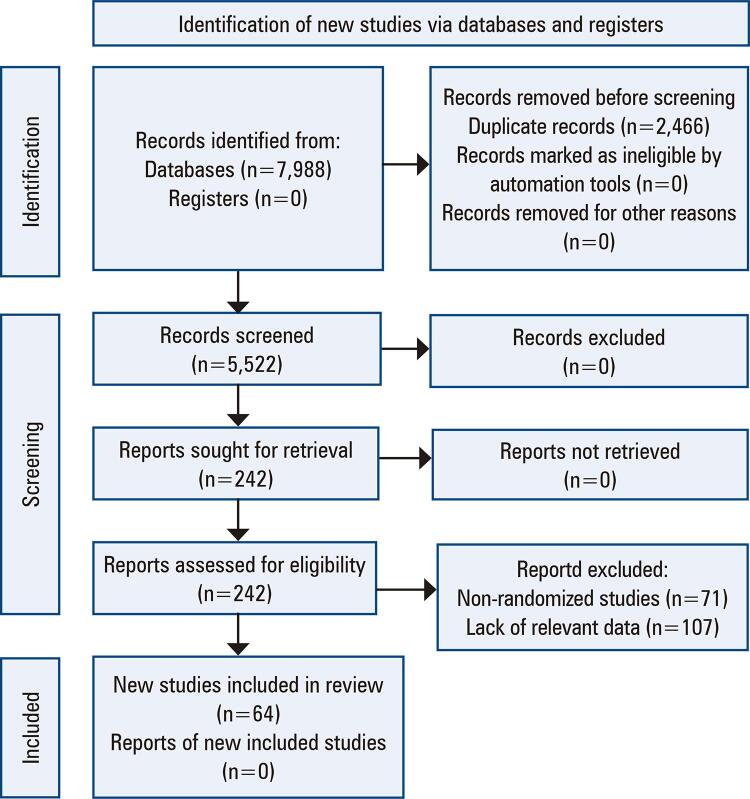




Verification
Claims the paper makes
The claims and statistics of this paper haven’t been checked yet.
Free: it reads the open-access text and checks the first 5 claims that cite a source we can check. Create a free account to check every claim.
Claims other papers make about this one
Each is checked against this paper’s own text: does it say what the citing paper says it does?
The source backs part of the claim, not all of it — or backs it for a different population, condition or comparison.
In the citing paper
“researchers have noted that acts of gratitude can serve as a valuable “therapeutic complement” to traditional mindfulness training for improving mental health [54].”
From The Effects of Mindfulness Techniques on Anxiety, Depression, and Stress, with an Emphasis on Gratitude: A Systematic Review and Meta-Analysis (2026) · cites this paper as [54]
Experimental — accuracy not yet measuredThe cited source says what the claim attributes to it.
In the citing paper
“Gratitude-focused interventions on their own confer only modest benefits.”
From The Effects of Mindfulness Techniques on Anxiety, Depression, and Stress, with an Emphasis on Gratitude: A Systematic Review and Meta-Analysis (2026) · cites this paper as [54]
The cited source says what the claim attributes to it.
In the citing paper
“a larger systematic review of 64 RCTs likewise reported that gratitude interventions lead to statistically fewer anxiety and depression symptoms than controls, but with only modest magnitude (e.g., ~7–8% reductions in symptom scores [54].”
From The Effects of Mindfulness Techniques on Anxiety, Depression, and Stress, with an Emphasis on Gratitude: A Systematic Review and Meta-Analysis (2026) · cites this paper as [54]
Self-check
Percentages, sums and reported differences re-computed from the paper’s own numbers.
The self-check needs the paper’s full text.
Citations
Cites
Preferred Reporting Items for Systematic Reviews and Meta-Analyses: the PRISMA statement
Moher, D., Liberati, A., Tetzlaff, J., Altman, D. G., & for the PRISMA Group (2009) · BMJ · doi:10.1136/bmj.b2535 · Cited by 83,823
Preferred Reporting Items for Systematic Reviews and Meta-Analyses: The PRISMA Statement
Moher, D., Liberati, A., Tetzlaff, J., Altman, D. G., & The PRISMA Group (2009) · PLoS Medicine · doi:10.1371/journal.pmed.1000097 · Cited by 64,042 · cited 1×
“This systematic review followed the Preferred Reporting Items for Systematic Reviews and Meta-Analyses (PRISMA) guidelines(5) and the details of the protocol”
The PHQ-9: Validity of a brief depression severity measure
Kroenke, K., Spitzer, R. L., & Williams, J. B. W. (2001) · Journal of General Internal Medicine · doi:10.1046/j.1525-1497.2001.016009606.x · Cited by 44,910 · cited 1×
“Depression Depression symptoms (n=525) were assessed in three articles using the Patient Health Questionnaire-9 (PHQ-9).(76) Analysis of the results showed that patients who underwent gratitude interventions had fewer symptoms of depression with 6.”
MethodThe Pittsburgh Sleep Quality Index: a new instrument for psychiatric practice and research
Buysse, D. J., Reynolds, C. F., Monk, T. H., Berman, S. R., & Kupfer, D. J. (1989) · Psychiatry Research · doi:10.1016/0165-1781(89)90047-4 · Cited by 35,234 · cited 2×
“The Pittsburgh Sleep Quality Index: a new instrument for psychiatric practice and research.”
ResultRoB 2: a revised tool for assessing risk of bias in randomised trials
Sterne, J. A. C., Savović, J., Page, M. J., Elbers, R. G., Blencowe, N. S., Boutron, I., Cates, C. J., Cheng, H.-Y., Corbett, M. S., Eldridge, S. M., et al. (2019) · BMJ · doi:10.1136/bmj.l4898 · Cited by 34,787 · cited 1×
“The risk of bias was assessed using the Risk of Bias 2 (RoB 2)(7) tool for interventional studies and was classified as low, high, or very high.”
MethodDevelopment and validation of brief measures of positive and negative affect: The PANAS scales.
Watson, D., Clark, L. A., & Tellegen, A. (1988) · Journal of Personality and Social Psychology · doi:10.1037/0022-3514.54.6.1063 · Cited by 32,433 · cited 1×
“Moreover, there was no significant difference in any positive and negative affect scores (Implicit Positive and Negative Affect Test,(82) Scale of Positive and Negative Experience,(73) Positive Affect Negative Affect Scale,(83) and a numerical scale of 1–5), except in the Affect Balance Scale(84) reported by Yang et a…”
BackgroundA Brief Measure for Assessing Generalized Anxiety Disorder: The GAD-7
Spitzer, R. L., Kroenke, K., Williams, J. B. W., & Löwe, B. (2006) · Archives of Internal Medicine · doi:10.1001/archinte.166.10.1092 · Cited by 31,765 · cited 3×
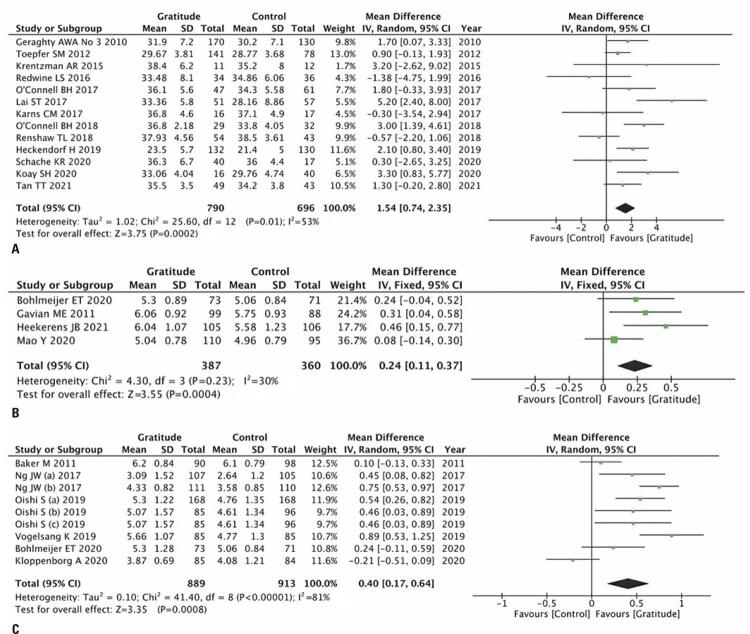
“The analysis of 579 patients in three articles showed that gratitude interventions led to fewer anxiety symptoms, with a 7.76% lower Generalized Anxiety Disorder (GAD-7)(75) score than that of the control group (MD= -1.63; 95%CI= -2.37, -0.89; p<0.0001; I2=27%, fixed effect; certainty: low) (Figure 5).”
BackgroundInfluentialWang, G., Ma, R., Qiao, G., Wada, K., Aizawa, Y., & Satoh, T. (2015) · Integrative Medicine International · doi:10.1159/000368408 · Cited by 18,657
Validation of the Insomnia Severity Index as an outcome measure for insomnia research
Bastien, C. (2001) · Sleep Medicine · doi:10.1016/s1389-9457(00)00065-4 · Cited by 8,067 · cited 2×
“When analyzing sleep-related outcomes, only the Insomnia Severity Index(80) showed a significant difference in favor of the gratitude group, whereas analysis of sleep quality and the Pittsburgh Sleep Quality Index(81) showed no difference.”
ResultPositive Psychology Progress: Empirical Validation of Interventions.
Seligman, M. E. P., Steen, T. A., Park, N., & Peterson, C. (2005) · American Psychologist · doi:10.1037/0003-066x.60.5.410 · Cited by 5,947 · cited 1×
“In the happiness outcome, two scores (Subjective Happiness Scale(78) and Authentic Happiness Inventory(79)) were not significantly different, while two numerical scales (1–5 and 1–7) showed benefits for the gratitude groups.”
Background
Research works printed but not linked: 5
- 8. The Cochrane Collaboration. Review Manager (RevMan). Version 5.4 [Computer program]. [cited 2020 June 1]. Available from: https://training.cochrane.org/online-learning/core-software-cochranereviews/revman The Cochrane Collaboration Review Manager (RevMan). Version 5.4 [Computer program] cited 2020 June 1 https://training.cochrane.org/online-learning/core-software-cochranereviews/revman
- 9. McMaster University. GRA- DEpro GDT: GRADEpro Guideline Development Tool [Soft-ware]. Canadá: McMaster University; 2020 [cited 2020 May 1]. Available from: https://gradepro.org McMaster University GRA- DEpro GDT: GRADEpro Guideline Development Tool [Soft-ware] Canadá McMaster University 2020 cited 2020 May 1 https://gradepro.org
- 35. Ki TP. Gratitude and Stress of Health Care Professionals in Hong Kong [thesis]. Hong Kong: University of Hong Kong; 2009 [cited 2020 July 1]. Available from: http://dspace.cityu.edu.hk/handle/2031/5812 Ki TP Gratitude and Stress of Health Care Professionals in Hong Kong thesis Hong Kong University of Hong Kong 2009 cited 2020 July 1 http://dspace.cityu.edu.hk/handle/2031/5812
- 39. Kobayashi F. Effects of Gratitude Savoring toward One’s Parents on Subjective Well-Being in Japanese Undergraduate Students. Comparative Culture J Miyazaki Intern College. 2016;21:15-36. Kobayashi F Effects of Gratitude Savoring toward One’s Parents on Subjective Well-Being in Japanese Undergraduate Students Comparative Culture J Miyazaki Intern College 2016 21 15 36
- 66. Tofangchi M, Kajbaf M, Ghamarani A. Effectiveness of gratitude training on happiness in mother of child with mental retardation. N Y Sci J. 2013;6(12):98-101. Tofangchi M Kajbaf M Ghamarani A Effectiveness of gratitude training on happiness in mother of child with mental retardation N Y Sci J 2013 6 12 98 101
Cited by
Items 101–176 of 176
Development and validation of the Pursuit of Happiness Scale
Singh, K., Saxena, G., & Bandyopadhyay, S. (2026) · International Journal of Wellbeing · doi:10.5502/ijw.v16i1.4807
Diário da gratidão e a espiritualidade dos profissionais de enfermagem: estudo quase-experimental
Esquierdo, M. L. S., Reichert, M. C. F., & Balsanelli, A. P. (2025) · Acta Paulista de Enfermagem · doi:10.37689/acta-ape/2025ao0000426i
“(12) In the presence of countless possibilities for exercising gratitude, the adoption of simple, quick, flexible, easy-to-understand, and easy-to-execute activities has proven to be more effective in engaging participants.”
Abreu, R., Maturana, W., Ridolfi, M., Carestiato, C., & Mograbi, D. C. (2026) · Journal of Workplace Behavioral Health · doi:10.1080/15555240.2026.2615427
“A recent systematic review (Diniz et al., 2023) indicated that patients who underwent gratitude interventions experienced greater feelings of gratitude, better mental health, and fewer symptoms of anxiety and depression, as well as other benefits such as more positive emotions, mood, pro-social…”
Franco-Jimenez, R. A. (2026) · Interacciones Revista de Avances en Psicología · doi:10.24016/2026.v12.493
Yang, A., Manaswi, A., Fischer, I. C., Na, P. J., Norman, S. B., & Pietrzak, R. H. (2026) · Journal of Affective Disorders · doi:10.1016/j.jad.2026.121461
Kerkez, M., & Şanlı, M. E. (2026) · Journal of Pediatric Nursing · doi:10.1016/j.pedn.2026.02.024
Li, J., Wu, X., 杨玉玲, Dong, Y., Wang, T., & Teng, L. (2026) · Journal of Psychosomatic Research · doi:10.1016/j.jpsychores.2026.112631
Saravanakumar, H., & Sekar, K. (2026) · International Journal of Innovative Science and Research Technology (IJISRT) · doi:10.38124/ijisrt/26mar188
Toxicological and biochemical study of mancozeb (Fungicide) on zebrafish (Denio rerio)
Prathiba, B., Nikhitha, L., Begum, S. S., Rani, V., & Joginapally, V. R. (2026) · International Journal of Molecular Biology and Biochemistry · doi:10.33545/26646501.2026.v8.i3a.115
Yusuf, G. T. P., & Putri, P. K. (2026) · Journal of Educational Health and Community Psychology · doi:10.12928/jehcp.vi.31446
Ingram, G., Carrillo, S., Gómez-Maquet, Y., Linares‐Vásquez, M., Parra-Agudelo, L., Perdomo, M., & Torres, J. F. (2026) · International Journal of Child-Computer Interaction · doi:10.1016/j.ijcci.2026.100817
Silver Lining of Adversity: Role of Gratitude
Khurana, P., Chhikara, D., & Kapoor, R. (2026) · IGI Global eBooks · doi:10.4018/979-8-3373-3521-6.ch010
Yasmeen, S., Ghayas, S., & Makhdoom, I. F. (2026) · Discover Public Health · doi:10.1186/s12982-026-01747-y
GÜÇLÜ EBEVEYN PSİKOEĞİTİM PROGRAMININ ETKİLİLİĞİ
Yazar, M., & Yılmaz, K. (2025) · DergiPark
Gratitude envers soi : Perspectives fondamentale et appliquée à la promotion de la santé mentale
Tachon, G. (2023) · theses.fr (ABES) · doi:10.70675/5f054005z1a21z4cd7z9b40z86227d2701cc
Thampi, A. J., Kuriakose, J., Saravanan, B., & Sundararaj, J. J. (2026) · Progress in Palliative Care · doi:10.1080/09699260.2026.2651462
Exploring the relationship between gratitude, self-esteem, and life satisfaction
Sah, R. (2024) · International Journal of Psychology Research · doi:10.33545/26648903.2024.v6.i2a.176
Amene, C. (2026) · Scholars Crossing (Liberty University)
KETIKA PIKIRAN DAN JIWA BERTANDING Strategi Imajinasi dan Spiritual Training untuk Atlet Berprestasi
F.Lumba, A. (. J. (2026) · Neliti
Cultivating Gratefulness: The Power of Combined Gratitude Interventions in Youth
Haroon, Z., Khawar, A., & Muazzam, A. (2025) · Forman Journal of Social Sciences · doi:10.32368/fjss.20250532
Gratitude and Well-being in Emergent Adults
Sabău, B., & Vaida, S. R. (2026) · Educatia 21 · doi:10.24193/ed21.2026.33.03
“…et al., 2024), reducing stress (Rash et al., 2011; Demichelis et al., 2024), lowering levels of depression and anxiety (Cunha et al., 2019; Diniz et al., 2023; Petrocchi & Couyoumdjian, 2015), increasing self-esteem (Rash et al., 2011), and enhancing life satisfaction (Salvador-Ferrer,…”
Ramiarina, C. (2025) · Congresso Brasileiro de Medicina do Estilo de Vida · doi:10.61661/congresso.cbmev.8.2025.177
Frappolli, A. (2026) · Digital Commons (Liberty University)
Burik, A., Johnson, N. J., Nelson, S. K., & Kil, H. (2026) · The Journal of Positive Psychology · doi:10.1080/17439760.2026.2678580
Sherriff, D., Woolley, A., Pattillo, B., Yang, C., Duraccio, K. M., & Kay, D. B. (2026) · Frontiers in Sleep · doi:10.3389/frsle.2026.1800391
Designing for the Moment: How One-Minute Interventions Fit or Falter Across Domains
Hassanzadeh, Z., Hsu, A., Kornfield, R., Haag, D., Bhattacharjee, A., Olson, J., Smeddinck, J. D., Farb, N., Mariakakis, A. T., Chilton, L., et al. (2026) · Graphics Interface · doi:10.1145/3831423.3831453
Therapeutic yoga for spiritual well-being and life skills: Yogis’ perception in Nepal and Thailand
Ashton, A. S. (2026) · Nepalese Culture · doi:10.3126/nc.v19i01.94910
“…retreats focused on creating feelings of appreciation and thankfulness provides opportunity to people to rebalance their cognitive and emotional orientation from purely deficit-focused, to noticing and acknowledging the blessings and resources they have (Diniz et al., 2023; Fuertes, 2024).”
Nuraini, I., Rahmasari, D., & Laksmiwati, H. (2026) · Journal of Educational Health and Community Psychology · doi:10.12928/jehcp.vi.32091
Titov, N., Dagnall, A., Fisher, A., Nielssen, O. B., Kayrouz, R., Jones, M., Hadjistavropoulos, H. D., Rock, D. J., Staples, L., & Dear, B. F. (2026) · Behaviour Research and Therapy · doi:10.1016/j.brat.2026.105100
Transformative Mindfulness in Education: Caring for Ourselves While Kindling Change
Kim, R. (2026) · Routledge eBooks · doi:10.4324/9781003540687
Effects of Sprituality on Resiliance and Psychological Well-being Among Fatherless Adolescents
Esmaeili, M., Khayyer, Z., & بصیری, ن. (2025) · Health Spirituality and Medical Ethics · doi:10.32598/hsmej.12.3.391.1
Managing Stress and Fostering Well-Being in Leadership Roles
Reddy, K. J., & Devassy, V. P. (2026) · Springer eBooks · doi:10.1007/978-3-032-25498-6_11
Morales, A. P. M., & Martinez, L. M. H. (2026) · Repositorio Institucional Universidad El Bosque
PENGARUH KECERDASAN EMOSIONAL DAN KEBERSYUKURAN TERHADAP KEPUASAN HIDUP FRESH GRADUATE
LAILI, Y. S. (2026) · Repository UIN Sultan Syarif Kasim Riau (Universitas Islam Negeri Sultan Syarif Kasim Riau)
Ang, B. T., Lim, M. A., Ngu, Y. X., Ng, S.-Y., Ng, D.-L.-C., Chai, C.-S., & Beng, T. S. (2026) · American Journal of Hospice and Palliative Medicine® · doi:10.1177/10499091261471078
Halstead, I. N., Major‐Smith, D., Heron, J. E., Golding, J., Iles-Caven, Y., Svob, C., & Joinson, C. J. (2026) · Religion Brain & Behavior · doi:10.1080/2153599x.2026.2684682
Lee, S. (2026) · Loyola eCommons (Loyola University of Chicago)
Promoting male adolescents’ well-being and social outcomes through a gratitude intervention
Sng, A. (2025) · ResearchOnline - JCU (James Cook University) · doi:10.25903/xz9h-tf46
Paul, A., & Sengupta, S. (2026) · International Journal of Science and Research (IJSR) · doi:10.21275/sr26724112146
Dayenu: The Ancient Jewish Case for Thankfulness and Its Modern Psychological ParallelsPreprint
Friedman, H. H. (2026) · SSRN Electronic Journal · doi:10.2139/ssrn.6991819
Enhancing well-being in accounting students through gratitude interventions
Daff, L., & Halabi, A. K. (2026) · Cogent Education · doi:10.1080/2331186x.2026.2709745
Mucuk, M. D., Çetin, M. K., & Sarı, T. (2026) · Current Psychology · doi:10.1007/s12144-026-09839-3
“Meta-analytic studies on gratitude interventions have shown that stress levels decreased in some studies (Chan, 2013 ) but did not change in others (Kaplan et al., 2014; Komase et al., 2021 ; Diniz et al., 2023 ).”
InfluentialEffect of Paying Gratitude to Allah on the Life Satisfaction of Female University Students
Khaliq, K., Akhtar, D. N., & Iqbal, I. (2026) · Sociology & Cultural Research Review · doi:10.5281/zenodo.21884069
Klaudina, F., & D. W. D. P. (2026) · UMS Library Center of Academic Activities (Universitas Muhammadiyah Surakarta)
Gratitude and savoring interventions for older adults: a narrative review
Kloos, N., Baxter, R., Edvardsson, D., Gerritsen, D. L., & Bohlmeijer, E. (2026) · The Gerontologist · doi:10.1093/geront/gnag206
“…mixed weak effects for savoring-related interventions (only life review and reminiscence) in older adult clinical samples (Cullen et al., 2024), whereas gratitude interventions appeared to have beneficial effects, although age-specific effects could not be dis-entangled (Diniz et al., 2023).”
Schmitt, N. N., Schlicher, M., Triantafyllopoulos, A., Seizer, L., Gawrilow, C., Eickhoff, C., Schuller, B. W., & Löchner, J. (2026) · Frontiers in Digital Health · doi:10.3389/fdgth.2026.1863876
“Empirical evidence indicates that journaling can reduce anxiety and depression [10, 11], increase resilience [12], and foster acceptance of negative emotions [13].”
Almaraz, D. (2026) · Docta Complutense (Universidad Complutense de Madrid)
The Predictive Role of Gratitude in Forgiveness: Regression Evidence from IT Professionals
Raju, S., & Choudhury, S. A. (2026) · International Conference on Trends in Quantum Computing and Emerging Business Technologies (TQCEBT) · doi:10.1109/tqcebt67648.2026.11681132
“A study conducted by [14] highlights enhanced emotional resilience, improved immune function and stress reduction as the positive outcomes of the practice of gratitude.”
Adambaevna, K. I. (2026) · Journal of Multidisciplinary Academic and Practice Studies · doi:10.35912/jomaps.v4.n3.p191-204.2026
Positive Psychology-Based Psychoeducation to Improve Generation Z Self-Esteem
Syafira, A., & Djudiyah (2026) · Journal of Scientific Research Education and Technology (JSRET) · doi:10.58526/jsret.v5i3.1199
ANANDA: The Brain's Response to Gratitude
Pathak, M. F., Sable, R. G., Subhashree, M. S., Chhasatiya, N. R., Patel, D. N., Bhatt, K. D., & Madhu, S. (2026) · IGI Global eBooks · doi:10.4018/979-8-3373-7401-7.ch007
Ghritlahare, M., & Shrivastava, D. P. (2025) · INTERNATIONAL JOURNAL OF RESEARCH AND ANALYTICAL REVIEWS · doi:10.56975/ijrar.v12i2.340552
Hamim, N., Rahmat, N. N., & Widhiyanto, A. (2026) · Malaysian Journal of Medicine and Health Sciences · doi:10.47836/mjmhs.22.s9.31
Zeza, B., Shahinas, J., Cenameri, E., Spahiu, K., Mingomataj, D., Disha, V., & Isufaj, E. (2026) · Dentistry Journal · doi:10.3390/dj14100630
Fitriwati, C. I. (2025) · Jurnal Kesehatan Medika Saintika · doi:10.30633/jkms.v16i2.30548
ความสุขจากการได้มีเท่าเดิม: การวิเคราะห์แนวคิดทางจิตวิทยาเชิงบวกเพื่อความเป็นอยู่ที่ดีอย่างยั่งยืน
Mekwilai, W. (2026) · Thai Journal of Psychology
Cultivating Gratitude through Intervention among Gay Working Men in Thailand: A Narrative Research
Lohanan, C., & Sakunpong, N. (2024) · The Journal of Behavioral Science
The Concept of Gratitude to the Buddha (Buddhānussati) and the Science of Gratitude
Satitpatanaphan, V. (2026) · The Journal of International Buddhist Studies College
Shrestha, B. (2026) · The Journal of International Buddhist Studies College
Wagenmann, S., Clauß, E., & Becher, C. (2026) · Fehlzeiten-Report · doi:10.1007/978-3-662-73665-4_21
Tsai, J. (2026) · Psychological Reports · doi:10.1177/00332941261494583
Pengaruh Gratitude Journaling terhadap Tingkat Stres Akademik pada Siswa SMA
Fadhilah, A. R., Aisyarani, C., Makhasa, H. S., Azzahra, K. F., & Faiza, K. A. (2026) · AKADEMIK Jurnal Mahasiswa Humanis · doi:10.37481/jmh.v6i3.2187
Gaslighting, Emotional Invalidation and Well-Being in Married Individuals
Noor, A., Alam, D. N., & Khan, M. L. (2026) · Annals of Human and Social Sciences
LAYAR INSPIRASI: EDUKASI RASA SYUKUR DAN KEBAHAGIAN MELALUI FILM “SOUL” PADA SDN KERTAGENA DAJA 1
Martasari, R. E., Prameswari, I. N., Khusnia, Z. M., & Arwan, A. P. (2026) · Journal of Community Service · doi:10.56670/jcs.v8i2.523
The Sleep-Gratitude Connection: Positive Thinking for Restful Nights and Better Health
Shintani, R. (2025) · Critical Debates in Humanities Science and Global Justice · doi:10.68709/001c.141840
The Gratitude Advantage: How Appreciation Drives Engagement and Performance
Hirakubo, N., & Friedman, H. H. (2026) · Journal of Intercultural Management and Ethics · doi:10.35478/jime.2026.1.02
Silinda, F. T. (2026) · International Journal of Studies in Psychology · doi:10.66434/ijspsy.v1i2si.535
Kim, J. M. (2026) · Asia-pacific Journal of Convergent Research Interchange · doi:10.47116/apjcri.2026.10.30
Coulombe, S., Rickard, N. S., Pacheco, T., Francis, J., Vella-Brodrick, D., Dionne, É., Shestopaloff, A., Vokey, F., Hoang, N. B. L., Leitch, J., et al. (2026) · doi:10.2196/preprints.114548
Mental health and wellbeing of children
Xu, T., Chen, Z., Liu, P., & Zhang, J. (2026) · Frontiers research topics · doi:10.3389/978-2-8325-8953-3
Pradana, R. P., & P. (2026) · UMS Library Center of Academic Activities (Universitas Muhammadiyah Surakarta)
Wangchuk, P., & Choden, U. (2026) · RABSEL · doi:10.17102/rabsel.26.11.260303
Sunday, J. R., Akpan, E. M., Babatunde, S. I., Effiong, J. E., Umoh, G. R., Usen, K. B., Etuk, A. P., Essien, O. O., Akpan, W., Isaiah, U. S., et al. (2026) · Research Square · doi:10.21203/rs.3.rs-10983584/v1
Le, H. A. (2026) · UEA Digital Repository (University of East Anglia)
Cullen, K., Murphy, M., Blasi, Z. D., & Bryant, F. B. (2024) · doi:10.1371/journal.pone.0302014.r003
Şen, H. T., Polat, Ş., Özkan, A., & Aktürk, A. (2026) · Progress in Disaster Science · doi:10.1016/j.pdisas.2026.100804
Metadata
- Authors
- Diniz, G., Korkes, L., Tristão, L. S., Pelegrini, R., Bellodi, P. L., & Bernardo, W. M.
- Affiliations
- Universidade de São Paulo (BR)
- ORCID
- Venue
- einstein (São Paulo)
- Published
- 2023
- Volume
- 21
- Pages
- eRW0371-eRW0371
- ISSN
- 1679-4508 (ISSN-L)
- 2317-6385
- PMC
- PMC10393216
- OpenAlex
- W4385468057
- Cited by
- 92
- References
- 91
- Citations by year
- 2026: 37 · 2025: 38 · 2024: 17
- FWCI
- 4.49
- Type
- journal article
- Language
- en
- Open access
- diamond
- doi.org
- Licence
- cc-by
- Locations
- Einstein (São Paulo) (publishedVersion, cc-by)
- PubMed Central (publishedVersion, cc-by)
- PubMed (publishedVersion)
- DOAJ (DOAJ: Directory of Open Access Journals) (submittedVersion, cc-by-sa)
- Topics
- Social Sciences › Psychology › Social Psychology › Psychological Well-being and Life Satisfaction
- Social Sciences › Psychology › Clinical Psychology › Mindfulness and Compassion Interventions
- Social Sciences › Psychology › Social Psychology › Mental Health via Writing
- Keywords
- gratitude interventions, gratitude, mental health, anxiety, depression, positive emotions, well-being, positive psychology, therapeutic interventions
- MeSH terms
- Anxiety, Humans, Mental Health
About these checks
Registry, retraction, Cites and statistics results are computed, not judged, with one exception: a printed reference that no index lists is read once by a model before it counts as a citation error. Claims are extracted by a model and kept only when their quote appears verbatim in the text; each cited source is then checked, with a model’s help, for whether it says what the claim relies on. Those verdicts can be wrong — read the claim’s quote and the cited source before relying on one.
Statistics and arithmetic are recomputed, not judged.
Confidence bands are shown only for fields calibrated on our annotated test set. None is calibrated yet, so no band is shown.
What counts as a claim ›How we measure confidence ›How we check this ›
Are you an author, or do you see a problem with this page? Request a review
Data sources
Bibliographic data: Semantic Scholar, OpenAlex, Crossref.
Contains information from the Semantic Scholar Academic Graph Datasets, made available under the ODC Attribution License (ODC-BY 1.0).
Semantic Scholar’s data is described in: Kinney, R., et al. (2023). The Semantic Scholar Open Data Platform. arXiv:2301.10140.
