

The DOI matches its Crossref record; 95 of the 95 references it cites were found in a registry or an index.
Post-traumatic stress disorder: the neurobiological impact of psychological trauma
Open accessAbstract
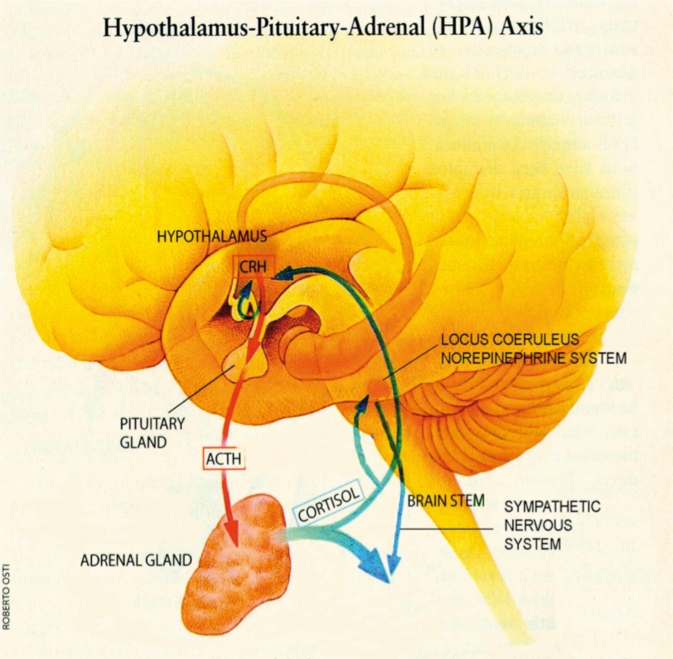
The classic fight-or-flight response to perceived threat is a reflexive nervous phenomenon thai has obvious survival advantages in evolutionary terms. However, the systems that organize the constellation of reflexive survival behaviors following exposure to perceived threat can under some circumstances become dysregulated in the process. Chronic dysregulation of these systems can lead to functional impairment in certain individuals who become "psychologically traumatized" and suffer from post-traumatic stress disorder (PTSD), A body of data accumulated over several decades has demonstrated neurobiological abnormalities in PTSD patients. Some of these findings offer insight into the pathophysiology of PTSD as well as the biological vulnerability of certain populations to develop PTSD, Several pathological features found in PTSD patients overlap with features found in patients with traumatic brain injury paralleling the shared signs and symptoms of these clinical syndromes.
Overview
The claims and statistics of this paper haven’t been checked yet.
Run the check — free, no account needed. It reads the open-access text and checks the sources it cites.
Integrity signals
Registry
Cites
Statistics
Figures
Verification
Claims the paper makes
The claims and statistics of this paper haven’t been checked yet.
Run the check — free, no account needed. It reads the open-access text and checks the sources it cites.
Claims other papers make about this one
Each is checked against this paper’s own text: does it say what the citing paper says it does?
The cited source says what the claim attributes to it.
In the citing paper
“In hippocampal activation, deficits occur while solving the tasks relating to verbal declarative memory (Bremner et al., 2003;Sherin and Nemeroff, 2011).”
From Neuroimaging research in posttraumatic stress disorder – Focus on amygdala, hippocampus and prefrontal cortex (2019) · cites this paper as Sherin and Nemeroff, 2011
Self-check
Percentages, sums and reported differences re-computed from the paper’s own numbers.
The self-check needs the paper’s full text.
Citations
Cites
Lesch, K.-P., Bengel, D., Heils, A., Sabol, S. Z., Greenberg, B. D., Petri, S., Benjamin, J., Müller, C. R., Hamer, D. H., & Murphy, D. L. (1996) · Science · doi:10.1126/science.274.5292.1527 · Cited by 5,162
Nestler, E. J., Barrot, M., DiLeone, R. J., Eisch, A. J., Gold, S. J., & Monteggia, L. M. (2002) · Neuron · doi:10.1016/s0896-6273(02)00653-0 · Cited by 3,217
Serotonin transporter genetic variation and the response of the human amygdala.
Hariri, A. R., Mattay, V. S., Tessitore, A., Kolachana, B., Fera, F., Goldman, D., Egan, M. F., & Weinberger, D. R. (2002) · Science · doi:10.1126/science.1071829 · Cited by 2,340
Heim, C. (2000) · JAMA · doi:10.1001/jama.284.5.592 · Cited by 1,968
Risch, N., Herrell, R., Lehner, T., Liang, K.-Y., Eaves, L., Hoh, J., Griem, A., Kovacs, M., Ott, J., & Merikangas, K. R. (2009) · JAMA · doi:10.1001/jama.2009.878 · Cited by 1,655
Smaller hippocampal volume predicts pathologic vulnerability to psychological trauma
Gilbertson, M. W., Shenton, M. E., Ciszewski, A., Kasai, K., Lasko, N. B., Orr, S. P., & Pitman, R. K. (2002) · Nature Neuroscience · doi:10.1038/nn958 · Cited by 1,635
Sex differences in HPA axis responses to stress: a review
Kudielka, B. M., & Kirschbaum, C. (2005) · Biological Psychology · doi:10.1016/j.biopsycho.2004.11.009 · Cited by 1,624
(1995) · American Journal of Psychiatry · doi:10.1176/ajp.152.7.973 · Cited by 1,610
Rauch, S. L., Shin, L. M., & Phelps, E. A. (2006) · Biological Psychiatry · doi:10.1016/j.biopsych.2006.06.004 · Cited by 1,397
The role of corticotropin-releasing factor in depression and anxiety disorders
Arborelius, L., Owens, M., Plotsky, P., & Nemeroff, C. (1999) · Journal of Endocrinology · doi:10.1677/joe.0.1600001 · Cited by 1,378
Self-citation
Research works printed but not linked: 9
- American Psychiatric Association., 1994, Diagnostic and Statistical Manual of Mental Disorders. 4th ed. Washington, DC: American Psychiatric Association
- Prang AJ., 1999, Psychosom Med., 61, 139, 10.1097/00006842-199903000-00002 · DOI
- Gelpin E., 1996, J Clin Psychiatry., 57, 390
- Wang LX., PLoS One. In press
- Bremner JD., 2008, Prog Brain Res., 167, 171, 10.1016/S0079-6123(07)67012-5 · DOI
- Rauch SL., 2003, Neuroreport., 14, 913
- Nemeroff CB., 2004, J Clin Psychiatry., 65, 18
- Kulka RA., 1990, Trauma and the Vietnam War Generation: Report of Findings from the National Vietnam Veterans Readjustment Study. New York, NY: Brunner/Mazel
- Van Reekum R., 2000, J Neuropsychiatry Clin Neurosci., 12, 316, 10.1176/appi.neuropsych.12.3.316 · DOI
Cited by
Sorted by citations
Medicinal plants in Brazil: Pharmacological studies, drug discovery, challenges and perspectives
Dutra, R. C., Campos, M. M., Santos, A. R. S., & Calixto, J. Β. (2016) · Pharmacological Research · doi:10.1016/j.phrs.2016.01.021 · Cited by 485
Caslini, M., Bartoli, F., Crocamo, C., Dakanalis, A., Clerici, M., & Carrà, G. (2016) · Psychosomatic Medicine · doi:10.1097/psy.0000000000000233 · Cited by 327
Traumatic Childhood Events and Autism Spectrum Disorder
Kerns, C. M., Newschaffer, C. J., & Berkowitz, S. J. (2015) · Journal of Autism and Developmental Disorders · doi:10.1007/s10803-015-2392-y · Cited by 312
Flattening the Curve for Incarcerated Populations — Covid-19 in Jails and Prisons
Akiyama, M. J., Spaulding, A. C., & Rich, J. D. (2020) · New England Journal of Medicine · doi:10.1056/nejmp2005687 · Cited by 273
Parental Advisory: Maternal and Paternal Stress Can Impact Offspring Neurodevelopment
Chan, J. C., Nugent, B. M., & Bale, T. L. (2018) · Biological Psychiatry · doi:10.1016/j.biopsych.2017.10.005 · Cited by 241
Metadata
- Authors
- Sherin, J. E., & Nemeroff, C. B.
- Affiliations
- University of Miami (US)
- Corresponding author
- Sherin, Jonathan E.
- ORCID
- Nemeroff, Charles B.
- Venue
- Dialogues in Clinical Neuroscience
- Publisher
- Informa UK Limited
- Published
- 2011-09-30
- Volume
- 13
- Issue
- 3
- Pages
- 263-278
- ISSN
- 1294-8322 (ISSN-L)
- 1958-5969
- PMC
- PMC3182008
- OpenAlex
- W1548863913
- Cited by
- 750
- References
- 95
- Citations by year
- 2026: 56 · 2025: 76 · 2024: 86 · 2023: 67 · 2022: 55 · 2021: 71 · 2020: 38 · 2019: 54 · 2018: 59 · 2017: 54 · 2016: 40 · 2015: 43 · 2014: 30 · 2013: 15 · 2012: 6
- FWCI
- 17.61
- Type
- journal article
- Language
- en
- Open access
- diamond
- doi.org
- Licence
- Locations
- Dialogues in Clinical Neuroscience (publishedVersion, cc-by-nc-nd)
- Europe PMC (PubMed Central) (publishedVersion, cc-by-nc-nd)
- PubMed Central (publishedVersion, cc-by-nc-nd)
- PubMed (publishedVersion)
- Topics
- Social Sciences › Psychology › Clinical Psychology › Posttraumatic Stress Disorder Research
- Health Sciences › Medicine › Clinical Neurology › Traumatic Brain Injury Research
- Social Sciences › Psychology › Clinical Psychology › Child Abuse and Trauma
- Keywords
- post-traumatic stress disorder, psychological trauma, fight-or-flight response, threat perception, biological vulnerability, pathophysiology, traumatic brain injury
- MeSH terms
- Endocrine System, Humans, Hypothalamo-Hypophyseal System, Neurobiology, Neurochemistry, Risk Factors, Stress Disorders, Post-Traumatic, Stress, Psychological
About these checks
Registry, retraction, Cites and statistics results are computed, not judged, with one exception: a printed reference that no index lists is read once by a model before it counts as a citation error. Claims are extracted by a model and kept only when their quote appears verbatim in the text; each cited source is then checked, with a model’s help, for whether it says what the claim relies on. Those verdicts can be wrong — read the claim’s quote and the cited source before relying on one.
Statistics and arithmetic are recomputed, not judged.
Confidence bands are shown only for fields calibrated on our annotated test set. None is calibrated yet, so no band is shown.
What counts as a claim ›How we measure confidence ›How we check this ›
Are you an author, or do you see a problem with this page? Request a review
