

A lifespan view of anxiety disorders
Open accessThe DOI matches its Crossref record, with a small difference in title or year; 230 of the 230 references it cites were found in a registry or an index.
Abstract
Neurodevelopmental changes over the lifespan, from childhood through adulthood into old age, have important implications for the onset, presentation, course, and treatment of anxiety disorders. This article presents data on anxiety disorders as they appear in older adults, as compared with earlier in life. In this article, we focus on aging-related changes in the epidemiology, presentation, and treatment of anxiety disorders. Also, this article describes some of the gaps and limitations in our understanding and suggests research directions that may elucidate the mechanisms of anxiety disorder development later in life. Finally we describe optimal management of anxiety disorders across the lifespan, in "eight simple steps" for practitioners.
Overview
The claims and statistics of this paper haven’t been checked yet.
Free: it reads the open-access text and checks the first 5 claims that cite a source we can check. Create a free account to check every claim.
Integrity signals
Registry
Cites
Statistics
Figures
Verification
Claims the paper makes
The claims and statistics of this paper haven’t been checked yet.
Free: it reads the open-access text and checks the first 5 claims that cite a source we can check. Create a free account to check every claim.
Claims other papers make about this one
Each is checked against this paper’s own text: does it say what the citing paper says it does?
The source backs part of the claim, not all of it — or backs it for a different population, condition or comparison.
In the citing paper
“However, preliminary results indicate that ACT can be beneficial for treating anxiety problems in older adults, particularly suitable for this population's characteristics (2, 15, 17).”
From Is acceptance and commitment therapy helpful in reducing anxiety symptomatology in people aged 65 or over? A systematic review (2022) · cites this paper as [2]
Experimental — accuracy not yet measuredThe cited source says what the claim attributes to it.
In the citing paper
“Anxiety is recognized as a major health issue and is quite prevalent among older adults.”
From Benefits from one session of deep and slow breathing on vagal tone and anxiety in young and older adults (2021) · cites this paper as [14]
The cited source says what the claim attributes to it.
In the citing paper
“Anxiety-related mental health problems in older adults are among the most persistent, prevalent and impactful (1–3).”
From Is acceptance and commitment therapy helpful in reducing anxiety symptomatology in people aged 65 or over? A systematic review (2022) · cites this paper as [2]
The cited source says what the claim attributes to it.
In the citing paper
“there appears to be a bidirectional association between anxiety and disability (2, 6)”
From Is acceptance and commitment therapy helpful in reducing anxiety symptomatology in people aged 65 or over? A systematic review (2022) · cites this paper as [2]
The check wasn’t confident either way, so it gives no verdict — never disputed.
In the citing paper
“more recent research exploring ACT in older adults suggests that ACT contributes more significantly to alleviating anxious symptoms than traditional cognitive-behavioral techniques (2, 15, 16).”
From Is acceptance and commitment therapy helpful in reducing anxiety symptomatology in people aged 65 or over? A systematic review (2022) · cites this paper as [2]
Experimental — accuracy not yet measured
1 more claim about this paper
Create a free account to see every claim other papers make about this one.
Self-check
Percentages, sums and reported differences re-computed from the paper’s own numbers.
The self-check needs the paper’s full text.
Citations
Cites
The benefits of being present: Mindfulness and its role in psychological well-being
Brown, K. W., & Ryan, R. M. (2003) · Journal of Personality and Social Psychology · doi:10.1037/0022-3514.84.4.822 · Cited by 13,448
The assessment of anxiety states by rating
HAMILTON, M. (1959) · British Journal of Medical Psychology · doi:10.1111/j.2044-8341.1959.tb00467.x · Cited by 11,455
Sapolsky, R. M., Romero, L. M., & Munck, A. U. (2000) · Endocrine Reviews · doi:10.1210/edrv.21.1.0389 · Cited by 7,541
Sapolsky, R. M. (2000) · Endocrine Reviews · doi:10.1210/er.21.1.55 · Cited by 7,533
Using Self-Report Assessment Methods to Explore Facets of Mindfulness
Baer, R. A., Smith, G. T., Hopkins, J., Krietemeyer, J., & Toney, L. (2006) · Assessment · doi:10.1177/1073191105283504 · Cited by 7,511
Protective and Damaging Effects of Stress Mediators
McEwen, B. S. (1998) · New England Journal of Medicine · doi:10.1056/nejm199801153380307 · Cited by 6,733 · cited 1×
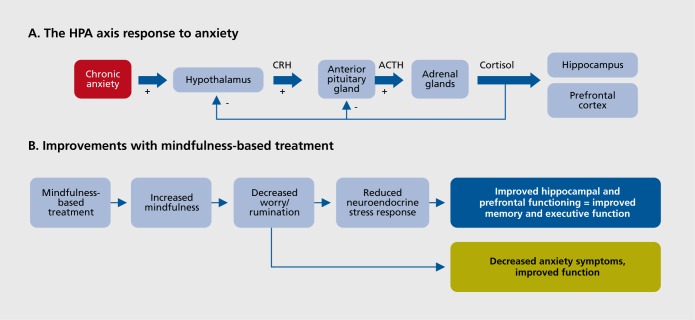
“The aging brain is less able to downregulate the HPA axis(51-56) and is more vulnerable to physiological insults.(57,58) As a result, in older adults, chronic anxiety can cause HPA axis hyperactivity,(59-64) with deleterious effects on memory and executive function.”
Ecological momentary assessment
Shiffman, S., Stone, A. A., & Hufford, M. R. (2008) · Annual Review of Clinical Psychology · doi:10.1146/annurev.clinpsy.3.022806.091415 · Cited by 6,454
The effect of mindfulness based therapy on anxiety and depression: A meta analytic review
Hofmann, S. G., Sawyer, A. T., Witt, A. A., & Oh, D. (2010) · Journal of Consulting and Clinical Psychology · doi:10.1037/a0018555 · Cited by 3,846
The empirical status of cognitive-behavioral therapy: A review of meta-analyses
Butler, A. C., Chapman, J. E., Forman, E. M., & Beck, A. T. (2006) · Clinical Psychology Review · doi:10.1016/j.cpr.2005.07.003 · Cited by 3,215
Accelerated telomere shortening in response to life stress
Epel, E. S., Blackburn, E. H., Lin, J., Dhabhar, F. S., Adler, N. E., Morrow, J. D., & Cawthon, R. M. (2004) · Proceedings of the National Academy of Sciences · doi:10.1073/pnas.0407162101 · Cited by 3,002
Research works printed but not linked: 5
- Mohlman J. Bryant C. Lenze EJ. et al. Improving recognition of late life anxiety disorders in DSM-V: observations and recommendations of the Advisory Committee to the Lifespan Disorders Work Group. Int J Geriatr Psychiatry. In press. PMC4048716 21773996
- Blazer D. George KL. Hughes D. The epidemiology of anxiety disorders: an age comparison. In: Salzman C LB, ed. Anxiety in the Elderly: Treatment and Research. New York, NY: Springer. 1991 17 30
- Slater CH. Bick D. Quality of Life Research: An International Journal of Quality of Life Aspects of Treatment, Care and Rehabilitation. JAMA. 1994 271 1377
- Kamarck TW. Shiftman S. Wethington E. Contrada RJ. Baum A. Measuring Psychosocial Stress Using Ecological Momentary Assessment Methods. New York, NY: Springer Publishing Co; 2011
- Goldin PR. Gross JJ. Effects of mindfulness-based stress reduction (MBSR) on emotion regulation in social anxiety disorder. Emotion. 2010 10 83 91 20141305 PMC4203918 · DOI · Paper page
Cited by
Items 201–227 of 227
America's First Public High School.
Carroll, R. (1975) · American education
STUDI LITERATUR: PENGARUH LATIHAN FISIK TERHADAP PENURUNAN KECEMASAN PADA LANSIA
Tehuayo, S. A., Olla, M. B., & Rauf, S. (2021) · Jurnal Keperawatan Indonesia Timur (East Indonesian Nursing Journal) · doi:10.32695/jkit.v1i2.208 · Cited by 2
Global Epidemiology, Etiology, and Treatment
Wittenborn, A. K., Lachmar, E. M., Huerta, P. L., Mitchell, E. A., & Tseng, C. (2020) · Wiley eBooks · doi:10.1002/9781119788409.ch10
Heo, J., & Noh, O. K. (2020) · Research Square · doi:10.21203/rs.3.rs-16154/v1
Pachana, N. A. (2018) · Oxford University Press eBooks · doi:10.1093/obo/9780199828340-0205
Ivaşcu, L., Arulanandam, B. V., Artene, A. E., Selvarajah, P., Ching, L. F., & Ragunathan, C. D. (2022) · Frontiers in Psychology · doi:10.3389/fpsyg.2022.990192
Ferenbach, C. (2020) · FPOP Bulletin Psychology of Older People · doi:10.53841/bpsfpop.2020.1.150.35
Caldirola, D., Donatis, D. D., Alciati, A., Daccò, S., & Perna, G. (2023) · Expert Review of Neurotherapeutics · doi:10.1080/14737175.2023.2254938
Elizabeth Stein, M., Halverson, J. L., & Manderscheid, R. (2023) · American Public Health Association eBooks · doi:10.2105/9780875533377ch19
Hudock, J., & Kenney, J. W. (2023) · bioRxiv (Cold Spring Harbor Laboratory) · doi:10.1101/2023.11.03.565457
Balkrishna, A., Gupta, A., Ghosh, S., Om, R., & Arya, V. (2023) · doi:10.22541/au.170293715.51976421/v1
Slavin‐Stewart, C., Hategan, A., Sarin, S., & Samaan, Z. (2024) · Springer eBooks · doi:10.1007/978-3-031-47802-4_12
Mehra, L. M., Hajcak, G., & Meyer, A. (2024) · Biological Psychology · doi:10.1016/j.biopsycho.2024.108790 · Cited by 1
Panik Bozukluğun Bilişsel Davranışçı Vaka Formülasyonu
Aslan, B. (2025) · Türkiye Bütüncül Psikoterapi Dergisi · doi:10.56955/bpd.1499866
Trajectories of mental disorders from early to late adulthood
Fung, A. W. T., Lee, A. T. C., & LAM, L. C. W. (2025) · Oxford University Press eBooks · doi:10.1093/med/9780198874799.003.0016
Suicide in the Older Adults: A Comparative Review of Indian and International Perspectives
Khanna, A., & Jain, S. (2025) · Springer eBooks · doi:10.1007/978-981-96-1403-5_16
Anxiety, brain structure and socioeconomic status in middle-aged and older adultsPreprint
Johns, S., Lea‐Carnall, C., Shryane, N. M., & Maharani, A. (2025) · medRxiv · doi:10.1101/2025.04.14.25325776
Yoshioka, K., & Rossetto, A. (2025) · Aging & Mental Health · doi:10.1080/13607863.2025.2519613
Symptoms of Depression and Anxiety among Myopes: A Systematic Review and Meta-Analysis
Kyei, S., Asiamah, R., Owusu, G., & Ampiah, E. E. (2026) · British and Irish Orthoptic Journal · doi:10.22599/bioj.500
Tian, Y., Guo, W., Tian, Y., & Shan, Q. (2026) · Physiology & Behavior · doi:10.1016/j.physbeh.2026.115360
López, J., Noriega, C., Medrano‐Martínez, P., & Pérez-Rojo, G. (2026) · Archives of Gerontology and Geriatrics · doi:10.1016/j.archger.2026.106290
The Change of Diagnosis from Panic Disorder to Generalized Anxiety Disorder in the Elderly
Nashira, E. A., Algristian, H., & Kasiani, T. N. (2026) · Sinergi International Journal of Psychology · doi:10.61194/psychology.v4i2.979
Olatunji, B. O., Beam, C. R., & Cole, D. A. (2026) · Journal of Affective Disorders · doi:10.1016/j.jad.2026.122075
Altersbedingte Besonderheiten der Symptomatik
(2024) · Elsevier eBooks · doi:10.1016/b978-3-437-21372-4.00002-0
Mertens, A. T., & Doucet, G. E. (2026) · Frontiers in Psychiatry · doi:10.3389/fpsyt.2026.1797635
Dimitrov, N., Brähler, E., Hinz, A., Schmalbach, B., Fegert, J. M., & Zenger, M. (2026) · BMC Geriatrics · doi:10.1186/s12877-026-08172-5
Zhang, X., & Shi, Y. (2026) · Frontiers in Psychology · doi:10.3389/fpsyg.2026.1917045
Metadata
- Authors
- Lenze, E. J., & Wetherell, J. L.
- Affiliations
- Washington University in St. Louis (US)
- University of California San Diego (US)
- Corresponding author
- Lenze, Eric J.
- Venue
- Dialogues in Clinical Neuroscience
- Publisher
- Informa UK Limited
- Published
- 2011-12-31
- Volume
- 13
- Issue
- 4
- Pages
- 381-399
- ISSN
- 1294-8322 (ISSN-L)
- 1958-5969
- PMC
- PMC3263387
- OpenAlex
- W4296300777
- Cited by
- 227
- References
- 214
- Citations by year
- 2026: 9 · 2025: 15 · 2024: 20 · 2023: 20 · 2022: 13 · 2021: 22 · 2020: 25 · 2019: 17 · 2018: 16 · 2017: 24 · 2016: 15 · 2015: 10 · 2014: 10 · 2013: 9 · 2012: 1
- FWCI
- 8.24
- Type
- journal article
- Language
- en
- Open access
- diamond
- doi.org
- Licence
- Locations
- Dialogues in Clinical Neuroscience (publishedVersion, cc-by-nc-nd)
- PubMed Central (publishedVersion, cc-by-nc-nd)
- PubMed (publishedVersion)
- PubMed
- Funders
- National Institute of Mental Health (R34MH080151, R34MH086668, R01MH083648)
- Topics
- Social Sciences › Psychology › Experimental and Cognitive Psychology › Anxiety, Depression, Psychometrics, Treatment, Cognitive Processes
- Social Sciences › Psychology › Clinical Psychology › Child and Adolescent Psychosocial and Emotional Development
- Health Sciences › Medicine › Psychiatry and Mental health › Mental Health Treatment and Access
- Keywords
- anxiety disorders, aging, lifespan development, older adults, brain development, anxiety disorder treatment
- MeSH terms
- Aged, Aging, Anxiety Disorders, Humans, Psychotherapy, Anti-Anxiety Agents, Prevalence
About these checks
Registry, retraction, Cites and statistics results are computed, not judged, with one exception: a printed reference that no index lists is read once by a model before it counts as a citation error. Claims are extracted by a model and kept only when their quote appears verbatim in the text; each cited source is then checked, with a model’s help, for whether it says what the claim relies on. Those verdicts can be wrong — read the claim’s quote and the cited source before relying on one.
Statistics and arithmetic are recomputed, not judged.
Confidence bands are shown only for fields calibrated on our annotated test set. None is calibrated yet, so no band is shown.
What counts as a claim ›How we measure confidence ›How we check this ›
Are you an author, or do you see a problem with this page? Request a review
Data sources
Bibliographic data: Semantic Scholar, OpenAlex, Crossref.
Contains information from the Semantic Scholar Academic Graph Datasets, made available under the ODC Attribution License (ODC-BY 1.0).
Semantic Scholar’s data is described in: Kinney, R., et al. (2023). The Semantic Scholar Open Data Platform. arXiv:2301.10140.
