

Physiological correlates of bereavement and the impact of bereavement interventions
Open accessThe DOI matches its Crossref record; 69 of the 69 references it cites were found in a registry or an index.
Abstract
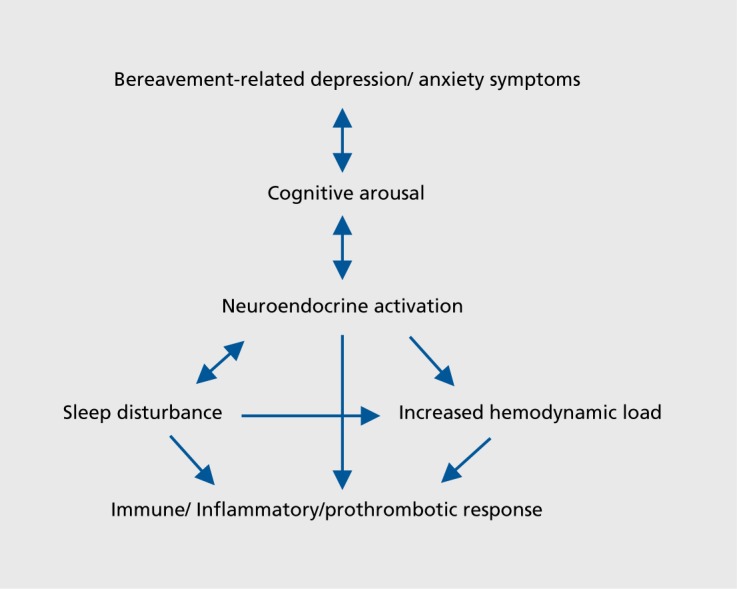
The death of a loved one is recognized as one of life's greatest stresses, with reports of increased mortality and morbidity for the surviving spouse or parent, especially in the early months of bereavement. The aim of this paper is to review the evidence to date to identify physiological changes in the early bereaved period, and evaluate the impact of bereavement interventions on such physiological responses, where they exist. Research to date suggests that bereavement is associated with neuroendocrine activation (cortisol response), altered sleep (electroencephalography changes), immune imbalance (reduced T-lymphocyte proliferation), inflammatory cell mobilization (neutrophils), and prothrombotic response (platelet activation and increased vWF-ag) as well as hemodynamic changes (heart rate and blood pressure), especially in the early months following loss. Additional evidence suggests that bereavement interventions have the potential to be of value in instances where sleep disturbance becomes a prolonged feature of complicated grief, but have limited efficacy in maintaining immune function in the normal course of bereavement.
Overview
The claims and statistics of this paper haven’t been checked yet.
Free: it reads the open-access text and checks the first 5 claims that cite a source we can check. Create a free account to check every claim.
Integrity signals
Registry
Cites
Statistics
Figures
Verification
Claims the paper makes
The claims and statistics of this paper haven’t been checked yet.
Free: it reads the open-access text and checks the first 5 claims that cite a source we can check. Create a free account to check every claim.
Claims other papers make about this one
Each is checked against this paper’s own text: does it say what the citing paper says it does?
The source backs part of the claim, not all of it — or backs it for a different population, condition or comparison.
In the citing paper
“Persistent grief reactions have been associated with marked occupational and social impairment 56 , impaired sleep 57 , increased rates of cancer and cardiovascular problems 58 and other medical conditions 59 , and poor health behaviours, such as increased alcohol and tobacco use 60,61 .”
From Emerging experience with selected new categories in the ICD‐11: complex PTSD, prolonged grief disorder, gaming disorder, and compulsive sexual behaviour disorder (2022) · cites this paper as [58]
Experimental — accuracy not yet measuredThe cited source says what the claim attributes to it.
In the citing paper
“Impaired sleep is a common problem in bereaved individuals (Buckley et al., 2012; Hardison et al., 2005; Lancel et al., 2020).”
From Feasibility and preliminary efficacy of guided internet-delivered cognitive behavioral therapy for insomnia after the loss of a child to cancer: Randomized controlled trial (2021) · cites this paper as Buckley et al., 2012
Self-check
Percentages, sums and reported differences re-computed from the paper’s own numbers.
The self-check needs the paper’s full text.
Citations
Cites
Inflammation, aspirin, and the risk of cardiovascular disease in apparently healthy men
Ridker, P. M., Cushman, M., Stampfer, M. J., Tracy, R. P., & Hennekens, C. H. (1997) · New England Journal of Medicine · doi:10.1056/nejm199704033361401 · Cited by 5,504 · cited 1×
“While the significance of increased leukocytes in bereavement is unclear to date, inflammation plays a significant role in atherosclerosis, and inflammatory markers, including leukocytes, correlate with cardiovascular mortality.(40,41)”
Psychological stress and the human immune system: a meta-analytic study of 30 Years of inquiry
Segerstrom, S. C., & Miller, G. E. (2004) · Psychological Bulletin · doi:10.1037/0033-2909.130.4.601 · Cited by 3,334
Inventory of complicated grief: a scale to measure maladaptive symptoms of loss.
Prigerson, H. G., Maciejewski, P. K., Reynolds, C. F., Bierhals, A. J., Newsom, J. T., Fasiczka, A., Frank, E., Doman, J., & Miller, M. (1995) · Psychiatry Research · doi:10.1016/0165-1781(95)02757-2 · Cited by 1,582
DEPRESSED LYMPHOCYTE FUNCTION AFTER BEREAVEMENT
Bartrop, R. W., Lazarus, L., Luckhurst, E., Kiloh, L. G., & Penny, R. (1977) · The Lancet · doi:10.1016/s0140-6736(77)92780-5 · Cited by 932 · cited 1×
“Response to the mitogenic stimulant phytohemagglutinin (PHA) was significantly depressed in the bereaved group at 6 weeks after bereavement, but not at the 2-week assessment.(32) Since this study, altered T-cell responses have been reported following the death of a loved one at 1 month following loss of a spouse,(33)…”
Self-citationTraumatic grief as a risk factor for mental and physical morbidity
(1997) · American Journal of Psychiatry · doi:10.1176/ajp.154.5.616 · Cited by 693
Sleep and depression--results from psychobiological studies: an overview
Riemann, D., Berger, M., & Voderholzer, U. (2001) · Biological Psychology · doi:10.1016/s0301-0511(01)00090-4 · Cited by 653 · cited 1×
“In bereavement, reduced sleep time, likely a result of an increased hypothalamic-pituitary-adrenal axis activation, may exacerbate depressive symptoms since a strong bidirectional relationship between sleep and depression has been previously suggested.(26) While sleep disturbance can become persistent and debilitating…”
Suppression of Lymphocyte Stimulation Following Bereavement
Schleifer, S. J. (1983) · JAMA: The Journal of the American Medical Association · doi:10.1001/jama.1983.03340030034024 · Cited by 643
Healthy Older Adults’ Sleep Predicts All-Cause Mortality at 4 to 19 Years of Follow-Up
Dew, M. A., Hoch, C. C., Buysse, D. J., Monk, T. H., Begley, A. E., Houck, P. R., Hall, M., Kupfer, D. J., & Reynolds, C. F. (2003) · Psychosomatic Medicine · doi:10.1097/01.psy.0000039756.23250.7c · Cited by 587
Sleep Research in Affective Illness: State of the Art Circa 1987
Reynolds, C. F., & Kupfer, D. J. (1987) · Sleep · doi:10.1093/sleep/10.3.199 · Cited by 465 · cited 1×
“It is not surprising that disturbed sleep patterns are a prominent feature of bereavement, as sleep disturbance is a prominent feature of depressive symptomatology, affecting more than 80% of people experiencing depression.(24,25) In bereavement, reduced sleep time, likely a result of an increased hypothalamic-pituita…”
Research works printed but not linked: 1
- Spratt ML. Denney DR. Immune variables, depression, and plasma cortisol over time in suddenly bereaved parents. J Neuropsychiatry Clin Neurosci. 1991 3 299 306 1821246 · DOI · Paper page
Cited by
Items 101–187 of 187
Exploratory study of salivary cortisol levels among Syrian refugee children
Dalou, A. Y. A., Ababneh, L. A., Thum, E., & Flinn, M. V. (2025) · Psychoneuroendocrinology · doi:10.1016/j.psyneuen.2025.107443 · Cited by 3
Killikelly, C., & Maercker, A. (2022) · Springer eBooks · doi:10.1007/978-3-662-64057-9_4 · Cited by 3
The association between adverse events in later life and mortality in older individuals
Nilaweera, D., Gurvich, C., Freak‐Poli, R., Woods, R. L., Owen, A. J., McNeil, J. J., Nelson, M. R., Stocks, N. P., & Ryan, J. L. (2023) · Comprehensive Psychoneuroendocrinology · doi:10.1016/j.cpnec.2023.100210 · Cited by 3
“In terms of physiological responses to losing a spouse, increased levels of cortisol have been reported as a short-term effect of spousal loss [33].”
Highlights on Several Underestimated Topics in Palliative Care
Cascella, M. (2017) · InTech eBooks · doi:10.5772/63659 · Cited by 3
Emir, B. S., Yıldız, S., Kılıçaslan, A. K., Uğur, K., & Kurt, O. (2022) · Journal of Medical Topics and Updates · doi:10.5281/zenodo.7476198 · Cited by 3
Diabetes, Palliative and End-of-Life Care
Dunning, T. L. (2017) · InTech eBooks · doi:10.5772/67192 · Cited by 3
The Role of Massage in Bereavement: A Scoping Review
Fogarty, S., & Hay, P. (2019) · OBM Integrative and Complementary Medicine · doi:10.21926/obm.icm.1904058 · Cited by 3
Corless, I. B., & Meisenhelder, J. B. (2019) · Oxford University Press eBooks · doi:10.1093/med/9780190862374.003.0031 · Cited by 3
Psychotherapy for Pregnancy Loss: Applying Relationship Science to Clinical Practice
Markin, R. D. (2023) · doi:10.1093/oso/9780197693353.001.0001 · Cited by 2
Macaque mothers’ responses to the deaths of their infants
Johnson, E. A., Talyigás, F., & Carter, A. J. (2025) · Biology Letters · doi:10.1098/rsbl.2024.0484 · Cited by 2
“Similarly, bereaved humans who are grieving secrete higher levels of cortisol [15,16].”
Esmailnia, S., Ensan, N., Prigerson, H. G., & Killikelly, C. (2026) · Death Studies · doi:10.1080/07481187.2026.2693542 · Cited by 2
Psychological functioning and bereavement care needs of bereaved Chinese immigrants in Canada
Ho, G. H.-Y. (2017) · Summit (Simon Fraser University) · Cited by 3
Dewi, D., Prawesti, A., & Emaliyawati, E. (2019) · Padjadjaran Acute Care Nursing Journal · doi:10.24198/pacnj.v1i1.24818 · Cited by 2
Identifying bereaved grievers with greatest medical or social service needs in Japan
Becker, C., Taniyama, Y., Kondo‐Arita, M., Sasaki, N., Yamada, S., & Yamamoto, K. (2022) · Family Medicine and Community Health · doi:10.1136/fmch-2021-001260 · Cited by 2
Güler, Y., Genç, Ö., Yıldırım, A., Erdoğan, A., Akgün, H., Acar, G., Güler, A., & Kırma, C. (2024) · Journal of Human Hypertension · doi:10.1038/s41371-024-00920-7 · Cited by 2
McGill, G., Allen, S., Osborne, A. K., & Gates, J. R. (2025) · Family Court Review · doi:10.1111/fcre.70020 · Cited by 2
Evangelista, N. D., Kohn, J. N., Patapoff, M. A., Shin, J., & Jester, D. J. (2026) · Journal of the American Medical Directors Association · doi:10.1016/j.jamda.2025.106078 · Cited by 2
Caregivers’ Loss of the Dyadic Experience after Their Care Partners’ Death
Buck, H. G., Lyons, K. S., Barrison, P., Cairns, P. L., Mason, T. M., Tofthagen, C. S., & Kip, K. E. (2021) · Western Journal of Nursing Research · doi:10.1177/0193945921990426 · Cited by 2
“Bereavement research supports that the death of a significant other is one of life’s major stressors, with psychological, physiological, and behavioral effects (Buckley et al., 2012).”
BackgroundKillikelly, C., & Maercker, A. (2019) · Springer eBooks · doi:10.1007/978-3-662-58470-5_4 · Cited by 2
A Study on the Factors Influencing the Psychological Problems of Suicide Survivors
Choi, J.-H., Sung, K. B., & Hwang, T.-Y. (2024) · 신경정신의학 · doi:10.4306/jknpa.2024.63.2.140 · Cited by 2
The therapist in crisis : experiencing the therapeutic process after personal loss
Horwell, A. (2018) · Middlesex University Research Repository (Middlesex University Of London) · Cited by 2
Mason, T. M. (2021) · Digital Commons - University of South Florida (University of South Florida) · Cited by 2
Romero Javier, V. (2018) · Docta Complutense (Universidad Complutense de Madrid) · Cited by 2
Villazor, J., & Guzman, R. D. (2022) · Journal of Education Management and Development Studies · doi:10.52631/jemds.v2i1.59 · Cited by 1
Strand, B. H., Haberg, A. K., Eyjólfsdóttir, H. S., Kok, A. A. L., Skirbekk, V., Huxhold, O., Løset, G. K., Lennartsson, C., Schirmer, H., Herlofson, K., et al. (2024) · GeroScience · doi:10.1007/s11357-024-01150-y · Cited by 1
“The death of a spouse or partner is a life-changing, stressful event linked to increased mortality and morbidity of the surviving partner via several biological pathways [1–3].”
BackgroundEffectiveness of group therapy for prolonged grief symptoms: A systematic review and meta-analysis
Moray, İ. T., Çakır, B., & Kargı, B. (2025) · Death Studies · doi:10.1080/07481187.2025.2559725 · Cited by 1
The death of a child and parents’ frailty in mid to later life: a longitudinal study in China
Su, Q. F., & Cheng, C. (2025) · Death Studies · doi:10.1080/07481187.2025.2608241 · Cited by 1
Larsson, A.-L., Einberg, E., Janlöv, A., & Beck, I. (2026) · Journal of research in nursing · doi:10.1177/17449871261442439 · Cited by 1
“…the risk of depression (Maercker and Lalor, 2022), memory problems (Näsman et al., 2020), permanent cognitive impairment (Pérez et al., 2018), cardiovascular diseases, disorders of the immune system (Buckley et al., 2022) and even death through ‘broken heart’ syndrome (Fagundes and Wu, 2020).”
Palliative and end‐of‐life care
Dunning, T. L., & Sinclair, A. J. (2017) · Wiley eBooks · doi:10.1002/9781118954621.ch33 · Cited by 1
Life Course: Developmental and Transitional Events
Mehta-Naik, N. (2018) · Springer eBooks · doi:10.1007/978-3-319-73078-3_1 · Cited by 1
Der Körper trauert mit: Psychoneuroimmunologie der Trauer
Hagen, C., & Schubert, C. (2017) · Leidfaden · doi:10.13109/leid.2017.6.4.10 · Cited by 1
THE GRIEVING RESPONSE OF CERVICAL CANCER PATIENTS IN A REFERRAL HOSPITAL IN BANDUNG CITY
Nuruliani, A., Sriati, A., & Hermayanti, Y. (2019) · Journal of Maternity Care and Reproductive Health · doi:10.36780/jmcrh.v2i1.62 · Cited by 1
PROLONGED GRIEF AND SOCIAL SUPPORT AMONG BEREAVED YOUNG ADULTS
Huda, N. U., Malik, K., & Ateeq, A. (2024) · IJASOS- International E-journal of Advances in Social Sciences · doi:10.5281/zenodo.10987640 · Cited by 1
Kruse, R. F., Stiel, S., & Schwabe, S. (2024) · OMEGA - Journal of Death and Dying · doi:10.1177/00302228241263367 · Cited by 1
The Working Wounded: HRM Practices to Support Bereaved Employees
Bergeron, D. M. (2025) · Emerald Group Publishing Limited eBooks · doi:10.1108/979-8-88730-816-620251011 · Cited by 1
Neuropsychiatric Aspects of Healthy Aging: an Epidemiological Approach
Milić, J. (2018) · EUR Research Repository (Erasmus University Rotterdam) · Cited by 1
Karl, S. (2018) · OPen Access Repositorium der Universität Ulm (OPARU) (Ulm University) · doi:10.18725/oparu-8467 · Cited by 1
Inflammation, metabolic syndrome, & early life stress in major depression
Zeugmann, S. (2015) · Universitätsbibliothek der FU Berlin Hochschulschriftenstelle u. Dokumentenserver · doi:10.17169/refubium-7364
Seeley, S. H. (2016) · UA Campus Repository (The University of Arizona)
Healing the Grieving Heart: A Journey toward Wholeness
Williams, P. (2018) · Creative Nursing · doi:10.1891/1078-4535.24.2.133
救急外来死亡患者の近親者における複雑性悲嘆の発生予測(Prediction of complicated grief in bereaved at emergency department)
堀雅俊, 則本和伸, 真弓, 藤., まさよ, 三., 成美, 舛., 愛, 岡., & 躍, 出. (2018) · Nihon Kyukyu Igakukai Zasshi Journal of Japanese Association for Acute Medicine · doi:10.1002/jja2.12310
Assessing the role of sleep, grief, anxiety, and depression in a miscarriage population
Gencarelli, A., & Geller, P. A. (2016) · iDEA - Drexel University Institutional Repository · doi:10.17918/etd-6685
Problemy psychiczne po śmierci osoby bliskiej jako przedmiot ekspertyzy sądowej
Cynkier, P. N. (2022) · Archives of Forensic Medicine and Criminology · doi:10.4467/16891716amsik.21.007.15617
Der Körper trauert mit: Psychoneuroimmunologie der Trauer
Hagen, C., & Schubert, C. (2017) · Vandenhoeck & Ruprecht eBooks · doi:10.13109/9783666402906.10
(2016) · Elsevier eBooks · doi:10.1016/b978-3-437-21833-0.16001-2
Tur, C., & Tur Domenech, C. (2023) · Tesis Doctorals en Xarxa (Consorci de Serveis Universitaris de Catalunya) · doi:10.6035/14109.2023.433029
Markin, R. D. (2023) · Oxford University Press eBooks · doi:10.1093/oso/9780197693353.003.0004
Managing Countertransference in Psychotherapy for Pregnancy Loss
Markin, R. D. (2023) · Oxford University Press eBooks · doi:10.1093/oso/9780197693353.003.0007
Markin, R. D. (2023) · Oxford University Press eBooks · doi:10.1093/oso/9780197693353.003.0001
Markin, R. D. (2023) · Oxford University Press eBooks · doi:10.1093/oso/9780197693353.003.0009
Emotion in Psychotherapy for Pregnancy Loss: Mourning as an Affective-Relational Process
Markin, R. D. (2023) · Oxford University Press eBooks · doi:10.1093/oso/9780197693353.003.0005
Markin, R. D. (2023) · Oxford University Press eBooks · doi:10.1093/oso/9780197693353.002.0006
The Alliance in Individual and Couples Therapy for Pregnancy Loss
Markin, R. D. (2023) · Oxford University Press eBooks · doi:10.1093/oso/9780197693353.003.0003
Alliance Rupture and Repair Episodes in Psychotherapy for Pregnancy Loss: An Attachment Perspective
Markin, R. D. (2023) · Oxford University Press eBooks · doi:10.1093/oso/9780197693353.003.0006
Markin, R. D. (2023) · Oxford University Press eBooks · doi:10.1093/oso/9780197693353.003.0002
Markin, R. D. (2023) · Oxford University Press eBooks · doi:10.1093/oso/9780197693353.003.0008
Markin, R. D. (2023) · Oxford University Press eBooks · doi:10.1093/oso/9780197693353.003.0010
Markin, R. D. (2023) · Oxford University Press eBooks · doi:10.1093/oso/9780197693353.002.0003
Martin, H., & Weisfeld, C. C. (2024) · Oxford University Press eBooks · doi:10.1093/oxfordhb/9780197544754.013.27
Ione, A. (2024) · Springer eBooks · doi:10.1007/978-3-031-55440-7_1
Psychoneuroimmunology of the Perceived Social Isolation/Loneliness
Vlachos, I. I., Ayres, C., Huber, M., Jacoby, M., Oikonomopoulos, A., Psara, E., & Cambanis, A. (2024) · Integrated science · doi:10.1007/978-3-031-73061-0_13
OS EFEITOS DO LUTO NO SISTEMA CARDIOVASCULAR DE PESSOAS IDOSAS: UMA REVISÃO NARRATIVA
de Abreu, B. L. M., & Salles, R. J. (2025) · Congresso Nacional Interdisciplinar de Saúde Coletiva · doi:10.51161/iii-conasc/57686
Barros-Lane, L. (2025) · The Conversation · doi:10.64628/aai.mydj3vr5f
Penberthy, J. K. (2024) · The Conversation · doi:10.64628/aai.6fkt3r7es
Modern perspectives on loss and grief: emerging concepts, diagnosis, and therapeutic approaches
Khaustova, O. O., Skrynnyk, O. V., & Zelenko, Y. (2025) · INTERNATIONAL NEUROLOGICAL JOURNAL · doi:10.22141/2224-0713.21.6.2025.1210
Social Health and Mortality Risk Following Bereavement: A Systematic Scoping Review
Hardt, M. M., Smith, K. V., Winoker, H., Rogers, M., Kolla, S., Maciejewski, P. K., & Prigerson, H. G. (2025) · Journal of Palliative Medicine · doi:10.1177/10966218251395423
Behringer, K. F. (2025) · Aquila Digital Community (University of Southern Mississippi)
Orman yangınlarına müdahale eden bireylerde ekolojik yas deneyimlerini anlamak
Çay, K. N. (2024) · OpenMETU (Middle East Technical University)
Neuromodulation of Pair Bonding and Bond Loss in Monogamous Prairie Voles
Pierce, A. (2023) · CU Scholar (University of Colorado Boulder)
Koh, K. B. (2026) · Springer eBooks · doi:10.1007/978-3-032-11214-9_3
Grief‐Related Chest Pain: A Review, Conceptual Analysis, and Integrative Model
Evstigneev, S. R., Wilhelm, F. H., Slavich, G. M., Blum, D., & Seiler, A. (2026) · Psychophysiology · doi:10.1111/psyp.70248
“…side effects such as electrical instability of the heart, transient myocardial ischemia, plaque disruption, thrombus formation, ventricular fibrillation, myocardial infarction, pulmonary embolism, or stroke (Buckley, Sunari, et al. 2012; Carey et al. 2014; Kivimäki and Steptoe 2018).”
Life After Sudden Partner Loss: Health and Economic Consequences for Sole Parents in New Zealand
Reid, P. (2025) · Tuwhera (Auckland University of Technology)
Cheatley, L. E. (2021) · Discovery Research Portal (University of Dundee)
Divorce Experience of Middle-Aged Women
Pauliukienė, A. (2022) · Lithuanian University of Health Sciences
Francois, T. L. (2025) · theses.fr (ABES) · doi:10.70675/e84e51caz6a3az40a4z8721z9edbb0792ace
Psychological Aspects of Widowhood in Old Age
Lodha, P., & Sousa, A. D. (2026) · Springer eBooks · doi:10.1007/978-981-95-2121-0_37
Death of a Spouse in Old Age: Psychosocial Aspects
Dokhania, P., & Trivedi, R. (2026) · Springer eBooks · doi:10.1007/978-981-95-2121-0_57
Gao, Y., Burns, R., Leach, L., Chilver, M. R., & Butterworth, P. (2026) · Research Square · doi:10.21203/rs.3.rs-9497267/v1
Suk, L. J., & Kwan, C. J. (2026) · Modern Psychophysiology. Vibraimage Technology International Scientific and Technical Conference · doi:10.25696/elsys_mpvt_09_en06
Tsipper, I., & Ifrah, K. (2026) · Death Studies · doi:10.1080/07481187.2026.2704572
The dimensionality and somatisation correlates of ICD-11 prolonged grief disorder
McCusker, P., Killikelly, C., O'Connor, M., McBride, O., Cunningham, J. M., Murphy, J., Duffy, M., & Shevlin, M. E. (2026) · European Journal of Psychotraumatology · doi:10.1080/20008066.2026.2702687
Finality and Continuity: What Drives Bereaved Parents to Choose Posthumous Sperm Retrieval
Doft, Y., Leichtentritt, R. D., Pitcho‐Prelorentzos, S., & Shamir, M. M. (2026) · Family Relations · doi:10.1111/fare.70321
Paynter, M. (2025) · Digital Commons - DU (University of Denver) · doi:10.56902/etdcrp.2025.204
Beeris, C., Niemeijer, A. R., Bisseling, R., & Machielse, A. (2025) · Ageing and Society · doi:10.1017/s0144686x26100944
“It is associated with suffering, health decline and increased mortality (Lee and Carr 2007; Manzoli et al. 2007; Jones et al. 2010; van den Berg et al. 2011; Buckley et al. 2012; Utz et al. 2012; Holland et al. 2013; Shear et al. 2013; Ang 2023).”
Solberg, M. A., Giang, C., Kcomt, L., Dickinson, K., Tennant, M., Touchard, M., Evans‐Polce, R. J., Saylor, K., & McCabe, S. E. (2026) · Deep Blue (University of Michigan) · doi:10.7302/dspace/30366
AS BASES NEURAIS DO LUTO E SEUS IMPACTOS NA SAÚDE MENTAL NA PERSPECTIVA DA NEUROCIÊNCIA
Teixeira, A. D. S., & Corrêa, R. (2026) · Revista Tópicos · doi:10.70773/revistatopicos/792897651
Kang, M., Bohorquez-Montoya, L., McAuliffe, T., Claesges, S. A., Blair, N.-O., Sauber, G., III., C. F. R., Hillard, C. J., & Goveas, J. S. (2021) · doi:10.3389/fpsyt.2021.783187.s001
Metadata
- Authors
- Buckley, T., Sunari, D., Marshall, A., Bartrop, R., McKinley, S., & Tofler, G.
- Affiliations
- The University of Sydney (AU)
- University of Technology Sydney (AU)
- Corresponding author
- Buckley, Thomas
- Venue
- Dialogues in Clinical Neuroscience
- Publisher
- Informa UK Limited
- Published
- 2012-06-30
- Volume
- 14
- Issue
- 2
- Pages
- 129-139
- ISSN
- 1294-8322 (ISSN-L)
- 1958-5969
- PMC
- PMC3384441
- OpenAlex
- W1505503209
- Cited by
- 160
- References
- 69
- Citations by year
- 2026: 10 · 2025: 16 · 2024: 13 · 2023: 21 · 2022: 16 · 2021: 14 · 2020: 14 · 2019: 12 · 2018: 10 · 2017: 11 · 2016: 7 · 2015: 3 · 2014: 9 · 2013: 3 · 2012: 1
- FWCI
- 5.79
- Type
- journal article
- Language
- en
- Open access
- diamond
- doi.org
- Licence
- Locations
- Dialogues in Clinical Neuroscience (publishedVersion, cc-by-nc-nd)
- Europe PMC (PubMed Central) (publishedVersion, cc-by-nc-nd)
- PubMed Central (publishedVersion, cc-by-nc-nd)
- PubMed (publishedVersion)
- Griffith Research Online (submittedVersion)
- OPUS - Open Publications of UTS Scholars (University of Technology Sydney) (submittedVersion)
- Topics
- Social Sciences › Psychology › Clinical Psychology › Grief, Bereavement, and Mental Health
- Social Sciences › Anthropology › Death, Funerary Practices, and Mourning
- Life Sciences › Neuroscience › Behavioral Neuroscience › Stress Responses and Cortisol
- Keywords
- bereavement, grief, cortisol, neuroendocrine activation, sleep disorders, EEG, T cell proliferation, immune function, neutrophils, platelet activation, von Willebrand factor, hemodynamic changes, heart rate, blood pressure, complicated grief, bereavement interventions
- MeSH terms
- Bereavement, Blood Pressure, Grief, Heart Rate, Humans, Hydrocortisone, Immune System, Sleep Wake Disorders, Stress, Psychological
About these checks
Registry, retraction, Cites and statistics results are computed, not judged, with one exception: a printed reference that no index lists is read once by a model before it counts as a citation error. Claims are extracted by a model and kept only when their quote appears verbatim in the text; each cited source is then checked, with a model’s help, for whether it says what the claim relies on. Those verdicts can be wrong — read the claim’s quote and the cited source before relying on one.
Statistics and arithmetic are recomputed, not judged.
Confidence bands are shown only for fields calibrated on our annotated test set. None is calibrated yet, so no band is shown.
What counts as a claim ›How we measure confidence ›How we check this ›
Are you an author, or do you see a problem with this page? Request a review
Data sources
Bibliographic data: Semantic Scholar, OpenAlex, Crossref.
Contains information from the Semantic Scholar Academic Graph Datasets, made available under the ODC Attribution License (ODC-BY 1.0).
Semantic Scholar’s data is described in: Kinney, R., et al. (2023). The Semantic Scholar Open Data Platform. arXiv:2301.10140.
