

Impact of oral vitamin C on histamine levels and seasickness
Open accessThe DOI matches its Crossref record; 13 of the 13 references it cites were found in a registry or an index.
Abstract
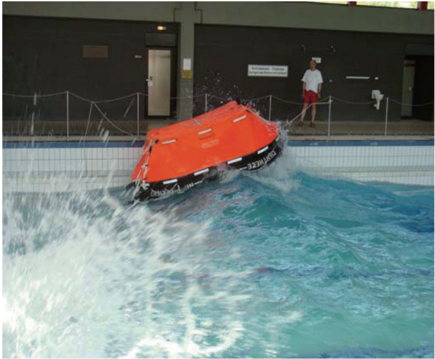
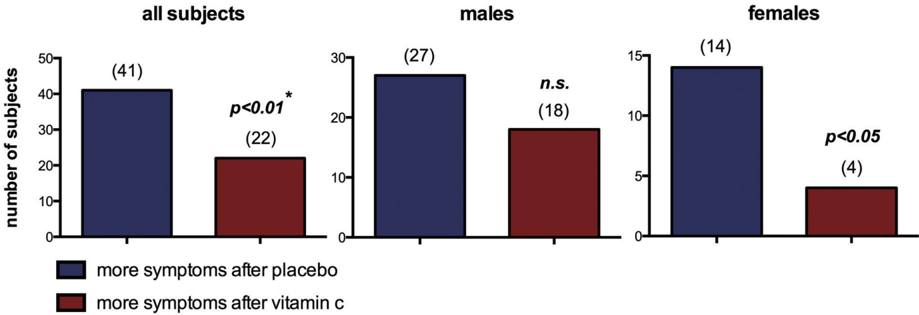
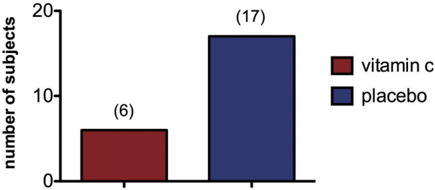
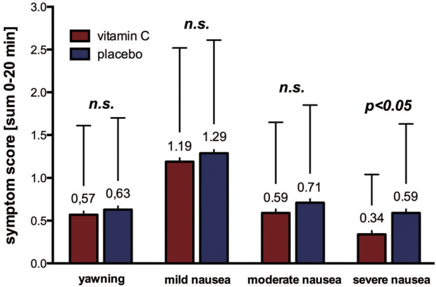
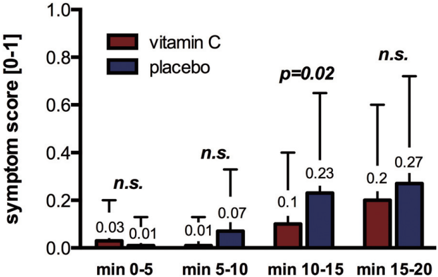
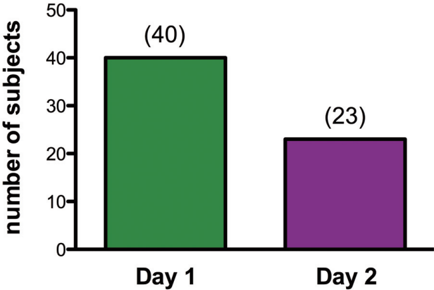
BACKGROUND: Seasickness is a risk aboard a ship. Histamine is postulated as a causative agent, inversely related to the intake of vitamin C. Persons with mastocytosis experienced improvement of nausea after the intake of vitamin C. OBJECTIVE: To determine whether vitamin C suppresses nausea in 70 volunteers who spent 20 minutes in a life raft, exposed to one-meter-high waves in an indoor pool. METHOD: Double-blind placebo-controlled crossover study. Two grams of vitamin C or placebo was taken one hour before exposure. Blood samples were taken one hour before and after exposure to determine histamine, diamine oxidase, tryptase, and vitamin C levels. Symptom scores were noted on a visual analog scale. On the second day the test persons were asked which day they had felt better. RESULTS: Seven persons without symptoms were excluded from the analysis. Test persons had less severe symptoms after the intake of vitamin C (p < 0.01). Scores on the visual analog scale were in favor of vitamin C, but the difference was not significant. Twenty-three of 63 persons wished to leave the raft earlier: 17 after the intake of placebo and 6 after the intake of vitamin C (p < 0.03). Women (p < 0.02) and men below 27 years of age (p < 0.02) had less pronounced symptoms after the intake of vitamin C. Histamine (p < 0.01) and DAO levels were increased after the intake of vitamin C (p < 0.001) and after placebo (n.s.). The fact that the second test day was rated less stressful by most volunteers is indicative of habituation. CONCLUSIONS: Some of the data show that vitamin C is effective in suppressing symptoms of seasickness, particularly in women and men younger than 27 years of age, and is devoid of side effects. Histamine levels were initially increased after the test persons had been exposed to waves.
Overview
The claims and statistics of this paper haven’t been checked yet.
Free: it reads the open-access text and checks the first 5 claims that cite a source we can check. Create a free account to check every claim.
Integrity signals
Registry
Cites
Statistics
Figures
Verification
Claims the paper makes
The claims and statistics of this paper haven’t been checked yet.
Free: it reads the open-access text and checks the first 5 claims that cite a source we can check. Create a free account to check every claim.
Claims other papers make about this one
Each is checked against this paper’s own text: does it say what the citing paper says it does?
The cited source says what the claim attributes to it.
In the citing paper
“A recent double-blind, placebo-controlled crossover study found that vitamin C was effective in suppressing symptoms of seasickness, particularly in youngsters [160].”
From Motion Sickness: Current Knowledge and Recent Advance. (2016) · cites this paper as [160]
Self-check
Percentages, sums and reported differences re-computed from the paper’s own numbers.
The self-check needs the paper’s full text.
Citations
Cites
(2005) · PubMed · Cited by 220
Lackner, J. R., & DiZio, P. (2006) · Experimental Brain Research · doi:10.1007/s00221-006-0697-y · Cited by 163
Effects of ethnicity and gender on motion sickness susceptibility.
Klosterhalfen, S., Kellermann, S., Pan, F., Stockhorst, U., Hall, G., & Enck, P. (2005) · PubMed · Cited by 130
Susceptibility to Nausea and Motion Sickness as a Function of the Menstrual Cycle
Matchock, R. L., Levine, M. E., Gianaros, P. J., & Stern, R. M. (2008) · Women s Health Issues · doi:10.1016/j.whi.2008.01.006 · Cited by 80
Bos, J. E., Damala, D., Lewis, C., Ganguly, A., & Turan, O. (2007) · Ergonomics · doi:10.1080/00140130701245512 · Cited by 63
Effects of cosmonaut vestibular training on vestibular function prior to spaceflight
Clement, G. R., Déguine, O., Parant, M., Costes-Salon, M.-C., Vasseur-Clausen, P., & Traon, A. P. (2001) · European Journal of Applied Physiology · doi:10.1007/s004210100494 · Cited by 46
Histamin-Intoleranz Histamin und Seekrankheit
Jarisch, R., Götz, M., Hemmer, W., Mißbichler, A., Raithel, M., & Wantke, F. (2004) · Thieme eBooks · doi:10.1055/b-002-8291 · Cited by 43 · cited 2×
“In addition, persons with nausea ceased to experience nausea after the intake of vitamin C [8].”
Self-citationMotion sickness increases the risk of accidental hypothermia
Nobel, G., Eiken, O., Tribukait, A., Kölegård, R., & Mekjavić, I. B. (2006) · European Journal of Applied Physiology · doi:10.1007/s00421-006-0217-6 · Cited by 37
Motion sickness, migraine, and menstruation in mariners
Grunfeld, E. A., Price, C., Goadsby, P. J., & Gresty, M. A. (1998) · The Lancet · doi:10.1016/s0140-6736(05)79388-0 · Cited by 30
The Antihistamine Action of Ascorbic Acid
Johnston, C. S. (1996) · Sub-cellular biochemistry/Subcellular biochemistry · doi:10.1007/978-1-4613-0325-1_10 · Cited by 20 · cited 1×
“On the other hand, an inverse relation was registered between vitamin C and histamine [1,9].”
Research works printed but not linked: 8
- H.K. Biesalski and J. Schrezenmeir, in: Vitamine: Physiolo- gie, Pathophysiologie, Therapie, H.K. Biesalski, J. Schrezen- meir and K. Weber, eds, Thieme Stuttgart, 1995, p. 360
- W. Bles, J. Bos and H. Kruit, Motion Sickness, Current Opin- ion in Neurology 13 (2000), 19-25.
- J.E. Bos, D. Damala, C. Lewis et al., Susceptibility to seasick- ness, Ergonomics 50 (2007), 890-901
- A. Estrada, P.A. LeDuc, I.P Curry et al., Airsickness preven- tion in helicopter passangers, Aviat Space Environ Med 78 (2007), 408-413.
- R. Jarisch in: Histamin Intoleranz, Histamin und Seekr- ankheit, Thieme Stuttgart, 2013;
- R. Jarisch, Histamine In- tolerance, Histamine and Seasickness, Springer Heidelberg, 2014 in press.
- J.B. Lucot and N. Takeda, alpha-Fluoromethylhistidine but not diphenhydramine prevents motion-induced emesis in cat, Am J Otolaryngol 13 (1992), 176-180.
- T. Watanabe, A. Yamatodani, K. Maeyama et al., Pharmacol- ogy of alpha-fluoromethylhistidine, a specific inhibitor of his- tidine decarboxylase, Trends Pharmacol Sci 11 (1990), 363- 367.
Cited by
Motion Sickness: Current Knowledge and Recent Advance.
Zhang, L., Wang, J., Qi, R., Pan, L., Li, M., & Cai, Y. (2016) · CNS Neuroscience & Therapeutics · doi:10.1111/cns.12468 · Cited by 216
The Neurophysiology and Treatment of Motion Sickness
Koch, A., Cascorbi, I., Westhofen, M., Dafotakis, M., Klapa, S., & Kuhtz-Buschbeck, J. P. (2018) · Deutsches Ärzteblatt international · doi:10.3238/arztebl.2018.0687 · Cited by 178
“High-dose vitamin C, another remedy which has been credited with some antihistaminergic effect, was shown in a prospective, double-blind, placebo-controlled study to reduce the symptoms of sea sickness without identifiable adverse effects (31).”
BackgroundSelf-citationLeung, A. K. C., & Hon, K. E. (2019) · Drugs in Context · doi:10.7573/dic.2019-9-4 · Cited by 142
Food Intolerance: The Role of Histamine
Shulpekova, Y. O., Nechaev, V. M., Popova, I. R., Deeva, Т. A., Kopylov, A. T., Malsagova, K. A., Kaysheva, A. L., & Ivashkin, V. T. (2021) · Nutrients · doi:10.3390/nu13093207 · Cited by 100
Rahimzadeh, G., Tay, A., Travica, N., Lacy, K. E., Mohamed, S. M. K., Nahavandi, D., Pławiak, P., Qazani, M. R. C., & Asadi, H. (2023) · Nutrients · doi:10.3390/nu15061320 · Cited by 44
Metadata
- Authors
- Jarisch, R., Weyer, D., Ehlert, E., Koch, C. H., Pinkowski, E., Jung, P., Kähler, W., Girgensohn, R., Kowalski, J., Weisser, B., & Koch, A.
- Affiliations
- FAZ Floridsdorf Allergy Center, Vienna, Austria
- Schifffahrtmedizinisches Institut der Marine (DE)
- Havariekommando (Central Command for Maritime Emergencies), Cuxhaven, Germany
- Ship's doctor, anesthesist in a private practice, Pohlheim, Germany
- Bundeswehr Joint Medical Service (DE)
- Christian-Albrechts-Universität zu Kiel (DE)
- Corresponding author
- Jarisch, R.
- Venue
- Journal of Vestibular Research
- Publisher
- SAGE Publications
- Published
- 2014-07-09
- Volume
- 24
- Issue
- 4
- Pages
- 281-288
- ISSN
- 0957-4271 (ISSN-L)
- 1878-6464
- OpenAlex
- W2169969083
- Cited by
- 17
- References
- 13
- Citations by year
- 2026: 3 · 2025: 4 · 2024: 2 · 2023: 1 · 2022: 1 · 2021: 2 · 2019: 1 · 2018: 1 · 2015: 1 · 2014: 1
- FWCI
- 0.66
- Type
- journal article
- Language
- en
- Open access
- hybrid
- doi.org
- Licence
- Locations
- Journal of Vestibular Research (publishedVersion, cc-by-nc)
- PubMed (publishedVersion)
- Topics
- Health Sciences › Medicine › Surgery › Nausea and vomiting management
- Health Sciences › Nursing › Nutrition and Dietetics › Vitamin C and Antioxidants Research
- Life Sciences › Immunology and Microbiology › Immunology › Mast cells and histamine
- Keywords
- seasickness, vitamin C, histamine, diamine oxidase, tryptase, nausea, mastocytosis, motion sickness, habituation, age and sex differences
- MeSH terms
- Administration, Oral, Adult, Age Factors, Ascorbic Acid, Double-Blind Method, Female, Histamine, Humans, Male, Middle Aged, Motion Sickness, Placebos, Sex Factors, Cross-Over Studies, Young Adult
About these checks
Registry, retraction, Cites and statistics results are computed, not judged, with one exception: a printed reference that no index lists is read once by a model before it counts as a citation error. Claims are extracted by a model and kept only when their quote appears verbatim in the text; each cited source is then checked, with a model’s help, for whether it says what the claim relies on. Those verdicts can be wrong — read the claim’s quote and the cited source before relying on one.
Statistics and arithmetic are recomputed, not judged.
Confidence bands are shown only for fields calibrated on our annotated test set. None is calibrated yet, so no band is shown.
What counts as a claim ›How we measure confidence ›How we check this ›
Are you an author, or do you see a problem with this page? Request a review
How to cite
Cite CoChat for the checks on this page, and the paper for its own findings.
- This page
- CoChat. (2026). Citation check: Impact of oral vitamin C on histamine levels and seasickness. https://app.cochat.ai/papers/10.3233/ves-140509
- The paper
- Jarisch, R., Weyer, D., Ehlert, E., Koch, C. H., Pinkowski, E., Jung, P., Kähler, W., Girgensohn, R., Kowalski, J., Weisser, B., & Koch, A. (2014). Impact of oral vitamin C on histamine levels and seasickness. Journal of Vestibular Research. https://doi.org/10.3233/ves-140509
Data sources
Bibliographic data: Semantic Scholar, OpenAlex, Crossref.
Contains information from the Semantic Scholar Academic Graph Datasets, made available under the ODC Attribution License (ODC-BY 1.0).
Semantic Scholar’s data is described in: Kinney, R., et al. (2023). The Semantic Scholar Open Data Platform. arXiv:2301.10140.
