

Communicating Price Increases: A Systematic Review of Price Fairness and Consumer Responses
Open accessThe DOI matches its Crossref record; 47 of the 47 references it cites were found in a registry or an index; none of the 267 sources its claims cite is checked for support yet.
Abstract
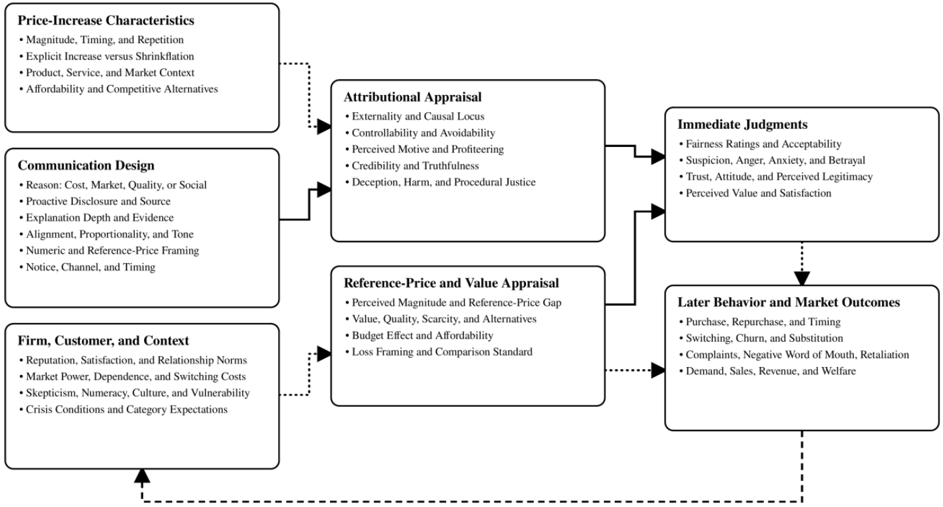
When firms raise prices, customers assess both the financial loss and how the firm treats them. This systematic review synthesizes 48 journal articles assessed from full text, identified across four databases without a publication-year restriction. Single-reviewer screening and extraction yielded 26 core direct, 18 supporting, and four conceptual records across seven themes. Tests of cost and other causal explanations form the largest direct-evidence cluster. Their effects depend on perceived control, credibility, fit to the affected offering, and the magnitude of the increase. Disclosure, reference-price framing, and package downsizing change what customers see. Some improve immediate judgments in the tested settings; others raise concerns about comprehension or deception. Reputation and vulnerability chiefly inform fairness appraisals in this corpus; budgets and alternatives may constrain action, but their interactions with specific messages on observed behavior are largely untested. The proposed framework organizes relationships examined across separate studies. Experimental evidence chiefly supports effects on immediate fairness judgments. Evidence connecting those judgments to later behavior is less direct, and the proposed feedback path is conceptual. Fewer, more varied studies observe choice, demand, or attrition; none tests the full sequence from communication through judgment to behavior. Conceptual sources provide ideas rather than independent effect estimates.
Overview
CoChat Summary
TL;DR
This systematic review synthesizes 48 full-text-reviewed journal articles on how firms communicate price increases and how consumers judge fairness and respond. It finds strongest experimental support for immediate fairness and motive judgments, while evidence linking communication to later behavior is thinner, heterogeneous, and does not test the full communication-to-behavior sequence.
Key findings
- Across 48 included publications (26 core direct, 18 supporting/mechanism, 4 conceptual), cost/causal justification and attribution is the largest direct-evidence cluster: 15 studies, all core direct. Cost-based increases were generally judged fairer than demand-based increases, with effects depending on perceived control, credibility, fit to the affected offering, and magnitude.
- In a randomized Canadian self-storage field test (N = 1,626 customers; 694 exits), a truthful market-based reason lowered exit hazard by 29.5% versus no reason, while average cost and quality reasons were not statistically significant; scenario mechanisms differed.
- Disclosure and framing effects are conditional: a firm announcement raised immediate fairness; detailed aligned explanation helped a 20% increase, but a limited reason beat aligned detail at 2%; dual-percentage framing raised fairness partly through base-value neglect; profit disclosure in laboratory markets reduced prices, volume, and efficiency.
- Shrinkflation evidence shows noticed downsizing was judged more unfair than an equivalent price increase because it might go unnoticed, while explicit package-size notice eliminated the fairness gap in one vignette study. Scanner and modeled studies estimate weaker immediate demand sensitivity to downsizing than to explicit rises (e.g., canned-tuna elasticity −0.26 with unit-price disclosure versus −0.07 without; modeled beverage demand about 4.6 times more sensitive to the explicit rise; ice-cream price elasticity roughly fourfold size elasticity).
Methods
- Systematic review of English-language, peer-reviewed journal articles identified in four databases (ABI/INFORM Complete, Academic Search Complete, Business Source Premier, ProQuest Research Library) with no publication-year restriction; five title-and-abstract search sets produced 20 database-by-set searches.
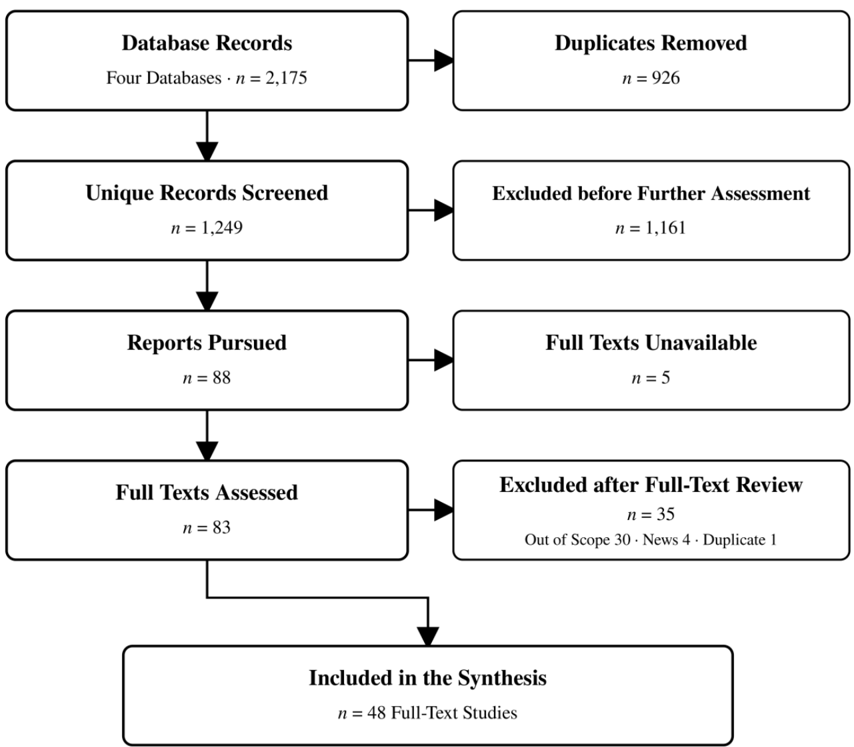
- Selection flow: 2,175 exported hits, 926 duplicates removed, 1,249 unique records; 1,196 excluded at title/abstract screening, 53 retained; after reconciliation, 1,161 excluded before further assessment, 88 pursued, 5 not assessed from full text, 83 assessed, 35 excluded, and 48 included.
- Analysis: single-reviewer screening and extraction; each included publication received one dominant theme, one synthesis role, and one primary design family; narrative thematic synthesis without pooled effect estimates.
Limitations
- Stated: the four-database title-and-abstract searches were limited to peer-reviewed English-language journal articles with no publication-year restriction; relevant work outside those indexes, languages, and formats may be absent.
- Stated: a single reviewer made eligibility, extraction, and classification decisions, so reviewer agreement and error rates cannot be estimated; five records could not be assessed from full text (three had abstracts or indexed excerpts) and none entered the synthesis; single-theme and primary-design labels simplify publications examining several mechanisms, studies, or outcomes, with no second reviewer resolving alternative labels.
- Stated and evident: included studies use different samples, price changes, messages, and outcomes, so the extracted results cannot support a meaningful pooled effect; experiments mostly measure immediate fairness or stated intentions, often hypothetical, while observed choice, demand, and attrition come from fewer and more varied designs; no included study tests the full sequence from communication through judgment to behavior. Evident: as a systematic review, it provides no new primary effect estimates, and the four conceptual records contribute ideas rather than independent effect estimates.
Model-written summary. Check it against the paper before relying on it.
Integrity signals
Registry
Cites
Statistics
Figures
Verification
Claims the paper makes
0 Valid · 2 Not valid · 225 Not checked · 111 Own results and interpretations
A result the paper states — it cites no source for it, so there is none to check. The quote shows it is in the paper.
In the paper
“Reputation and vulnerability chiefly inform fairness appraisals in this corpus; budgets and alternatives may constrain action, but their interactions with specific messages on observed behavior are largely untested.”
§ Communicating Price Increases: A Systematic Review of Price Fairness and Consumer Responses > Abstract
hedged- Asserted: passes — The authors put it forward as true.
- Checkable: passes — It can be checked against evidence.
- Load-bearing: passes — The paper’s conclusions depend on it.
- Based: passes — The paper gives a reason why it holds.
A result the paper states — it cites no source for it, so there is none to check. The quote shows it is in the paper.
In the paper
“It does not yield a universal formula for the amount of pass-through consumers regard as legitimate.”
§ Communicating Price Increases: A Systematic Review of Price Fairness and Consumer Responses > 4.1 Reference Transactions and Dual Entitlement
plain- Asserted: passes — The authors put it forward as true.
- Checkable: passes — It can be checked against evidence.
- Load-bearing: passes — The paper’s conclusions depend on it.
- Based: passes — The paper gives a reason why it holds.
A result the paper states — it cites no source for it, so there is none to check. The quote shows it is in the paper.
In the paper
“Experimental evidence chiefly supports effects on immediate fairness judgments.”
§ Communicating Price Increases: A Systematic Review of Price Fairness and Consumer Responses > Abstract
plainstates a cause- Asserted: passes — The authors put it forward as true.
- Checkable: passes — It can be checked against evidence.
- Load-bearing: passes — The paper’s conclusions depend on it.
- Based: passes — The paper gives a reason why it holds.
None of the sources cited for this claim have been checked yet.
In the paper
“The corpus supports this mechanism through price-fairness comparisons of external cost shocks and seller-controlled changes (Gielissen et al., 2008;Huangfu & Zhu, 2012;Vaidyanathan & Aggarwal, 2003).”
§ Communicating Price Increases: A Systematic Review of Price Fairness and Consumer Responses > 4.1 Reference Transactions and Dual Entitlement
What the sources say
- Not matchedcites Gielissen et al., 2008
An author–year citation the paper’s reference list doesn’t settle. We don’t search these by name.
- Not checked yetcites Huangfu & Zhu, 2012 matched to “Do Consumers' Perceptions of Price Fairness Differ According to Type of Firm Ownership?” (2012) source
- Not checked yetcites Vaidyanathan & Aggarwal, 2003 matched to “Who is the fairest of them all? An attributional approach to price fairness perceptions” (2003) source
plainstates an association- Asserted: passes — The authors put it forward as true.
- Checkable: passes — It can be checked against evidence.
- Load-bearing: passes — The paper’s conclusions depend on it.
- Based: passes — The paper gives a reason why it holds.
- Not matched
A result the paper states — it cites no source for it, so there is none to check. The quote shows it is in the paper.
In the paper
“Evidence connecting those judgments to later behavior is less direct, and the proposed feedback path is conceptual.”
§ Communicating Price Increases: A Systematic Review of Price Fairness and Consumer Responses > Abstract
plainstates an association- Asserted: passes — The authors put it forward as true.
- Checkable: passes — It can be checked against evidence.
- Load-bearing: passes — The paper’s conclusions depend on it.
- Based: passes — The paper gives a reason why it holds.
158 more claims
Create a free account to see all 338 claims and to verify the 139 references still open.
- It may state two separate claims as one. 138
- Probably not a substantial claim. 66
Citations
Cites
Homburg, C. (2005) · Journal of the Academy of Marketing Science · doi:10.1177/0092070304269953 · Cited by 299
Who is the fairest of them all? An attributional approach to price fairness perceptions
Vaidyanathan, R., & Aggarwal, P. (2003) · Journal of Business Research · doi:10.1016/s0148-2963(01)00231-4 · Cited by 274
Price fairness perceptions and customer loyalty in a retail context
Martin, W. C., Ponder, N., & Lueg, J. E. (2009) · Journal of Business Research · doi:10.1016/j.jbusres.2008.05.017 · Cited by 197
Price fairness: Good and service differences and the role of vendor costs
Bolton, L. E., & Alba, J. W. (2006) · Journal of Consumer Research · doi:10.1086/506306 · Cited by 178
When will price increases associated with company donations to charity be perceived as fair?
Koschate‐Fischer, N., Huber, I. V., & Hoyer, W. D. (2015) · Journal of the Academy of Marketing Science · doi:10.1007/s11747-015-0454-5 · Cited by 126
Exploring price fairness perceptions and their influence on consumer behavior
Malc, D., Mumel, D., & Pisnik, A. (2016) · Journal of Business Research · doi:10.1016/j.jbusres.2016.03.031 · Cited by 120
Consumer Response to Package Downsizing: Evidence from the Chicago Ice Cream Market
Çakır, M., & Balagtas, J. V. (2013) · Journal of Retailing · doi:10.1016/j.jretai.2013.06.002 · Cited by 114
Ferguson, J. L. (2013) · Journal of Business Research · doi:10.1016/j.jbusres.2013.03.023 · Cited by 110
Kwak, H., Puzakova, M., & Rocereto, J. F. (2015) · Journal of Marketing · doi:10.1509/jm.13.0410 · Cited by 109
Effect of price increases on future intentions of sport consumers
Moreno, F. C., Pomar, J. M. N., Prado‐Gascó, V., & Añó, V. (2013) · Journal of Business Research · doi:10.1016/j.jbusres.2013.11.035 · Cited by 93
Research works printed but not linked: 1
- Chang, S.-S., & Lin, Y.-T. (2012). The effects of customers' relationship and controllability of price increase on consumers' attitudes toward price increase. NTU Management Review, 23(1), 59-84. https://doi.org/10.6226/nturm2012.sep.m7 · doi:10.6226/nturm2012.sep.m7
Metadata
- Authors
- Joyal, A.
- Corresponding author
- Aaron Joyal
- Venue
- Journal of Economics, Finance and Accounting Studies
- Published
- 2026-10-07
- Volume
- 8
- Issue
- 10
- Pages
- 01-20
- ISSN
- 2709-0809 (ISSN-L)
- OpenAlex
- W7220906083
- Semantic Scholar
- 98664f856cdbaebc4e476c18b0dc071914e38318
- Cited by
- 0
- References
- 46
- FWCI
- 0.00
- Type
- journal article
- Language
- en
- Open access
- diamond
- doi.org
- Locations
- Journal of Economics Finance and Accounting Studies (publishedVersion, cc-by)
- Topics
- Social Sciences › Business, Management and Accounting › Marketing › Consumer Market Behavior and Pricing
- Social Sciences › Business, Management and Accounting › Marketing › Customer Service Quality and Loyalty
- Social Sciences › Business, Management and Accounting › Marketing › Consumer Behavior and Marketing Influence
- Keywords
- price increases, price fairness, consumer response, price communication, perceived control, credibility, consumer deception, corporate reputation, consumer vulnerability, consumer choice, demand, customer churn, fairness judgments
About these checks
Registry, retraction, Cites and statistics results are computed, not judged, with one exception: a printed reference that no index lists is read once by a model before it counts as a citation error. Claims are extracted by a model and kept only when their quote appears verbatim in the text; each cited source is then checked, with a model’s help, for whether it says what the claim relies on. Those verdicts can be wrong — read the claim’s quote and the cited source before relying on one.
A language model drew the claims from the paper on 2026-11-28, under version 3 of the claim definition (model deepseek-v4.1-flash, prompt extract-v3).
A second model labelled each claim on 2026-11-28 (model jev-1.13-20260917, definition revision gold-guideline-v0.2).
Statistics and arithmetic are recomputed, not judged.
Confidence bands are shown only for fields calibrated on our annotated test set. None is calibrated yet, so no band is shown.
What counts as a claim ›How we measure confidence ›How we check this ›
Are you an author, or do you see a problem with this page? Request a review
How to cite
Cite CoChat for the checks on this page, and the paper for its own findings.
- This page
- CoChat. (2026). Citation check: Communicating Price Increases: A Systematic Review of Price Fairness and Consumer Responses. https://app.cochat.ai/papers/10.32996/jefas.2026.8.10.1
- The paper
- Joyal, A. (2026). Communicating Price Increases: A Systematic Review of Price Fairness and Consumer Responses. Journal of Economics, Finance and Accounting Studies. https://doi.org/10.32996/jefas.2026.8.10.1
Data sources
Bibliographic data: Semantic Scholar, OpenAlex, Crossref.
Contains information from the Semantic Scholar Academic Graph Datasets, made available under the ODC Attribution License (ODC-BY 1.0).
Semantic Scholar’s data is described in: Kinney, R., et al. (2023). The Semantic Scholar Open Data Platform. arXiv:2301.10140.
