

The DOI matches its Crossref record; 29 of the 30 references it cites were found in a registry or an index.
Iron absorption from supplements is greater with alternate day than with consecutive day dosing in iron-deficient anemic women
Open accessAbstract
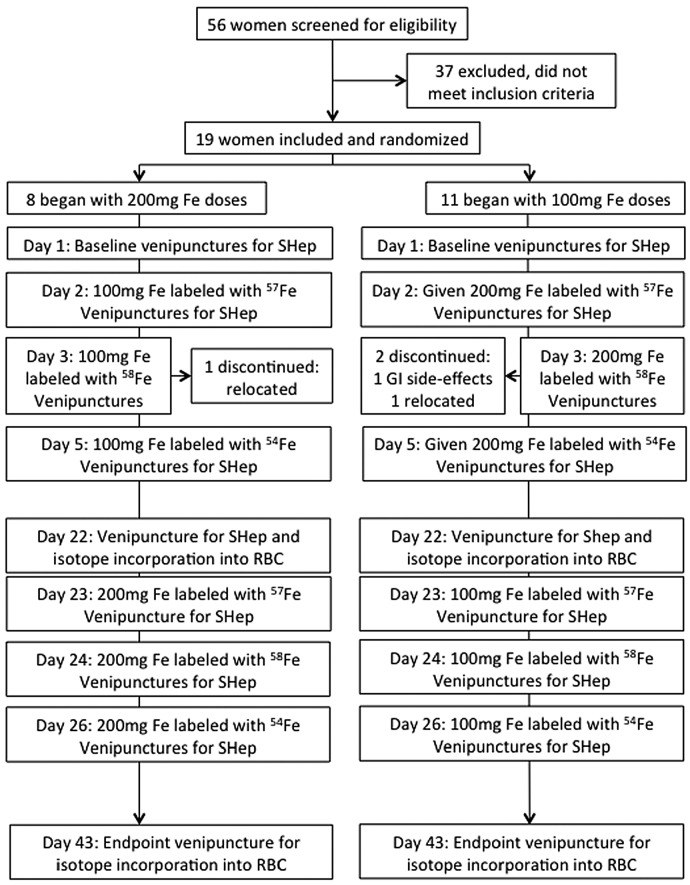
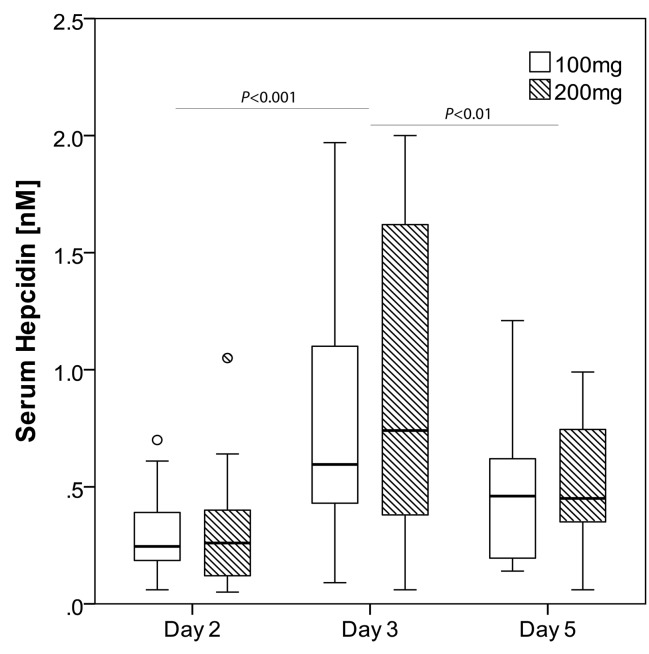
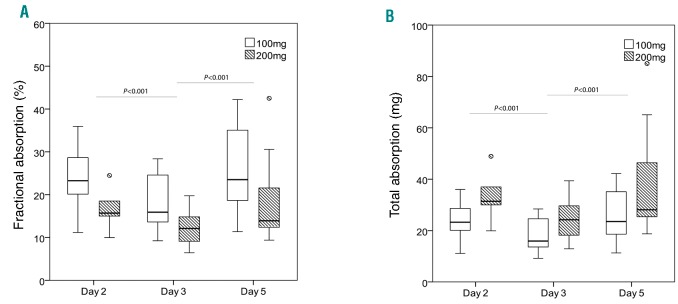
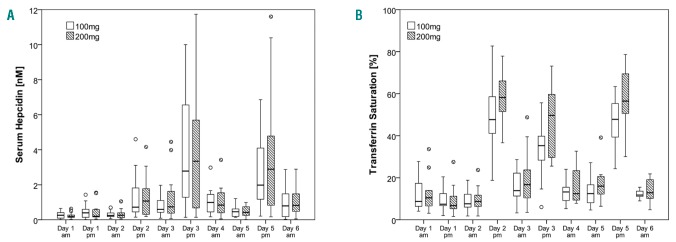
In iron-depleted women without anemia, oral iron supplements induce an increase in serum hepcidin (SHep) that persists for 24 hours, decreasing iron absorption from supplements given later on the same or next day. Consequently, iron absorption from supplements is highest if iron is given on alternate days. Whether this dosing schedule is also beneficial in women with iron-deficiency anemia (IDA) given high-dose iron supplements is uncertain. The primary objective of this study was to assess whether, in women with IDA, alternate-day administration of 100 and 200 mg iron increases iron absorption compared to consecutive-day iron administration. Secondary objectives were to correlate iron absorption with SHep and iron status parameters. We performed a cross-over iron absorption study in women with IDA (n=19; median hemoglobin 11.5 mg/dL; mean serum ferritin 10 mg/L) who received either 100 or 200 mg iron as ferrous sulfate given at 8 AM on days 2, 3 and 5 labeled with stable iron isotopes 57Fe, 58Fe and 54Fe; after a 16-day incorporation period, the other labeled dose was given at 8 AM on days 23, 24 and 26 (days 2, 3 and 5 of the second period). Iron absorption on days 2 and 3 (consecutive) and day 5 (alternate) was assessed by measuring erythrocyte isotope incorporation. For both doses, SHep was higher on day 3 than on day 2 (P
Overview
The claims and statistics of this paper haven’t been checked yet.
Run the check — free, no account needed. It reads the open-access text and checks the sources it cites.
Integrity signals
Registry
Cites
Statistics
Figures
Verification
Claims the paper makes
The claims and statistics of this paper haven’t been checked yet.
Run the check — free, no account needed. It reads the open-access text and checks the sources it cites.
Claims other papers make about this one
Each is checked against this paper’s own text: does it say what the citing paper says it does?
The cited source doesn’t support the claim as written.
In the citing paper
“They found that dosing 48 h apart enhanced iron absorption compared to three daily doses as it allows sufficient time for hepcidin levels to decrease and remove the mucosal block on absorption [34,35].”
From Oral Iron Supplementation—Gastrointestinal Side Effects and the Impact on the Gut Microbiota (2021) · cites this paper as [34]
Checked by a reasoning model — may be wrong.
Experimental — accuracy not yet measuredThe cited source says what the claim attributes to it.
In the citing paper
“Other groups have also confirmed enhanced iron absorption with single dosing once daily or alternate day dosing [33,34,36].”
From Oral Iron Supplementation—Gastrointestinal Side Effects and the Impact on the Gut Microbiota (2021) · cites this paper as [34]
In the citing paper
“The dynamics of the increase in hepcidin levels after oral iron therapy have suggested that alternate-day administration of iron salts is an alternative to daily refracted doses, with the former being a protocol that increases both efficacy and tolerability, at least in women with iron deficiency without or with mild anemia.116,118,119”
From Iron metabolism and iron disorders revisited in the hepcidin era (2020) · cites this paper as [116]
In the citing paper
“By changing iron dosing schedules to reflect the negative feedback mechanisms intrinsic to mammalian iron homeostasis, fractional iron uptake can be maximized. 185 , 186”
From The battle for iron in enteric infections (2020) · cites this paper as [185]
Self-check
Percentages, sums and reported differences re-computed from the paper’s own numbers.
The self-check needs the paper’s full text.
Citations
Cites
A systematic analysis of global anemia burden from 1990 to 2010
Kassebaum, N. J., Jasrasaria, R., Naghavi, M., Wulf, S. K., Johns, N. E., Lozano, R., Regan, M. C., Weatherall, D. J., Chou, D. P., Eisele, T. P., et al. (2013) · Blood · doi:10.1182/blood-2013-06-508325 · Cited by 2,115
Tolkien, Z., Stecher, L., Mander, A. P., Pereira, D. I. A., & Powell, J. J. (2015) · PLOS ONE · doi:10.1371/journal.pone.0117383 · Cited by 833
Jaeggi, T., Kortman, G. A. M., Moretti, D., Chassard, C., Holding, P., Dostal, A., Boekhorst, J., Timmerman, H. M., Swinkels, D. W., Tjalsma, H., et al. (2015) · Gut · doi:10.1136/gutjnl-2014-307720 · Cited by 622
Self-citationUK guidelines on the management of iron deficiency in pregnancy
Pavord, S. R., Myers, B., Robinson, S. E., Allard, S., Strong, J., & Oppenheimer, C. A. (2012) · British Journal of Haematology · doi:10.1111/j.1365-2141.2011.09012.x · Cited by 620
Moretti, D., Goede, J. S., Zeder, C., Jiskra, M., Chatzinakou, V., Tjalsma, H., Melse-Boonstra, A., Brittenham, G., Swinkels, D. W., & Zimmermann, M. B. (2015) · Blood · doi:10.1182/blood-2015-05-642223 · Cited by 547
Self-citationRegulation of the Iron Homeostatic Hormone Hepcidin
Sangkhae, V., & Nemeth, E. (2017) · Advances in Nutrition · doi:10.3945/an.116.013961 · Cited by 454
Diagnosis and Management of Iron-Deficiency Anaemia
COOK, J. (2005) · Best Practice & Research Clinical Haematology · doi:10.1016/j.beha.2004.08.022 · Cited by 452 · cited 1×
“Oral iron supplementation with ferrous sulfate (FeSO4) is recommended to treat ID and iron deficiency anemia (IDA).(3) Because iron absorption from oral supplements tends to be low, current recommendations call for daily provision of high doses of FeSO4, in the range of 60-200 mg, preferably split into 2 or 3 daily do…”
BackgroundStoffel, N. U., Cercamondi, C. I., Brittenham, G., Zeder, C., Geurts-Moespot, A. J., Swinkels, D. W., Moretti, D., & Zimmermann, M. B. (2017) · The Lancet Haematology · doi:10.1016/s2352-3026(17)30182-5 · Cited by 435
Self-citation(1998) · PubMed · Cited by 406
Zoller, H., Weiss, G., Theurl, I., Koch, R. O., Vogel, W., Obrist, P., Pietrangelo, A., Montosi, G., & Haile, D. J. (2001) · Gastroenterology · doi:10.1053/gast.2001.24033 · Cited by 304
Cited by
Sorted by citations
Items 201–240 of 240
Algül, M., Mete, F., Bostan, G. O., Erol, M., & Özdemir, N. (2025) · Journal of Pediatric Hematology/Oncology · doi:10.1097/mph.0000000000003083
Amjad, A., Siddiqi, F. A., Mateen, A., Siddiqi, K. A., Khan, I., & Safdar, L. (2025) · Journal of Rawalpindi Medical College · doi:10.37939/jrmc.v29i3.2888
Caljé, E., Groom, K. M., Dixon, L., Marriott, J., Foon, R., Oyston, C., Bloomfield, F. H., & Jordan, V. (2024) · Figshare · doi:10.6084/m9.figshare.26658667
Kron, A., Giudice, M. E. D., Sholzberg, M., Callum, J., Cserti-Gazdewich, C. M., Swarup, V., Huang, M., Distefano, L., Anani, W., Skeate, R. C., et al. (2022) · Figshare · doi:10.6084/m9.figshare.19711319
Caljé, E., Groom, K. M., Dixon, L., Marriott, J., Foon, R., Oyston, C., Bloomfield, F. H., & Jordan, V. (2024) · Figshare · doi:10.6084/m9.figshare.26658664
Liy‐Wong, C., Tarango, C., Pope, E., Coates, T. D., Bruckner, A. L., Feinstein, J. A., Schwieger‐Briel, A., Hubbard, L. D., Jane, C., Torres-Pradilla, M., et al. (2024) · Figshare · doi:10.6084/m9.figshare.26570959
Liy‐Wong, C., Tarango, C., Pope, E., Coates, T. D., Bruckner, A. L., Feinstein, J. A., Schwieger‐Briel, A., Hubbard, L. D., Jane, C., Torres-Pradilla, M., et al. (2024) · Figshare · doi:10.6084/m9.figshare.26570962
Gerges, M., Nichols, C., Sutherland, S., & Chiasson, M. (2025) · Canadian Journal of General Internal Medicine · doi:10.3138/cjgim.2025.0012
Hamed, H. M., Abdelhamid, N., Salama, H. M., Motawie, A. A., El-Bostany, E. A., Galal, A. A., Elghoroury, E. A., Kamel, S. A., Hassan, E. M., Helmy, N. A., et al. (2026) · Indian Journal of Hematology and Blood Transfusion · doi:10.1007/s12288-025-02267-6
Hasan, T., Khanam, R., Chowdhury, N. H., Mohan, D., Ahmed, S., Rahman, S., Islam, M. S., Roy, A. D., Ghosh, D., Hosen, M. B., et al. (2026) · Journal of Global Health · doi:10.7189/jogh.16.04016
Hussein, Y. T., Mohammed, S. M., & Rahman, F. (2026) · Naunyn-Schmiedeberg s Archives of Pharmacology · doi:10.1007/s00210-026-05211-1
Makó, R. A., & Sípos, P. (2026) · Biomolecules · doi:10.3390/biom16040540
Yassine, J., Al‑Zahra, F., & Semenza, G. L. (2026) · Frontiers in Humanities and Social Sciences · doi:10.54691/47dm0m17
Post-Acute and Long-Term Care Medical Association Adds 5 New Choosing Wisely Statements
Cai, C. Y., Gleason, L. J., & Palat, S. T. (2026) · Journal of the American Medical Directors Association · doi:10.1016/j.jamda.2026.106158
Gabarin, N., & Zeller, M. P. (2026) · Springer eBooks · doi:10.1007/978-3-032-13858-3_2
Iron deficiency anemia in pregnancy: prevention, diagnosis and treatment: Number 5 – 2026
Maganha, C. A., dos Santos, A. A., Mocarzel, C. C., Oliveira, R. P. C., Céspedes, I. C., & Mattar, R. (2026) · Revista Brasileira Ginecologia e Obstetrícia · doi:10.61622/rbgo/2026fps5
Jans, K., Huebbe, P., Kipp, A. P., & Rimbach, G. (2026) · BioFactors · doi:10.1002/biof.70115
Pflanzenbasierte Ernährung im Kindes- und Jugendalter
Hünninghaus, K., & Naami, N. (2026) · Springer eBooks · doi:10.1007/978-3-662-71302-0_6
Aggarwal, A., Hess, J., Yoost, J., Preston, D. L., Lamichhane, R., & Finch, P. T. (2026) · Journal of Pediatric and Adolescent Gynecology · doi:10.1016/j.jpag.2026.05.009
Anemia ferropriva na gestação: prevenção, diagnóstico e tratamento Número 5 – 2026
Maganha, C. A., dos Santos, A. A., Mocarzel, C. C., Oliveira, R. P. C., Céspedes, I. C., & Mattar, R. (2026) · Femina · doi:10.61622/0100-7254544202605
Patient blood management in pregnancy, the peripartum, and the postpartum period
Filho, A. L. D. S., Alves, Á. L. L., & Osanan, G. C. (2026) · Revista Brasileira Ginecologia e Obstetrícia · doi:10.61622/rbgo/2026fps7
Iron Deficiency in Women: A Practical Illustrated Review
Tang, G. H., & Sholzberg, M. (2026) · Journal of Obstetrics and Gynaecology Canada · doi:10.1016/j.jogc.2026.103449
Ouafa, Y. E., Mourabiti, I., Abdi, N. E., Fadi, M., Benrahma, H., & Bouanani, N. (2026) · Cureus · doi:10.7759/cureus.112040
Patient Blood Management na gravidez, no periparto e no pós-parto Número 7 – 2026
Filho, A. L. D. S., Alves, Á. L. L., & Osanan, G. C. (2026) · Femina · doi:10.61622/0100-7254545202605
Momtaz, M., Elkholy, A. G., El-Din, A. S. S., Maged, A. M., Ahmed, A. H., Awad, E.-S. E.-B., El-Bishry, G., Allam, I. S., Moussa, M. S., Shaaban, O. M., et al. (2026) · The Journal of Maternal-Fetal & Neonatal Medicine · doi:10.1080/14767058.2026.2694824
Saccone, G., Motta, M., Seta, F. D., Mola, S., Iannantuoni, S., & Simone, N. D. (2026) · Nutrients · doi:10.3390/nu18152446
Han, Y., Zhang, Y., Wu, Y., Lei, Z., Zhao, S., li, H., & He, R. (2026) · Research Square · doi:10.21203/rs.3.rs-10203004/v1
Fujii, T. (2026) · Biological Trace Element Research · doi:10.1007/s12011-026-05289-x
REPOSIÇÃO ORAL DE FERRO EM DIAS ALTERNADOS VERSUS DIÁRIA NA ANEMIA FERROPRIVA: REVISÃO INTEGRATIVA
Lemos, I. B., Dias, R. R., Santin, J. A., Marnoto, R. S., Vigna, P. S., & Lima, M. M. R. (2026) · RECIMA21 - Revista Científica Multidisciplinar · doi:10.47820/recima21.v7i8.8787
Sharma, A., Gill, K., & Chatterjee, M. (2026) · Phytochemical Analysis · doi:10.1002/pca.70088
Gangwar, D. P. A., Duhan, N., & Sai, D. (2026) · Archives of Medicine and Health Sciences · doi:10.4103/amhs.amhs_326_25
Makis, A. C., Saougou, I., & Hatzimichael, E. C. (2026) · HemaSphere · doi:10.1002/hem3.70465
Lee, J., & Ha, J. (2026) · Nutrients · doi:10.3390/nu18193117
Nasr, A. A. M., fathy, M. K., & Ahmad, R. A. A. (2026) · Al-Azhar Assiut Medical Journal · doi:10.4103/azmj.azmj_21_26
Editorial, A. (2026) · Nephrology and Dialysis · doi:10.28996/2618-9801-2026-3suppl-1-111
Cyclical Iron Homeostasis: The Role of Sex Hormones in Female Iron Regulation
Balakirishnan, D., Dukovski, F., Bytheway, H. G., & Dugan, C. (2026) · Frontiers in Bioscience-Landmark · doi:10.31083/fbl54404
Anaemia and Women’s Health in India: A Narrative Review of Burden, Drivers and Emerging Approaches
Alla, L., Pawar, A. K., Veerabhadram, K., Banerjee, P., Sushma, P., & Madhuri, K. (2026) · Journal of Applied Pharmaceutical Science · doi:10.1177/22313354261485438
Ciont, C., Pop, R. M., Tăbăran, F., Pop, R., Simon, E., Barbu–Tudoran, L., Mesaroş, A., Suharoschi, R., Vodnar, D. C., & Pop, O. L. (2026) · Journal of Drug Delivery Science and Technology · doi:10.1016/j.jddst.2026.109010
Valerii, M. C., Dussias, N. K., Perri, A., Spigarelli, R., Bernacchi, A., Rizzello, F., Magri, G., Gionchetti, P., & Spisni, E. (2026) · European Journal of Nutrition · doi:10.1007/s00394-026-04139-9
Metadata
- Authors
- Stoffel, N. U., Zeder, C., Brittenham, G. M., Moretti, D., & Zimmermann, M. B.
- Affiliations
- ETH Zurich (CH)
- Columbia University (US)
- Corresponding author
- Stoffel, Nicole U.
- Venue
- Haematologica
- Published
- 2019-08-14
- Volume
- 105
- Issue
- 5
- Pages
- 1232-1239
- ISSN
- 0390-6078 (ISSN-L)
- 1592-8721
- PMC
- PMC7193469
- OpenAlex
- W2967031988
- Cited by
- 241
- References
- 30
- Citations by year
- 2026: 38 · 2025: 35 · 2024: 30 · 2023: 53 · 2022: 40 · 2021: 15 · 2020: 28 · 2019: 2
- FWCI
- 15.02
- Type
- journal article
- Language
- en
- Open access
- gold
- doi.org
- Locations
- Haematologica (publishedVersion)
- PubMed Central (publishedVersion, cc-by-nc)
- PubMed (publishedVersion)
- DOAJ (DOAJ: Directory of Open Access Journals) (submittedVersion)
- Topics
- Health Sciences › Medicine › Hematology › Iron Metabolism and Disorders
- Health Sciences › Medicine › Hematology › Erythropoietin and Anemia Treatment
- Health Sciences › Nursing › Nutrition and Dietetics › Trace Elements in Health
- Keywords
- iron absorption, iron deficiency anemia, alternate-day dosing, oral iron supplementation, ferrous sulfate, hepcidin, iron status, erythrocyte iron incorporation, iron stable isotopes, women
- MeSH terms
- Female, Humans, Iron, Switzerland, Cross-Over Studies, Anemia, Iron-Deficiency, Dietary Supplements, Hepcidins
About these checks
Registry, retraction, Cites and statistics results are computed, not judged, with one exception: a printed reference that no index lists is read once by a model before it counts as a citation error. Claims are extracted by a model and kept only when their quote appears verbatim in the text; each cited source is then checked, with a model’s help, for whether it says what the claim relies on. Those verdicts can be wrong — read the claim’s quote and the cited source before relying on one.
Statistics and arithmetic are recomputed, not judged.
Confidence bands are shown only for fields calibrated on our annotated test set. None is calibrated yet, so no band is shown.
What counts as a claim ›How we measure confidence ›How we check this ›
Are you an author, or do you see a problem with this page? Request a review
