

The DOI matches its Crossref record; 29 of the 30 references it cites were found in a registry or an index.
Iron absorption from supplements is greater with alternate day than with consecutive day dosing in iron-deficient anemic women
Open accessAbstract
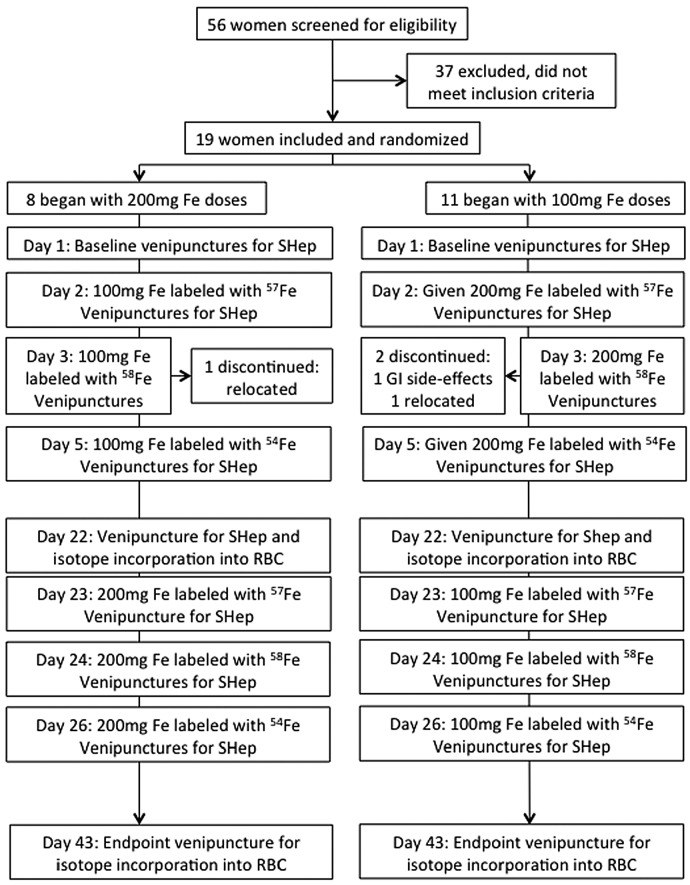
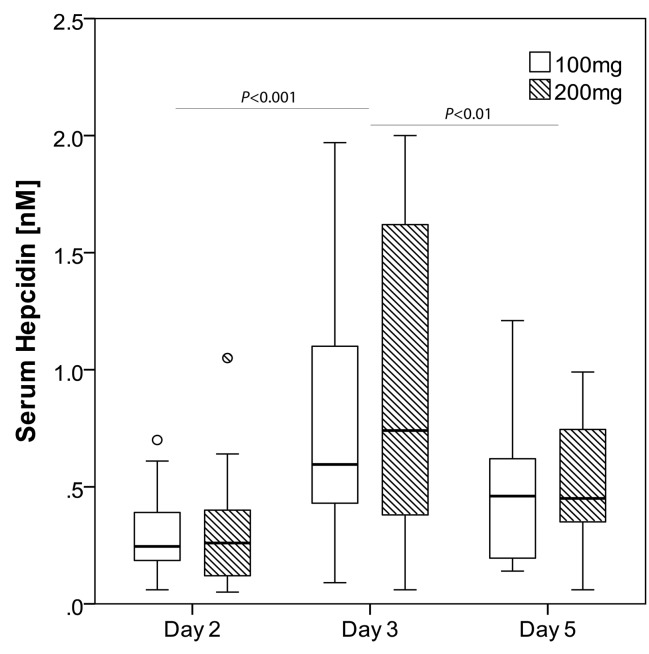
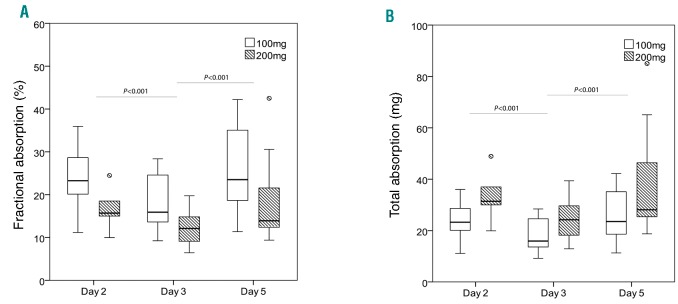
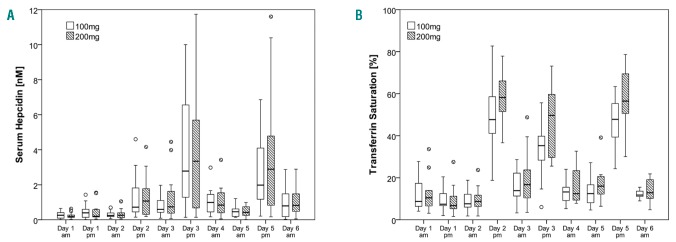
In iron-depleted women without anemia, oral iron supplements induce an increase in serum hepcidin (SHep) that persists for 24 hours, decreasing iron absorption from supplements given later on the same or next day. Consequently, iron absorption from supplements is highest if iron is given on alternate days. Whether this dosing schedule is also beneficial in women with iron-deficiency anemia (IDA) given high-dose iron supplements is uncertain. The primary objective of this study was to assess whether, in women with IDA, alternate-day administration of 100 and 200 mg iron increases iron absorption compared to consecutive-day iron administration. Secondary objectives were to correlate iron absorption with SHep and iron status parameters. We performed a cross-over iron absorption study in women with IDA (n=19; median hemoglobin 11.5 mg/dL; mean serum ferritin 10 mg/L) who received either 100 or 200 mg iron as ferrous sulfate given at 8 AM on days 2, 3 and 5 labeled with stable iron isotopes 57Fe, 58Fe and 54Fe; after a 16-day incorporation period, the other labeled dose was given at 8 AM on days 23, 24 and 26 (days 2, 3 and 5 of the second period). Iron absorption on days 2 and 3 (consecutive) and day 5 (alternate) was assessed by measuring erythrocyte isotope incorporation. For both doses, SHep was higher on day 3 than on day 2 (P
Overview
The claims and statistics of this paper haven’t been checked yet.
Run the check — free, no account needed. It reads the open-access text and checks the sources it cites.
Integrity signals
Registry
Cites
Statistics
Figures
Verification
Claims the paper makes
The claims and statistics of this paper haven’t been checked yet.
Run the check — free, no account needed. It reads the open-access text and checks the sources it cites.
Claims other papers make about this one
Each is checked against this paper’s own text: does it say what the citing paper says it does?
The cited source doesn’t support the claim as written.
In the citing paper
“They found that dosing 48 h apart enhanced iron absorption compared to three daily doses as it allows sufficient time for hepcidin levels to decrease and remove the mucosal block on absorption [34,35].”
From Oral Iron Supplementation—Gastrointestinal Side Effects and the Impact on the Gut Microbiota (2021) · cites this paper as [34]
Checked by a reasoning model — may be wrong.
Experimental — accuracy not yet measuredThe cited source says what the claim attributes to it.
In the citing paper
“Other groups have also confirmed enhanced iron absorption with single dosing once daily or alternate day dosing [33,34,36].”
From Oral Iron Supplementation—Gastrointestinal Side Effects and the Impact on the Gut Microbiota (2021) · cites this paper as [34]
In the citing paper
“The dynamics of the increase in hepcidin levels after oral iron therapy have suggested that alternate-day administration of iron salts is an alternative to daily refracted doses, with the former being a protocol that increases both efficacy and tolerability, at least in women with iron deficiency without or with mild anemia.116,118,119”
From Iron metabolism and iron disorders revisited in the hepcidin era (2020) · cites this paper as [116]
In the citing paper
“By changing iron dosing schedules to reflect the negative feedback mechanisms intrinsic to mammalian iron homeostasis, fractional iron uptake can be maximized. 185 , 186”
From The battle for iron in enteric infections (2020) · cites this paper as [185]
Self-check
Percentages, sums and reported differences re-computed from the paper’s own numbers.
The self-check needs the paper’s full text.
Citations
Cites
A systematic analysis of global anemia burden from 1990 to 2010
Kassebaum, N. J., Jasrasaria, R., Naghavi, M., Wulf, S. K., Johns, N. E., Lozano, R., Regan, M. C., Weatherall, D. J., Chou, D. P., Eisele, T. P., et al. (2013) · Blood · doi:10.1182/blood-2013-06-508325 · Cited by 2,115
Tolkien, Z., Stecher, L., Mander, A. P., Pereira, D. I. A., & Powell, J. J. (2015) · PLOS ONE · doi:10.1371/journal.pone.0117383 · Cited by 833
Jaeggi, T., Kortman, G. A. M., Moretti, D., Chassard, C., Holding, P., Dostal, A., Boekhorst, J., Timmerman, H. M., Swinkels, D. W., Tjalsma, H., et al. (2015) · Gut · doi:10.1136/gutjnl-2014-307720 · Cited by 622
Self-citationUK guidelines on the management of iron deficiency in pregnancy
Pavord, S. R., Myers, B., Robinson, S. E., Allard, S., Strong, J., & Oppenheimer, C. A. (2012) · British Journal of Haematology · doi:10.1111/j.1365-2141.2011.09012.x · Cited by 620
Moretti, D., Goede, J. S., Zeder, C., Jiskra, M., Chatzinakou, V., Tjalsma, H., Melse-Boonstra, A., Brittenham, G., Swinkels, D. W., & Zimmermann, M. B. (2015) · Blood · doi:10.1182/blood-2015-05-642223 · Cited by 547
Self-citationRegulation of the Iron Homeostatic Hormone Hepcidin
Sangkhae, V., & Nemeth, E. (2017) · Advances in Nutrition · doi:10.3945/an.116.013961 · Cited by 454
Diagnosis and Management of Iron-Deficiency Anaemia
COOK, J. (2005) · Best Practice & Research Clinical Haematology · doi:10.1016/j.beha.2004.08.022 · Cited by 452 · cited 1×
“Oral iron supplementation with ferrous sulfate (FeSO4) is recommended to treat ID and iron deficiency anemia (IDA).(3) Because iron absorption from oral supplements tends to be low, current recommendations call for daily provision of high doses of FeSO4, in the range of 60-200 mg, preferably split into 2 or 3 daily do…”
BackgroundStoffel, N. U., Cercamondi, C. I., Brittenham, G., Zeder, C., Geurts-Moespot, A. J., Swinkels, D. W., Moretti, D., & Zimmermann, M. B. (2017) · The Lancet Haematology · doi:10.1016/s2352-3026(17)30182-5 · Cited by 435
Self-citation(1998) · PubMed · Cited by 406
Zoller, H., Weiss, G., Theurl, I., Koch, R. O., Vogel, W., Obrist, P., Pietrangelo, A., Montosi, G., & Haile, D. J. (2001) · Gastroenterology · doi:10.1053/gast.2001.24033 · Cited by 304
Nutritional iron turned inside out: intestinal stress from a gut microbial perspective
Kortman, G. A. M., Raffatellu, M., Swinkels, D. W., & Tjalsma, H. (2014) · FEMS Microbiology Reviews · doi:10.1111/1574-6976.12086 · Cited by 291
New insights into iron deficiency and iron deficiency anemia
Camaschella, C. (2017) · Blood Reviews · doi:10.1016/j.blre.2017.02.004 · Cited by 290
Lund, E. K., Wharf, S. G., Fairweather‐Tait, S. J., & Johnson, I. T. (1999) · American Journal of Clinical Nutrition · doi:10.1093/ajcn/69.2.250 · Cited by 241
Are we giving too much iron? Low-dose iron therapy is effective in octogenarians
Rimon, E., Kagansky, N., Kagansky, M., Mechnick, L., Mashiah, T., Namir, M., & Levy, S. (2005) · The American Journal of Medicine · doi:10.1016/j.amjmed.2005.01.065 · Cited by 221
Cogswell, M. E., Looker, A. C., Pfeiffer, C. M., Cook, J. D., Lacher, D. A., Beard, J. L., Lynch, S. R., & Grummer‐Strawn, L. M. (2009) · American Journal of Clinical Nutrition · doi:10.3945/ajcn.2008.27151 · Cited by 214
Brown, E., Hopper, J., Hodges, J. L., Bradley, B., Wennesland, R., & Yamauchi, H. (1962) · Journal of Clinical Investigation · doi:10.1172/jci104677 · Cited by 203
Iron deficiency: new insights into diagnosis and treatment
Camaschella, C. (2015) · Hematology · doi:10.1182/asheducation-2015.1.8 · Cited by 201
Paganini, D., Uyoga, M. A., Kortman, G. A. M., Cercamondi, C. I., Moretti, D., Barth-Jaeggi, T., Schwab, C., Boekhorst, J., Timmerman, H. M., Lacroix, C., et al. (2017) · Gut · doi:10.1136/gutjnl-2017-314418 · Cited by 172
Self-citationTroutt, J. S., Rudling, M., Persson, L., Ståhle, L., Angelin, B., Butterfield, A. M., Schade, A. E., Cao, G., & Konrad, R. J. (2012) · Clinical Chemistry · doi:10.1373/clinchem.2012.186866 · Cited by 100 · cited 1×
“The increase after iron administration is distinct(18) from the natural circadian increase in SHep over the day.(19) We previously showed that twice daily administration of 60 mg oral iron sharply augments the circadian SHep increase and results in higher SHep on the next day compared to once daily dosing with 120 mg…”
BackgroundLund, E. K., Fairweather‐Tait, S. J., Wharf, S. G., & Johnson, I. T. (2001) · Journal of Nutrition · doi:10.1093/jn/131.11.2928 · Cited by 90
Intermittent oral iron supplementation during pregnancy.
Peña-Rosas, J. P., De-Regil, L., Malave, H. G., Flores-Urrutia, M. C., & Dowswell, T. (2015) · Cochrane Database of Systematic Reviews · doi:10.1002/14651858.cd009997.pub2 · Cited by 89
Diurnal Rhythm rather than Dietary Iron Mediates Daily Hepcidin Variations
Schaap, C., Hendriks, J. C., Kortman, G. A. M., Klaver, S. M., Kroot, J. J., Laarakkers, C. M., Wiegerinck, E. T. G., Tjalsma, H., Janssen, M. C. H., & Swinkels, D. W. (2012) · Clinical Chemistry · doi:10.1373/clinchem.2012.194977 · Cited by 81
Mobilization of storage iron is reflected in the iron isotopic composition of blood in humans
Hotz, K., Krayenbuehl, P., & Walczyk, T. (2011) · JBIC Journal of Biological Inorganic Chemistry · doi:10.1007/s00775-011-0851-2 · Cited by 69
Combating iron deficiency: daily administration of iron is far superior to weekly administration
Hallberg, L. (1998) · American Journal of Clinical Nutrition · doi:10.1093/ajcn/68.2.213 · Cited by 59
Nesheim, M. C., Peña‐Rosas, J. P., Sanjur, D., Frongillo, E. A., Garcia‐Casal, M. N., Crompton, D. W. T., Viteri, F. E., & Lorenzana, P. (2004) · Journal of Nutrition · doi:10.1093/jn/134.5.1099 · Cited by 29
The effect of phlebotomy on serum erythropoietin levels in normal healthy subjects.
Maeda, H., Hitomi, Y., Hirata, R. D. C., Tohyama, H., Suwata, J., Kamata, S., Fujino, Y., & Murata, N. (1992) · PubMed · Cited by 21
The nature of internal iron exchange in man.
HOSAIN, F., Marsaglia, G., Noyes, W. A., & Finch, C. A. (1962) · PubMed · Cited by 18
Schotten, N., Laarakkers, C. M., Roelofs, R., Origa, R., van Kraaij, M. G. J., & Swinkels, D. W. (2016) · American Journal of Hematology · doi:10.1002/ajh.24636 · Cited by 11
Prediction of human iron bioavailability using rapid c-ELISAs for human plasma hepcidin
Stoffel, N. U., Zeder, C., Fort, E., Swinkels, D. W., Zimmermann, M. B., & Moretti, D. (2017) · Clinical Chemistry and Laboratory Medicine (CCLM) · doi:10.1515/cclm-2017-0097 · Cited by 7
Self-citation
Cited by
Sorted by citations
Pasricha, S.-R., Tye-Din, J., Muckenthaler, M. U., & Swinkels, D. W. (2021) · The Lancet · doi:10.1016/s0140-6736(20)32594-0 · Cited by 1,069
Iron metabolism and iron disorders revisited in the hepcidin era
Camaschella, C., Nai, A., & Silvestri, L. (2020) · Haematologica · doi:10.3324/haematol.2019.232124 · Cited by 734
Iron deficiency anaemia: pathophysiology, assessment, practical management
Kumar, A., Sharma, E., Marley, A., Samaan, M., & Brookes, M. (2022) · BMJ Open Gastroenterology · doi:10.1136/bmjgast-2021-000759 · Cited by 351
Snook, J. A., Bhala, N. B., Beales, I., Cannings, D., Kightley, C., Logan, R. P., Pritchard, D. M., Sidhu, R., Surgenor, S., Thomas, W., et al. (2021) · Gut · doi:10.1136/gutjnl-2021-325210 · Cited by 348
AGA Clinical Practice Guidelines on the Gastrointestinal Evaluation of Iron Deficiency Anemia
Ko, C. W., Siddique, S. M., Patel, A. C., Harris, A. S., Sultan, S., Altayar, O., & Falck-Ytter, Y. T. (2020) · Gastroenterology · doi:10.1053/j.gastro.2020.06.046 · Cited by 219
Metadata
- Authors
- Stoffel, N. U., Zeder, C., Brittenham, G. M., Moretti, D., & Zimmermann, M. B.
- Affiliations
- ETH Zurich (CH)
- Columbia University (US)
- Corresponding author
- Stoffel, Nicole U.
- Venue
- Haematologica
- Published
- 2019-08-14
- Volume
- 105
- Issue
- 5
- Pages
- 1232-1239
- ISSN
- 0390-6078 (ISSN-L)
- 1592-8721
- PMC
- PMC7193469
- OpenAlex
- W2967031988
- Cited by
- 241
- References
- 30
- Citations by year
- 2026: 38 · 2025: 35 · 2024: 30 · 2023: 53 · 2022: 40 · 2021: 15 · 2020: 28 · 2019: 2
- FWCI
- 15.02
- Type
- journal article
- Language
- en
- Open access
- gold
- doi.org
- Locations
- Haematologica (publishedVersion)
- PubMed Central (publishedVersion, cc-by-nc)
- PubMed (publishedVersion)
- DOAJ (DOAJ: Directory of Open Access Journals) (submittedVersion)
- Topics
- Health Sciences › Medicine › Hematology › Iron Metabolism and Disorders
- Health Sciences › Medicine › Hematology › Erythropoietin and Anemia Treatment
- Health Sciences › Nursing › Nutrition and Dietetics › Trace Elements in Health
- Keywords
- iron absorption, iron deficiency anemia, alternate-day dosing, oral iron supplementation, ferrous sulfate, hepcidin, iron status, erythrocyte iron incorporation, iron stable isotopes, women
- MeSH terms
- Female, Humans, Iron, Switzerland, Cross-Over Studies, Anemia, Iron-Deficiency, Dietary Supplements, Hepcidins
About these checks
Registry, retraction, Cites and statistics results are computed, not judged, with one exception: a printed reference that no index lists is read once by a model before it counts as a citation error. Claims are extracted by a model and kept only when their quote appears verbatim in the text; each cited source is then checked, with a model’s help, for whether it says what the claim relies on. Those verdicts can be wrong — read the claim’s quote and the cited source before relying on one.
Statistics and arithmetic are recomputed, not judged.
Confidence bands are shown only for fields calibrated on our annotated test set. None is calibrated yet, so no band is shown.
What counts as a claim ›How we measure confidence ›How we check this ›
Are you an author, or do you see a problem with this page? Request a review
