

The DOI matches its Crossref record; 1 of the 1 references it cites were found in a registry or an index.
The future of food allergy diagnosis
Abstract
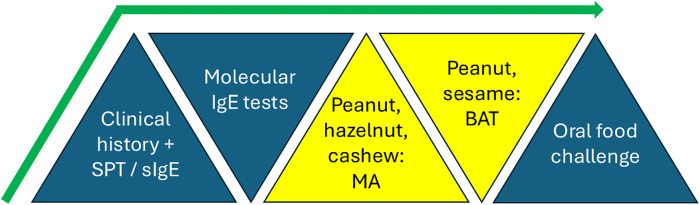
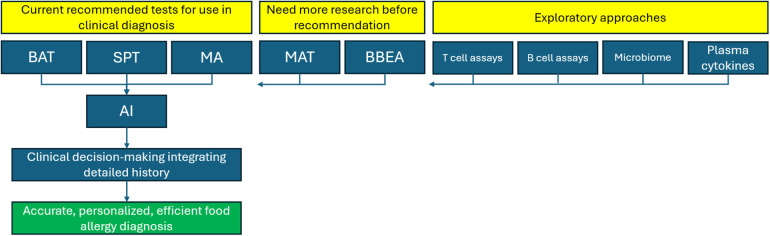
Food allergy represents an increasing global health issue, significantly impacting society on a personal and on a systems-wide level. The gold standard for diagnosing food allergy, the oral food challenge, is time-consuming, expensive, and carries risks of allergic reactions, with unpredictable severity. There is, therefore, an urgent need for more accurate, scalable, predictive diagnostic techniques. In this review, we discuss possible future directions in the world of food allergy diagnosis. We start by describing the current clinical approach to food allergy diagnosis, highlighting novel diagnostic methods recommended for use in clinical practice, such as the basophil activation test and molecular allergology, and go on to discuss tests that require more research before they can be applied to routine clinical use, including the mast cell activation test and bead-based epitope assay. Finally, we consider exploratory approaches, such as IgE glycosylation, IgG4, T and B cell assays, microbiome analysis, and plasma cytokines. Artificial intelligence is assessed for potential integrated interpretation of panels of diagnostic tests. Overall, a framework is proposed suggesting how combining established and emerging technologies can effectively enhance the accuracy of food allergy diagnosis in the future.
Overview
The claims and statistics of this paper haven’t been checked yet.
Run the check — free, no account needed. It reads the open-access text and checks the sources it cites.
Integrity signals
Registry
Cites
Statistics
Figures
Verification
Claims the paper makes
The claims and statistics of this paper haven’t been checked yet.
Run the check — free, no account needed. It reads the open-access text and checks the sources it cites.
Claims other papers make about this one
Each is checked against this paper’s own text: does it say what the citing paper says it does?
In the citing paper
“However, challenges include difficulty in isolating mast cells, high variability of primary cells, and lower sensitivity than BAT, making MAT particularly useful only as a secondary diagnostic option for basophil non-responders [197,217,219,220].”
From Pollen–Food Allergy Syndrome: Allergens, Clinical Insights, Diagnostic and Therapeutic Challenges (2024) · cites this paper as [217]
In the citing paper
“Until then, microbiome analysis is better suited as an adjunct to traditional diagnostic methods, providing complementary insights rather than serving as a stand-alone tool [217].”
From Pollen–Food Allergy Syndrome: Allergens, Clinical Insights, Diagnostic and Therapeutic Challenges (2024) · cites this paper as [217]
In the citing paper
“BBEA represents a scalable, high-throughput platform for detecting IgE and IgG 4 binding to allergen epitopes [217].”
From Pollen–Food Allergy Syndrome: Allergens, Clinical Insights, Diagnostic and Therapeutic Challenges (2024) · cites this paper as [217]
Self-check
Percentages, sums and reported differences re-computed from the paper’s own numbers.
The self-check needs the paper’s full text.
Citations
Cites
Host variables confound gut microbiota studies of human disease
Vujkovic-Cvijin, I., Sklar, J., Jiang, L., Natarajan, L., Knight, R., & Belkaid, Y. (2020) · Nature · doi:10.1038/s41586-020-2881-9 · Cited by 614
Research works printed but not linked: 87
- Spolidoro, 2023, Frequency of food allergy in Europe: an updated systematic review and meta-analysis, Allergy, 78, 351, 10.1111/all.15560 · DOI
- Michelson, 2020, Trends in emergency care for anaphylaxis, J Allergy Clin Immunol Pract, 8, 767, 10.1016/j.jaip.2019.07.018 · DOI
- DunnGalvin, 2015, The effects of food allergy on quality of life, Chem Immunol Allergy, 101, 235, 10.1159/000375106 · DOI
- Ravid, 2012, Mental health and quality-of-life concerns related to the burden of food allergy, Immunol Allergy Clin North Am, 32, 83, 10.1016/j.iac.2011.11.005 · DOI
- Bilaver, 2019, Economic burden of food allergy, Ann Allergy Asthma Immunol, 122, 373, 10.1016/j.anai.2019.01.014 · DOI
- Lopes, 2020, Food allergy: epidemiology, pathogenesis, diagnosis, prevention, and treatment, Curr Opin Immunol, 66, 57, 10.1016/j.coi.2020.03.014 · DOI
- Santos, 2023, Executive summary of the EAACI guidelines on diagnosis of IgE-mediated food allergy, Allergy, 78, 3053, 10.1111/all.15906 · DOI
- Grabenhenrich, 2016, A new framework for the documentation and interpretation of oral food challenges in population-based and clinical research, Allergy, 72, 453, 10.1111/all.13049 · DOI
- Patel, 2023, Will oral food challenges still be part of allergy care in 10 years’ time?, J Allergy Clin Immunol Pract, 11, 988, 10.1016/j.jaip.2023.02.010 · DOI
- Riggioni, 2023, Systematic review and meta-analyses on the accuracy of diagnostic tests for IGE-mediated food allergy, Allergy, 79, 324, 10.1111/all.15939 · DOI · Paper page
- Krawiec, 2023, Diagnostic utility of allergy tests to predict baked egg and lightly cooked egg allergies compared to double-blind placebo-controlled food challenges, Allergy, 78, 2510, 10.1111/all.15797 · DOI
- Dramburg, 2023, EAACI molecular allergology user’s guide 2.0, Pediatr Allergy Immunol, 34, e13854, 10.1111/pai.13854 · DOI · Paper page
- Calamelli, 2019, Component-resolved diagnosis in food allergies, Medicina (B Aires), 55, 498, 10.3390/medicina55080498 · DOI
- Kim, 2018, Diagnostic accuracy, risk assessment, and cost-effectiveness of component-resolved diagnostics for food allergy: a systematic review, Allergy, 73, 1609, 10.1111/all.13399 · DOI
- Steckelbroeck, 2008, Potential, pitfalls, and prospects of food allergy diagnostics with recombinant allergens or synthetic sequential epitopes, J Allergy Clin Immunol, 121, 1323, 10.1016/j.jaci.2008.04.008 · DOI
- Santos, 2017, Road map for the clinical application of the basophil activation test in food allergy, Clinical & Experimental Allergy, 47, 1115, 10.1111/cea.12964 · DOI
- Santos, 2013, Basophil activation test discriminates between allergy and tolerance among peanut sensitized children, J Allergy Clin Immunol, 131, AB130, 10.1016/j.jaci.2012.12.1133 · DOI
- Rubio, 2010, Benefit of the basophil activation test in deciding when to reintroduce cow’s milk in allergic children, Allergy, 66, 92, 10.1111/j.1398-9995.2010.02432.x · DOI
- Wanich, 2009, Allergen-specific basophil suppression associated with clinical tolerance in patients with milk allergy, J Allergy Clin Immunol, 123, 789, 10.1016/j.jaci.2008.12.1128 · DOI
- Yanagida, 2016, New approach for food allergy management using low-dose oral food challenges and low-dose oral immunotherapies, Allergol Int, 65, 135, 10.1016/j.alit.2015.10.010 · DOI
- Barni, 2018, Low-dose oral food challenge with hazelnut: efficacy and tolerability in children, Int Arch Allergy Appl Immunol, 178, 97, 10.1159/000493019 · DOI
- Hsu, 2020, Oral food challenge implementation: the first mixed-methods study exploring barriers and solutions, J Allergy Clin Immunol Pract, 8, 149, 10.1016/j.jaip.2019.06.034 · DOI
- Wells, 2022, National survey of United Kingdom paediatric allergy services, Clin Exp Allergy, 52, 1276, 10.1111/cea.14198 · DOI
- Bahri, 2018, Mast cell activation test in the diagnosis of allergic disease and anaphylaxis, J Allergy Clin Immunol, 142, 485, 10.1016/j.jaci.2018.01.043 · DOI
- Ebo, 2024, Mast cell versus basophil activation test in allergy: current status, Clinical & Experimental Allergy, 54, 378, 10.1111/cea.14487 · DOI · Paper page
- Santos, 2018, A novel human mast cell activation test for peanut allergy, J Allergy Clin Immunol, 142, 689, 10.1016/j.jaci.2018.03.011 · DOI
- Santos, 2014, Basophil activation test discriminates between allergy and tolerance in peanut-sensitized children, J Allergy Clin Immunol, 134, 645, 10.1016/j.jaci.2014.04.039 · DOI
- Suprun, 2019, Novel bead-based epitope assay is a sensitive and reliable tool for profiling epitope-specific antibody repertoire in food allergy, Sci Rep, 9, 18425, 10.1038/s41598-019-54868-7 · DOI · Paper page
- Suárez-Fariñas, 2021, Accurate and reproducible diagnosis of peanut allergy using epitope mapping, Allergy, 76, 3789, 10.1111/all.14905 · DOI
- Santos, 2022, Bringing the next generation of food allergy diagnostics into the clinic, J Allergy Clin Immunol Pract, 10, 1, 10.1016/j.jaip.2021.09.009 · DOI · Paper page
- Hemmings, 2021, Peanut diversity and specific activity are the dominant IGE characteristics for effector cell activation in children, J Allergy Clin Immunol, 148, 495, 10.1016/j.jaci.2021.02.029 · DOI
- van Ree, 2002, Carbohydrate epitopes and their relevance for the diagnosis and treatment of allergic diseases, Int Arch Allergy Appl Immunol, 129, 189, 10.1159/000066770 · DOI
- Amoah, 2013, Peanut-specific IGE antibodies in asymptomatic Ghanaian children possibly caused by carbohydrate determinant cross-reactivity, J Allergy Clin Immunol, 132, 639, 10.1016/j.jaci.2013.04.023 · DOI
- Homann, 2017, Glycans and glycan-specific IGE in clinical and molecular allergology: sensitization, diagnostics, and clinical symptoms, J Allergy Clin Immunol, 140, 356, 10.1016/j.jaci.2017.04.019 · DOI
- Commins, 2009, Delayed anaphylaxis, angioedema, or urticaria after consumption of red meat in patients with IGE antibodies specific for galactose-α-1,3-galactose, J Allergy Clin Immunol, 123, 426, 10.1016/j.jaci.2008.10.052 · DOI
- Shade, 2020, Sialylation of immunoglobulin E is a determinant of allergic pathogenicity, Nature, 582, 265, 10.1038/s41586-020-2311-z · DOI · Paper page
- Rowntree, 1987, A subclass igg4-specific antigen-binding radioimmunoassay (RIA): comparison between IGG and igg4 antibodies to food and inhaled antigens in adult atopic dermatitis after desensitization treatment and during development of antibody responses in children, J Allergy Clin Immunol, 80, 622, 10.1016/0091-6749(87)90017-0 · DOI
- Wilson, 2018, Allergen sensitization in a birth cohort at midchildhood: focus on food component IGE and igg4 responses, J Allergy Clin Immunol, 141, 419, 10.1016/j.jaci.2017.07.029 · DOI
- Stapel, 2008, Testing for igg4 against foods is not recommended as a diagnostic tool: eAACI task force report*, Allergy, 63, 793, 10.1111/j.1398-9995.2008.01705.x · DOI · Paper page
- Du Toit, 2015, Randomized trial of peanut consumption in infants at risk for peanut allergy, N Engl J Med, 372, 803, 10.1056/NEJMoa1414850 · DOI · Paper page
- Marques-Mejias, 2024, Partial egg consumption modifies the diagnostic performance of allergy tests to predict outcome of double-blind placebo-controlled food challenges to egg, J Allergy Clin Immunol Pract, 12, 660, 10.1016/j.jaip.2023.12.036 · DOI
- Janzi, 2009, Selective IgA deficiency in early life: association to infections and allergic diseases during childhood, Clin Immunol, 133, 78, 10.1016/j.clim.2009.05.014 · DOI
- Kulis, 2012, Increased peanut-specific IgA levels in saliva correlate with food challenge outcomes after peanut sublingual immunotherapy, J Allergy Clin Immunol, 129, 1159, 10.1016/j.jaci.2011.11.045 · DOI
- Liu, 2022, Food-specific immunoglobulin A does not correlate with natural tolerance to peanut or egg allergens, Sci Transl Med, 14, eabq0599, 10.1126/scitranslmed.abq0599 · DOI
- Wambre, 2017, A phenotypically and functionally distinct human TH2 cell subpopulation is associated with allergic disorders, Sci Transl Med, 9, eaam9171, 10.1126/scitranslmed.aam9171 · DOI
- Calise, 2023, Distinct trajectories distinguish antigen-specific T cells in peanut-allergic individuals undergoing oral immunotherapy, J Allergy Clin Immunol, 152, 155, 10.1016/j.jaci.2023.03.020 · DOI
- Crespo, 2023, Recent advances in cellular and molecular mechanisms of IGE-mediated food allergy, Food Chem, 411, 135500, 10.1016/j.foodchem.2023.135500 · DOI
- Savilahti, 2010, Combined T regulatory cell and Th2 expression profile identifies children with cow’s milk allergy, Clin Immunol, 136, 16, 10.1016/j.clim.2010.02.011 · DOI
- Croote, 2018, High-affinity allergen-specific human antibodies cloned from single IGE B cell transcriptomes, Science, 362, 1306, 10.1126/science.aau2599 · DOI
- Jiménez-Saiz, 2019, Human BCR analysis of single-sorted, putative IGE+ memory B cells in food allergy, J Allergy Clin Immunol, 144, 336, 10.1016/j.jaci.2019.04.001 · DOI
- Hoh, 2020, Origins and clonal convergence of gastrointestinal IGE B cells in human peanut allergy, Sci Immunol, 5, eaay4209, 10.1126/sciimmunol.aay4209 · DOI
- Koenig, 2024, Type 2–polarized memory B cells hold allergen-specific IgE memory, Sci Transl Med, 16, eadi0944, 10.1126/scitranslmed.adi0944 · DOI
- von Borstel, 2024, Ige in allergy: it takes two, Sci Transl Med, 16, eadl1202, 10.1126/scitranslmed.adl1202 · DOI
- Ota, 2024, CD23+IgG1+memory B cells are poised to switch to pathogenic IgE production in food allergy, Sci Transl Med, 16, eadi0673, 10.1126/scitranslmed.adi0673 · DOI
- Ho, 2021, Multidimensional study of the oral microbiome, metabolite, and immunologic environment in peanut allergy, J Allergy Clin Immunol, 148, 627, 10.1016/j.jaci.2021.03.028 · DOI
- Chun, 2023, Longitudinal dynamics of the gut microbiome and metabolome in peanut allergy development, J Allergy Clin Immunol, 152, 1569, 10.1016/j.jaci.2023.08.012 · DOI
- Zhang, 2022, Multiscale study of the oral and gut environments in children with high- and low-threshold peanut allergy, J Allergy Clin Immunol, 150, 714, 10.1016/j.jaci.2022.04.026 · DOI · Paper page
- Foong, 2021, Biomarkers of diagnosis and resolution of food allergy, Pediatr Allergy Immunol, 32, 223, 10.1111/pai.13389 · DOI
- Radonjic-Hoesli, 2022, Are blood cytokines reliable biomarkers of allergic disease diagnosis and treatment responses?, J Allergy Clin Immunol, 150, 251, 10.1016/j.jaci.2022.06.008 · DOI
- Dang, 2013, Characterization of plasma cytokines in an infant population cohort of challenge-proven food allergy, Allergy, 68, 1233, 10.1111/all.12215 · DOI
- Kulis, 2018, High- and low-dose oral immunotherapy similarly suppress pro-allergic cytokines and basophil activation in young children, Clin Exp Allergy, 49, 180, 10.1111/cea.13256 · DOI
- Gorelik, 2015, Suppression of the immunologic response to peanut during immunotherapy is often transient, J Allergy Clin Immunol, 135, 1283, 10.1016/j.jaci.2014.11.010 · DOI
- Chiang, 2018, Single-cell profiling of peanut-responsive T cells in patients with peanut allergy reveals heterogeneous effector TH2 subsets, J Allergy Clin Immunol, 141, 2107, 10.1016/j.jaci.2017.11.060 · DOI
- Neeland, 2021, Altered immune cell profiles and impaired CD4T-cell activation in single and multi-food allergic adolescents, Clin Exp Allergy, 51, 674, 10.1111/cea.13857 · DOI
- Metwally, 2019, Utilizing longitudinal microbiome taxonomic profiles to predict food allergy via long short-term memory networks, PLoS Comput Biol, 15, e1006693, 10.1371/journal.pcbi.1006693 · DOI
- Alag, 2018, Machine learning approach yields epigenetic biomarkers of food allergy: a novel 13-gene signature to diagnose clinical reactivity V1, PLoS One, 14, 10.17504/protocols.io.wa8fahw · DOI
- Kuniyoshi, 2021, Machine learning approach and oral food challenge with heated egg, Pediatr Allergy Immunol, 32, 776, 10.1111/pai.13433 · DOI · Paper page
- Suárez-Fariñas, 2019, Predicting development of sustained unresponsiveness to milk oral immunotherapy using epitope-specific antibody binding profiles, J Allergy Clin Immunol, 143, 1038, 10.1016/j.jaci.2018.10.028 · DOI
- Chong, 2020, Reaction phenotypes in IGE-mediated food allergy and anaphylaxis, Ann Allergy Asthma Immunol, 124, 473, 10.1016/j.anai.2019.12.023 · DOI · Paper page
- Martinroche, 2024, Towards an artificial intelligence-assisted allergy diagnosis using semantic attributes and allergen Multiplex technology, J Allergy Clin Immunol, 153, AB373, 10.1016/j.jaci.2023.11.895 · DOI
- Martino, 2015, Blood DNA methylation biomarkers predict clinical reactivity in food-sensitized infants, J Allergy Clin Immunol, 135, 1319, 10.1016/j.jaci.2014.12.1933 · DOI
- Hemmings, 2022, Combining allergen components improves the accuracy of peanut allergy diagnosis, J Allergy Clin Immunol Pract, 10, 189, 10.1016/j.jaip.2021.08.029 · DOI
- Bunyavanich, 2015, Systems biology of asthma and allergic diseases: a multiscale approach, J Allergy Clin Immunol, 135, 31, 10.1016/j.jaci.2014.10.015 · DOI
- Sato, 2010, Basophil activation marker CD203c is useful in the diagnosis of hen’s egg and cow’s milk allergies in children, Int Arch Allergy Appl Immunol, 152, 54, 10.1159/000312126 · DOI
- Ocmant, 2009, Basophil activation tests for the diagnosis of food allergy in children, Clin Exp Allergy, 39, 1234, 10.1111/j.1365-2222.2009.03292.x · DOI
- Tokuda, 2009, Antigen-induced expression of CD203c on basophils predicts IgE-mediated wheat allergy, Allergol Int, 58, 193, 10.2332/allergolint.08-OA-0023 · DOI
- Glaumann, 2011, Basophil allergen threshold sensitivity, CD-sens, IgE-sensitization and DBPCFC in peanut-sensitized children, Allergy, 67, 242, 10.1111/j.1398-9995.2011.02754.x · DOI
- Brandström, 2015, Basophil allergen threshold sensitivity and component-resolved diagnostics improve hazelnut allergy diagnosis, Clin Exp Allergy, 45, 1412, 10.1111/cea.12515 · DOI
- Alessandri, 2012, Tolerability of a fully maturated cheese in cow’s milk allergic children: biochemical, immunochemical, and clinical aspects, PLoS One, 7, e40945, 10.1371/journal.pone.0040945 · DOI
- Ando, 2008, Utility of ovomucoid-specific IgE concentrations in predicting symptomatic egg allergy, J Allergy Clin Immunol, 122, 583, 10.1016/j.jaci.2008.06.016 · DOI
- Ayuso, 2011, Is epitope recognition of shrimp allergens useful to predict clinical reactivity?, Clin Exp Allergy, 42, 293, 10.1111/j.1365-2222.2011.03920.x · DOI
- Klemans, 2013, Ige binding to peanut components by four different techniques: ara h 2 is the most relevant in peanut allergic children and adults, Clin Exp Allergy, 43, 967, 10.1111/cea.12136 · DOI
- Lieberman, 2013, The utility of peanut components in the diagnosis of IgE-mediated peanut allergy among distinct populations, J Allergy Clin Immunol Pract, 1, 75, 10.1016/j.jaip.2012.11.002 · DOI
- Masthoff, 2013, Sensitization to cor a 9 and cor a 14 is highly specific for a hazelnut allergy with objective symptoms in Dutch children and adults, J Allergy Clin Immunol, 132, 393, 10.1016/j.jaci.2013.02.024 · DOI
- Lin, 2012, A bioinformatics approach to identify patients with symptomatic peanut allergy using peptide microarray immunoassay, J Allergy Clin Immunol, 129, 1321, 10.1016/j.jaci.2012.02.012 · DOI
- Zhang, 2023, Prediction of oral food challenge outcomes via ensemble learning, Inform Med Unlocked, 36, 101142, 10.1016/j.imu.2022.101142 · DOI · Paper page
- Gryak, 2024, Prediction of pediatric peanut oral food challenge outcomes using machine learning, J Allergy Clin Immunol Glob, 100252, 10.1016/j.jacig.2024.100252 · DOI
Cited by
Sorted by citations
Pollen–Food Allergy Syndrome: Allergens, Clinical Insights, Diagnostic and Therapeutic Challenges
Haidar, L., Bănărescu, C. F., Uța, C., Moldovan, S. I., Zimbru, E.-L., Zimbru, R.-I., Ciurariu, E., Georgescu, M., & Panaitescu, C. (2024) · Applied Sciences · doi:10.3390/app15010066 · Cited by 21
Metadata
- Authors
- Wong, D. S. H., & Santos, A. F.
- Venue
- Frontiers in Allergy
- Publisher
- Frontiers Media SA
- Published
- 2024-11-07
- Volume
- 5
- ISSN
- 2673-6101
- PMC
- PMC11578968
- Cited by
- 19
- References
- 1
About these checks
Registry, retraction, Cites and statistics results are computed, not judged, with one exception: a printed reference that no index lists is read once by a model before it counts as a citation error. Claims are extracted by a model and kept only when their quote appears verbatim in the text; each cited source is then checked, with a model’s help, for whether it says what the claim relies on. Those verdicts can be wrong — read the claim’s quote and the cited source before relying on one.
Statistics and arithmetic are recomputed, not judged.
Confidence bands are shown only for fields calibrated on our annotated test set. None is calibrated yet, so no band is shown.
What counts as a claim ›How we measure confidence ›How we check this ›
Are you an author, or do you see a problem with this page? Request a review
How to cite
Cite CoChat for the checks on this page, and the paper for its own findings.
- This page
- CoChat. (2026). Citation check: The future of food allergy diagnosis. https://app.cochat.ai/papers/10.3389/falgy.2024.1456585
- The paper
- Wong, D. S. H., & Santos, A. F. (2024). The future of food allergy diagnosis. Frontiers in Allergy. https://doi.org/10.3389/falgy.2024.1456585
