

The DOI matches its Crossref record; 160 of the 164 references it cites were found in a registry or an index.
Alginate Formulations: Current Developments in the Race for Hydrogel-Based Cardiac Regeneration
Open accessAbstract
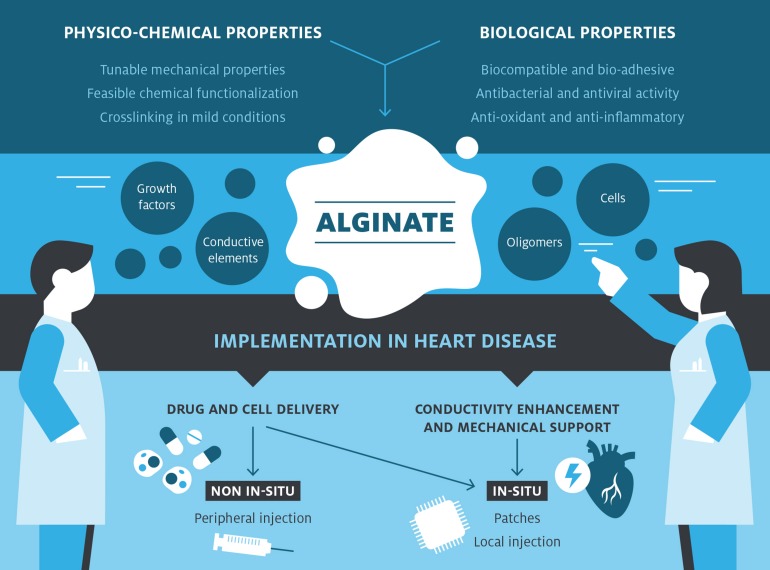
Cardiovascular diseases, including myocardial infarction, represent the main worldwide cause of mortality and morbidity. In this scenario, to contrast the irreversible damages following myocardial infarction, cardiac regeneration has emerged as a novel and promising solution for in situ cellular regeneration, preserving cell behavior and tissue cytoarchitecture. Among the huge variety of natural, synthetic, and hybrid compounds used for tissue regeneration, alginate emerged as a good candidate for cellular preservation and delivery, becoming one of the first biomaterial tested in pre-clinical research and clinical trials concerning cardiovascular diseases. Although promising results have been obtained, recellularization and revascularization of the infarcted area present still major limitations. Therefore, the demand is rising for alginate functionalization and its combination with molecules, factors, and drugs capable to boost the regenerative potential of the cardiac tissue. The focus of this review is to elucidate the promising properties of alginate and to highlight its benefits in clinical trials both in relation to cardiac regeneration. The definition of hydrogels, the alginate characteristics, and recent biomedical applications are herewith described. Afterwards, the review examines in depth the ongoing developments to refine the material relevance in cardiac recovery and regeneration after myocardial infarction (MI) and presents current clinical trials based on alginate.
Overview
The claims and statistics of this paper haven’t been checked yet.
Run the check — free, no account needed. It reads the open-access text and checks the sources it cites.
Integrity signals
Registry
Cites
Statistics
Figures
Verification
Claims the paper makes
The claims and statistics of this paper haven’t been checked yet.
Run the check — free, no account needed. It reads the open-access text and checks the sources it cites.
Claims other papers make about this one
Each is checked against this paper’s own text: does it say what the citing paper says it does?
In the citing paper
“Alginate has a number of advantages that make it attractive as a material for further study; it is inexpensive, relatively easy to modify and functionalize, biocompatible, and has been used in a wide range of biological and materials applications106–108.”
From Towards organoid culture without Matrigel (2021) · cites this paper as [108]
Self-check
Percentages, sums and reported differences re-computed from the paper’s own numbers.
The self-check needs the paper’s full text.
Citations
Cites
Alginate: Properties and biomedical applications
Lee, K. Y., & Mooney, D. J. (2011) · Progress in Polymer Science · doi:10.1016/j.progpolymsci.2011.06.003 · Cited by 8,477
The Extracellular Matrix: Not Just Pretty Fibrils
Hynes, R. O. (2009) · Science · doi:10.1126/science.1176009 · Cited by 3,527
Task Force Members, Thygesen, K. A., Alpert, J. S., White, H. D., Biomarker Group, Jaffe, A. S., Apple, F. S., Galvani, M., Katus, H. A., Newby, L. K., et al. (2007) · European Heart Journal · doi:10.1093/eurheartj/ehm355 · Cited by 2,536
Direct reprogramming of fibroblasts into functional cardiomyocytes by defined factors
Ieda, M., Fu, J.-D., Delgado-Olguin, P., Vedantham, V., Hayashi, Y., Bruneau, B. G., & Srivastava, D. (2010) · Cell · doi:10.1016/j.cell.2010.07.002 · Cited by 2,454
Paracrine Mechanisms in Adult Stem Cell Signaling and Therapy
Gnecchi, M., Zhang, Z., Ni, A., & Dzau, V. J. (2008) · Circulation Research · doi:10.1161/circresaha.108.176826 · Cited by 2,069
Alginate Hydrogels as Biomaterials
Augst, A., Kong, H. J., & Mooney, D. J. (2006) · Macromolecular Bioscience · doi:10.1002/mabi.200600069 · Cited by 1,905
Gnecchi, M., He, H., Liang, O. D., Melo, L. G., Morello, F., Mu, H., Noiseux, N., Zhang, L., Pratt, R. E., Ingwall, J. S., et al. (2005) · Nature Medicine · doi:10.1038/nm0405-367 · Cited by 1,677
Alginate derivatization: A review of chemistry, properties and applications
Pawar, S. N., & Edgar, K. J. (2012) · Biomaterials · doi:10.1016/j.biomaterials.2012.01.007 · Cited by 1,675
Current advances and future perspectives in extrusion-based bioprinting
Ozbolat, I. T., & Hospodiuk, M. (2015) · Biomaterials · doi:10.1016/j.biomaterials.2015.10.076 · Cited by 1,642
Kuo, C. K., & Ma, P. X. (2001) · Biomaterials · doi:10.1016/s0142-9612(00)00201-5 · Cited by 1,497
Cited by
Sorted by citations
Ions-induced gelation of alginate: Mechanisms and applications
Hu, C., Lu, W., Mata, A., Nishinari, K., & Fang, Y. (2021) · International Journal of Biological Macromolecules · doi:10.1016/j.ijbiomac.2021.02.086 · Cited by 600
Towards organoid culture without Matrigel
Kozlowski, M. T., Crook, C. J., & Ku, H. T. (2021) · Communications Biology · doi:10.1038/s42003-021-02910-8 · Cited by 409
Bojorges, H., López‐Rubio, A., Martínez‐Abad, A., & Fabra, M. J. (2023) · Trends in Food Science & Technology · doi:10.1016/j.tifs.2023.104142 · Cited by 247
Wei, Q., Zhou, J., An, Y., Li, M., Zhang, J., & Yang, S. (2023) · International Journal of Biological Macromolecules · doi:10.1016/j.ijbiomac.2023.123450 · Cited by 196
Biofabrication of natural hydrogels for cardiac, neural, and bone Tissue engineering Applications
Elkhoury, K., Morsink, M. A. J., Sánchez‐González, L., Kahn, C. J. F., Tamayol, A., & Arab‐Tehrany, E. (2021) · Bioactive Materials · doi:10.1016/j.bioactmat.2021.03.040 · Cited by 162
Metadata
- Authors
- Cattelan, G., Guerrero Gerbolés, A., Foresti, R., Pramstaller, P. P., Rossini, A., Miragoli, M., & Caffarra Malvezzi, C.
- Affiliations
- Eurac Research (IT)
- University of Parma (IT)
- Corresponding author
- Cattelan, Giada
- Venue
- Frontiers in Bioengineering and Biotechnology
- Publisher
- Frontiers Media SA
- Published
- 2020-05-08
- Volume
- 8
- Pages
- 414-414
- ISSN
- 2296-4185 (ISSN-L)
- PMC
- PMC7226066
- OpenAlex
- W3030898095
- Cited by
- 152
- References
- 164
- Citations by year
- 2026: 12 · 2025: 22 · 2024: 37 · 2023: 35 · 2022: 16 · 2021: 26 · 2020: 4
- FWCI
- 4.59
- Type
- journal article
- Language
- en
- Open access
- gold
- doi.org
- Licence
- Locations
- Frontiers in Bioengineering and Biotechnology (publishedVersion, cc-by)
- PubMed Central (publishedVersion, cc-by)
- PubMed (publishedVersion)
- DOAJ (DOAJ: Directory of Open Access Journals) (submittedVersion, cc-by-sa)
- Open Research (University of Surrey) (submittedVersion, other-oa)
- Funders
- Università degli Studi di Parma
- Provincia autonoma di Bolzano - Alto Adige
- Topics
- Health Sciences › Medicine › Surgery › Tissue Engineering and Regenerative Medicine
- Physical Sciences › Materials Science › Biomaterials › Hydrogels: synthesis, properties, applications
- Life Sciences › Biochemistry, Genetics and Molecular Biology › Molecular Biology › Congenital heart defects research
- Keywords
- alginate hydrogel, cardiac regeneration, myocardial infarction, cell delivery, cell preservation, recellularization, revascularization, biomaterials, clinical trials, tissue engineering
About these checks
Registry, retraction, Cites and statistics results are computed, not judged, with one exception: a printed reference that no index lists is read once by a model before it counts as a citation error. Claims are extracted by a model and kept only when their quote appears verbatim in the text; each cited source is then checked, with a model’s help, for whether it says what the claim relies on. Those verdicts can be wrong — read the claim’s quote and the cited source before relying on one.
Statistics and arithmetic are recomputed, not judged.
Confidence bands are shown only for fields calibrated on our annotated test set. None is calibrated yet, so no band is shown.
What counts as a claim ›How we measure confidence ›How we check this ›
Are you an author, or do you see a problem with this page? Request a review
