

The DOI matches its Crossref record; 4 of the 4 references it cites were found in a registry or an index.
Nanoparticle accumulation and penetration in 3D tumor models: the effect of size, shape, and surface charge
Published version of a preprint
Abstract
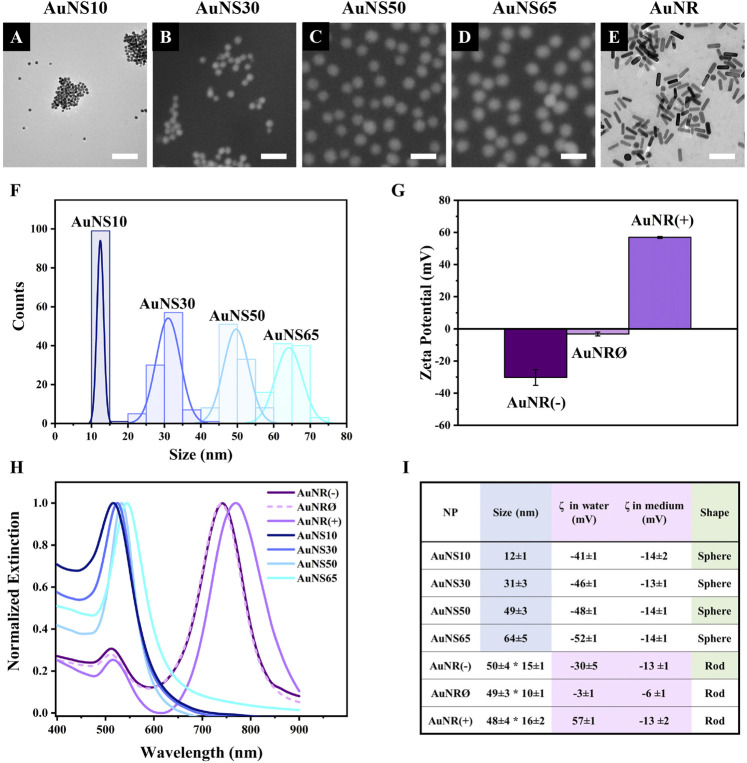
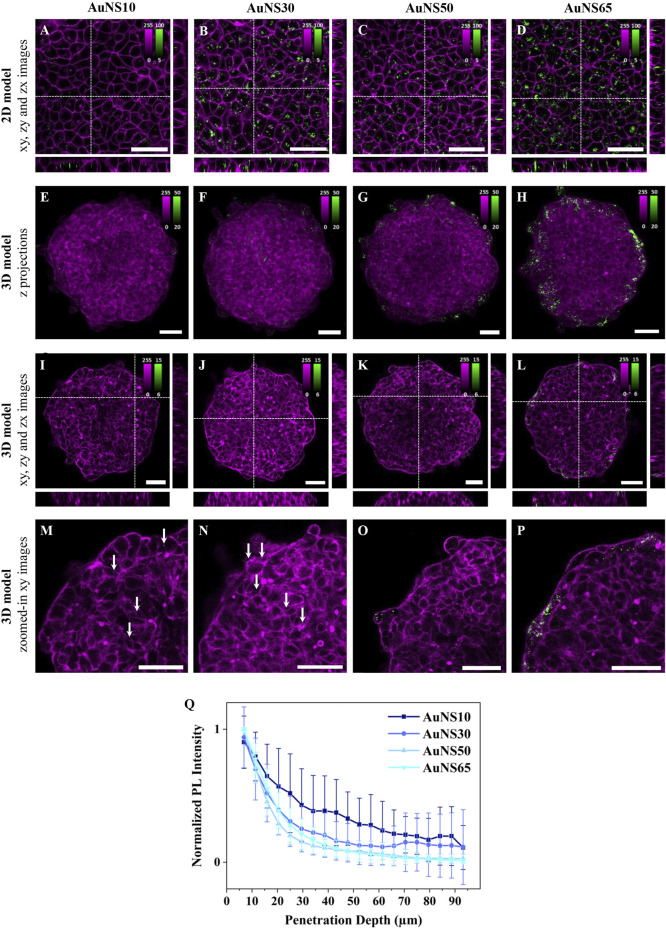
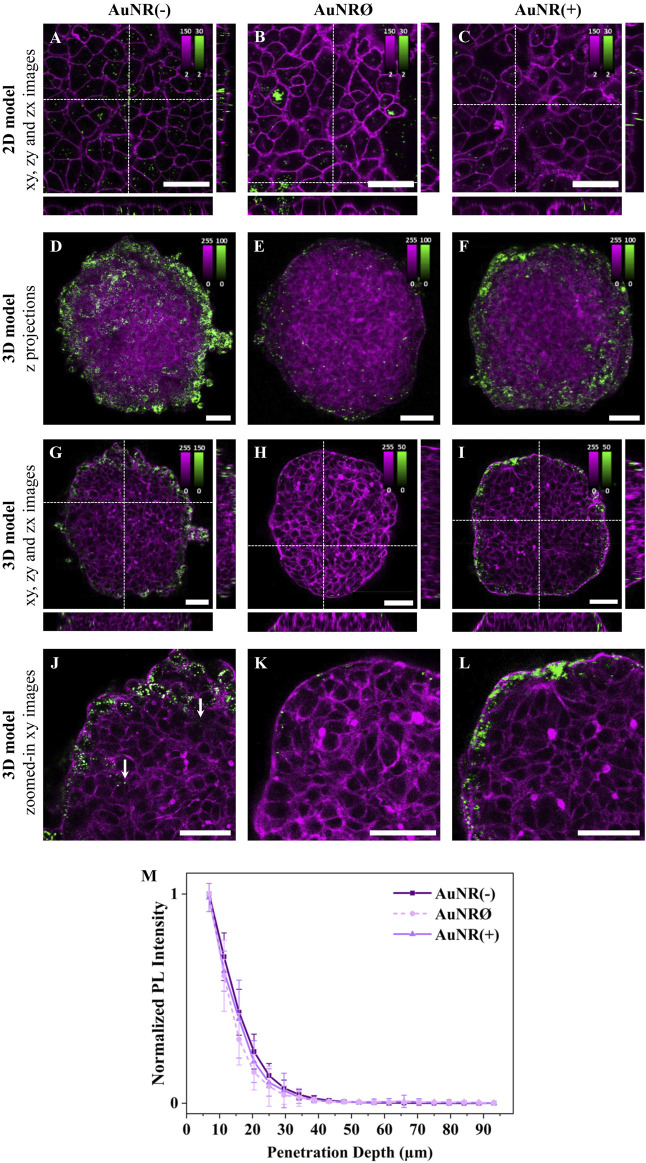
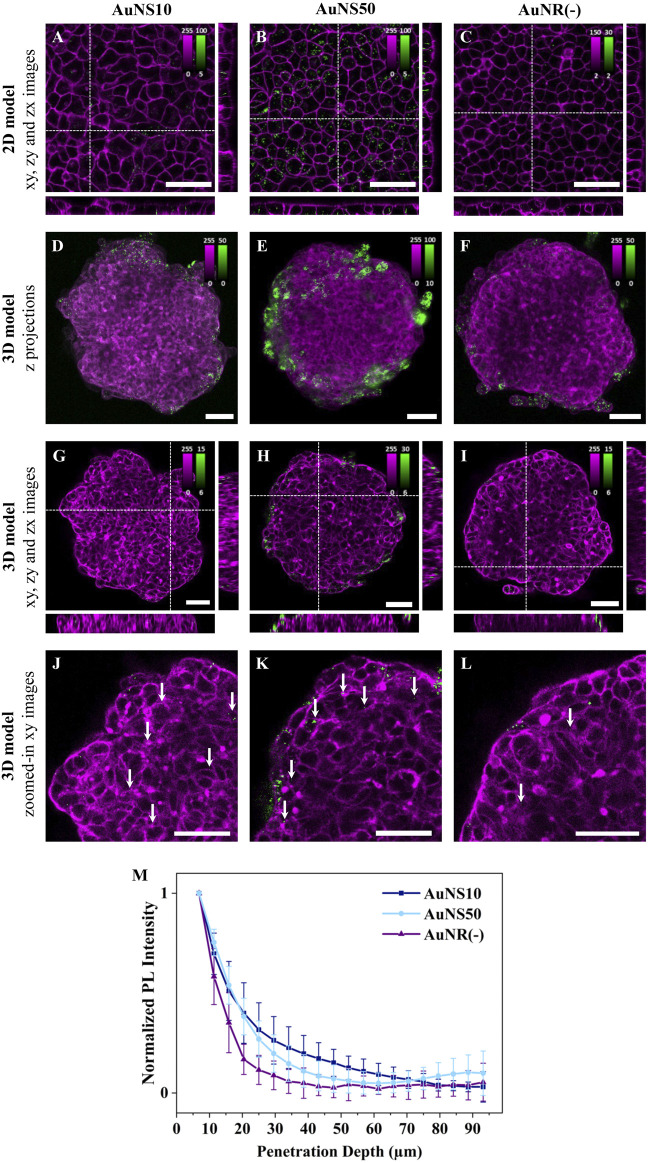
Preclinical studies have demonstrated that nanoparticles (NPs) hold significant potential for advancing cancer therapy by enhancing therapeutic efficacy while reducing side effects. Their effectiveness in solid tumors is, however, often constrained by insufficient accumulation and penetration. Understanding how the physicochemical properties of NPs – such as size, shape, and surface charge – influence their interaction with cells within the tumor is critical for optimizing NP design. In this study, we addressed the challenge of inconsistent NP behavior by systematically evaluating NP uptake in both 2D and 3D tumor models, and NP penetration in spheroids. Our results showed that larger NPs exhibited higher internalization rates in 2D models but limited penetration in 3D spheroids. Furthermore, negatively charged NPs consistently achieved superior accumulation and deeper penetration than neutral and positively charged NPs. Spherical NPs outperformed rod-shaped NPs in tumor accumulation and penetration. These findings underscore the importance of carefully tailoring NP properties to the complex tumor microenvironment for improved therapeutic outcomes in real tumors.
Overview
The claims and statistics of this paper haven’t been checked yet.
Run the check — free, no account needed. It reads the open-access text and checks the sources it cites.
Integrity signals
Registry
Cites
Statistics
Figures
Verification
Claims the paper makes
The claims and statistics of this paper haven’t been checked yet.
Run the check — free, no account needed. It reads the open-access text and checks the sources it cites.
Claims other papers make about this one
Each is checked against this paper’s own text: does it say what the citing paper says it does?
In the citing paper
“In the same study, Cybulski et al. further demonstrated that positively charged AuNR(+) underwent complete charge inversion in serum-containing medium due to the adsorption of a predominantly anionic protein corona, which reduced close contact with cell membranes and limited penetration into inner spheroid layers [17].”
From Overcoming tumor microenvironment barriers: transformable and bioinspired nanomedicine strategies for deep tumor penetration (2026) · cites this paper as [17]
In the citing paper
“In three dimensional tumor models, recent work using well-defined gold nanoparticles highlights the multi-parameter dependence of penetration on both physicochemical properties and material composition.”
From Overcoming tumor microenvironment barriers: transformable and bioinspired nanomedicine strategies for deep tumor penetration (2026) · cites this paper as [17]
In the citing paper
“They observed that larger nanospheres showed higher overall accumulation but shallower penetration, whereas smaller nanospheres and negatively charged particles could reach inner spheroid layers, and rod-shaped particles generally displayed more limited penetration than spherical ones [17].”
From Overcoming tumor microenvironment barriers: transformable and bioinspired nanomedicine strategies for deep tumor penetration (2026) · cites this paper as [17]
Self-check
Percentages, sums and reported differences re-computed from the paper’s own numbers.
The self-check needs the paper’s full text.
Citations
Cites
Cellular uptake of nanoparticles: Journey inside the cell
Behzadi, S., Serpooshan, V., Tao, W., Hamaly, M. A., Alkawareek, M. Y., Dreaden, E. C., Brown, D., Alkilany, A. M., Farokhzad, O. C., & Mahmoudi, M. (2017) · Chemical Society Reviews · doi:10.1039/c6cs00636a · Cited by 2,859
The Effect of Nanoparticle Size on In Vivo Pharmacokinetics and Cellular Interaction
Hoshyar, N., Gray, S., Han, H., & Bao, G. (2016) · Nanomedicine · doi:10.2217/nnm.16.5 · Cited by 1,990
Nanoparticle protein corona: from structure and function to therapeutic targeting
Bashiri, G., Padilla, M. S., Swingle, K. L., Shepherd, S. J., Mitchell, M. J., & Wang, K. (2023) · Lab on a Chip · doi:10.1039/d2lc00799a · Cited by 296
Huang, K., Boerhan, R., Liu, C., & Jiang, G. (2017) · Molecular Pharmaceutics · doi:10.1021/acs.molpharmaceut.7b00726 · Cited by 74
Research works printed but not linked: 36
- Agarwal, 2015, Effect of shape, size, and aspect ratio on nanoparticle penetration and distribution inside solid tissues using 3D spheroid models, Adv. Healthc. Mater, 4, 2269, 10.1002/adhm.201500441 · DOI · Paper page
- Barua, 2014, Challenges associated with penetration of nanoparticles across cell and tissue barriers: a review of current status and future prospects, Nano Today, 23, 223, 10.1016/j.nantod.2014.04.008 · DOI
- Biju, 2023, Role of three-dimensional cell culture in therapeutics and diagnostics: an updated review, Drug Deliv. Transl. Res., 13, 2239, 10.1007/s13346-023-01327-6 · DOI
- Bravo, 2024, Nanoparticle-mediated thermal Cancer therapies: strategies to improve clinical translatability, J. Control. Release, 372, 751, 10.1016/j.jconrel.2024.06.055 · DOI
- Chen, 2024, Size-dependent penetration of nanoparticles in tumor spheroids: a multidimensional and quantitative study of transcellular and paracellular pathways, Small, 20, 2304693, 10.1002/smll.202304693 · DOI
- Chen, 2023, Current understanding of passive and active targeting nanomedicines to enhance tumor accumulation, Coord. Chem. Rev., 481, 215051, 10.1016/j.ccr.2023.215051 · DOI
- Dreaden, 2012, The golden age: gold nanoparticles for biomedicine, Chem. Soc. Rev., 41, 2740, 10.1039/c1cs15237h · DOI
- Fan, 2023, Nanomedicine in cancer therapy, Signal Transduct. Target Ther., 8, 293, 10.1038/s41392-023-01536-y · DOI
- Forest, 2017, Preferential binding of positive nanoparticles on cell membranes is due to electrostatic interactions: a too simplistic explanation that does not take into account the nanoparticle protein corona, Mater. Sci. Eng. C, 70, 889, 10.1016/j.msec.2016.09.016 · DOI
- Gessner, 2000, Nanoparticles with decreasing surface hydrophobicities: influence on plasma protein adsorption, Int. J. Pharm., 196, 245, 10.1016/s0378-5173(99)00432-9 · DOI
- Görlach, 1994, pO2- and pH-gradients in multicellular spheroids and their relationship to cellular metabolism and radiation sensitivity of malignant human tumor cells, Biochim. Biophys. Acta, 1227, 105, 10.1016/0925-4439(94)90085-x · DOI
- He, 2019, Survey of clinical translation of cancer nanomedicines - lessons learned from successes and failures, Acc. Chem. Res., 52, 2445, 10.1021/acs.accounts.9b00228 · DOI
- Huang, 2012, Size-dependent localization and penetration of ultrasmall gold nanoparticles in cancer cells, multicellular spheroids, and tumors in vivo, ACS Nano, 6, 4483, 10.1021/nn301282m · DOI
- Huang, 2010, Gold nanoparticles: optical properties and implementations in cancer diagnosis and photothermal therapy, J. Adv. Res., 1, 13, 10.1016/j.jare.2010.02.002 · DOI
- Keller, 2010, Stability and aggregation of metal oxide nanoparticles in natural aqueous matrices, Environ. Sci. Technol., 44, 1962, 10.1021/es902987d · DOI
- Lesniak, 2013, Nanoparticle adhesion to the cell membrane and its effect on nanoparticle uptake efficiency, J. Am. Chem. Soc., 135, 1438, 10.1021/ja309812z · DOI
- Li, 2015, Shape effect in cellular uptake of PEGylated nanopar-ticles: comparison between sphere, rod, cube and disk, Nanoscale, 7, 16631, 10.1039/C5NR02970H · DOI
- Link, 2005, Erratum: simulation of the optical absorption spectra of gold nanorods as a function of their aspect ratio and the effect of the medium dielectric constant (Journal of Physical Chemistry B (1999) 103B), J. Phys. Chem. B, 109, 10531, 10.1021/jp058091f · DOI
- Lunnoo, 2019, In silico study of gold nanoparticle uptake into a mammalian cell: interplay of size, shape, surface charge, and aggregation, J. Phys. Chem. C, 123, 3801, 10.1021/acs.jpcc.8b07616 · DOI
- Ma, 2013, Influence of nanoparticle shape, size, and surface functionalization on cellular uptake, J. Nanosci. Nanotechnol., 13, 6485, 10.1166/jnn.2013.7525 · DOI
- Ma, 2017, Introducing membrane charge and membrane potential to T cell signaling, Front. Immunol., 8, 1513, 10.3389/fimmu.2017.01513 · DOI
- Moore, 2019, Nanoparticle administration method in cell culture alters particle-cell interaction, Sci. Rep., 9, 900, 10.1038/s41598-018-36954-4 · DOI
- Olesiak-Banska, 2019, Two-photon absorption and photoluminescence of colloidal gold nanoparticles and nanoclusters, Chem. Soc. Rev., 48, 4087, 10.1039/c8cs00849c · DOI
- Pratiwi, 2021, Evaluation of nanoparticle penetration in the tumor spheroid using two-photon microscopy, Biomedicines, 9, 10, 10.3390/biomedicines9010010 · DOI
- Salatin, 2015, Effect of the surface modification, size, and shape on cellular uptake of nanoparticles, Cell Biol. Int., 39, 881, 10.1002/cbin.10459 · DOI
- Shin, 2013, Membrane potential mediates the cellular binding of nanoparticles, Nanoscale, 5, 5879, 10.1039/c3nr01667f · DOI
- Sujai, 2020, Surface charge modulates the internalization: vs. penetration of gold nanoparticles: comprehensive scrutiny on monolayer cancer cells, multicellular spheroids and solid tumors by SERS modality, Nanoscale, 12, 6971, 10.1039/d0nr00809e · DOI
- Tchoryk, 2019, Penetration and uptake of nanoparticles in 3D tumor spheroids, Bioconjug Chem., 30, 1371, 10.1021/acs.bioconjchem.9b00136 · DOI
- Van Zundert, 2020, From 2d to 3d cancer cell models—the enigmas of drug delivery research, Nanomaterials, 10, 2236, 10.3390/nano10112236 · DOI
- Van Zundert, 2022, Fluorescence imaging of 3D cell models with subcellular resolution, Bio Protoc., 12, e4469, 10.21769/BioProtoc.4469 · DOI
- Wang, 2016, Surface charge critically affects tumor penetration and therapeutic efficacy of cancer nanomedicines, Nano Today, 11, 133, 10.1016/j.nantod.2016.04.008 · DOI
- Wriedt, 2012, The mie theory: a review, 10.1007/978-3-642-28738-1_2 · DOI
- Xie, 2017, The effect of shape on cellular uptake of gold nanoparticles in the forms of stars, rods, and triangles, Sci. Rep., 7, 3827, 10.1038/s41598-017-04229-z · DOI
- Yetisgin, 2020, Therapeutic nanoparticles and their targeted delivery applications, Molecules, 25, 2193, 10.3390/molecules25092193 · DOI
- Zhang, 2019, Shape effect of nanoparticles on tumor penetration in monolayers versus spheroids, Mol. Pharm., 16, 2902, 10.1021/acs.molpharmaceut.9b00107 · DOI
- Zhao, 2017, Influence of nanoparticle shapes on cellular uptake of paclitaxel loaded nanoparticles in 2D and 3D cancer models, Polym. Chem., 8, 3317, 10.1039/c7py00385d · DOI
Cited by
Sorted by citations
Sheng, J., Yuan, W., Zhang, M., Chen, Z., Qi, Y., Zhao, Y., & Zhang, S. (2026) · Journal of Nanobiotechnology · doi:10.1186/s12951-026-04028-7 · Cited by 35
Metadata
- Authors
- Cybulski, P., Bravo, M., Chen, J. J.-K., Van Zundert, I., Krzyzowska, S., Taemaitree, F., Uji-i, H., Hofkens, J., Rocha, S., & Fortuni, B.
- Venue
- Frontiers in Cell and Developmental Biology
- Publisher
- Frontiers Media SA
- Published
- 2025-01-24
- Volume
- 12
- ISSN
- 2296-634X
- PMC
- PMC11802510
- Cited by
- 51
- References
- 4
- Funders
- H2020 Marie Skłodowska-Curie Actions (860914)
- Fonds Wetenschappelijk Onderzoek (G0D4519N G081916N VS08523N G0C1821N G022724N 12X1419N 12X1423N 12A6N25N)
- KU Leuven (IDN/20/021 C14/15/053 C14/19/079 C14/22/085 GPUM/21/025)
About these checks
Registry, retraction, Cites and statistics results are computed, not judged, with one exception: a printed reference that no index lists is read once by a model before it counts as a citation error. Claims are extracted by a model and kept only when their quote appears verbatim in the text; each cited source is then checked, with a model’s help, for whether it says what the claim relies on. Those verdicts can be wrong — read the claim’s quote and the cited source before relying on one.
Statistics and arithmetic are recomputed, not judged.
Confidence bands are shown only for fields calibrated on our annotated test set. None is calibrated yet, so no band is shown.
What counts as a claim ›How we measure confidence ›How we check this ›
Are you an author, or do you see a problem with this page? Request a review
How to cite
Cite CoChat for the checks on this page, and the paper for its own findings.
- This page
- CoChat. (2026). Citation check: Nanoparticle accumulation and penetration in 3D tumor models: the effect of size, shape, and surface charge. https://app.cochat.ai/papers/10.3389/fcell.2024.1520078
- The paper
- Cybulski, P., Bravo, M., Chen, J. J.-K., Van Zundert, I., Krzyzowska, S., Taemaitree, F., Uji-i, H., Hofkens, J., Rocha, S., & Fortuni, B. (2025). Nanoparticle accumulation and penetration in 3D tumor models: the effect of size, shape, and surface charge. Frontiers in Cell and Developmental Biology. https://doi.org/10.3389/fcell.2024.1520078
