

The DOI matches its Crossref record; 132 of the 133 references it cites were found in a registry or an index.
Drought Response in Wheat: Key Genes and Regulatory Mechanisms Controlling Root System Architecture and Transpiration Efficiency
Open accessAbstract
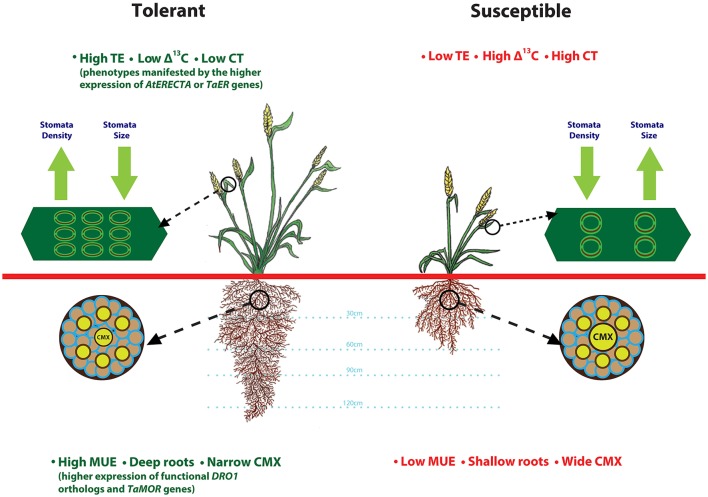
Abiotic stresses such as drought, heat, salinity and flooding threaten global food security. Crop genetic improvement with increased resilience to abiotic stresses is a critical component of crop breeding strategies. Wheat is an important cereal crop and a staple food source globally. Enhanced drought tolerance in wheat is critical for sustainable food production and global food security. Recent advances in drought tolerance research have uncovered many key genes and transcription regulators governing morpho-physiological traits. Genes controlling root architecture and stomatal development play an important role in soil moisture extraction and its retention, and therefore have been targets of molecular breeding strategies for improving drought tolerance. In this systematic review, we have summarized evidence of beneficial contributions of root and stomatal traits to plant adaptation to drought stress. Specifically, we discuss a few key genes such as DRO1 in rice and ERECTA in Arabidopsis and rice that were identified to be the enhancers of drought tolerance via regulation of root traits and transpiration efficiency. Additionally, we highlight several transcription factor families, such as ERF (ethylene response factors), DREB (dehydration responsive element binding), ZFP (zinc finger proteins), WRKY and MYB that were identified to be both positive and negative regulators of drought responses in wheat, rice, maize and/or Arabidopsis. The overall aim of this review was to provide an overview of candidate genes that have been tested as regulators of drought response in plants. The lack of a reference genome sequence for wheat and nontransgenic approaches for manipulation of gene functions in the past had impeded high-resolution interrogation of functional elements, including genes and QTLs, and their application in cultivar improvement. The recent developments in wheat genomics and reverse genetics, including the availability of a gold-standard reference genome sequence and advent genome editing technologies, are expected to aid in deciphering of the functional roles of genes and regulatory networks underlying adaptive phenological traits, and utilizing the outcomes of such studies in developing drought tolerance cultivars.
Overview
The claims and statistics of this paper haven’t been checked yet.
Run the check — free, no account needed. It reads the open-access text and checks the sources it cites.
Integrity signals
Registry
Cites
Statistics
Figures
Verification
Claims the paper makes
The claims and statistics of this paper haven’t been checked yet.
Run the check — free, no account needed. It reads the open-access text and checks the sources it cites.
Claims other papers make about this one
Each is checked against this paper’s own text: does it say what the citing paper says it does?
The source backs part of the claim, not all of it — or backs it for a different population, condition or comparison.
In the citing paper
“A notable example is the ERECTA gene family, which plays a critical role in drought tolerance by influencing root system architecture and transpiration efficiency in both Arabidopsis thaliana and economically important crops like Oryza sativa (Kulkarni et al., 2017; Wen J. et al., 2019).”
From Emerging applications of gene editing technologies for the development of climate-resilient crops (2025) · cites this paper as Kulkarni et al., 2017
Experimental — accuracy not yet measured
Self-check
Percentages, sums and reported differences re-computed from the paper’s own numbers.
The self-check needs the paper’s full text.
Citations
Cites
The role of stomata in sensing and driving environmental change
Hetherington, A. M., & Woodward, F. I. (2003) · Nature · doi:10.1038/nature01843 · Cited by 2,468
Shiferaw, B. A., Prasanna, B. M., Hellin, J., & Bänziger, M. (2011) · Food Security · doi:10.1007/s12571-011-0140-5 · Cited by 1,676
Uga, Y., Sugimoto, K., Ogawa, S., Rane, J., Ishitani, M., Hara, N., Kitomi, Y., Inukai, Y., Ono, K., Kanno, N., et al. (2013) · Nature Genetics · doi:10.1038/ng.2725 · Cited by 1,663
Self-citationA chromosome-based draft sequence of the hexaploid bread wheat ( Triticum aestivum ) genome
The International Wheat Genome Sequencing Consortium (IWGSC), Mayer, K. F. X., Rogers, J., Doležel, J., Pozniak, C., Eversole, K., Feuillet, C., Gill, B., Friebe, B., Lukaszewski, A. J., et al. (2014) · Science · doi:10.1126/science.1251788 · Cited by 1,583
Shiferaw, B. A., Smale, M., Braun, H., Duveiller, E., Reynolds, M. P., & Muricho, G. (2013) · Food Security · doi:10.1007/s12571-013-0263-y · Cited by 1,467
A Critical Evaluation of Traits for Improving Crop Yields in Water-Limited Environments
Ludlow, M. M., & Muchow, R. C. (1990) · Advances in agronomy · doi:10.1016/s0065-2113(08)60477-0 · Cited by 1,318
Breeding for high water-use efficiency
Condon, A. G. (2004) · Journal of Experimental Botany · doi:10.1093/jxb/erh277 · Cited by 1,218
Tuning gene expression to changing environments: from rapid responses to evolutionary adaptation
López-Maury, L., Marguerat, S., & Bähler, J. (2008) · Nature Reviews Genetics · doi:10.1038/nrg2398 · Cited by 1,061
Licausi, F., Ohme‐Takagi, M., & Pierdomenico Perata, A. (2013) · New Phytologist · doi:10.1111/nph.12291 · Cited by 1,022
NINJA connects the co-repressor TOPLESS to jasmonate signalling
Pauwels, L., Barbero, G. F., Geerinck, J., Tilleman, S., Grunewald, W., Pérez, A. C., Chico, J. M., Bossche, R. V., Sewell, J. A., Gil, E., et al. (2010) · Nature · doi:10.1038/nature08854 · Cited by 1,022
Cited by
Sorted by citations
Items 201–232 of 232
BIOCHEMICAL AND PHYSICAL CHANGES DUE TO DROUGHT STRESS IN WHEAT (Triticum aestivum L.)
Gautam, N., Sah, M., Bhandari, L., Aryal, S., Kafle, J., Pokharel, S., & Dhakal, K. (2021) · Tropical Agrobiodiversity · doi:10.26480/trab.02.2021.72.76
The role of silicon (Si) in increasing drought tolerance in wheat
Duvnjak, J., & Španić, V. (2023) · Agronomski glasnik · doi:10.33128/ag.84.4-5.2
MORPHOLOGICAL CHARACTERS VARIABILITY OF THE A4-10 WINTER WHEAT LINE UNDER CURRENT CLIMATE CONDITIONS
Ionescu, N., Gheorghe, R., Nicolae, M. C., Badea, O. D., Popescu, D., & GHIORGHE, C. (2023) · LIFE SCIENCE AND SUSTAINABLE DEVELOPMENT · doi:10.58509/25y18f83
Nawaz, M., Li, L., Azeem, F., Shabbir, S., Zohaib, A., Ashraf, U., Yang, H., & Wang, Z. (2021) · Figshare · doi:10.6084/m9.figshare.13698119
Li, Y., Sun, A., Wu, Q., Zou, X., Chen, F., Cai, R., Xie, H., Zhang, M., & Guo, X. (2021) · Figshare · doi:10.6084/m9.figshare.15253308
Kim, K., Hong, S., Choi, M.-G., Choi, C., Lee, M. H., Yoon, M., Kang, C.-S., Jang, K.-C., Mo, Y., & Park, C. S. (2024) · Korean Journal of Breeding Science · doi:10.9787/kjbs.2024.56.2.113
Danishiar, S. Q. (2024) · Journal of Natural Science Review · doi:10.62810/jnsr.v2ispecial.issue.130
تنظیم عملکرد جینها در تغیرات فزیولوژیکی گندم در شرایط خشک
دانشیار, س. (2025) · Journal of Natural Sciences – Kabul University · doi:10.62810/jns.v4i2.226
Mathur, P., Munjal, R., Kumari, A., Beniwal, J., Bhambhu, M. K., Saini, S., Rahimi, M., & Kordrostami, M. (2025) · Plant Molecular Biology Reporter · doi:10.1007/s11105-025-01627-w
faCRSA: An automated pipeline for high-throughput analysis of crop root system architecture
Ge, J., Zhang, R., He, Y., Sun, Z., Li, Q., Jin, S., Cai, J. B., Zhou, Q., Huang, M., Wang, X., et al. (2025) · The Crop Journal · doi:10.1016/j.cj.2025.09.011
Koilkonda, P., Sarkar, B., Maheswari, M., Mythily, R., Maruthi, V., & Singh, V. K. (2025) · Research Square · doi:10.21203/rs.3.rs-8132177/v1
Mediga, K. R., Sharma, B., Joshi, R., Palanivel, H., Kuruva, M., & Sunkad, G. (2025) · Elsevier eBooks · doi:10.1016/b978-0-443-22090-6.00004-7
Zaki, H. E. M., & Radwan, K. S. A. (2022) · Figshare · doi:10.6084/m9.figshare.18132435
Li, Y., Sun, A., Wu, Q., Zou, X., Chen, F., Cai, R., Xie, H., Zhang, M., & Guo, X. (2021) · Figshare · doi:10.6084/m9.figshare.15253311
Nawaz, M., Li, L., Azeem, F., Shabbir, S., Zohaib, A., Ashraf, U., Yang, H., & Wang, Z. (2021) · Figshare · doi:10.6084/m9.figshare.13698113
Nawaz, M., Li, L., Azeem, F., Shabbir, S., Zohaib, A., Ashraf, U., Yang, H., & Wang, Z. (2021) · Figshare · doi:10.6084/m9.figshare.13698116
Chen, Y., Palta, J. A., Prasad, P. V. V., & Siddique, K. H. M. (2020) · Figshare · doi:10.6084/m9.figshare.12211751
Li, Y., Sun, A., Wu, Q., Zou, X., Chen, F., Cai, R., Xie, H., Zhang, M., & Guo, X. (2021) · Figshare · doi:10.6084/m9.figshare.15253314
Host-associated stress and molecular regulations
Kumari, N., Kumar, A., Shilpa, C., & Sharma, M. (2026) · Elsevier eBooks · doi:10.1016/b978-0-443-41696-5.00009-1
Ali, Z., Nawaz, R., Nisa, Q. U., & Hakeem, S. (2026) · Molecular Biology Reports · doi:10.1007/s11033-026-11790-2
Assessing Genetic Diversity and Drought Adaptive Potential in Diverse Hexaploid Wheat Accessions
Choudhary, D., Sheoran, S., Kumar, S. P. J., Sonu, Mishra, C. N., Kumar, S. P. J., Singh, R., & Sareen, S. (2026) · Indian Journal of Genetics and Plant Breeding (The) · doi:10.1007/s44489-026-00027-y
Ochieng, G. A., Gujer, L., Christopher, S., Mason, A. S., & Ballvora, A. (2026) · Plant Cell & Environment · doi:10.1111/pce.70625
The Channelled Substrate: Physical Constraints on Biological VariationPreprint
Goel, S. S. (2026) · SSRN Electronic Journal · doi:10.2139/ssrn.6916240
Huang, P., Chai, J., Niu, K., Zeng, L., Wang, W., Ma, Y., Cao, Y., & Zhao, G. (2026) · BMC Plant Biology · doi:10.1186/s12870-026-09663-8
Golik, O., & Relina, L. I. (2026) · Fiziologia rastenij i genetika · doi:10.15407/frg2026.04.329
Khalil, H. B., Alsahoud, H. A., Mostafa, A. D., Alhassan, F. A., Al-helal, N., & Ikeno, S. (2026) · International Journal of Molecular Sciences · doi:10.3390/ijms27177616
Wheat Drought Management: A Broader Prospect
Batool, A., Li, S.-S., Tu, W., Xiao, Y.-L., Zhou, T., & Du, H. (2026) · Plants · doi:10.3390/plants15172653
Salsinha, Y. C. F., Laia, D. Y. W., & Salsinha, C. N. (2026) · Plant Physiology Reports · doi:10.1007/s40502-026-00992-2
Francis, D. V., Kishorkumar, M., Abdulla, T., Jaleel, A., AlSafar, H. S., Dhaheri, A. S. A., & Kurup, S. S. (2026) · Frontiers in Plant Science · doi:10.3389/fpls.2026.1942405
Hayat, M. K., Cengiz, R., Arif, M., & Gull, U. (2026) · Artificial Intelligence in Plant Systems · doi:10.1016/j.aips.2026.100008
Metadata
- Authors
- Kulkarni, M., Soolanayakanahally, R., Ogawa, S., Uga, Y., Selvaraj, M. G., & Kagale, S.
- Affiliations
- National Research Council Canada (CA)
- Agriculture and Agri-Food Canada (CA)
- The University of Tokyo (JP)
- National Agriculture and Food Research Organization (JP)
- International Center for Tropical Agriculture (CO)
- Corresponding author
- Kagale, Sateesh
- ORCID
- Venue
- Frontiers in Chemistry
- Publisher
- Frontiers Media SA
- Published
- 2017-12-05
- Volume
- 5
- Pages
- 106-106
- ISSN
- 2296-2646 (ISSN-L)
- PMC
- PMC5723305
- OpenAlex
- W2774114587
- Cited by
- 230
- References
- 133
- Citations by year
- 2026: 16 · 2025: 27 · 2024: 33 · 2023: 31 · 2022: 35 · 2021: 36 · 2020: 28 · 2019: 15 · 2018: 9
- FWCI
- 1.48
- Type
- journal article
- Language
- en
- Open access
- gold
- doi.org
- Licence
- cc-by
- Locations
- Frontiers in Chemistry (publishedVersion, cc-by)
- Europe PMC (PubMed Central) (publishedVersion, cc-by)
- PubMed Central (publishedVersion, cc-by)
- PubMed (publishedVersion)
- CGSPace A Repository of Agricultural Research Outputs (Consultative Group for International Agricultural Research) (submittedVersion, other-oa)
- DOAJ (DOAJ: Directory of Open Access Journals) (submittedVersion)
- Funders
- Agriculture and Agri-Food Canada
- National Research Council Canada
- Topics
- Life Sciences › Agricultural and Biological Sciences › Plant Science › Plant Stress Responses and Tolerance
- Life Sciences › Agricultural and Biological Sciences › Plant Science › Plant Molecular Biology Research
- Life Sciences › Agricultural and Biological Sciences › Plant Science › Genetics and Plant Breeding
- Keywords
- wheat, drought tolerance, root architecture, transpiration efficiency, stomatal development, DRO1, ERECTA, transcription factors, ERF, DREB, WRKY, MYB, zinc finger proteins, abiotic stress, candidate genes, genome editing, wheat genomics, quantitative trait loci, food security
About these checks
Registry, retraction, Cites and statistics results are computed, not judged, with one exception: a printed reference that no index lists is read once by a model before it counts as a citation error. Claims are extracted by a model and kept only when their quote appears verbatim in the text; each cited source is then checked, with a model’s help, for whether it says what the claim relies on. Those verdicts can be wrong — read the claim’s quote and the cited source before relying on one.
Statistics and arithmetic are recomputed, not judged.
Confidence bands are shown only for fields calibrated on our annotated test set. None is calibrated yet, so no band is shown.
What counts as a claim ›How we measure confidence ›How we check this ›
Are you an author, or do you see a problem with this page? Request a review
