

The DOI matches its Crossref record; 29 of the 29 references it cites were found in a registry or an index.
AI chatbots not yet ready for clinical use.
Open accessPublished version of a preprint
Abstract
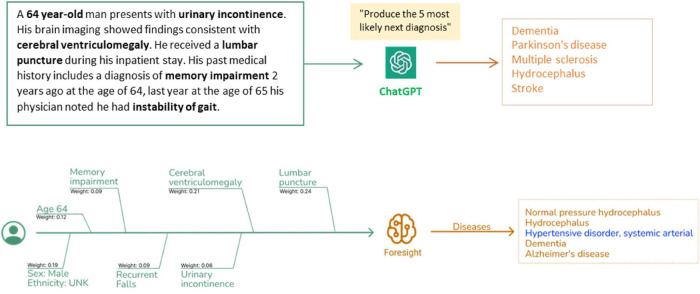
As large language models (LLMs) expand and become more advanced, so do the natural language processing capabilities of conversational AI, or "chatbots". OpenAI's recent release, ChatGPT, uses a transformer-based model to enable human-like text generation and question-answering on general domain knowledge, while a healthcare-specific Large Language Model (LLM) such as GatorTron has focused on the real-world healthcare domain knowledge. As LLMs advance to achieve near human-level performances on medical question and answering benchmarks, it is probable that Conversational AI will soon be developed for use in healthcare. In this article we discuss the potential and compare the performance of two different approaches to generative pretrained transformers-ChatGPT, the most widely used general conversational LLM, and Foresight, a GPT (generative pretrained transformer) based model focused on modelling patients and disorders. The comparison is conducted on the task of forecasting relevant diagnoses based on clinical vignettes. We also discuss important considerations and limitations of transformer-based chatbots for clinical use.
Overview
The claims and statistics of this paper haven’t been checked yet.
Run the check — free, no account needed. It reads the open-access text and checks the sources it cites.
Integrity signals
Registry
Cites
Statistics
Figures

Verification
Claims the paper makes
The claims and statistics of this paper haven’t been checked yet.
Run the check — free, no account needed. It reads the open-access text and checks the sources it cites.
Claims other papers make about this one
Each is checked against this paper’s own text: does it say what the citing paper says it does?
The cited source says what the claim attributes to it.
In the citing paper
“hallucinations are also well described in transformerbased generative models, 24,25 including the recent ChatGPT”
From Foresight-a generative pretrained transformer for modelling of patient timelines using electronic health records: a retrospective modelling study (2024) · cites this paper as [25]
Self-check
Percentages, sums and reported differences re-computed from the paper’s own numbers.
The self-check needs the paper’s full text.
Citations
Cites
Vaswani, A., Shazeer, N., Parmar, N., Uszkoreit, J., Jones, L., Gomez, A. N., Kaiser, L., & Polosukhin, I. (2017) · arXiv · doi:10.48550/arxiv.1706.03762 · Cited by 120,404
Jakubův, J., Chvalovský, K., Goertzel, Z., et al. (2023) · DROPS (Schloss Dagstuhl – Leibniz Center for Informatics) · doi:10.4230/lipics.itp.2023.19 · Cited by 76,648
Language Models are Few-Shot Learners
Brown, T. B., Mann, B., Ryder, N., Subbiah, M., Kaplan, J., Dhariwal, P., Neelakantan, A., Shyam, P., Sastry, G., Askell, A., et al. (2020) · arXiv · doi:10.48550/arxiv.2005.14165 · Cited by 23,372
Large language models encode clinical knowledge
Singhal, K., Azizi, S., Tu, T., Mahdavi, S. S., Wei, J., Chung, H. W., Scales, N., Tanwani, A., Cole-Lewis, H., Pfohl, S., et al. (2023) · Nature · doi:10.1038/s41586-023-06291-2 · Cited by 4,083
Large Language Models Encode Clinical Knowledge
Singhal, K., Azizi, S., Tu, T., Mahdavi, S. S., Wei, J., Chung, H. W., Scales, N., Tanwani, A., Cole-Lewis, H., Pfohl, S., et al. (2022) · arXiv · doi:10.48550/arxiv.2212.13138 · Cited by 4,083
Semantics derived automatically from language corpora contain human-like biases
Caliskan, A., Bryson, J. J., & Narayanan, A. (2017) · Science · doi:10.1126/science.aal4230 · Cited by 2,887
PaLM: Scaling Language Modeling with Pathways
Chowdhery, A., Narang, S., Devlin, J., Bosma, M., Mishra, G., Roberts, A., Barham, P., Chung, H. W., Sutton, C., Gehrmann, S., et al. (2022) · arXiv · doi:10.48550/arxiv.2204.02311 · Cited by 2,590
On Faithfulness and Factuality in Abstractive Summarization
Maynez, J., Narayan, S., Bohnet, B., & McDonald, R. (2020) · Proceedings of the 58th Annual Meeting of the Association for Computational Linguistics · doi:10.18653/v1/2020.acl-main.173 · Cited by 1,185
On Faithfulness and Factuality in Abstractive Summarization
Maynez, J., Narayan, S., Bohnet, B., & McDonald, R. (2020) · arXiv · doi:10.48550/arxiv.2005.00661 · Cited by 1,185
Training Compute-Optimal Large Language Models
Hoffmann, J., Borgeaud, S., Mensch, A., Buchatskaya, E., Cai, T., Rutherford, E., Casas, D. D. L., Hendricks, L. A., Welbl, J., Clark, A., et al. (2022) · Advances in Neural Information Processing Systems 35 · doi:10.52202/068431-2176 · Cited by 932
Training Compute-Optimal Large Language Models
Hoffmann, J., Borgeaud, S., Mensch, A., Buchatskaya, E., Cai, T., Rutherford, E., Casas, D. D. L., Hendricks, L. A., Welbl, J., Clark, A., et al. (2022) · arXiv · doi:10.48550/arxiv.2203.15556 · Cited by 929
Jin, D., Pan, E., Oufattole, N., Weng, W.-H., Fang, H., & Szolovits, P. (2021) · Applied Sciences · doi:10.3390/app11146421 · Cited by 718
PubMedQA: A Dataset for Biomedical Research Question Answering
Jin, Q., Dhingra, B., Liu, Z., Cohen, W., & Lu, X. (2019) · Proceedings of the 2019 Conference on Empirical Methods in Natural Language Processing and the 9th International Joint Conference on Natural Language Processing (EMNLP-IJCNLP) · doi:10.18653/v1/d19-1259 · Cited by 685
Galactica: A Large Language Model for Science
Taylor, R., Kardas, M., Cucurull, G., Scialom, T., Hartshorn, A., Saravia, E., Poulton, A., Kerkez, V., & Stojnic, R. (2022) · arXiv · doi:10.48550/arxiv.2211.09085 · Cited by 605
BEHRT: Transformer for Electronic Health Records
Li, Y., Rao, S., Solares, J. R. A., Hassaine, A., Ramakrishnan, R., Canoy, D., Zhu, Y., Rahimi, K., & Salimi-Khorshidi, G. (2020) · Scientific Reports · doi:10.1038/s41598-020-62922-y · Cited by 595
Ethical and social risks of harm from Language Models
Weidinger, L., Mellor, J., Rauh, M., Griffin, C., Uesato, J., Huang, P.-S., Cheng, M., Glaese, M., Balle, B., Kasirzadeh, A., et al. (2021) · arXiv · doi:10.48550/arxiv.2112.04359 · Cited by 477
Anthropomorphism of computers: Is it mindful or mindless?
Kim, Y., & Sundar, S. S. (2012) · Computers in Human Behavior · doi:10.1016/j.chb.2011.09.006 · Cited by 462
Can large language models reason about medical questions?
Liévin, V., Hother, C. E., Motzfeldt, A. G., & Winther, O. (2024) · Patterns · doi:10.1016/j.patter.2024.100943 · Cited by 343 · cited 1×
“Transformer-based LLMs have demonstrated close to human-level performances in medical question and answering benchmarks and summarisation tasks (7–9), and with techniques like self-consistency (9), chain of thought prompting (10), and reinforcement learning from human feedback (11) the model performance can be further…”
BackgroundCan large language models reason about medical questions?
Liévin, V., Hother, C. E., Motzfeldt, A. G., & Winther, O. (2022) · arXiv · doi:10.48550/arxiv.2207.08143 · Cited by 343
Singhal, A., Tien, Y.-Y., & Hsia, R. Y.-J. (2016) · PLoS ONE · doi:10.1371/journal.pone.0159224 · Cited by 305
Scaling Language Models: Methods, Analysis & Insights from Training Gopher
Rae, J. W., Borgeaud, S., Cai, T., Millican, K., Hoffmann, J., Song, F., Aslanides, J., Henderson, S., Ring, R., Young, S., et al. (2021) · arXiv · doi:10.48550/arxiv.2112.11446 · Cited by 235
Kraljevic, Z., Bean, D., Shek, A., Bendayan, R., Hemingway, H., Yeung, J. A., Deng, A., Balston, A., Ross, J., Idowu, E., et al. (2024) · The Lancet Digital Health · doi:10.1016/s2589-7500(24)00025-6 · Cited by 169
Self-citationA Comparison of Artificial Intelligence and Human Doctors for the Purpose of Triage and Diagnosis
Baker, A., Perov, Y., Middleton, K., Baxter, J., Mullarkey, D., Sangar, D., Butt, M., DoRosario, A., & Johri, S. (2020) · Frontiers in Artificial Intelligence · doi:10.3389/frai.2020.543405 · Cited by 167
MedMCQA : A Large-scale Multi-Subject Multi-Choice Dataset for Medical domain Question Answering
Pal, A., Umapathi, L. K., & Sankarasubbu, M. (2022) · arXiv · doi:10.48550/arxiv.2203.14371 · Cited by 157
Reducing Sentiment Bias in Language Models via Counterfactual EvaluationPreprint
Huang, P.-S., Zhang, H., Jiang, R., Stanforth, R., Welbl, J., Rae, J. W., Maini, V., Yogatama, D., & Kohli, P. (2019) · arXiv (Cornell University) · doi:10.48550/arxiv.1911.03064 · Cited by 98
Blagec, K., Kraiger, J., Frühwirt, W., & Samwald, M. (2023) · Journal of Biomedical Informatics · doi:10.1016/j.jbi.2022.104274 · Cited by 47
Sato, K., Tobo, A., Mogi, C., Tobo, M., Yamane, N., Tosaka, M., Tomura, H., Im, D., & Okajima, F. (2020) · Scientific Reports · doi:10.1038/s41598-020-74372-7 · Cited by 32
Foresight -- Generative Pretrained Transformer (GPT) for Modelling of Patient Timelines using EHRsPreprint
Kraljević, Ž., Bean, D. M., Shek, A., Bendayan, R., Hemingway, H., Yeung, J. A., Deng, A., Baston, A., Ross, J., Idowu, E., et al. (2022) · arXiv (Cornell University) · doi:10.48550/arxiv.2212.08072 · Cited by 16
Self-citationJi, Y., & Gao, S. (2023) · DROPS (Schloss Dagstuhl – Leibniz Center for Informatics) · doi:10.4230/lipics.giscience.2023.43 · Cited by 10
Cited by
Sorted by citations
Alqahtani, T., Badreldin, H. A., Alrashed, M., Alshaya, A. I., Alghamdi, S. S., bin Saleh, K., Alowais, S. A., Alshaya, O. A., Rahman, I., Al Yami, M. S., et al. (2023) · Research in Social and Administrative Pharmacy · doi:10.1016/j.sapharm.2023.05.016 · Cited by 565
Haltaufderheide, J., & Ranisch, R. (2024) · npj Digital Medicine · doi:10.1038/s41746-024-01157-x · Cited by 396
Large Language Models in Medicine: The Potentials and Pitfalls
Omiye, J. A., Gui, H., Rezaei, S. J., Zou, J., & Daneshjou, R. (2024) · Annals of Internal Medicine · doi:10.7326/m23-2772 · Cited by 430
Zaretsky, J., Kim, J. M., Baskharoun, S., Zhao, Y., Austrian, J., Aphinyanaphongs, Y., Gupta, R., Blecker, S. B., & Feldman, J. (2024) · JAMA Network Open · doi:10.1001/jamanetworkopen.2024.0357 · Cited by 303
Large Language Models for Chatbot Health Advice Studies: A Systematic Review
Huo, B., Boyle, A., Marfo, N., Tangamornsuksan, W., Steen, J. P., McKechnie, T., Lee, Y., Mayol, J., Antoniou, S. A., Thirunavukarasu, A. J., et al. (2025) · JAMA Network Open · doi:10.1001/jamanetworkopen.2024.57879 · Cited by 283
Metadata
- Authors
- Au Yeung, J., Kraljevic, Z., Luintel, A., Balston, A., Idowu, E., Dobson, R. J., & Teo, J. T.
- Affiliations
- King's College Hospital (GB)
- St Thomas' Hospital (GB)
- King's College London (GB)
- Venue
- Frontiers in Digital Health
- Publisher
- Frontiers Media SA
- Published
- 2023-04-12
- Volume
- 5
- Pages
- 1161098-1161098
- ISSN
- 2673-253X (ISSN-L)
- PMC
- PMC10130576
- OpenAlex
- W4365148488
- Cited by
- 176
- References
- 23
- Citations by year
- 2026: 21 · 2025: 61 · 2024: 59 · 2023: 34
- FWCI
- 6.97
- Type
- journal article
- Language
- en
- Open access
- gold
- doi.org
- Licence
- Locations
- Frontiers in Digital Health (publishedVersion, cc-by)
- medRxiv (acceptedVersion, cc-by-nd)
- PubMed Central (publishedVersion, cc-by)
- PubMed (publishedVersion)
- Research Portal (King's College London) (publishedVersion, other-oa)
- DOAJ (DOAJ: Directory of Open Access Journals) (submittedVersion, cc-by-sa)
- Funders
- National Institute for Health and Care Research (ACF-2021-17-002)
- King's College London
- Medical Research Council (HDR-23004, MC_PC_17214)
- Topics
- Health Sciences › Medicine › Health Informatics › Artificial Intelligence in Healthcare and Education
- Physical Sciences › Computer Science › Artificial Intelligence › Machine Learning in Healthcare
- Health Sciences › Health Professions › Health Information Management › Artificial Intelligence in Healthcare
- Keywords
- large language models, chatbots, clinical decision support, ChatGPT, foresight, generative pre-trained transformer, clinical vignettes, medical question answering
About these checks
Registry, retraction, Cites and statistics results are computed, not judged, with one exception: a printed reference that no index lists is read once by a model before it counts as a citation error. Claims are extracted by a model and kept only when their quote appears verbatim in the text; each cited source is then checked, with a model’s help, for whether it says what the claim relies on. Those verdicts can be wrong — read the claim’s quote and the cited source before relying on one.
Statistics and arithmetic are recomputed, not judged.
Confidence bands are shown only for fields calibrated on our annotated test set. None is calibrated yet, so no band is shown.
What counts as a claim ›How we measure confidence ›How we check this ›
Are you an author, or do you see a problem with this page? Request a review
