

The DOI matches its Crossref record; 2 of the 2 references it cites were found in a registry or an index.
Holocene Environmental Dynamics of the Lago Cochrane/Pueyrredón Valley, Central West Patagonia (47°S)
Abstract
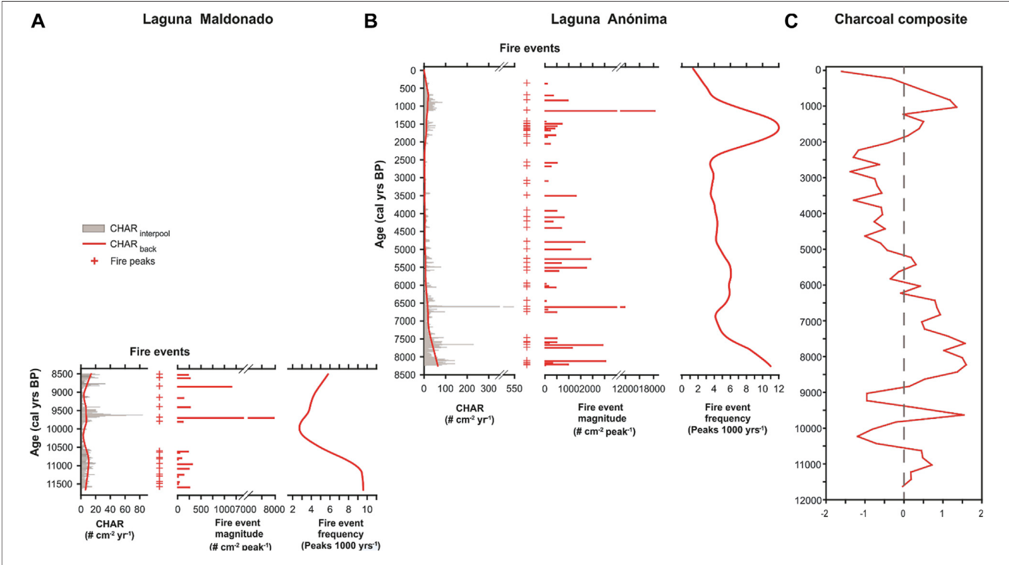
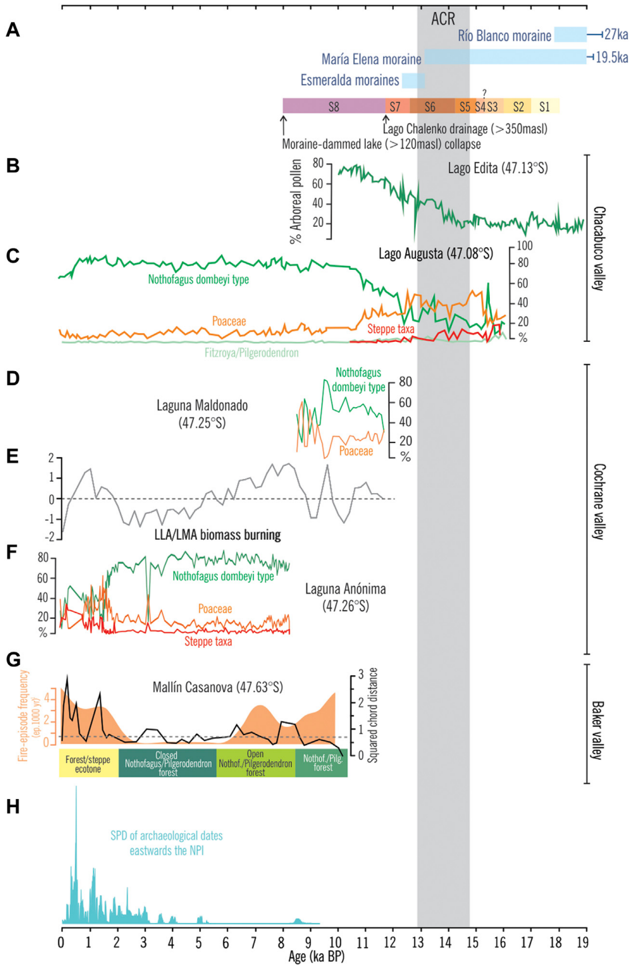
Deglaciation modeling of the Patagonian Ice Field since the Last Glacial Maximum has been a topic of intensive research in Central West Patagonia (44°–49°S). However, the chronology of deglaciation onset, acceleration, and the subsequent thinning and recession of the different ice lobes as well as the timing and extension of large proglacial systems are still a matter of discussion. The maximum eastward extension the Lago Cochrane/Pueyrredón ice lobe was around ∼20,000–27,000 cal yrs BP; its associated proglacial lake drained toward the Pacific between 12,600 and 8,000 cal yrs BP. This study presents the first two pollen and charcoal records from the Lago Cochrane/Pueyrredón valley, spanning the last 11,650 cal yrs BP. The Laguna Maldonado record spans between 11,650 and 8,500 cal yrs BP, while the Laguna Anónima record the last 8,500 cal yrs BP, thereby overlapping chronologically. The lithological record of Laguna Maldonado shows that organic sedimentation began at the onset of the Holocene (11,650 cal yrs BP), once the site was free of glacio-lacustrine influence. Between 11,650 and 10,500 cal yrs BP, an open Nothofagus forest developed associated with high fire occurrence/frequency, followed by a transitional phase to a closer forest associated with a shift from low to high fire activity up to 9,400 cal yrs BP. Between 9,400 and 8,500 cal yrs BP, the Laguna Maldonado record suggests the development of an open forest or probably scattered patches of forest of variable size in a steppe matrix, probably related to geomorphological and paraglacial dynamics as well as climatic forcings, while the Laguna Anónima record indicates the development of a closed Nothofagus forest and high to low fire occurrence/frequency from 8,200 to 3,800 cal yrs BP. Since 3,800 cal yrs BP, a highly dynamic open forest or forest patches scattered in a grass/shrub–grass steppe matrix occurred around Laguna Anónima associated with high fire occurrence/frequency synchronous with an important increase in the presence of hunter-gatherers during the last 3,000 years. The results from the Lago Cochrane/Pueyrredón valley are integrated and discussed at the regional scale alongside other records from Central West Patagonia.
Overview
The claims and statistics of this paper haven’t been checked yet.
Run the check — free, no account needed. It reads the open-access text and checks the sources it cites.
Integrity signals
Registry
Cites
Statistics
Figures

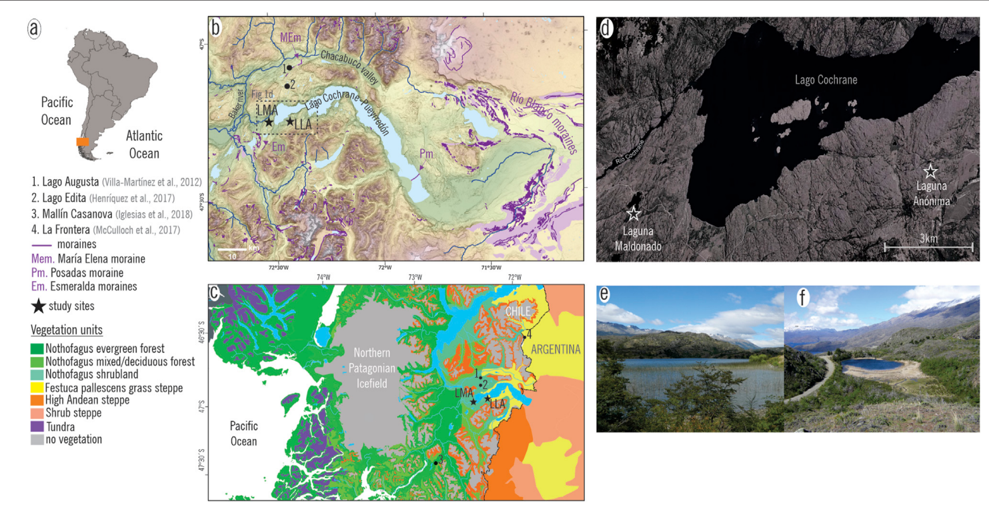
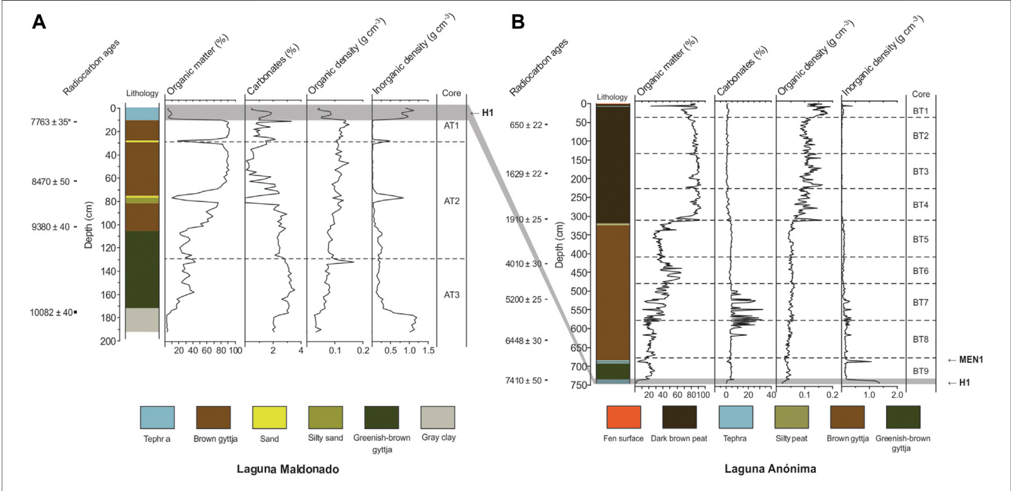
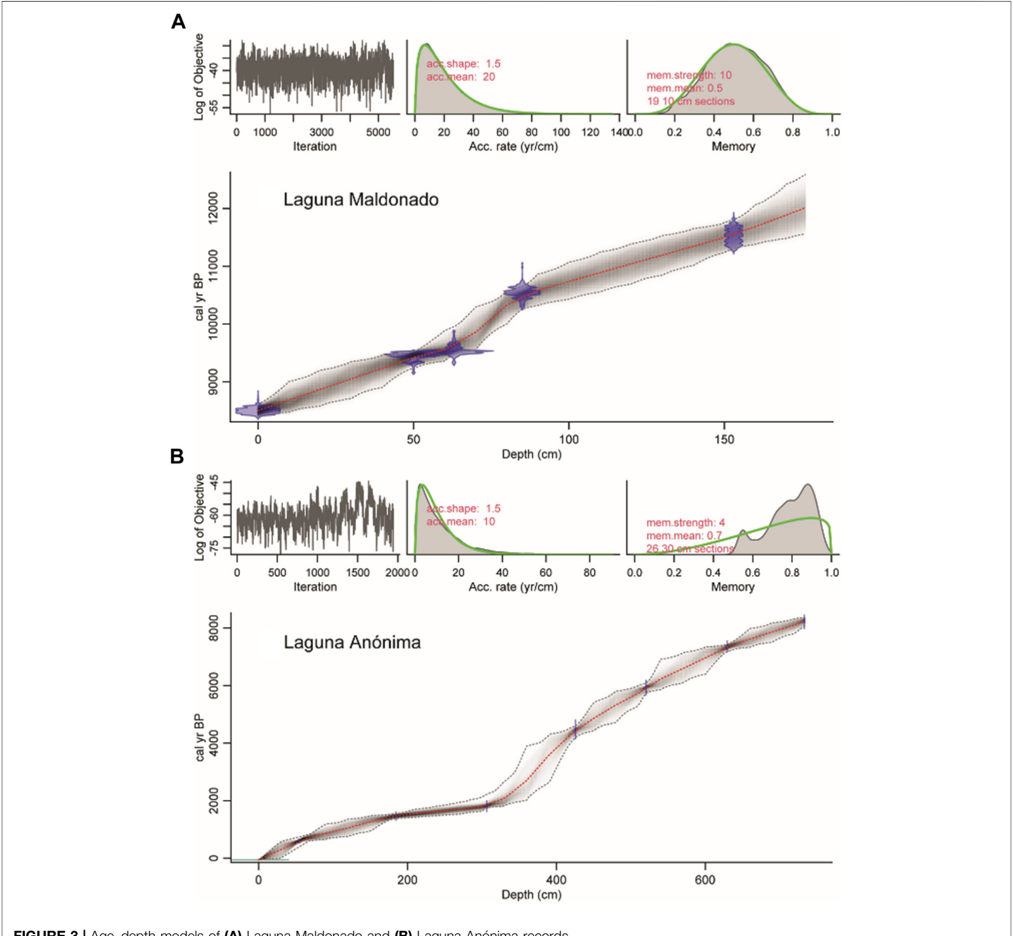
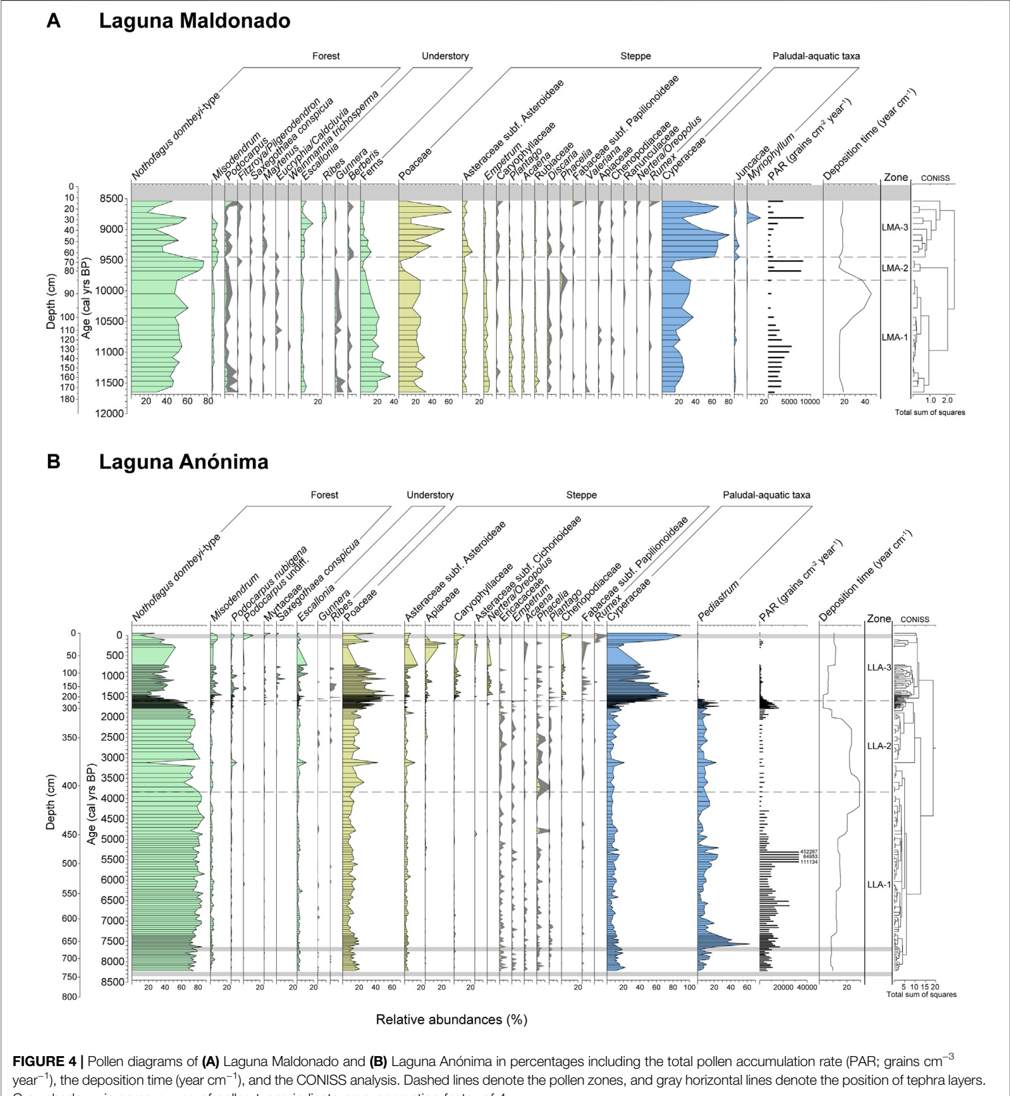
Verification
Claims the paper makes
The claims and statistics of this paper haven’t been checked yet.
Run the check — free, no account needed. It reads the open-access text and checks the sources it cites.
Claims other papers make about this one
Each is checked against this paper’s own text: does it say what the citing paper says it does?
The source backs part of the claim, not all of it — or backs it for a different population, condition or comparison.
In the citing paper
“However, this time span fits appropriately with the chronology of neighboring basins (e.g., Cisnes, Jeinemeni, Ibáñez, and Chacabuco River valleys, see Figure 1a) that show increased human occupation during the late Holocene period [43,73,74].”
From Past human mobility corridors and least-cost path models south of general carrera lake, central west patagonia (46° S, south america) (2022) · cites this paper as [43]
Experimental — accuracy not yet measured
Self-check
Percentages, sums and reported differences re-computed from the paper’s own numbers.
The self-check needs the paper’s full text.
Citations
Cites
Power, M. J., Marlon, J., Ortiz, N., Bartlein, P. J., Harrison, S. P., Mayle, F. E., Ballouche, A., Bradshaw, R. H. W., Carcaillet, C., Cordova, C., et al. (2008) · Climate Dynamics · doi:10.1007/s00382-007-0334-x · Cited by 717
The chronology of the Last Glacial Maximum and deglacial events in central Argentine Patagonia
Hein, A. S., Hulton, N. R. J., Dunai, T. J., Sugden, D. E., Kaplan, M. R., & Xu, S. (2010) · Quaternary Science Reviews · doi:10.1016/j.quascirev.2010.01.020 · Cited by 158
Research works printed but not linked: 82
- Abarzúa, 2008, Changing Fire Regimes in the Temperate Rainforest Region of Southern Chile over the Last 16,000 Yr, Quat. Res., 69, 62, 10.1016/j.yqres.2007.09.004 · DOI
- Abram, 2014, Evolution of the Southern Annular Mode during the Past Millennium, Nat. Clim Change, 4, 564, 10.1038/NCLIMATE2235 · DOI
- Alder, 2015, Global Climate Simulations at 3000-year Intervals for the Last 21 000 Years with the GENMOM Coupled Atmosphere-Ocean Model, Clim. Past, 11, 449, 10.5194/cp-11-449-2015 · DOI
- Bell, 2008, Punctuated Drainage of an Ice‐dammed Quaternary lake in Southern South america, Geografiska Annaler: Ser. A, Phys. Geogr., 90, 1, 10.1111/j.1468-0459.2008.00330.x · DOI
- Bendle, 2017, The Glacial Geomorphology of the Lago Buenos Aires and Lago Pueyrredón Ice Lobes of central Patagonia, J. Maps, 13, 654, 10.1080/17445647.2017.1351908 · DOI
- Bengtsson, 1986, Chemical Analysis, 423
- Blaauw, 2021, Rbacon: Age-Depth Modelling Using Bayesian Statistics
- Blarquez, 2014, Paleofire: An R Package to Analyse Sedimentary Charcoal Records from the Global Charcoal Database to Reconstruct Past Biomass Burning, Comput. Geosciences, 72, 255, 10.1016/j.cageo.2014.07.020 · DOI
- Boex, 2013, Rapid Thinning of the Late Pleistocene Patagonian Ice Sheet Followed Migration of the Southern Westerlies, Sci. Rep., 3, 2118, 10.1038/srep02118 · DOI
- Borrero, 2019, Ethnographical and Historical Accounts for Understanding the Exploration of New Lands: The Case of Central Western Patagonia, Southernmost South America, J. Anthropological Archaeology, 54, 1, 10.1016/j.jaa.2019.02.001 · DOI · Paper page
- Borrero, 2004, The Archaeozoology of the Andean 'Dead Ends' in Patagonia: Living Near the continental Ice Cap, 55
- Bourgois, 2016, Geomorphic Records along the General Carrera (Chile)-Buenos Aires (Argentina) Glacial Lake (46°-48°S), Climate Inferences, and Glacial Rebound for the Past 7-9 Ka, J. Geology, 124, 27, 10.1086/684252 · DOI
- Caldenius, 1932, Las Glaciaciones Cuaternarias en Patagonia y Tierra del Fuego, Dirección Genera de Minas y Geología, 95, 148
- Cárdenas, 1993, Los Chono y Los Veliche de Chiloé
- Coronato, 2011, Pleistocene Glaciations in Southern Patagonia and Tierra del Fuego, 715
- Dätwyler, 2018, Teleconnection Stationarity, Variability and Trends of the Southern Annular Mode (SAM) during the Last Millennium, Clim. Dyn., 51, 2321, 10.1007/s00382-017-4015-0 · DOI
- Davies, 2020, The Evolution of the Patagonian Ice Sheet from 35 Ka to the Present Day (PATICE), Earth-Science Rev., 204, 103152, 10.1016/j.earscirev.2020.103152 · DOI · Paper page
- Davies, 2018, Asynchronous Glacier Dynamics during the Antarctic Cold Reversal in central Patagonia, Quat. Sci. Rev., 200, 287, 10.1016/j.quascirev.2018.09.025 · DOI
- de Porras, 2012, Postglacial Vegetation, Fire and Climate Dynamics at Central Chilean Patagonia (Lake Shaman, 44°S), Quat. Sci. Rev., 50, 71, 10.1016/j.quascirev.2012.06.015 · DOI
- de Porras, 2014, Environmental and Climatic Changes in central Chilean Patagonia since the Late Glacial (Mallín El Embudo, 44° S), Clim. Past, 10, 1063, 10.5194/cp-10-1063-2014 · DOI
- Douglass, 2006, Cosmogenic Nuclide Surface Exposure Dating of Boulders on Last-Glacial and Late-Glacial Moraines, Lago Buenos Aires, Argentina: Interpretive Strategies and Paleoclimate Implications, Quat. Geochronol., 1, 43, 10.1016/j.quageo.2006.06.001 · DOI
- Faegri, 1989, Textbook of Pollen Analysis
- García Guraieb, 2015, Paleodemography of Late Holocene hunter-gatherers from Patagonia (Santa Cruz, Argentina): An Approach Using Multiple Archaeological and Bioarchaeological Indicators, Quat. Int., 356, 147, 10.1016/j.quaint.2014.09.054 · DOI
- García, 2019, Early Deglaciation and Paleolake History of Río Cisnes Glacier, Patagonian Ice Sheet (44°S), Quat. Res., 91, 194, 10.1017/qua.2018.93 · DOI
- Garreaud, 2009, The Andes Climate and Weather, Adv. Geosci., 22, 3, 10.5194/adgeo-22-3-2009 · DOI · Paper page
- Garreaud, 2013, Large-scale Control on the Patagonian Climate, J. Clim., 26, 215, 10.1175/JCLI-D-12-00001.1 · DOI
- Glasser, 2012, Younger Dryas and Early Holocene Age Glacier Advances in Patagonia, Quat. Sci. Rev., 58, 7, 10.1016/j.quascirev.2012.10.011 · DOI
- Goñi, 2019, Climate Changes, Human Peopling and Regional Differentiation during Late Holocene in Patagonia, Quat. Int., 505, 4, 10.1016/j.quaint.2018.03.007 · DOI
- Grimm, 1987, CONISS: a FORTRAN 77 Program for Stratigraphically Constrained Cluster Analysis by the Method of Incremental Sum of Squares, Comput. Geosciences, 13, 13, 10.1016/0098-3004(87)90022-7 · DOI
- Haberle, 2004, Postglacial Formation and Dynamics of North Patagonian Rainforest in the Chonos Archipelago, Southern Chile, Quat. Sci. Rev., 23, 2433, 10.1016/j.quascirev.2004.03.001 · DOI
- Haberle, 2001, Modern Pollen Rain and lake Mud-Water Interface Geochemistry along Environmental Gradients in Southern Chile, Rev. Palaeobotany Palynology, 117, 93, 10.1016/S0034-6667(01)00079-3 · DOI
- Haberle, 2000, Late Holocene Vegetation Dynamics and lake Geochemistry at Laguna Miranda, XI Region, Chile, Revista Chilena de Historia Nat., 73, 655, 10.4067/s0716-078x2000000400010 · DOI
- Harrison, 2012, Early and Mid-holocene Age for the Tempanos Moraines, Laguna San Rafael, Patagonian Chile, Quat. Sci. Rev., 31, 82, 10.1016/j.quascirev.2011.10.015 · DOI
- Harrison, 2011, The Pleistocene Glaciations of Chile, 739
- Hein, 2011, Exposure Dating Outwash Gravels to Determine the Age of the Greatest Patagonian Glaciations, Geology, 39, 103, 10.1130/g31215.1 · DOI
- Hein, 2009, Middle Pleistocene Glaciation in Patagonia Dated by Cosmogenic-Nuclide Measurements on Outwash Gravels, Earth Planet. Sci. Lett., 286, 184, 10.1016/j.epsl.2009.06.026 · DOI
- Heiri, 2001, Loss on Ignition as a Method for Estimating Organic and Carbonate Content in Sediments: Reproducibility and Comparability of Results, J. Paleolimnology, 25, 101, 10.1023/A:1008119611481 · DOI
- Henríquez, 2017, The Last Glacial Termination on the Eastern Flank of the central Patagonian Andes (47 ° S), Clim. Past, 13, 879, 10.5194/cp-13-879-2017 · DOI
- Heusser, 2003, Ice Age Southern Andes: A Chronicle of Paleoecological Events
- Higuera, 2009, Vegetation Mediated the Impacts of Postglacial Climate Change on Fire Regimes in the South-central Brooks Range, Alaska, Ecol. Monogr., 79, 201, 10.1890/07-2019.1 · DOI
- Hogg, 2020, SHCal20 Southern Hemisphere Calibration, 0-55,000 Years Cal BP, Radiocarbon, 62, 759, 10.1017/RDC.2020.59 · DOI · Paper page
- Holz, 2012, Wildfire Activity in Rainforests in Western Patagonia Linked to the Southern Annular Mode, Int. J. Wildland Fire, 21, 114, 10.1071/WF10121 · DOI
- Iglesias, 2018, Holocene Dynamics of Temperate Rainforests in West-Central Patagonia, Front. Ecol. Evol., 5, 10.3389/fevo.2017.00177 · DOI
- Kaplan, 2004, Cosmogenic Nuclide Chronology of Millennial-Scale Glacial Advances during O-Isotope Stage 2 in Patagonia, Geo. Soc. Am. Bull., 116, 308, 10.1130/b25178.1 · DOI
- Kaplan, 2016, Patagonian and Southern South Atlantic View of Holocene Climate, Quat. Sci. Rev., 141, 112, 10.1016/j.quascirev.2016.03.014 · DOI
- Kaplan, 2020, Holocene Glacier Behavior Around the Northern Antarctic Peninsula and Possible Causes, Earth Planet. Sci. Lett., 534, 116077, 10.1016/j.epsl.2020.116077 · DOI
- Kelly, 2011, Short Paper: A Signal-To-Noise index to Quantify the Potential for Peak Detection in Sediment-Charcoal Records, Quat. Res., 75, 11, 10.1016/j.yqres.2010.07.011 · DOI
- Leger, 2021, Geomorphology and 10Be Chronology of the Last Glacial Maximum and Deglaciation in Northeastern Patagonia, 43°S-71°W, Quat. Sci. Rev., 272, 107194, 10.1016/j.quascirev.2021.107194 · DOI
- Luebert, 2017, Sinopsis bioclimática y vegetacional de Chile
- Maldonado, 2006, Climate Variability over the Last 9900 Cal Yr BP from a Swamp forest Pollen Record along the Semiarid Coast of Chile, Quat. Res., 66, 246, 10.1016/j.yqres.2006.04.003 · DOI
- Markgraf, 2007, Vegetation and Fire History during the Last 18,000 Cal Yr B.P. In Southern Patagonia: Mallín Pollux, Coyhaique, Province Aisén (45°41′30″ S, 71°50′30″ W, 640 M Elevation), Palaeogeogr. Palaeoclimatol. Palaeoecol., 254, 492, 10.1016/j.palaeo.2007.07.008 · DOI
- Martinic, 2005, De La Trapanada Al Aysén
- McCulloch, 2017, A Holocene Record of Environmental Change from Río Zeballos, central Patagonia, The Holocene, 27, 941, 10.1177/0959683616678460 · DOI
- Mena L., 2017, Estado De La Investigación Arqueológica Del Valle Del Chacabuco. Andes Centro Patagónicos. Xi Region De Aisén, Chile, Magallania, 45, 199, 10.4067/s0718-22442017000200199 · DOI · Paper page
- Méndez, 2016, Human Effects in Holocene Fire Dynamics of Central Western Patagonia (∼44° S, Chile), Front. Ecol. Evol., 4, 10.3389/fevo.2016.00100 · DOI
- Méndez, 2018, Spatial and Temporal Distributions of Exotic and Local Obsidians in Central Western Patagonia, Southernmost South America, Quat. Int., 468, 155, 10.1016/j.quaint.2017.08.062 · DOI
- Mengoni Goñalons, 2019, Persistencia y hiatos en el área de Los Antiguos, Monte Zeballos y Paso Roballos, NO de Santa Cruz, Patagonia: nuevas dataciones para la cronología regional, 327
- Moreno, 2021, An Early Holocene westerly Minimum in the Southern Mid-latitudes, Quat. Sci. Rev., 251, 106730, 10.1016/j.quascirev.2020.106730 · DOI
- Moreno, 2019, Early Arboreal Colonization, Postglacial Resilience of Deciduous Nothofagus Forests, and the Southern Westerly Wind Influence in central-east Andean Patagonia, Quat. Sci. Rev., 218, 61, 10.1016/j.quascirev.2019.06.004 · DOI
- Moreno, 2020, Timing and Structure of Vegetation, Fire, and Climate Changes on the Pacific Slope of Northwestern Patagonia since the Last Glacial Termination, Quat. Sci. Rev., 238, 106328, 10.1016/j.quascirev.2020.106328 · DOI
- Moreno, 2018, Onset and Evolution of Southern Annular Mode-like Changes at Centennial Timescale, Sci. Rep., 8, 3458, 10.1038/s41598-018-21836-6 · DOI
- Moreno, 2014, Southern Annular Mode-like Changes in Southwestern Patagonia at Centennial Timescales over the Last Three Millennia, Nat. Commun., 5, 4375, 10.1038/ncomms5375 · DOI
- Nanavati, 2019, Postglacial Vegetation, Fire, and Climate History along the Eastern Andes, Argentina and Chile (Lat. 41-55°S), Quat. Sci. Rev., 207, 145, 10.1016/j.quascirev.2019.01.014 · DOI
- Nuevo Delaunay, 2015, Transformación del paisaje arqueológico rural en el centro-oeste de la provincia de Santa Cruz, siglo XX
- Nuevo-Delaunay, 2022, La ocupación humana antigua de los callejones sin salida de los Andes de Patagonia: midiendo la intensidad de uso del espacio en los márgenes del Campo de Hielo Norte (Aisén, Chile)
- Pérez, 2016, Peopling Time, Spatial Occupation and Demography of Late Pleistocene–Holocene Human Population from Patagonia, Quat. Int., 425, 214, 10.1016/j.quaint.2016.05.004 · DOI · Paper page
- Quade, 2017, Lake-level Stratigraphy and Geochronology Revisited at Lago (Lake) Cardiel, Argentina, and Changes in the Southern Hemispheric Westerlies over the Last 25 Ka, Quat. Sci. Rev., 177, 173, 10.1016/j.quascirev.2017.10.006 · DOI
- 2021, R: A Language and Environment for Statistical Computing
- Renssen, 2005, Holocene Climate Evolution in the High-Latitude Southern Hemisphere Simulated by a Coupled Atmosphere-Sea Ice-Ocean-Vegetation Model, The Holocene, 15, 951, 10.1191/0959683605hl869ra · DOI
- Sacchi, 2016, Dataciones y circulación humana: influencia de las fluctuaciones del sistema lacustre Pueyrredón-Posadas durante el Holoceno, Andes, 27, 1
- Sagredo, 2018, Trans-pacific Glacial Response to the Antarctic Cold Reversal in the Southern Mid-latitudes, Quat. Sci. Rev., 188, 160, 10.1016/j.quascirev.2018.01.011 · DOI
- Stern, 2016, Holocene Tephrochronology Around Cochrane (∼47° S), Southern Chile, Andean Geology, 43, 1, 10.5027/andgeoV43n1-a01 · DOI
- Stockmarr, 1971, Tablets with Spores Used in Absolute Pollen Analysis, Pollen spores, 13, 615
- Stuiver, 2020, CALIB
- Thorndycraft, 2019, Glacial lake Evolution and Atlantic-Pacific Drainage Reversals during Deglaciation of the Patagonian Ice Sheet, Quat. Sci. Rev., 203, 102, 10.1016/j.quascirev.2018.10.036 · DOI · Paper page
- Turner, 2005, Deglaciation of the Eastern Flank of the north Patagonian Icefield and Associated continental‐scale lake Diversions, Geografiska Annaler: Ser. A, Phys. Geogr., 87, 363, 10.1111/j.0435-3676.2005.00263.x · DOI
- Viale, 2019, Contrasting Climates at Both Sides of the Andes in Argentina and Chile, Front. Environ. Sci., 7, 10.3389/fenvs.2019.00069 · DOI
- Villa-Martínez, 2021, Development and Resilience of Deciduous Nothofagus Forests since the Last Glacial Termination and Deglaciation of the central Patagonian Andes, Palaeogeogr. Palaeoclimatol. Palaeoecol., 574, 110459, 10.1016/j.palaeo.2021.110459 · DOI
- Villa-Martínez, 2012, Deglacial and Postglacial Vegetation Changes on the Eastern Slopes of the central Patagonian Andes (47°S), Quat. Sci. Rev., 32, 86, 10.1016/j.quascirev.2011.11.008 · DOI
- Villa-Martínez, 2003, The Last 7500 Cal Yr B.P. Of westerly Rainfall in Central Chile Inferred from a High-Resolution Pollen Record from Laguna Aculeo (34 °S), Quat. Res., 60, 284, 10.1016/j.yqres.2003.07.007 · DOI
- Whitlock, 2001, Charcoal as a Proxy Fire, 75
- Whitlock, 2007, Climatic Controls of Holocene Fire Patterns in Southern South America, Quat. Res., 68, 28, 10.1016/j.yqres.2007.01.012 · DOI
Cited by
Sorted by citations
Moreno-Meynard, P., Méndez, C., Irarrázaval, I., & Nuevo-Delaunay, A. (2022) · Land · doi:10.3390/land11081351 · Cited by 11
Self-citation
Metadata
- Authors
- Maldonado, A., de Porras, M. E., Martel-Cea, A., Reyes, O., Nuevo-Delaunay, A., & Méndez, C.
- Venue
- Frontiers in Earth Science
- Publisher
- Frontiers Media SA
- Published
- 2022-04-05
- Volume
- 10
- ISSN
- 2296-6463
- Cited by
- 13
- References
- 2
- Funders
- Fondo Nacional de Desarrollo Científico, Tecnológico y de Innovación Tecnológica (1180306 1210042 1210045)
- Agencia Nacional de Investigación y Desarrollo (Regional R20F0002)
- National Geographic Society (HJ-150R-17)
About these checks
Registry, retraction, Cites and statistics results are computed, not judged, with one exception: a printed reference that no index lists is read once by a model before it counts as a citation error. Claims are extracted by a model and kept only when their quote appears verbatim in the text; each cited source is then checked, with a model’s help, for whether it says what the claim relies on. Those verdicts can be wrong — read the claim’s quote and the cited source before relying on one.
Statistics and arithmetic are recomputed, not judged.
Confidence bands are shown only for fields calibrated on our annotated test set. None is calibrated yet, so no band is shown.
What counts as a claim ›How we measure confidence ›How we check this ›
Are you an author, or do you see a problem with this page? Request a review
