

The DOI matches its Crossref record; 150 of the 150 references it cites were found in a registry or an index.
The Roles of ApoC-III on the Metabolism of Triglyceride-Rich Lipoproteins in Humans
Open accessAbstract
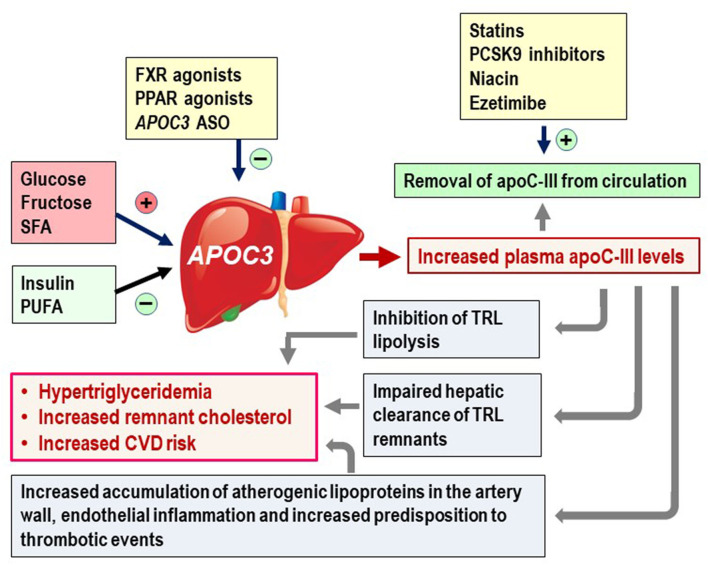
Cardiovascular disease (CVD) is the leading cause of death globally. It is well established based on evidence accrued during the last three decades that high plasma concentrations of cholesterol-rich atherogenic lipoproteins are causatively linked to CVD, and that lowering these reduces atherosclerotic cardiovascular events in humans.1-9 Historically, most attention has been on low-density lipoproteins (LDL) since these are the most abundant atherogenic lipoproteins in the circulation, and thus the main carrier of cholesterol into the artery wall. However, with the rise of obesity and insulin resistance in many populations, there is increasing interest in the role of triglyceride-rich lipoproteins (TRLs) and their metabolic remnants, with accumulating evidence showing they too are causatively linked to CVD. Plasma triglyceride, measured either in the fasting or non-fasting state, is a useful index of the abundance of TRLs and recent research into the biology and genetics of triglyceride heritability has provided new insight into the causal relationship of TRLs with CVD. Of the genetic factors known to influence plasma triglyceride levels variation in APOC3 - the gene for apolipoprotein (apo) C-III - has emerged as being particularly important as a regulator of triglyceride transport and a novel therapeutic target to reduce dyslipidaemia and CVD risk.
Overview
The claims and statistics of this paper haven’t been checked yet.
Run the check — free, no account needed. It reads the open-access text and checks the sources it cites.
Integrity signals
Registry
Cites
Statistics
Figures
Verification
Claims the paper makes
The claims and statistics of this paper haven’t been checked yet.
Run the check — free, no account needed. It reads the open-access text and checks the sources it cites.
Claims other papers make about this one
Each is checked against this paper’s own text: does it say what the citing paper says it does?
The source backs part of the claim, not all of it — or backs it for a different population, condition or comparison.
In the citing paper
“Moreover, the reduction in apolipoprotein C-III levels by the conventional triglyceride-lowering agents, such as fibrates and omega-3 fatty acids, is modest (10 to 40%)”
From Olezarsen, Acute Pancreatitis, and Familial Chylomicronemia Syndrome (2024) · cites this paper as [34]
Experimental — accuracy not yet measuredThe cited source says what the claim attributes to it.
In the citing paper
“Elevated apoC-III levels are associated with increased circulating TG, impaired remnant clearance, and a heightened burden of atherogenic lipoproteins.”
From Targeting triglycerides for cardiovascular risk reduction (2026) · cites this paper as [111]
The cited source says what the claim attributes to it.
In the citing paper
“beyond its inhibitory action on lipoprotein lipase (LPL), apoC-III also delays hepatic uptake of TRL remnants, contributing to both hypertriglyceridemia and atherosclerotic progression through LPL-independent pathways [111]”
From Targeting triglycerides for cardiovascular risk reduction (2026) · cites this paper as [111]
The check wasn’t confident either way, so it gives no verdict — never disputed.
In the citing paper
“and these agents have not been effective in lowering triglyceride levels in patients with familial chylomicronemia syndrome. 21,34”
From Olezarsen, Acute Pancreatitis, and Familial Chylomicronemia Syndrome (2024) · cites this paper as [34]
Experimental — accuracy not yet measured
Self-check
Percentages, sums and reported differences re-computed from the paper’s own numbers.
The self-check needs the paper’s full text.
Citations
Cites
Chapman, M. J., Ginsberg, H. N., Amarenco, P., Andreotti, F., Borén, J., Catapano, A. L., Descamps, O. S., Fisher, E., Kovanen, P. T., Kuivenhoven, J. A., et al. (2011) · European Heart Journal · doi:10.1093/eurheartj/ehr112 · Cited by 1,227
Self-citationLoss-of-Function Mutations in APOC3, Triglycerides, and Coronary Disease
The TG and HDL Working Group of the Exome Sequencing Project, N. H. (2014) · New England Journal of Medicine · doi:10.1056/nejmoa1307095 · Cited by 1,071
Subendothelial retention of atherogenic lipoproteins in early atherosclerosis
Skålén, K., Gustafsson, M., Rydberg, E. K., Hultén, L. M., Wiklund, O., Innerarity, T. L., & Borén, J. (2002) · Nature · doi:10.1038/nature00804 · Cited by 1,019 · cited 1×
“This is mediated by ionic interactions between positively charged domains in apoB100 (74), and negatively charged artery wall proteoglycans (75).”
BackgroundSelf-citationLoss-of-Function Mutations in APOC3 and Risk of Ischemic Vascular Disease
Jørgensen, A. B., Frikke-Schmidt, R., Nordestgaard, B. G., & Tybjærg-Hansen, A. (2014) · New England Journal of Medicine · doi:10.1056/nejmoa1308027 · Cited by 919
Crooke, S. T., Witztum, J. L., Bennett, C. F., & Baker, B. F. (2018) · Cell Metabolism · doi:10.1016/j.cmet.2018.03.004 · Cited by 841
Adiels, M., Olofsson, S.-O., Taskinen, M.-R., & Borén, J. (2008) · Arteriosclerosis, Thrombosis, and Vascular Biology · doi:10.1161/atvbaha.107.160192 · Cited by 820
Self-citationGalNAc-siRNA conjugates: leading the way for delivery of RNAi therapeutics
Springer, A. D., & Dowdy, S. F. (2018) · Nucleic Acid Therapeutics · doi:10.1089/nat.2018.0736 · Cited by 711 · cited 1×
“Development of novel technologies including ASOs, siRNAs and monoclonal antibodies (137, 138), as well as improved targeting methods (139, 140), including use of N-acetyl galactosamine-conjugated (GalNAc) adducts (i.”
BackgroundFerence, B. A., Kastelein, J. J. P., Ray, K. K., Ginsberg, H. N., Chapman, M. J., Packard, C. J., Laufs, U., Oliver-Williams, C., Wood, A. M., Butterworth, A. S., et al. (2019) · JAMA · doi:10.1001/jama.2018.20045 · Cited by 703 · cited 1×
“showing that reductions in triglyceride levels do not reduce CVD risk unless there was an accompanying reduction in circulating apoB levels, and that the reduction in risk was proportional to the decrement in apoB (105).”
BackgroundSelf-citationOverproduction of large VLDL particles is driven by increased liver fat content in man
Adiels, M., Taskinen, M.-R., Packard, C., Caslake, M. J., Soro-Paavonen, A., Westerbacka, J., Vehkavaara, S., Häkkinen, A., Olofsson, S.-O., Yki-Järvinen, H., et al. (2006) · Diabetologia · doi:10.1007/s00125-005-0125-z · Cited by 690
Self-citationPollin, T. I., Damcott, C. M., Shen, H., Ott, S. H., Shelton, J., Horenstein, R. B., Post, W., McLenithan, J. C., Bielak, L. F., Peyser, P. A., et al. (2008) · Science · doi:10.1126/science.1161524 · Cited by 688 · cited 1×
“Genetic studies have also shown that carriers of the APOC3 null mutation R19X have 50% lower plasma apoC-III levels, 35% lower plasma triglycerides, markedly lower postprandial triglycerides and significantly lower coronary artery calcification (CAC) scores than non-carriers (96, 97).”
Background
Cited by
Sorted by citations
Metabolism of triglyceride-rich lipoproteins in health and dyslipidaemia
Borén, J., Taskinen, M.-R., Björnson, E., & Packard, C. J. (2022) · Nature Reviews Cardiology · doi:10.1038/s41569-022-00676-y · Cited by 315
Self-citationOlezarsen, Acute Pancreatitis, and Familial Chylomicronemia Syndrome
Stroes, E. S. G., Alexander, V. J., Karwatowska-Prokopczuk, E., Hegele, R. A., Arca, M., Ballantyne, C. M., Soran, H., Prohaska, T. A., Xia, S., Ginsberg, H. N., et al. (2024) · New England Journal of Medicine · doi:10.1056/nejmoa2400201 · Cited by 271
Saturated fats and cardiovascular health: Current evidence and controversies
Maki, K. C., Dicklin, M. R., & Kirkpatrick, C. F. (2021) · Journal of clinical lipidology · doi:10.1016/j.jacl.2021.09.049 · Cited by 233
Glavinovic, T., Thanassoulis, G., Graaf, J. D., Couture, P., Hegele, R. A., & Sniderman, A. D. (2022) · Journal of the American Heart Association · doi:10.1161/jaha.122.025858 · Cited by 182
Apolipoprotein B-containing lipoproteins in atherogenesis
Borén, J., Packard, C. J., & Binder, C. J. (2025) · Nature Reviews Cardiology · doi:10.1038/s41569-024-01111-0 · Cited by 110
Self-citation
Metadata
- Authors
- Borén, J., Packard, C. J., & Taskinen, M.-R.
- Affiliations
- University of Gothenburg (SE)
- University of Glasgow (GB)
- University of Helsinki (FI)
- Corresponding author
- Borén, Jan
- Venue
- Frontiers in Endocrinology
- Publisher
- Frontiers Media SA
- Published
- 2020-07-28
- Volume
- 11
- Pages
- 474-474
- ISSN
- 1664-2392 (ISSN-L)
- PMC
- PMC7399058
- OpenAlex
- W3045911834
- Cited by
- 196
- References
- 149
- Citations by year
- 2026: 46 · 2025: 35 · 2024: 30 · 2023: 32 · 2022: 35 · 2021: 17 · 2020: 1
- FWCI
- 3.61
- Type
- journal article
- Language
- en
- Open access
- gold
- doi.org
- Licence
- Locations
- Frontiers in Endocrinology (publishedVersion, cc-by)
- PubMed Central (publishedVersion, cc-by)
- PubMed (publishedVersion)
- DOAJ (DOAJ: Directory of Open Access Journals) (submittedVersion, cc-by-sa)
- Työväentutkimus Vuosikirja (submittedVersion)
- Funders
- Vetenskapsrådet
- Hjärt-Lungfonden
- Topics
- Health Sciences › Medicine › Cardiology and Cardiovascular Medicine › Lipid metabolism and disorders
- Health Sciences › Medicine › Cardiology and Cardiovascular Medicine › Lipoproteins and Cardiovascular Health
- Health Sciences › Medicine › Endocrinology, Diabetes and Metabolism › Diabetes, Cardiovascular Risks, and Lipoproteins
- Keywords
- apolipoprotein C-III, triglyceride-rich lipoproteins, triglyceride metabolism, cardiovascular disease, dyslipidemia, plasma triglycerides, atherogenic lipoproteins, triglyceride transport, obesity, insulin resistance
- MeSH terms
- Cardiovascular Diseases, Humans, Lipoproteins, Triglycerides, Atherosclerosis, Lipid Metabolism, Apolipoprotein C-III
About these checks
Registry, retraction, Cites and statistics results are computed, not judged, with one exception: a printed reference that no index lists is read once by a model before it counts as a citation error. Claims are extracted by a model and kept only when their quote appears verbatim in the text; each cited source is then checked, with a model’s help, for whether it says what the claim relies on. Those verdicts can be wrong — read the claim’s quote and the cited source before relying on one.
Statistics and arithmetic are recomputed, not judged.
Confidence bands are shown only for fields calibrated on our annotated test set. None is calibrated yet, so no band is shown.
What counts as a claim ›How we measure confidence ›How we check this ›
Are you an author, or do you see a problem with this page? Request a review
