

The DOI matches its Crossref record; 28 of the 28 references it cites were found in a registry or an index.
Association between caffeine intake and lumbar spine bone mineral density in adults aged 20–49: A cross-sectional study.
Open accessAbstract
Background: Many epidemiological studies have investigated the connection between coffee intake and bone mineral density (BMD), but the results are controversial. This study aimed to assess the association between caffeine consumption and lumbar BMD in adults aged 20–49. Methods: From a cross-sectional study based on a large sample of the National Health and Nutrition Examination Survey 2011–2018. After controlling for confounders, the weighted multivariate linear regression model was created and stratified by age, gender, and race for subgroup analysis. In addition, we simultaneously stratified analysis by age and sex and divided caffeine intake into quartiles to assess the association between coffee intake and BMD. Results: Caffeine intake was not significantly linked with lumbar BMD in this study of 7041 adults. In subgroup studies stratified by age, there was a significant correlation between lumbar BMD and caffeine consumption in participants aged 30–39 and 40–49. In females, there was a positive correlation between lumbar BMD and coffee consumption stratified by gender. When evaluated by race, the association between lumbar BMD and caffeine intake was independent of race. Consequently, when stratifying for age, sex, and coffee intake quartiles, a significant positive correlation was discovered between the fourth coffee intake quartile and lumbar BMD in females aged 30–39. In addition, a negative correlation was discovered between coffee consumption and lumbar BMD in males aged 40–49. Conclusions: Our research indicates that drinking coffee may benefit 30–39 women’s lumbar BMD, but it may adversely affect men aged 40–49.
Overview
The claims and statistics of this paper haven’t been checked yet.
Run the check — free, no account needed. It reads the open-access text and checks the sources it cites.
Integrity signals
Registry
Cites
Statistics
Figures
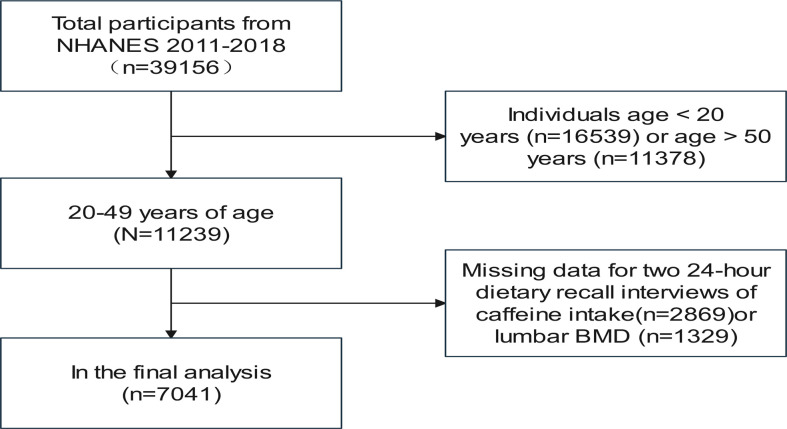
Verification
Claims the paper makes
The claims and statistics of this paper haven’t been checked yet.
Run the check — free, no account needed. It reads the open-access text and checks the sources it cites.
Claims other papers make about this one
Each is checked against this paper’s own text: does it say what the citing paper says it does?
The cited source says what the claim attributes to it.
In the citing paper
“A recent study of the National Health and Nutrition Examination Survey (NHANES) by Wang et al. [19] indicated caffeine could increase lumbar spine BMD in women aged 30–39 but could have a negative effect on men aged 40–49.”
From Association between caffeine consumption and bone mineral density in children and adolescent: Observational and Mendelian randomization study (2023) · cites this paper as [19]
The cited source says what the claim attributes to it.
In the citing paper
“However, clinical research has always drawn inconsistent conclusions with different populations, study designs, or doses of caffeine intake [13, 19, 20].”
From Association between caffeine consumption and bone mineral density in children and adolescent: Observational and Mendelian randomization study (2023) · cites this paper as [19]
Self-check
Percentages, sums and reported differences re-computed from the paper’s own numbers.
The self-check needs the paper’s full text.
Citations
Cites
The epidemiology of osteoporosis
Clynes, M. A., Harvey, N. C., Curtis, E. M., Fuggle, N. R., Dennison, E. M., & Cooper, C. C. (2020) · British Medical Bulletin · doi:10.1093/bmb/ldaa005 · Cited by 811
Wikoff, D. S., Welsh, B. T., Henderson, R. G., Brorby, G. P., Britt, J. K., Myers, E. F., Goldberger, J. J., Lieberman, H. R., O’Brien, C. P., Peck, J. D., et al. (2017) · Food and Chemical Toxicology · doi:10.1016/j.fct.2017.04.002 · Cited by 474
Wijarnpreecha, K., Thongprayoon, C., & Ungprasert, P. (2016) · European Journal of Gastroenterology & Hepatology · doi:10.1097/meg.0000000000000776 · Cited by 156
Liu, D., Li, Z., Shen, D., Zhang, P., Song, W.-Q., Zhang, W., Huang, Q., Chen, P., Zhang, X., & Mao, C. (2022) · Annals of Internal Medicine · doi:10.7326/m21-2977 · Cited by 124
Self-citationLong-term coffee consumption in relation to fracture risk and bone mineral density in women
Hallstrom, H., Byberg, L., Glynn, A., Lemming, E. W., Wolk, A., & Michaelsson, K. (2013) · American Journal of Epidemiology · doi:10.1093/aje/kwt062 · Cited by 105
Wu, L., Sun, D., & He, Y. (2016) · Clinical Nutrition · doi:10.1016/j.clnu.2016.05.015 · Cited by 103
Mansour, A., Mohajeri-Tehrani, M. R., Samadi, M., Qorbani, M., Merat, S., Adibi, H., Poustchi, H., & Hekmatdoost, A. (2021) · Nutrition Journal · doi:10.1186/s12937-021-00694-5 · Cited by 98
The effects of caffeine on bone mineral density and fracture risk
Berman, N., Honig, S., Cronstein, B. N., & Pillinger, M. H. (2022) · Osteoporosis International · doi:10.1007/s00198-021-05972-w · Cited by 90
Male risk factors for hip fracture—a 30-year follow-up study in 7,495 men
Trimpou, P., Landin‐Wilhelmsen, K., Odén, A., Rosengren, A., & Wilhelmsen, L. (2009) · Osteoporosis International · doi:10.1007/s00198-009-0961-7 · Cited by 89
Sartini, M., Bragazzi, N. L., Spagnolo, A. M., Schinca, E., Ottria, G., Dupont, C., & Cristina, M. L. (2019) · Nutrients · doi:10.3390/nu11030694 · Cited by 68
Cited by
Lycopene: A Potent Antioxidant with Multiple Health Benefits
Shafe, M. O., Gumede, N. M., Nyakudya, T. T., & Chivandi, E. (2024) · Journal of Nutrition and Metabolism · doi:10.1155/2024/6252426 · Cited by 144
Sun, A., Hu, J., Wang, S., Fen, Y., & Liu, Z. (2023) · Frontiers in Endocrinology · doi:10.3389/fendo.2023.1231527 · Cited by 66
Han, H., Chen, S., Wang, X., Jin, J., Li, X., & Li, Z. (2023) · Journal of Orthopaedic Surgery and Research · doi:10.1186/s13018-023-03877-4 · Cited by 47
Zhan, H., Liu, X., Piao, S., Rong, X., & Guo, J. (2023) · Journal of Orthopaedic Surgery and Research · doi:10.1186/s13018-023-04275-6 · Cited by 42
Zhang, M., Hou, Y., Ren, X., Cai, Y., Wang, J., & Chen, O. (2024) · Archives of Osteoporosis · doi:10.1007/s11657-024-01424-0 · Cited by 17
Metadata
- Authors
- Wang, G., Fang, Z.-B., Liu, D.-L., Chu, S.-F., Li, H.-L., & Zhao, H.-X.
- Affiliations
- Nanjing University of Chinese Medicine (CN)
- Guangzhou University of Chinese Medicine (CN)
- Shenzhen Traditional Chinese Medicine Hospital (CN)
- Corresponding author
- Chu, Shu-Fang
- Li, Hui-Lin
- Venue
- Frontiers in Endocrinology
- Publisher
- Frontiers Media SA
- Published
- 2022-10-17
- Volume
- 13
- Pages
- 1008275-1008275
- ISSN
- 1664-2392 (ISSN-L)
- PMC
- PMC9618951
- OpenAlex
- W4306698757
- Cited by
- 23
- References
- 28
- Citations by year
- 2026: 1 · 2025: 9 · 2024: 8 · 2023: 5
- FWCI
- 3.29
- Type
- journal article
- Language
- en
- Open access
- gold
- doi.org
- Licence
- Locations
- Frontiers in Endocrinology (publishedVersion, cc-by)
- PubMed Central (publishedVersion, cc-by)
- PubMed (publishedVersion)
- DOAJ (DOAJ: Directory of Open Access Journals) (submittedVersion, cc-by-sa)
- Funders
- National Natural Science Foundation of China (82104759)
- Natural Science Foundation of Guangdong Province (NO.2019A1515110108)
- Shenzhen Municipal Science and Technology Innovation Council (JCYJ20180302173821841, JCYJ20170817094838619)
- Topics
- Health Sciences › Medicine › Pharmacology (medical) › Coffee research and impacts
- Health Sciences › Medicine › Orthopedics and Sports Medicine › Bone health and osteoporosis research
- Health Sciences › Medicine › Endocrinology, Diabetes and Metabolism › Vitamin D Research Studies
- Keywords
- caffeine consumption, coffee consumption, lumbar spine bone mineral density, bone health, sex differences, age differences, racial differences, young and middle-aged adults
- MeSH terms
- Adult, Caffeine, Coffee, Cross-Sectional Studies, Female, Humans, Male, Nutrition Surveys, Absorptiometry, Photon, Bone Density
About these checks
Registry, retraction, Cites and statistics results are computed, not judged, with one exception: a printed reference that no index lists is read once by a model before it counts as a citation error. Claims are extracted by a model and kept only when their quote appears verbatim in the text; each cited source is then checked, with a model’s help, for whether it says what the claim relies on. Those verdicts can be wrong — read the claim’s quote and the cited source before relying on one.
Statistics and arithmetic are recomputed, not judged.
Confidence bands are shown only for fields calibrated on our annotated test set. None is calibrated yet, so no band is shown.
What counts as a claim ›How we measure confidence ›How we check this ›
Are you an author, or do you see a problem with this page? Request a review
How to cite
Cite CoChat for the checks on this page, and the paper for its own findings.
- This page
- CoChat. (2026). Citation check: Association between caffeine intake and lumbar spine bone mineral density in adults aged 20–49: A cross-sectional study. https://app.cochat.ai/papers/10.3389/fendo.2022.1008275
- The paper
- Wang, G., Fang, Z.-B., Liu, D.-L., Chu, S.-F., Li, H.-L., & Zhao, H.-X. (2022). Association between caffeine intake and lumbar spine bone mineral density in adults aged 20–49: A cross-sectional study. Frontiers in Endocrinology. https://doi.org/10.3389/fendo.2022.1008275
Data sources
Bibliographic data: Semantic Scholar, OpenAlex, Crossref.
Contains information from the Semantic Scholar Academic Graph Datasets, made available under the ODC Attribution License (ODC-BY 1.0).
Semantic Scholar’s data is described in: Kinney, R., et al. (2023). The Semantic Scholar Open Data Platform. arXiv:2301.10140.
