

The DOI matches its Crossref record; 35 of the 35 references it cites were found in a registry or an index; none of the 51 sources its claims cite is checked for support yet.
Hypothalamic-pituitary-adrenal axis activity and its relationship to the autonomic nervous system in patients with psychogenic erectile dysfunction
Open accessAbstract
Background: Psychological stress and its two stress response systems, the hypothalamic-pituitary-adrenal (HPA) axis and the autonomic nervous system (ANS), are closely related to psychogenic erectile dysfunction (pED). However, the analyses of perceived stress and stress systems in pED patients need to be more in-depth, especially the interactions between them. Methods: Our study included 75 patients with pEDs and 75 healthy men. The International Index of Erectile Function-5 (IIEF-5) and the 10-item Perceived Stress Scale (PSS-10) were used for assessing the severity of ED and perceived stress. All participants collected saliva samples on three consecutive days at eight specific times with strict reference to the time of morning awakening for measuring cortisol parameters and wore electrocardiography for 24 h to derive heart rate variability (HRV). Results: The PSS-10 scores of pED patients were significantly higher than the control group (p<0.001). Although PSS-10 and IIEF-5 scores were negatively correlated in pED patients, there was no statistical significance between them (r=−0.049, p=0.677). Compared with the control group, the HRV parameters of pED patients were significantly increased in LF/HF ratio (p=0.014) but significantly decreased in LF, HF, and pNN50 (p<0.001). However, the two groups had no statistically significant differences in cortisol variables (all p>0.05). The interaction between sympathovagal modulation (HF, rMSSD) and cortisol awakening response (CAR AUCi) explained significantly greater variance in perceived stress than either stress system alone. Higher parasympathetic activity combined with a higher cortisol awakening response was associated with greater perceived stress. Conclusion: Our results suggested that the interrelation between ANS and HPA axis activity might enhance our comprehension of how stress affected the physical and mental health of pED patients.
Overview
CoChat Summary
TL;DR
In 75 men with psychogenic erectile dysfunction (pED) and 75 healthy controls, pED patients reported greater perceived stress and showed autonomic imbalance (lower LF, HF, pNN50; higher LF/HF) but no significant differences in salivary cortisol measures. In pED patients, interactions between parasympathetic HRV indices (HF, rMSSD) and cortisol awakening response (CAR AUCi) explained additional variance in perceived stress beyond either system alone.
Key findings
- pED patients had significantly higher PSS-10 scores (17.44 ± 4.75 vs. 13.97 ± 6.08, p < 0.001) and lower IIEF-5 scores (8.40 ± 2.34 vs. 23.12 ± 0.97, p < 0.001); PSS-10 and IIEF-5 were negatively but not significantly correlated in pED patients (r = −0.049, p = 0.677).
- HRV differed significantly: pED patients had lower LF (median 670.00 vs. 1893.00 ms², p < 0.001), lower HF (622.00 vs. 3845.00 ms², p < 0.001), lower pNN50 (16.50 vs. 18.50 ms, p < 0.001), and higher LF/HF ratio (0.66 vs. 0.60, p = 0.014).
- No cortisol variable differed significantly between groups (all p > 0.05).
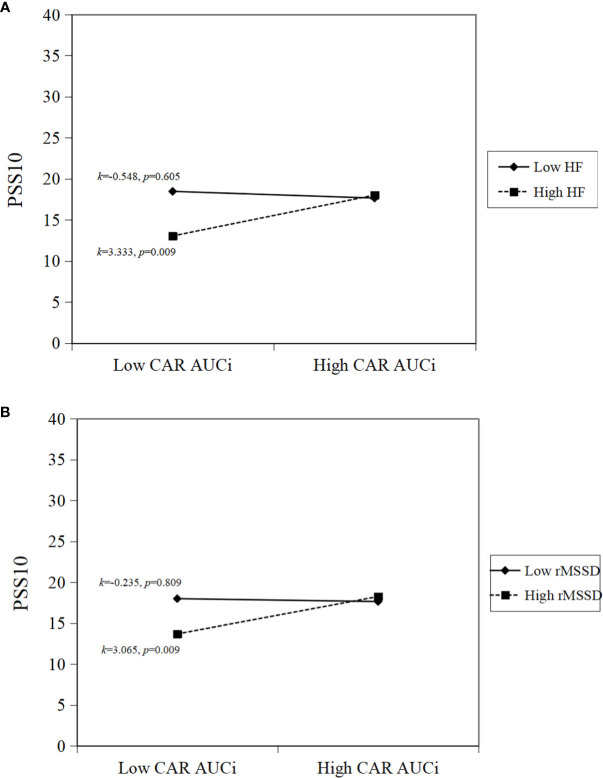
- In pED patients, HF × CAR AUCi and rMSSD × CAR AUCi interactions accounted for an additional 6.1% and 5.9% of variance in perceived stress; higher HF or rMSSD combined with higher CAR AUCi was associated with greater perceived stress (HF: k = 3.333, p = 0.009; rMSSD: k = 3.065, p = 0.009). In controls, only pNN50 was associated with perceived stress in the singular HRV model, and no significant interactions were found.
Methods
- Case-control study at a urology male clinic from March 2016 to August 2022; 75 pED patients and 75 healthy men completed the study (ages 20–49, mean 31.9 ± 7.1 years).
- Participants completed the IIEF-5 and PSS-10, collected saliva eight times per day for three consecutive weekdays for cortisol parameters, and wore 24-h electrocardiography for HRV.
- Analyses used independent-sample t-tests, Kruskal-Wallis tests, chi-square/Fisher’s exact tests, and hierarchical linear regression comparing singular HRV or cortisol models with inter-relation models including two-way interactions; simple slope analyses interpreted significant interactions.
Limitations
- The authors state that comparisons with other studies were difficult due to the lack of research on HPA axis activity and perceived stress in ED, and that their use of hierarchical regression, interaction, and simple slope analyses may have increased chances of finding meaningful associations.
- The authors state that more stress measures and additional autonomic/HPA measures (e.g., salivary alpha-amylase, pre-ejection period, cortisone, dehydroepiandrosterone) are needed, and that the cross-sectional design cannot determine causal direction.
- Evident from the text: the study was single-center, used a modest sample size, and recruited only men, which may limit generalizability; the authors also note a smaller sample size as a possible reason for not detecting subtle HPA axis changes.
Model-written summary. Check it against the paper before relying on it.
Integrity signals
Registry
Cites
Statistics
Figures
Verification
Claims the paper makes
0 Valid · 0 Not valid · 37 Not checked · 56 Own results and interpretations
A result the paper reports from its own data — it cites no other source for it, so there is none to check. The quote shows it is in the paper.
In the paper
“Compared with the control group, the HRV parameters of pED patients were significantly increased in LF/HF ratio (p=0.014) but significantly decreased in LF, HF, and pNN50 (p<0.001).”
- Also stated in: § Measurement of cortisol and HRV parameters · plain
“the LF and HF power of the pED group were significantly lower than those of the control group (both p<0.001)”
- Also stated in: § Demographic, symptomatic, and psychological characteristics · plain
“| LF (ms2), median (range) | 670.00 (121.00-6289.00) | 1893.00 (150.00-4876.00) | <0.001 |”
§ Hypothalamic-pituitary-adrenal axis activity and its relationship to the autonomic nervous system in patients with psychogenic erectile dysfunction > Abstract > Results
plain- Asserted: passes — The authors put it forward as true.
- Checkable: passes — It can be checked against evidence.
- Load-bearing: passes — The paper’s conclusions depend on it.
- Based: passes — The paper gives a reason why it holds.
- Also stated in: § Measurement of cortisol and HRV parameters · plain
A result the paper reports from its own data — it cites no other source for it, so there is none to check. The quote shows it is in the paper.
In the paper
“Compared with the control group, the HRV parameters of pED patients were significantly increased in LF/HF ratio (p=0.014) but significantly decreased in LF, HF, and pNN50 (p<0.001).”
- Also stated in: § Measurement of cortisol and HRV parameters · plain
“the pED patients had a significantly higher LF/HF ratio than the controls (p=0.014).”
- Also stated in: § Demographic, symptomatic, and psychological characteristics · plain
“| LF/HF, median (range) | 0.66 (0.07-14.05) | 0.60 (0.03-3.47) | 0.014 |”
§ Hypothalamic-pituitary-adrenal axis activity and its relationship to the autonomic nervous system in patients with psychogenic erectile dysfunction > Abstract > Results
plain- Asserted: passes — The authors put it forward as true.
- Checkable: passes — It can be checked against evidence.
- Load-bearing: passes — The paper’s conclusions depend on it.
- Based: passes — The paper gives a reason why it holds.
- Also stated in: § Measurement of cortisol and HRV parameters · plain
A result the paper reports from its own data — it cites no other source for it, so there is none to check. The quote shows it is in the paper.
In the paper
“Other parameters had no significant interactions.”
§ Hypothalamic-pituitary-adrenal axis activity and its relationship to the autonomic nervous system in patients with psychogenic erectile dysfunction > Results > Singular versus inter-relation models
plain- Asserted: passes — The authors put it forward as true.
- Checkable: passes — It can be checked against evidence.
- Load-bearing: unclear — It is unclear whether the paper’s conclusions depend on it.
- Based: passes — The paper gives a reason why it holds.
A result the paper reports from its own data — it cites no other source for it, so there is none to check. The quote shows it is in the paper.
In the paper
“The interaction between sympathovagal modulation (HF, rMSSD) and cortisol awakening response (CAR AUCi) explained significantly greater variance in perceived stress than either stress system alone.”
- Also stated in: § Singular versus inter-relation models · plain
“Inter-relation models with the interactions of HF*CAR AUCi and rMSSD*CAR AUCi accounted for significantly greater variance in perceived stress than the singular HRV or cortisol models.”
§ Hypothalamic-pituitary-adrenal axis activity and its relationship to the autonomic nervous system in patients with psychogenic erectile dysfunction > Abstract > Results
plainstates an association- Asserted: passes — The authors put it forward as true.
- Checkable: passes — It can be checked against evidence.
- Load-bearing: passes — The paper’s conclusions depend on it.
- Based: passes — The paper gives a reason why it holds.
- Also stated in: § Singular versus inter-relation models · plain
A result the paper reports from its own data — it cites no other source for it, so there is none to check. The quote shows it is in the paper.
In the paper
“In pED patients, CAR AUCi, CAR AUCg, and diurnal cortisol AUCg demonstrated significant associations with perceived stress in the models.”
§ Hypothalamic-pituitary-adrenal axis activity and its relationship to the autonomic nervous system in patients with psychogenic erectile dysfunction > Results > Singular versus inter-relation models
boostedstates an association- Asserted: passes — The authors put it forward as true.
- Checkable: passes — It can be checked against evidence.
- Load-bearing: passes — The paper’s conclusions depend on it.
- Based: passes — The paper gives a reason why it holds.
53 more claims
Create a free account to see all 93 claims and to verify the 51 references still open.
- It may state two separate claims as one. 14
- Probably not a substantial claim. 29
- The quote only partly states this claim. 1
Self-check
Percentages, sums and reported differences re-computed from the paper’s own numbers.
Each contradiction between two passages listed here was confirmed by an independent check.
Rated major: it would touch a result — a value a result rests on, reported and recomputed p-values on opposite sides of the significance level, two passages that conflict with no sign which is right, or a cited work retracted before this paper was published.
In the paper
§ Hypothalamic-pituitary-adrenal axis activity and its relationship to the autonomic nervous system in patients with psychogenic erectile dysfunction > Materials and methods > Participants
“history of psychogenic ED for at least six months”
§ Hypothalamic-pituitary-adrenal axis activity and its relationship to the autonomic nervous system in patients with psychogenic erectile dysfunction > Results > Demographic, symptomatic, and psychological characteristics
“the disease course lasted from three to nine months, with a median of about five months.”
Rated minor: it would not touch a result — a value no result rests on, a p-value that stays on the same side of the significance level, or a conflict that is clerical, resolved elsewhere in the paper, or outside its own findings.
In the paper
§ Hypothalamic-pituitary-adrenal axis activity and its relationship to the autonomic nervous system in patients with psychogenic erectile dysfunction > Results > Demographic, symptomatic, and psychological characteristics
“pNN50 (ms), median (range)”
§ Hypothalamic-pituitary-adrenal axis activity and its relationship to the autonomic nervous system in patients with psychogenic erectile dysfunction > Results > Demographic, symptomatic, and psychological characteristics
“pNN50, percent of R-R intervals differing more than 50 ms from each other”
Citations
Cites
Sapolsky, R. M., Romero, L. M., & Munck, A. U. (2000) · Endocrine Reviews · doi:10.1210/edrv.21.1.0389 · Cited by 7,541
Park, B. J., Tsunetsugu, Y., Kasetani, T., Kagawa, T., & Miyazaki, Y. (2010) · Environmental Health and Preventive Medicine · doi:10.1007/s12199-009-0086-9 · Cited by 1,116
Biological mechanisms underlying the role of physical fitness in health and resilience
Silverman, M. N., & Deuster, P. A. (2014) · Interface Focus · doi:10.1098/rsfs.2014.0040 · Cited by 416
Erectile Dysfunction in Young Men—A Review of the Prevalence and Risk Factors
Nguyen, H. M. T., Gabrielson, A. T., & Hellstrom, W. J. G. (2017) · Sexual Medicine Reviews · doi:10.1016/j.sxmr.2017.05.004 · Cited by 345
Childhood adversity and inflammatory processes in youth: a prospective study
Slopen, N., Kubzansky, L. D., McLaughlin, K. A., & Koenen, K. C. (2013) · Psychoneuroendocrinology · doi:10.1016/j.psyneuen.2012.05.013 · Cited by 330
Licht, C. M. M., Vreeburg, S. A., van Reedt Dortland, A. K. B., Giltay, E. J., Hoogendijk, W. J. G., DeRijk, R. H., Vogelzangs, N., Zitman, F. G., de Geus, E. J. C., & Penninx, B. W. J. H. (2010) · The Journal of Clinical Endocrinology & Metabolism · doi:10.1210/jc.2009-2801 · Cited by 240
Cancer and stress: NextGen strategies
Cui, B., Peng, F., Lu, J., He, B., Su, Q., Luo, H., Deng, Z., Jiang, T., Su, K., Huang, Y., et al. (2021) · Brain, Behavior, and Immunity · doi:10.1016/j.bbi.2020.11.005 · Cited by 152
Cortisol and children's adjustment: the moderating role of sympathetic nervous system activity
El-Sheikh, M., Erath, S. A., Buckhalt, J. A., Granger, D. A., & Mize, J. (2008) · Journal of Abnormal Child Psychology · doi:10.1007/s10802-007-9204-6 · Cited by 149
Marques, A. H., Silverman, M. N., & Sternberg, E. M. (2010) · Neuroimmunomodulation · doi:10.1159/000258725 · Cited by 139
Lee, S., & Rhee, D. (2017) · Journal of Ginseng Research · doi:10.1016/j.jgr.2017.01.010 · Cited by 132
Inter-relation between autonomic and HPA axis activity in children and adolescents
Rotenberg, S., & McGrath, J. J. (2016) · Biological Psychology · doi:10.1016/j.biopsycho.2016.01.015 · Cited by 127
Impact of ozone exposure on heart rate variability and stress hormones: A randomized-crossover study
Wang, C., Lin, J., Niu, Y., Wang, W., Wen, J., Lv, L., Liu, C., Du, X., Zhang, Q., Chen, B., et al. (2022) · Journal of Hazardous Materials · doi:10.1016/j.jhazmat.2021.126750 · Cited by 65
Paszynska, E., Dmitrzak-Weglarz, M., Tyszkiewicz-Nwafor, M., & Slopien, A. (2016) · The World Journal of Biological Psychiatry · doi:10.3109/15622975.2016.1163419 · Cited by 44
Sharma, R., Frasch, M. G., Zelgert, C., Zimmermann, P., Fabre, B. R., Wilson, R., Waldenberger, M., MacDonald, J. W., Bammler, T. K., Lobmaier, S. M., et al. (2022) · Clinical Epigenetics · doi:10.1186/s13148-022-01310-x · Cited by 37
Chen, C. J., Kuo, T. B. J., Tseng, Y.-J., & Yang, C. C. H. (2009) · Clinical Neurophysiology · doi:10.1016/j.clinph.2008.10.155 · Cited by 35
Effects of chronic stress on penile corpus cavernosum of rats
De Souza, D. B., Silva, D., Cortez, C. M., Costa, W. S., & Sampaio, F. J. B. (2012) · Journal of Andrology · doi:10.2164/jandrol.111.014225 · Cited by 34
Meina, M., Ratajczak, E., Sadowska, M., Rykaczewski, K., Dreszer, J., Bałaj, B., Biedugnis, S., Węgrzyński, W., & Krasuski, A. (2020) · Sensors · doi:10.3390/s20102834 · Cited by 32
Heart rate variability in men with erectile dysfunction
Lee, J. Y., Joo, K.-J., Kim, J. T., Cho, S. T., Cho, D. S., Won, Y.-Y., & Choi, J. B. (2011) · International Neurourology Journal · doi:10.5213/inj.2011.15.2.87 · Cited by 27
Stress management and erectile dysfunction: a pilot comparative study
Kalaitzidou, I., Venetikou, M. S., Konstadinidis, K., Artemiadis, A. K., Chrousos, G., & Darviri, C. (2014) · Andrologia · doi:10.1111/and.12129 · Cited by 26
Uçar, C., Özgöçer, T., & Yıldız, S. (2021) · Stress and Health · doi:10.1002/smi.3025 · Cited by 22
Li, X., Zhang, X., Liao, Z., Tang, Z., & Li, D. (2020) · Asian Journal of Andrology · doi:10.4103/aja.aja_71_20 · Cited by 19
Perceived stress scale among adolescents with polycystic ovary syndrome
Khafagy, G., El Sayed, I., Abbas, S., & Soliman, S. (2020) · International Journal of Women's Health · doi:10.2147/ijwh.s279245 · Cited by 18
Mazgelytė, E., Chomentauskas, G., Dereškevičiūtė, E., Rekienė, V., Jakaitienė, A., Petrėnas, T., Songailienė, J., Utkus, A., Aušrelė, K., & Karčiauskaitė, D. (2021) · Journal of Medical Biochemistry · doi:10.5937/jomb0-26045 · Cited by 17
Glier, S., Campbell, A., Corr, R., Pelletier‐Baldelli, A., Yefimov, M., Guerra, C., Scott, K., Murphy, L., Bizzell, J., & Belger, A. (2022) · Psychophysiology · doi:10.1111/psyp.14056 · Cited by 17
Zhang, X., Guan, M., Chen, X., Zhang, P., Wu, J., Zhang, X., & Dong, M. (2022) · Andrology · doi:10.1111/andr.13238 · Cited by 17
Şahin, T. D., Yazır, Y., Utkan, T., Göçmez, S. S., & Bayramgürler, D. (2017) · International Journal of Impotence Research · doi:10.1038/ijir.2016.50 · Cited by 15
Multicenter Pathophysiologic Investigation of Erectile Dysfunction in Clinic Outpatients in China
Li, D., Jiang, X., Zhang, X., Lu, Y., Zhu, X., Zeng, X., Guo, X., & Tang, Y. (2012) · Urology · doi:10.1016/j.urology.2011.11.035 · Cited by 14
Alkan, İ., Yüksel, M., Özveri, H., ATALAY, A. H., Canat, H. L., Çulha, M. G., Arabacı, Ç., Bozkurt, M., & Başar, M. M. (2018) · International Journal of Impotence Research · doi:10.1038/s41443-018-0047-1 · Cited by 13
Vieira, A., Sousa, P., Moura, A., Lopes, L., Silva, C., Robinson, N., Machado, J., & Moreira, A. (2022) · Healthcare · doi:10.3390/healthcare10101816 · Cited by 11
Lyu, L., Xu, Y., Wang, H., Guo, X., Gao, Y., Duan, S., Deng, F., Guo, X., & Wang, Y. (2022) · Environmental Pollution · doi:10.1016/j.envpol.2022.120418 · Cited by 11
Is milder psychological stress responsible for more severe erectile dysfunction
Liao, Z., Li, X., Tang, Y., Li, D., & Tang, Z. (2020) · Andrologia · doi:10.1111/and.13550 · Cited by 10
Yazir, Y., Utkan, T., Şahin, T. D., & Gocmez, S. S. (2018) · International Journal of Impotence Research · doi:10.1038/s41443-018-0016-8 · Cited by 9
Ma, Z., Ren, F., Huang, X., Yang, X., Li, H., Li, G., Chang, D., Yin, T., & Zhang, P. (2021) · Journal of Psychiatric Research · doi:10.1016/j.jpsychires.2021.12.006 · Cited by 8
Cruz, M. S. P., Reis, T. G., Oliveira, A. C., Macedo, M. M., de Bessa, J., & Oliveira, M. C. (2022) · Health Science Reports · doi:10.1002/hsr2.783 · Cited by 8
(2020) · PubMed
Cited by
Erectile dysfunction as a holistic indicator of well-being: a narrative review
Saffati, G., Seyan, Z. J., Rendon, D. O., Almuhaideb, M., Hinojosa-Gonzalez, D. E., Kronstedt, S., & Khera, M. (2024) · Sexual Medicine Reviews · doi:10.1093/sxmrev/qeae066 · Cited by 28
Mechanisms of erectile dysfunction induced by aging: A comprehensive review
Zhuang, B., Zhuang, C., Jiang, Y., Zhang, J., Zhang, Y., Zhang, P., Yu, X., & Xu, S. (2024) · Andrology · doi:10.1111/andr.13778 · Cited by 18
Yoga and Lifestyle Changes: A Path to Improved Fertility – A Narrative Review
Yadav, A., Tiwari, P., & Dada, R. (2024) · International Journal of Yoga · doi:10.4103/ijoy.ijoy_211_23 · Cited by 15
An Evaluation of Psychogenic Predictors of Non-Organic Erectile Dysfunction
Topak, O. Z., Sınık, Z., Oğuzhanoğlu, N. K., & Uğurlu, T. T. (2023) · Medicina · doi:10.3390/medicina59071195 · Cited by 11
Cao, Z. P., Zhu, T., Yang, P., Ma, Y., Ge, Y., Gao, P., Jiang, H., & Zhang, X. (2025) · The Journal of Sexual Medicine · doi:10.1093/jsxmed/qdaf045 · Cited by 4
Metadata
- Authors
- Xu, J., Chen, Y., Gu, L., Liu, X., Yang, J., Li, M., Rao, K., Dong, X., Yang, S., Huang, B., Jin, L., Wang, T., Liu, J., Wang, S., & Bai, J.
- Affiliations
- Tongji Hospital (CN)
- Corresponding author
- Bai, Jian
- ORCID
- Venue
- Frontiers in Endocrinology
- Publisher
- Frontiers Media SA
- Published
- 2023-03-03
- Volume
- 14
- Pages
- 1103621-1103621
- ISSN
- 1664-2392 (ISSN-L)
- PMC
- PMC10020360
- OpenAlex
- W4323045105
- Cited by
- 13
- References
- 35
- Citations by year
- 2026: 4 · 2025: 3 · 2024: 4 · 2023: 2
- FWCI
- 2.11
- Type
- journal article
- Language
- en
- Open access
- gold
- doi.org
- Licence
- Locations
- Frontiers in Endocrinology (publishedVersion, cc-by)
- PubMed Central (publishedVersion, cc-by)
- PubMed (publishedVersion)
- DOAJ (DOAJ: Directory of Open Access Journals) (submittedVersion, cc-by-sa)
- Topics
- Health Sciences › Medicine › Psychiatry and Mental health › Sexual function and dysfunction studies
- Life Sciences › Neuroscience › Behavioral Neuroscience › Stress Responses and Cortisol
- Health Sciences › Medicine › Cardiology and Cardiovascular Medicine › Heart Rate Variability and Autonomic Control
- Keywords
- psychogenic erectile dysfunction, hypothalamic-pituitary-adrenal axis, autonomic nervous system, perceived stress, cortisol awakening response, heart rate variability, parasympathetic activity, psychological stress
- MeSH terms
- Autonomic Nervous System, Humans, Hydrocortisone, Hypothalamo-Hypophyseal System, Erectile Dysfunction, Male, Pituitary-Adrenal System
About these checks
Registry, retraction, Cites and statistics results are computed, not judged, with one exception: a printed reference that no index lists is read once by a model before it counts as a citation error. Claims are extracted by a model and kept only when their quote appears verbatim in the text; each cited source is then checked, with a model’s help, for whether it says what the claim relies on. Those verdicts can be wrong — read the claim’s quote and the cited source before relying on one.
A language model drew the claims from the paper on 2026-11-14, under version 3 of the claim definition (model deepseek-v4.1-flash, prompt extract-v3).
A second model labelled each claim on 2026-11-14 (model jev-1.13-20260917, definition revision gold-guideline-v0.2).
Statistics and arithmetic are recomputed, not judged.
Confidence bands are shown only for fields calibrated on our annotated test set. None is calibrated yet, so no band is shown.
What counts as a claim ›How we measure confidence ›How we check this ›
Are you an author, or do you see a problem with this page? Request a review
Data sources
Bibliographic data: Semantic Scholar, OpenAlex, Crossref.
Contains information from the Semantic Scholar Academic Graph Datasets, made available under the ODC Attribution License (ODC-BY 1.0).
Semantic Scholar’s data is described in: Kinney, R., et al. (2023). The Semantic Scholar Open Data Platform. arXiv:2301.10140.
