

The DOI matches its Crossref record; 41 of the 41 references it cites were found in a registry or an index; none of the 25 sources its claims cite is checked for support yet.
Y chromosome evidence confirms northeast Asian origin of Xinjiang Kazakhs and genetic influence from 18th century expansion of Kerey clan
Open accessAbstract
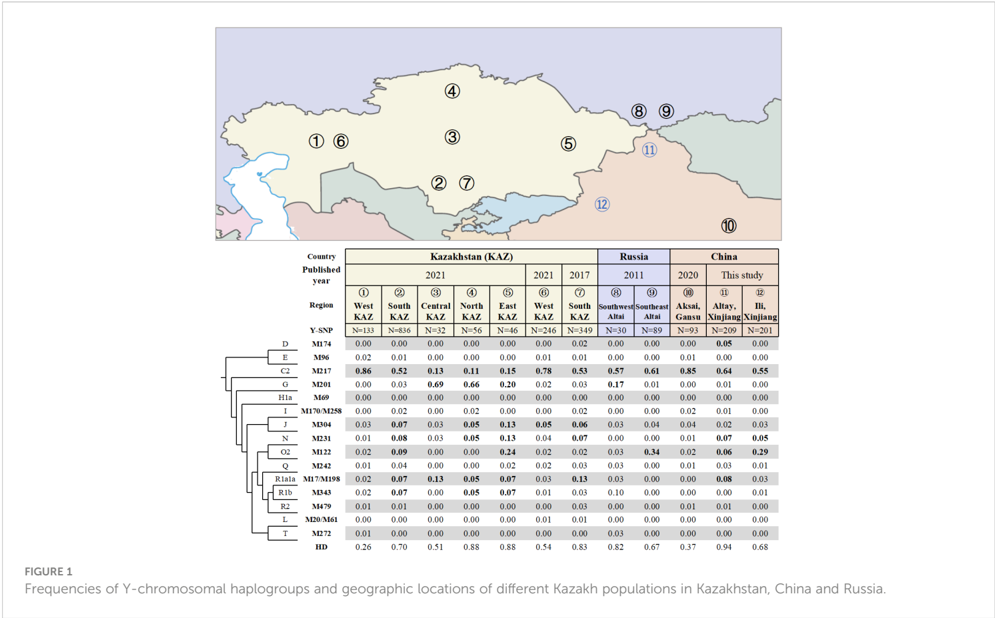
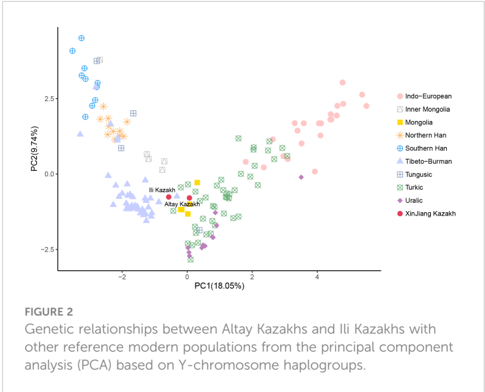
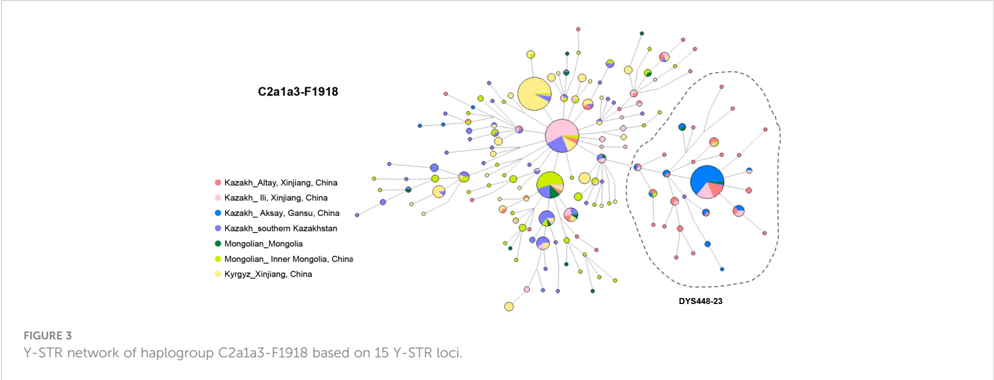
The Kazakhs of Xinjiang province are characterized by their nomadic lifestyle and patrilineal clan system. However, compared to Central Asian Kazakhs, a lack of Y chromosomal high-resolution analysis has hindered our understanding of the paternal history of modern Xinjiang Kazakhs. Methods: In this study, we present the analysis of 110 Y-SNP data from 209 Altay Kazakhs and 201 Ili Kazakhs in Xinjiang, along with their previously reported 24 Y-STR loci data. Results and discussion: We found that the Y chromosome haplogroups exhibit greater diversity in Altay Kazakhs compared to Kazakhs in Kazakhstan, Russia, and other regions of China. Y-SNP-based PCA plots reveal that both the Altay and Ili Kazakhs are situated between the Turkic, Mongolia, and Tibeto-Burman clusters. The dominant haplogroup C2a1a3-F1918, which originated in northeast Asia during the Neolithic Age, accounts for nearly half of the Altay and Ili Kazakhs. The Y lineage network of C2a1a3-F1918 contained two subclusters. Approximately 60.6% of the Altay Kazakhs belong to the DYS448-23 subcluster, indicating their Kerey-Abakh ancestry. On the other hand, around three-quarters of the Ili Kazakhs belong to the DYS448-22 subcluster, suggesting their Kerey-Ashmaily heritage. Notably, the TMRCA ages of the DYS448-23 subcluster were calculated to be 289.4 ± 202.65 years, which aligns with the historical immigration of the Kerey clan back to the Altay Mountains after the defeat of the Dzungar by the Qing dynasty in the mid-18th century.
Overview
CoChat Summary
Written by AI from the paper’s full text.
TL;DR
This study uses 110 Y-SNP markers and previously reported Y-STR data from 410 Xinjiang Kazakh males to reconstruct paternal ancestry in Altay and Ili. It finds northeast Asian origin for the dominant C2a1a3-F1918 lineage and links a Kerey-Abakh subcluster in Altay to an 18th-century Kerey clan expansion.
Key findings
- Altay Kazakhs had 34 Y-chromosome haplogroups and Ili Kazakhs 27; Altay Kazakhs showed the highest haplogroup diversity among Kazakh populations in Kazakhstan, Russia, and China, with HD = 0.94.
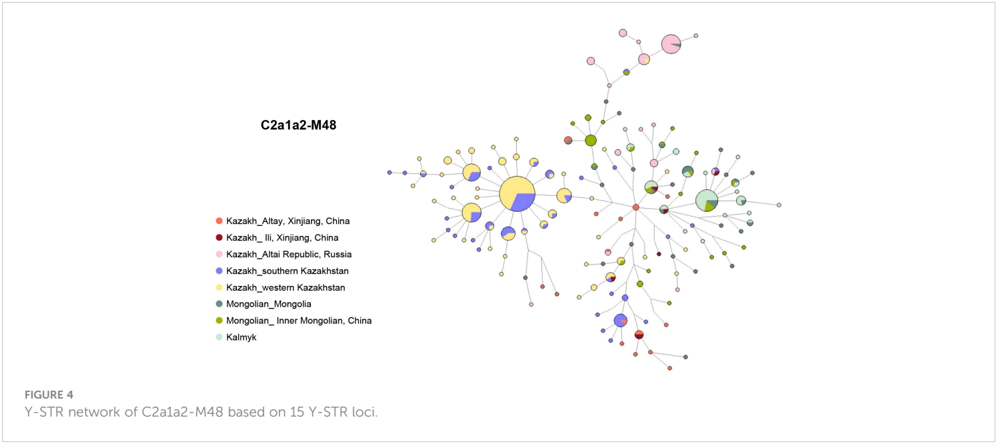
- C2-M217 was prevalent in Xinjiang Kazakhs: 64.1% in Altay and 55.2% in Ili. Within it, C2a1a3-F1918 accounted for 49.8% of Altay and 50.7% of Ili Kazakhs, while C2a1a2-M48 accounted for 9.6% and 2.5%, respectively. O2-M122 was 5.7% in Altay and 29.4% in Ili; O2a2b1a2a-F444 was 4.8% and 25.9%.
- PCA placed Altay and Ili Kazakhs between Turkic, Mongolia, and Tibeto-Burman clusters; Altay Kazakhs were closer to Northwest Mongolia Mongols, and Ili Kazakhs closer to Chamdo Tibetans.
- The C2a1a3-F1918 network split into subclusters: about 60.6% of Altay Kazakhs belonged to DYS448-23, indicating Kerey-Abakh ancestry, while around three-quarters of Ili Kazakhs belonged to DYS448-22, suggesting Kerey-Ashmaily heritage. TMRCA for DYS448-23 was 289.4 ± 202.65 years, aligning with mid-18th-century Kerey migration back to the Altay Mountains after the Qing defeat of the Dzungar.
Methods
- The study analyzed 410 Kazakh males from Xinjiang: 209 from Altay and 201 from Ili. DNA was extracted and genotyped for 110 Y-SNPs using SNaPshot; 24 Y-STR loci had been previously reported. Haplogroups were classified using ISOGG Y-DNA Haplogroup Tree 2019.
- Analyses included haplogroup diversity in Arlequin, Y-SNP-based PCA in RStudio against 156 published Eurasian populations, and median-joining networks in NETWORK v.10.2 using 15 Y-STRs for C2a1a3-F1918 and C2a1a2-M48. TMRCA was estimated by the ASD method with a 25-year generation time.
- Published ancient DNA data were analyzed with bcftools mpileup/call, haplogroup inference with Yleaf, and SNP verification in IGV.
Limitations
- The paper does not state a limitations section.
- Evident from the text: the key TMRCA estimate has a very wide confidence interval (289.4 ± 202.65 years), so the precise timing of the Kerey-Abakh expansion is uncertain.
- Evident from the text: the study is restricted to male Kazakhs from Altay and Ili, relies partly on previously reported Y-STR data, and uses Y-chromosome markers alone, so broader demographic or maternal/autosomal inferences are not tested here.
Model-written summary. Check it against the paper before relying on it.
Integrity signals
Registry
Cites
Statistics
Figures

Verification
Claims the paper makes
27 Own result · 14 Own interpretation · 8 Not checked yet · 7 Check pending · 6 No full text of the sources
A result the paper reports from its own data — it cites no other source for it, so there is none to check. The quote shows it is in the paper.
In the paper
“Approximately 60.6% of the Altay Kazakhs belong to the DYS448-23 subcluster, indicating their Kerey-Abakh ancestry.”
§ Y chromosome evidence confirms northeast Asian origin of Xinjiang Kazakhs and genetic influence from 18th century expansion of Kerey clan > Abstract
plain- Asserted: passes — The authors put it forward as true.
- Checkable: passes — It can be checked against evidence.
- Load-bearing: passes — The paper’s conclusions depend on it.
- Based: passes — The paper gives a reason why it holds.
A result the paper reports from its own data — it cites no other source for it, so there is none to check. The quote shows it is in the paper.
In the paper
“The network of haplogroup C2a1a2-M48 reveals distinct genetic patterns among different populations (Figure 4, Table S4).”
§ Y chromosome evidence confirms northeast Asian origin of Xinjiang Kazakhs and genetic influence from 18th century expansion of Kerey clan > Results
plainstates an association- Asserted: passes — The authors put it forward as true.
- Checkable: passes — It can be checked against evidence.
- Load-bearing: passes — The paper’s conclusions depend on it.
- Based: passes — The paper gives a reason why it holds.
A result the paper reports from its own data — it cites no other source for it, so there is none to check. The quote shows it is in the paper.
In the paper
“The Y lineage network of C2a1a3-F1918 contained two subclusters.”
§ Y chromosome evidence confirms northeast Asian origin of Xinjiang Kazakhs and genetic influence from 18th century expansion of Kerey clan > Abstract
plain- Asserted: passes — The authors put it forward as true.
- Checkable: passes — It can be checked against evidence.
- Load-bearing: passes — The paper’s conclusions depend on it.
- Based: passes — The paper gives a reason why it holds.
A result the paper reports from its own data — it cites no other source for it, so there is none to check. The quote shows it is in the paper.
In the paper
“This cluster is mainly composed of Altay Kazakhs (34.4%) and Aksay Kazakhs (56.8%) from Northwest China (Table S3).”
§ Y chromosome evidence confirms northeast Asian origin of Xinjiang Kazakhs and genetic influence from 18th century expansion of Kerey clan > Results
plainstates an association- Asserted: passes — The authors put it forward as true.
- Checkable: passes — It can be checked against evidence.
- Load-bearing: passes — The paper’s conclusions depend on it.
- Based: passes — The paper gives a reason why it holds.
A result the paper reports from its own data — it cites no other source for it, so there is none to check. The quote shows it is in the paper.
In the paper
“Among them, nearly half of Ili Kazaks (n=52) shared the haplotypes with South Kazakhstan Kazakhs (n=21), Xinjiang Kyrgyz (n=10), Altay Kazakhs (n=4) and Inner Mongolians (n=3), suggesting a potential patrilineal relationship (Table S3).”
§ Y chromosome evidence confirms northeast Asian origin of Xinjiang Kazakhs and genetic influence from 18th century expansion of Kerey clan > Results
hedgedstates an associationn = 52- Asserted: passes — The authors put it forward as true.
- Checkable: passes — It can be checked against evidence.
- Load-bearing: passes — The paper’s conclusions depend on it.
- Based: passes — The paper gives a reason why it holds.
- It may state two separate claims as one. 15
- Probably not a substantial claim. 8
Create a free account to see these claims.
Create a free account to see these assumptions.
36 more claims
Create a free account to see all 62 claims and to verify the 16 references still open.
Claims other papers make about this one
Each is checked against this paper’s own text: does it say what the citing paper says it does?
In the citing paper
“Similarly, among the Kazakhs residing in Aksai, located in Gansu Province, China, the frequency of occurrence is estimated to be 80% [28,29].”
From Y-Chromosomal insights into the paternal genealogy of the Kerey tribe have called into question their descent from the Stepfather of Genghis Khan (2024) · cites this paper as [29]
Self-check
Percentages, sums and reported differences re-computed from the paper’s own numbers.
Each contradiction between two passages listed here was confirmed by an independent check.
Rated major: it would touch a result — a value a result rests on, reported and recomputed p-values on opposite sides of the significance level, two passages that conflict with no sign which is right, or a cited work retracted before this paper was published.
In the paper
§ Y chromosome evidence confirms northeast Asian origin of Xinjiang Kazakhs and genetic influence from 18th century expansion of Kerey clan > Abstract
“Approximately 60.6% of the Altay Kazakhs belong to the DYS448-23 subcluster, indicating their Kerey-Abakh ancestry.”
§ Y chromosome evidence confirms northeast Asian origin of Xinjiang Kazakhs and genetic influence from 18th century expansion of Kerey clan > Results
“This specific STR haplotype accounts for 20.6% of the Altay Kazakhs' paternal pool and as much as 76.3% of the Aksay Kazakh pool.”
Rated minor: it would not touch a result — a value no result rests on, a p-value that stays on the same side of the significance level, or a conflict that is clerical, resolved elsewhere in the paper, or outside its own findings.
In the paper
§ Y chromosome evidence confirms northeast Asian origin of Xinjiang Kazakhs and genetic influence from 18th century expansion of Kerey clan > Materials and methods
“Y-STR loci data from the 24 analyzed participants had been previously reported (Mei et al., 2016;Li et al., 2020).”
§ Y chromosome evidence confirms northeast Asian origin of Xinjiang Kazakhs and genetic influence from 18th century expansion of Kerey clan > Introduction
“In this study, we aimed to gain a deeper understanding of the paternal genetic structure of modern Kazakhs in northwest China by analyzing 110 Y-SNPs and 24 Y-STRs from 410 male Kazakhs in the Altay and Ili Prefecture of Xinjiang.”
Cited works that were retracted
Works this paper cites that were later retracted, from the retraction notices publishers deposit. Major when the notice came out before this paper was published.
Rated major: it would touch a result — a value a result rests on, reported and recomputed p-values on opposite sides of the significance level, two passages that conflict with no sign which is right, or a cited work retracted before this paper was published.
In the paper
“Zhang, 2021, RETRACTED ARTICLE: Y Chromosomal STR haplotypes in Chinese Uyghur, Kazakh and Hui ethnic groups and genetic features of DYS448 null allele and DYS19 duplicated allele, Int. J. Legal. Med., 135, 1119, 10.1007/s00414-019-02049-6”
Cited work 10.1007/s00414-019-02049-6 · retracted 2019-03-29 · notice 10.1007/s00414-019-02049-6 · this paper published 2023-09-18
Citations
Cites
1 retracted
Zhang, D., Cao, G., Xie, M., Cui, X., Li, X., Tian, C., & Ye, Y. (2019) · International Journal of Legal Medicine · doi:10.1007/s00414-019-02049-6 · Cited by 16
RetractedIntegrative Genomics Viewer (IGV): high-performance genomics data visualization and exploration
Thorvaldsdottir, H., Robinson, J. T., & Mesirov, J. P. (2013) · Briefings in Bioinformatics · doi:10.1093/bib/bbs017 · Cited by 9,049
Li, H. (2011) · Bioinformatics · doi:10.1093/bioinformatics/btr509 · Cited by 6,454
China Marches West: The Qing Conquest of Central Eurasia
Perdue, P. C. (2005) · doi:10.4159/9780674042025 · Cited by 596
A recent bottleneck of Y chromosome diversity coincides with a global change in culture
Karmin, M., Saag, L., Vicente, M., Sayres, M. A. W., Järve, M., Talas, U. G., Rootsi, S., Ilumäe, A.-M., Mägi, R., Mitt, M., et al. (2015) · Genome Research · doi:10.1101/gr.186684.114 · Cited by 485
137 ancient human genomes from across the Eurasian steppes
Damgaard, P. D. B., Marchi, N., Rasmussen, S., Peyrot, M., Renaud, G., Korneliussen, T., Moreno-Mayar, J. V., Pedersen, M. W., Goldberg, A., Usmanova, E., et al. (2018) · Nature · doi:10.1038/s41586-018-0094-2 · Cited by 457
Genomic insights into the formation of human populations in East Asia
Wang, C.-C., Yeh, H.-Y., Popov, A. N., Zhang, H.-Q., Matsumura, H., Sirak, K., Cheronet, O., Kovalev, A., Rohland, N., Kim, A. M., et al. (2021) · Nature · doi:10.1038/s41586-021-03336-2 · Cited by 408
Self-citationA Dynamic 6,000-Year Genetic History of Eurasia’s Eastern Steppe
Jeong, C., Wang, K., Wilkin, S., Taylor, W. T. T., Miller, B. K., Bemmann, J. H., Stahl, R., Chiovelli, C., Knolle, F., Ulziibayar, S., et al. (2020) · Cell · doi:10.1016/j.cell.2020.10.015 · Cited by 328
Ancient genomes from northern China suggest links between subsistence changes and human migration
Ning, C., Li, T., Wang, K., Zhang, F., Li, T., Wu, X., Gao, S., Zhang, Q., Zhang, H., Hudson, M. J., et al. (2020) · Nature Communications · doi:10.1038/s41467-020-16557-2 · Cited by 305
Sequencing Y Chromosomes Resolves Discrepancy in Time to Common Ancestor of Males Versus Females
Poznik, G. D., Henn, B. M., Yee, M.-C., Sliwerska, E., Euskirchen, G. M., Lin, A. A., Snyder, M., Quintana-Murci, L., Kidd, J. M., Underhill, P. A., et al. (2013) · Science · doi:10.1126/science.1237619 · Cited by 248
Research works printed but not linked: 1
- Bi, 2015, Kazak, kirgiz, tajik and tatar
Cited by
Wang, Y., Xie, L., Wang, K., Jiang, Z., Feng, Y., Yu, Y., Chang, X., Meng, H., Xu, Y., Wu, Y.-S., et al. (2024) · Frontiers in Ecology and Evolution · doi:10.3389/fevo.2024.1349231
Self-citation
Metadata
- Authors
- Wang, B., Liang, J., Allen, E., Chang, X., Jiang, Z., Yu, Y., Shi, M., & Wen, S.
- Affiliations
- Fudan University (CN)
- China University of Political Science and Law (CN)
- Corresponding author
- Shi, Meisen
- Wen, Shaoqing
- Venue
- Frontiers in Ecology and Evolution
- Publisher
- Frontiers Media SA
- Published
- 2023-09-18
- Volume
- 11
- ISSN
- 2296-701X (ISSN-L)
- OpenAlex
- W4386864207
- Cited by
- 1
- References
- 41
- Citations by year
- 2024: 1
- FWCI
- 0.12
- Type
- journal article
- Language
- en
- Open access
- gold
- dx.doi.org
- Licence
- Locations
- Frontiers in Ecology and Evolution (publishedVersion, cc-by)
- DOAJ (DOAJ: Directory of Open Access Journals) (submittedVersion, cc-by-sa)
- Topics
- Life Sciences › Biochemistry, Genetics and Molecular Biology › Genetics › Forensic and Genetic Research
- Life Sciences › Biochemistry, Genetics and Molecular Biology › Genetics › Genetic diversity and population structure
- Social Sciences › Arts and Humanities › History › Eurasian Exchange Networks
- Keywords
- Y chromosome, paternal ancestry, Y-SNPs, Y-chromosome short tandem repeats, population structure
About these checks
Registry, retraction, Cites and statistics results are computed, not judged, with one exception: a printed reference that no index lists is read once by a model before it counts as a citation error. Claims are extracted by a model and kept only when their quote appears verbatim in the text; each cited source is then checked, with a model’s help, for whether it says what the claim relies on. Those verdicts can be wrong — read the claim’s quote and the cited source before relying on one.
A language model drew the claims from the paper on 2026-11-12, under version 3 of the claim definition (model deepseek-v4.1-flash, prompt extract-v3).
A second model labelled each claim on 2026-11-12 (model jev-1.13-20260917, definition revision gold-guideline-v0.2).
Statistics and arithmetic are recomputed, not judged.
Confidence bands are shown only for fields calibrated on our annotated test set. None is calibrated yet, so no band is shown.
What counts as a claim ›How we measure confidence ›How we check this ›
Are you an author, or do you see a problem with this page? Request a review
