

The DOI matches its Crossref record.
Genome-Wide Identification and Comparative Analysis of ARF Family Genes in Three Apiaceae Species
Abstract
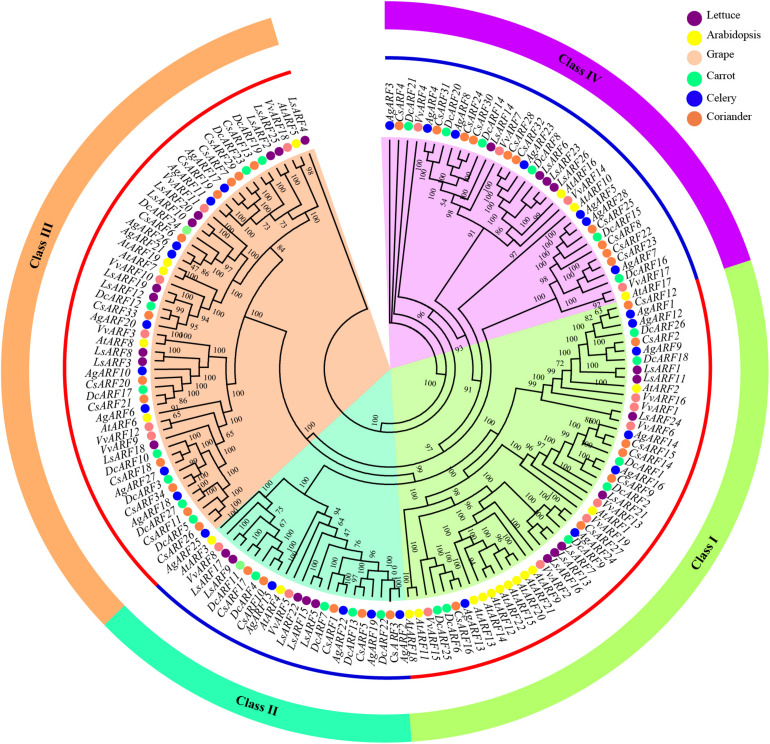
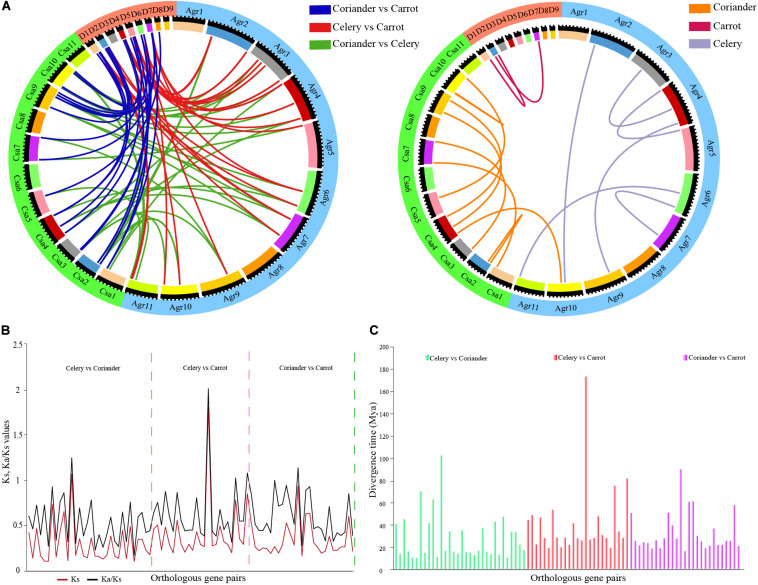
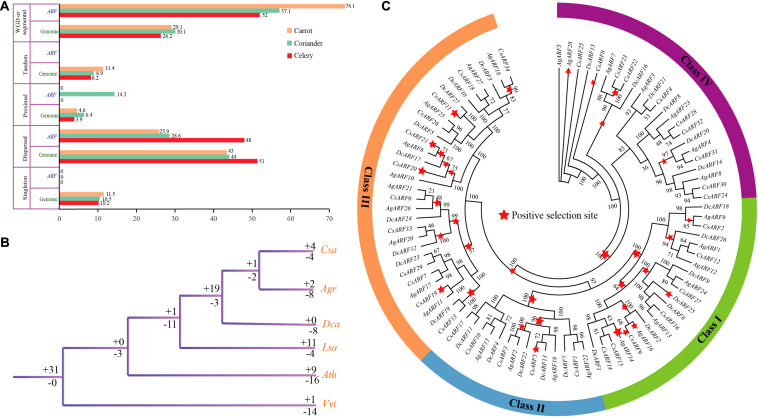
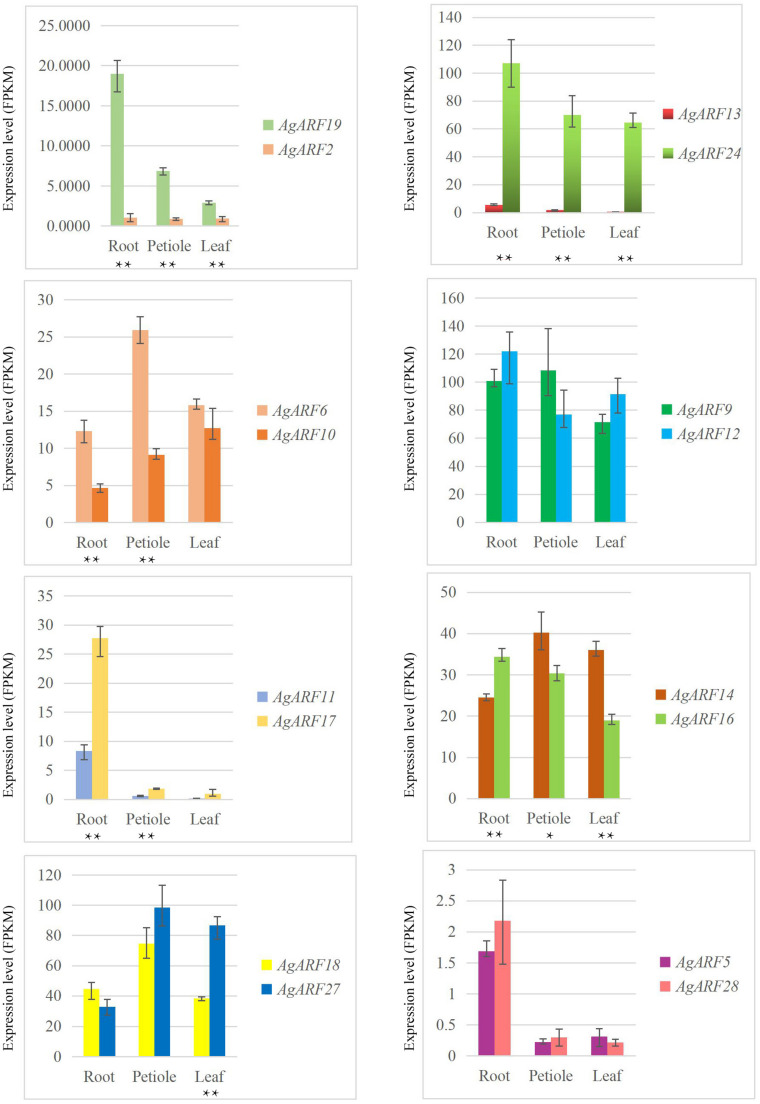
The family Apiaceae includes many important vegetables and medicinal plants. Auxin response factors (ARFs) play critical roles in regulating plant growth and development. Here, we performed a comprehensive analysis of the ARF gene family in three Apiaceae species, celery, coriander, and carrot, and compared the results with the ARF gene family of lettuce, Arabidopsis, and grape. We identified 156 ARF genes in all six species and 89 genes in the three Apiaceae species, including 28, 34, and 27 in celery, coriander, and carrot, respectively. The paralogous gene number in coriander was far greater than that in carrot and celery. Our analysis revealed that ARF genes of the three Apiaceae species in 34 branches of the phylogenetic tree underwent significant positive selection. Additionally, our findings indicated that whole-genome duplication played an important role in ARF gene family expansion. Coriander contained a greater number of ARF genes than celery and carrot because of more gene duplications and less gene losses. We also analyzed the expression of ARF genes in three tissues by RNA-seq and verified the results by quantitative real-time PCR. Furthermore, we found that several paralogous genes exhibited divergent expression patterns. Overall, this study provides a valuable resource for exploring how ARF family genes regulate plant growth and development in other plants. Since this is the first report of the ARF gene family in Apiaceae, our results will serve as a guide for comparative and functional analyses of ARF and other gene families in Apiaceae.
Overview
The claims and statistics of this paper haven’t been checked yet.
Run the check — free, no account needed. It reads the open-access text and checks the sources it cites.
Integrity signals
Registry
Cites
Statistics
Figures
Verification
Claims the paper makes
The claims and statistics of this paper haven’t been checked yet.
Run the check — free, no account needed. It reads the open-access text and checks the sources it cites.
Claims other papers make about this one
Each is checked against this paper’s own text: does it say what the citing paper says it does?
In the citing paper
“Additionally, a genome-wide study of the Auxin Response Factor (ARF) gene family across coriander and two related species revealed conserved and divergent gene functions relevant to plant development and stress responses (Pei et al. 2021).”
From Unlocking the Apiaceae: comprehensive advances in agronomy, biotechnology, phytochemistry, and health applications of major seed spices (2025) · cites this paper as Pei et al. 2021
Self-check
Percentages, sums and reported differences re-computed from the paper’s own numbers.
The self-check needs the paper’s full text.
Citations
Cites
No references could be resolved yet.
Research works printed but not linked: 56
- Ahmad, 2019, Phytochemicals in Daucus carota and Their Health Benefits-Review Article., Foods, 8, 10.3390/foods8090424 · DOI
- Assis, 2013, Neofunctionalization of young duplicate genes in Drosophila., Proc. Natl. Acad. Sci. U S A, 110, 17409, 10.1073/pnas.1313759110 · DOI
- Bailey, 2009, MEME SUITE: tools for motif discovery and searching., Nucleic Acids Res., 37, W202, 10.1093/nar/gkp335 · DOI · Paper page
- Ballmer-Weber, 2002, Influence of food processing on the allergenicity of celery: DBPCFC with celery spice and cooked celery in patients with celery allergy., Allergy, 57, 228, 10.1034/j.1398-9995.2002.1o3319.x · DOI
- Blanc, 2004, Functional divergence of duplicated genes formed by polyploidy during Arabidopsis evolution., Plant Cell, 16, 1679, 10.1105/tpc.021410 · DOI
- Chen, 2020, TBtools - an integrative toolkit developed for interactive analyses of big biological data., Mol. Plant, 2020
- Ellis, 2005, AUXIN RESPONSE FACTOR1 and AUXIN RESPONSE FACTOR2 regulate senescence and floral organ abscission in Arabidopsis thaliana., Development, 132, 4563, 10.1242/dev.02012 · DOI
- Finet, 2013, Evolution of the ARF gene family in land plants: old domains, new tricks., Mol. Biol. Evol., 30, 45, 10.1093/molbev/mss220 · DOI
- Guindon, 2010, New algorithms and methods to estimate maximum-likelihood phylogenies: assessing the performance of PhyML 3.0., Syst. Biol., 59, 307, 10.1093/sysbio/syq010 · DOI · Paper page
- Hu, 2015, GSDS 2.0: an upgraded gene feature visualization server., Bioinformatics, 31, 1296, 10.1093/bioinformatics/btu817 · DOI
- Iorizzo, 2016, A high-quality carrot genome assembly provides new insights into carotenoid accumulation and asterid genome evolution., Nat. Genet., 48, 657, 10.1038/ng.3565 · DOI
- Jaillon, 2007, The grapevine genome sequence suggests ancestral hexaploidization in major angiosperm phyla., Nature, 449, 463, 10.1038/nature06148 · DOI
- Kalluri, 2007, Genome-wide analysis of Aux/IAA and ARF gene families in Populus trichocarpa., BMC Plant Biol., 7, 10.1186/1471-2229-7-59 · DOI
- Krzywinski, 2009, Circos: an information aesthetic for comparative genomics., Genome Res., 19, 1639, 10.1101/gr.092759.109 · DOI
- Kumar, 2015, Genomic Survey. Gene Expression, and Interaction Analysis Suggest Diverse Roles of ARF and Aux/IAA Proteins in Solanaceae., Plant Mole. Biol. Rep., 33, 1552, 10.1007/s11105-015-0856-z · DOI
- Kumar, 2011, Genome-wide analysis of auxin response factor (ARF) gene family from tomato and analysis of their role in flower and fruit development., Mol. Genet. Genom., 285, 245, 10.1007/s00438-011-0602-7 · DOI
- Letunic, 2012, SMART 7: recent updates to the protein domain annotation resource., Nucleic Acids Res., 40, D302, 10.1093/nar/gkr931 · DOI
- Li, 2003, ClustalW-MPI: ClustalW analysis using distributed and parallel computing., Bioinformatics, 19, 1585, 10.1093/bioinformatics/btg192 · DOI
- Li, 2003, OrthoMCL: identification of ortholog groups for eukaryotic genomes., Genome Res., 13, 2178, 10.1101/gr.1224503 · DOI · Paper page
- Li, 2015, Genome-wide identification, isolation and expression analysis of auxin response factor (ARF) gene family in sweet orange (Citrus sinensis)., Front. Plant Sci., 6, 10.3389/fpls.2015.00119 · DOI
- Li, 2016, A Review of Auxin Response Factors (ARFs) in Plants., Front. Plant Sci., 7, 10.3389/fpls.2016.00047 · DOI
- Liscum, 2002, Genetics of Aux/IAA and ARF action in plant growth and development., Plant Mol. Biol., 49, 387, 10.1007/978-94-010-0377-3_10 · DOI · Paper page
- Luo, 2014, Genomewide identification and expression analysis of the ARF gene family in apple., J. Genet., 93, 785, 10.1007/s12041-014-0462-0 · DOI
- Maljaei, 2019, Effect of Celery Extract on Thyroid Function; Is Herbal Therapy Safe in Obesity?, Int. J. Prev. Med., 10, 10.4103/ijpvm.ijpvm_209_17 · DOI
- Marchler-Bauer, 2009, CDD: specific functional annotation with the Conserved Domain Database., Nucleic Acids Res., 37, D205, 10.1093/nar/gkn845 · DOI
- Mun, 2012, Auxin response factor gene family in Brassica rapa: genomic organization, divergence, expression, and evolution., Mol. Genet. Genomics, 287, 765, 10.1007/s00438-012-0718-4 · DOI
- Nguyen, 2015, IQ-TREE: a fast and effective stochastic algorithm for estimating maximum-likelihood phylogenies., Mol. Biol. Evol., 32, 268, 10.1093/molbev/msu300 · DOI · Paper page
- Okushima, 2007, ARF7 and ARF19 regulate lateral root formation via direct activation of LBD/ASL genes in Arabidopsis., Plant Cell, 19, 118, 10.1105/tpc.106.047761 · DOI
- Okushima, 2005, Functional genomic analysis of the AUXIN RESPONSE FACTOR gene family members in Arabidopsis thaliana: unique and overlapping functions of ARF7 and ARF19., Plant Cell, 17, 444, 10.1105/tpc.104.028316 · DOI
- Prachayasittikul, 2018, Coriander (Coriandrum sativum): A promising functional food toward the well-being., Food Res. Int., 105, 305, 10.1016/j.foodres.2017.11.019 · DOI
- Punta, 2012, The Pfam protein families database., Nucleic. Acids. Res., 40, 290, 10.1093/nar/gkr1065 · DOI · Paper page
- Reyes-Chin-Wo, 2017, Genome assembly with in vitro proximity ligation data and whole-genome triplication in lettuce., Nat. Commun., 8, 10.1038/ncomms14953 · DOI
- Song, Genome-wide analysis of the GRAS gene family in Chinese cabbage (Brassica rapa ssp. pekinensis)., Genomics, 103, 135, 10.1016/j.ygeno.2013.12.004 · DOI
- Song, Genome-wide identification, classification and expression analysis of the heat shock transcription factor family in Chinese cabbage., Mol. Genet. Genomics, 289, 541, 10.1007/s00438-014-0833-5 · DOI
- Song, 2016, Temperature expression patterns of genes and their coexpression with LncRNAs revealed by RNA-Seq in non-heading Chinese cabbage., BMC Genomics, 17, 10.1186/s12864-016-2625-2 · DOI
- Song, Coriander Genomics Database: a genomic, transcriptomic, and metabolic database for coriander., Horticul. Res., 7
- Song, Deciphering the high-quality genome sequence of coriander that causes controversial feelings., Plant Biotechnol. J., 18, 1444, 10.1111/pbi.13310 · DOI
- Soria, 2014, Functional divergence for every paralog., Mol. Biol. Evol., 31, 984, 10.1093/molbev/msu050 · DOI
- Stolzer, 2012, Inferring duplications, losses, transfers and incomplete lineage sorting with nonbinary species trees., Bioinformatics, 28, 409, 10.1093/bioinformatics/bts386 · DOI
- Su, 2017, Genome-Wide Identification of Auxin Response Factor (ARF) Genes Family and its Tissue-Specific Prominent Expression in Pineapple (Ananas comosus)., Tropical Plant Biol., 10, 86, 10.1007/s12042-017-9187-6 · DOI
- Tang, 2018, Genome-wide identification and expression profiling of the auxin response factor (ARF) gene family in physic nut., PLoS One, 13, 10.1371/journal.pone.0201024.t001 · DOI
- Tombuloglu, 2019, Genome-wide analysis of the auxin response factors (ARF) gene family in barley (Hordeum vulgare L.)., J. Plant Biochem. Biotechnol., 28, 14, 10.1007/s13562-018-0458-6 · DOI
- Ulmasov, 1997, ARF1, a transcription factor that binds to auxin response elements., Science, 276, 1865, 10.1126/science.276.5320.1865 · DOI
- Voorrips, 2002, MapChart: software for the graphical presentation of linkage maps and QTLs., J. Hered., 93, 77, 10.1093/jhered/93.1.77 · DOI
- Wan, 2014, Genome-wide identification, characterization and expression analysis of the auxin response factor gene family in Vitis vinifera., Plant Cell Rep., 33, 1365, 10.1007/s00299-014-1622-7 · DOI
- Wang, 2007, Genome-wide analysis of the auxin response factors (ARF) gene family in rice (Oryza sativa)., Gene, 394, 13, 10.1016/j.gene.2007.01.006 · DOI
- Wang, 2010, KaKs_Calculator 2.0: a toolkit incorporating gamma-series methods and sliding window strategies., Genom. Proteomics Bioinform., 8, 77, 10.1016/s1672-0229(10)60008-3 · DOI
- Wang, Divergent Evolutionary and Expression Patterns between Lineage Specific New Duplicate Genes and Their Parental Paralogs in Arabidopsis thaliana., PLoS One, 8, 10.1371/journal.pone.0072362 · DOI
- Wang, 2016, Evolutionary Fates and Dynamic Functionalization of Young Duplicate Genes in Arabidopsis Genomes., Plant Physiol., 172, 427, 10.1104/pp.16.01177 · DOI
- Wang, ARF-Aux/IAA interactions through domain III/IV are not strictly required for auxin-responsive gene expression., Plant signal. Behav., 8, e24526, 10.4161/psb.24526 · DOI
- Wang, 2012, MCScanX: a toolkit for detection and evolutionary analysis of gene synteny and collinearity., Nucleic Acids Res., 40, 10.1093/nar/gkr1293 · DOI · Paper page
- Wei, 2006, Research Progresses on Auxin Response Factors., J. Int. Plant Biol., 48, 622, 10.1111/j.1744-7909.2006.00280.x · DOI
- Wu, 2017, Evolution Analysis of the Aux/IAA Gene Family in Plants Shows Dual Origins and Variable Nuclear Localization Signals., Int. J. Mol. Sci., 18, 10.3390/ijms18102107 · DOI
- Xing, 2011, Genome-wide identification and expression profiling of auxin response factor (ARF) gene family in maize., BMC Genomics, 12, 10.1186/1471-2164-12-178 · DOI
- Yang, 2007, PAML 4: phylogenetic analysis by maximum likelihood., Mol. Biol. Evol., 24, 1586, 10.1093/molbev/msm088 · DOI · Paper page
- Zhang, 2017, Genome-wide Identification and Expression of ARF Gene Family during Adventitious Root Development in Hot Pepper (Capsicum annuum)., Horticultural Plant J., 3, 151, 10.1016/j.hpj.2017.07.001 · DOI
Cited by
Singh, R., Choudhary, S., Kumari, V., Meena, R. S., Meena, N. K., Y, R., & Verma, A. K. (2025) · Journal of Agriculture and Ecology · doi:10.58628/jae-2521-101
Metadata
- Authors
- Pei, Q., Li, N., Yang, Q., Wu, T., Feng, S., Feng, X., Jing, Z., Zhou, R., Gong, K., Yu, T., Wang, Z., & Song, X.
- Venue
- Frontiers in Genetics
- Publisher
- Frontiers Media SA
- Published
- 2021-01-13
- Volume
- 11
- ISSN
- 1664-8021
- PMC
- PMC7838617
- Cited by
- 18
- References
- 0
About these checks
Registry, retraction, Cites and statistics results are computed, not judged, with one exception: a printed reference that no index lists is read once by a model before it counts as a citation error. Claims are extracted by a model and kept only when their quote appears verbatim in the text; each cited source is then checked, with a model’s help, for whether it says what the claim relies on. Those verdicts can be wrong — read the claim’s quote and the cited source before relying on one.
Statistics and arithmetic are recomputed, not judged.
Confidence bands are shown only for fields calibrated on our annotated test set. None is calibrated yet, so no band is shown.
What counts as a claim ›How we measure confidence ›How we check this ›
Are you an author, or do you see a problem with this page? Request a review
Data sources
Bibliographic data: Semantic Scholar, OpenAlex, Crossref.
Contains information from the Semantic Scholar Academic Graph Datasets, made available under the ODC Attribution License (ODC-BY 1.0).
Semantic Scholar’s data is described in: Kinney, R., et al. (2023). The Semantic Scholar Open Data Platform. arXiv:2301.10140.
