

The EDA/EDAR/NF-κB pathway in non-syndromic tooth agenesis: A genetic perspective
Open accessThe DOI matches its Crossref record; 96 of the 97 references it cites were found in a registry or an index.
Abstract
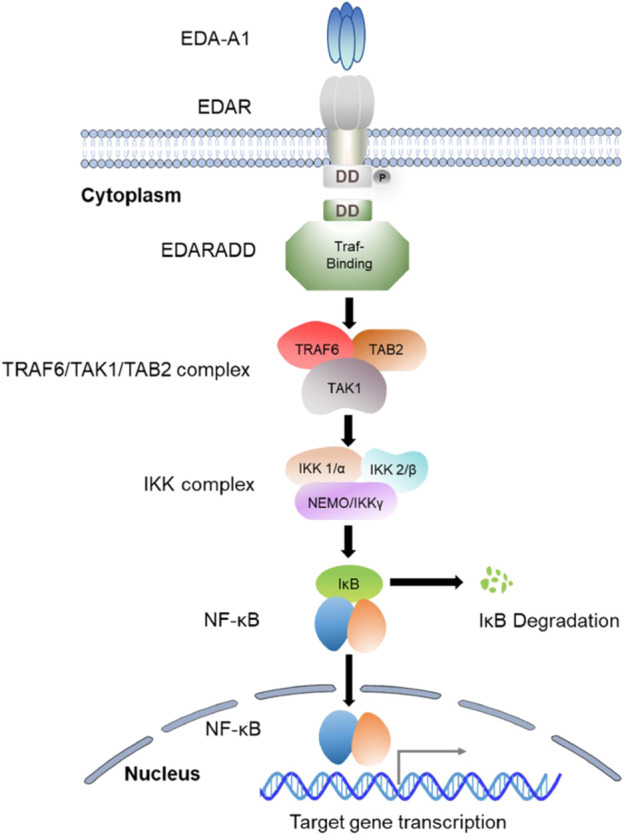
Non-syndromic tooth agenesis (NSTA) is one of the most common dental developmental malformations affected by genetic factors predominantly. Among all 36 candidate genes reported in NSTA individuals, EDA, EDAR, and EDARADD play essential roles in ectodermal organ development. As members of the EDA/EDAR/NF-κB signaling pathway, mutations in these genes have been implicated in the pathogenesis of NSTA, as well as hypohidrotic ectodermal dysplasia (HED), a rare genetic disorder that affects multiple ectodermal structures, including teeth. This review provides an overview of the current knowledge on the genetic basis of NSTA, with a focus on the pathogenic effects of the EDA/EDAR/NF-κB signaling pathway and the role of EDA, EDAR, and EDARADD mutations in developmental tooth defects. We also discuss the phenotypic overlap and genetic differences between NSTA and HED. Ultimately, this review highlights the importance of genetic analysis in diagnosing and managing NSTA and related ectodermal disorders, and the need for ongoing research to improve our understanding of these conditions.
Overview
The claims and statistics of this paper haven’t been checked yet.
Free: it reads the open-access text and checks the first 5 claims that cite a source we can check. Create a free account to check every claim.
Integrity signals
Registry
Cites
Statistics
Figures

Verification
Claims the paper makes
The claims and statistics of this paper haven’t been checked yet.
Free: it reads the open-access text and checks the first 5 claims that cite a source we can check. Create a free account to check every claim.
Claims other papers make about this one
Each is checked against this paper’s own text: does it say what the citing paper says it does?
The source backs part of the claim, not all of it — or backs it for a different population, condition or comparison.
In the citing paper
“Ectodermal dysplasia (ED) is a genetically inherited syndrome caused by mutations affecting ectodermal tissue development, often resulting in hypodontia or anodontia accompanied by severe alveolar bone deficiency [1–3].”
From Implant-supported fixed prosthodontic treatment for ectodermal dysplasia: a case report (2026) · cites this paper as [1]
Experimental — accuracy not yet measured
Self-check
Percentages, sums and reported differences re-computed from the paper’s own numbers.
The self-check needs the paper’s full text.
Citations
Cites
1 retracted
RETRACTED: Functional Study of Ectodysplasin-A Mutations Causing Non-Syndromic Tooth Agenesis
Shen, W., Wang, Y., Liu, Y., Liu, H., Zhao, H., Zhang, G., Snead, M. L., Han, D. K., & Feng, H. (2016) · PLoS ONE · doi:10.1371/journal.pone.0154884 · Cited by 23 · cited 1×
“To date, 45 mutations in EDA have been linked to NSTA (Schneider et al., 2001; Tao et al., 2006; Tarpey et al., 2007; Fan et al., 2008; Han et al., 2008; Li et al., 2008; Rasool et al., 2008; Mues et al., 2009; Song et al., 2009; Ayub et al., 2010; Mues et al., 2010; Arte et al., 2013; He et al., 2013; Nikopensius et…”
BackgroundRetractedShaping the nuclear action of NF-κB
Chen, L.-F., & Greene, W. C. (2004) · Nature Reviews Molecular Cell Biology · doi:10.1038/nrm1368 · Cited by 1,221 · cited 1×
“The phosphorylation of IκBs triggers their polyubiquitination, proteasomal degradation by the 26s proteasome, and eventually the release of NF-κB transcription factor into the nucleus (Chen and Greene, 2004).”
BackgroundThe molecular architecture of the TNF superfamily
Bodmer, J.-L., Schneider, P., & Tschopp, J. (2002) · Trends in Biochemical Sciences · doi:10.1016/s0968-0004(01)01995-8 · Cited by 916 · cited 1×
“The C-terminal portion comprising the collagen and TNF homology domains cleaves off at the furin consensus site, releasing homotrimers that can bind to its particular receptor EDAR (Yan et al., 2000; Bodmer et al., 2002; Mikkola and Thesleff, 2003).”
BackgroundThe IKK complex: an integrator of all signals that activate NF-κB?
Israël, A. (2000) · Trends in Cell Biology · doi:10.1016/s0962-8924(00)01729-3 · Cited by 398 · cited 1×
“The IKK complex is composed of two kinase subunits (IKK1/α and IKK2/β) and a structural component (NEMO/IKKγ) (Israël, 2000).”
BackgroundThe TNF-receptor-associated factor family
Wajant, H., Henkler, F., & Scheurich, P. (2001) · Cellular Signalling · doi:10.1016/s0898-6568(01)00160-7 · Cited by 353 · cited 1×
“The Traf family of scaffold proteins has six known members (Wajant et al., 2001), among”
BackgroundYan, M., Wang, L.-C., Hymowitz, S. G., Schilbach, S., Lee, J., Goddard, A., de Vos, A. M., Gao, W.-Q., & Dixit, V. M. (2000) · Science · doi:10.1126/science.290.5491.523 · Cited by 311 · cited 1×
“The C-terminal portion comprising the collagen and TNF homology domains cleaves off at the furin consensus site, releasing homotrimers that can bind to its particular receptor EDAR (Yan et al., 2000; Bodmer et al., 2002; Mikkola and Thesleff, 2003).”
BackgroundCluzeau, C., Hadj-Rabia, S., Jambou, M., Mansour, S., Guigue, P., Masmoudi, S., Bal, E., Chassaing, N., Vincent, M.-C., Viot, G., et al. (2011) · Human Mutation · doi:10.1002/humu.21384 · Cited by 311 · cited 3×
“Hypohidrotic ectodermal dysplasia (HED) is the most highly represented ED and is proven to be affected by mutations in EDA, EDAR, and EDARADD in most cases (Cluzeau et al., 2011; Martínez-Romero et al., 2019; Ahmed et al., 2021).”
BackgroundGenetic basis of tooth agenesis
Nieminen, P. (2009) · Journal of Experimental Zoology Part B: Molecular and Developmental Evolution · doi:10.1002/jez.b.21277 · Cited by 284 · cited 5×
“Compared with exogenous factors, compelling evidence has indicated that genetic factors play a predominant role in the etiology of NSTA (Nieminen, 2009; Yin and Bian, 2015; Ye and Attaie, 2016).”
BackgroundInfluentialSchneider, P., Street, S. L., Gaide, O., Hertig, S., Tardivel, A., Tschopp, J., Runkel, L., Alevizopoulos, K., Ferguson, B. M., & Zonana, J. (2001) · Journal of Biological Chemistry · doi:10.1074/jbc.m101280200 · Cited by 227 · cited 3×
“It was first discovered as a candidate gene in an NSTA individual in 2001 (Schneider et al., 2001) and was first identified in an X-linked inherited NSTA family in 2006 (Tao et al.”
BackgroundEctodysplasin signaling in development.
Mikkola, M. L., & Thesleff, I. (2003) · Cytokine & Growth Factor Reviews · doi:10.1016/s1359-6101(03)00020-0 · Cited by 217 · cited 3×
“The C-terminal portion comprising the collagen and TNF homology domains cleaves off at the furin consensus site, releasing homotrimers that can bind to its particular receptor EDAR (Yan et al., 2000; Bodmer et al., 2002; Mikkola and Thesleff, 2003).”
Background
Research works printed but not linked: 1
- Zhang, H., Yang, L., Meng, L., Zheng, S., Ma, W., Yang, D., et al. (2021). A novel EDAR mutation identified in nonsyndromic oligodontia patients by whole exome sequencing. J. Pract. Stomatology 37 (6), 783-789.
Cited by
Yang, J., Liao, Y., Wang, B., Cui, L., Yu, X., Wu, F., Zhang, Y., Liu, R., & Yao, Y. (2023) · Cancer Letters · doi:10.1016/j.canlet.2023.216427 · Cited by 26
The Roles of EDA2R in Ageing and Disease
Farrington, G., Tonge, L., Branagan, T., Sudirman, S., Fang, C., Luk, L. Y. P., Kır, S., Bolis, M., Ahmetov, I. I., & Ross, K. (2025) · Aging Cell · doi:10.1111/acel.70282 · Cited by 17
Exploring the genetics, mechanisms, and therapeutic innovations in non-syndromic tooth agenesis
Borges, G. H., Lins‐Candeiro, C. L., Henriques, I. V., de Brito, R. B., Pithon, M. M., & Paranhos, L. R. (2024) · Morphologie · doi:10.1016/j.morpho.2024.100941 · Cited by 17
Zheng, F., & Atukorallaya, D. (2023) · International Journal of Molecular Sciences · doi:10.3390/ijms242015061 · Cited by 8
“EDA signaling may regulate odontogenesis via the EDA/EDAR/nuclear factor-κ B (NF-κ B) pathway [64].”
BackgroundGonzález-Pérez, N. A., Herrera-Atoche, J. R., López-González, P., Pacheco‐Arjona, R., Rangel-Méndez, J. A., Canul-May, J. E., Sosa–Escalante, J. E., Zúñiga-Herrera, I. D., Aguilar-Ayala, F. J., & González-Herrera, L. J. (2024) · Odovtos - International Journal of Dental Sciences · doi:10.15517/ijds.2024.60223 · Cited by 6
“She also had oligodontia with a very similar pattern of missing teeth as proband 1, with the exception of dental organs 24, 36, 46, and 46 (Table 1).”
Metadata
- Authors
- Gao, Y., Jiang, X., Wei, Z., Long, H., & Lai, W.
- Affiliations
- Sichuan University (CN)
- Corresponding author
- Lai, Wenli
- Venue
- Frontiers in Genetics
- Publisher
- Frontiers Media SA
- Published
- 2023-04-03
- Volume
- 14
- Pages
- 1168538-1168538
- ISSN
- 1664-8021 (ISSN-L)
- PMC
- PMC10106650
- OpenAlex
- W4362586600
- Cited by
- 33
- References
- 97
- Citations by year
- 2026: 11 · 2025: 12 · 2024: 7 · 2023: 3
- FWCI
- 0.87
- Type
- journal article
- Language
- en
- Open access
- gold
- doi.org
- Licence
- Locations
- Frontiers in Genetics (publishedVersion, cc-by)
- PubMed Central (publishedVersion, cc-by)
- PubMed (publishedVersion)
- DOAJ (DOAJ: Directory of Open Access Journals) (submittedVersion, cc-by-sa)
- Topics
- Health Sciences › Dentistry › General Dentistry › dental development and anomalies
- Health Sciences › Medicine › Dermatology › Hair Growth and Disorders
- Life Sciences › Biochemistry, Genetics and Molecular Biology › Biochemistry › Bone and Dental Protein Studies
- Keywords
- non-syndromic tooth agenesis, EDA, EDAR, EDARADD, hypohidrotic ectodermal dysplasia, candidate genes, genetic diagnosis
About these checks
Registry, retraction, Cites and statistics results are computed, not judged, with one exception: a printed reference that no index lists is read once by a model before it counts as a citation error. Claims are extracted by a model and kept only when their quote appears verbatim in the text; each cited source is then checked, with a model’s help, for whether it says what the claim relies on. Those verdicts can be wrong — read the claim’s quote and the cited source before relying on one.
Statistics and arithmetic are recomputed, not judged.
Confidence bands are shown only for fields calibrated on our annotated test set. None is calibrated yet, so no band is shown.
What counts as a claim ›How we measure confidence ›How we check this ›
Are you an author, or do you see a problem with this page? Request a review
Data sources
Bibliographic data: Semantic Scholar, OpenAlex, Crossref.
Contains information from the Semantic Scholar Academic Graph Datasets, made available under the ODC Attribution License (ODC-BY 1.0).
Semantic Scholar’s data is described in: Kinney, R., et al. (2023). The Semantic Scholar Open Data Platform. arXiv:2301.10140.
