

The DOI matches its Crossref record; 104 of the 107 references it cites were found in a registry or an index.
Functions of Arginase Isoforms in Macrophage Inflammatory Responses: Impact on Cardiovascular Diseases and Metabolic Disorders
Open accessAbstract
Macrophages play a paramount role in immunity and inflammation-associated diseases, including infections, cardiovascular diseases, obesity-associated metabolic imbalances, and cancer. Compelling evidence from studies of recent years demonstrates that macrophages are heterogeneous and undergo heterogeneous phenotypic changes in response to microenvironmental stimuli. The M1 killer type response and the M2 repair type response are best known, and are two extreme examples. Among other markers, inducible nitric oxide synthase and type-I arginase (Arg-I), the enzymes that are involved in l-arginine/nitric oxide (NO) metabolism, are associated with the M1 and M2 phenotype, respectively, and therefore widely used as the markers for characterization of the two macrophage phenotypes. There is also a type-II arginase (Arg-II), which is expressed in macrophages and prevalently viewed as having the same function as Arg-I in the cells. In contrast to Arg-I, little information on the role of Arg-II in macrophage inflammatory responses is available. Emerging evidence, however, suggests that differential roles of Arg-I and Arg-II in regulating macrophage functions. In this article, we will review recent developments on the functional roles of the two arginase isoforms in regulation of macrophage inflammatory responses by focusing on their impact on the pathogenesis of cardiovascular diseases and metabolic disorders.
Overview
The claims and statistics of this paper haven’t been checked yet.
Run the check — free, no account needed. It reads the open-access text and checks the sources it cites.
Integrity signals
Registry
Cites
Statistics
Figures
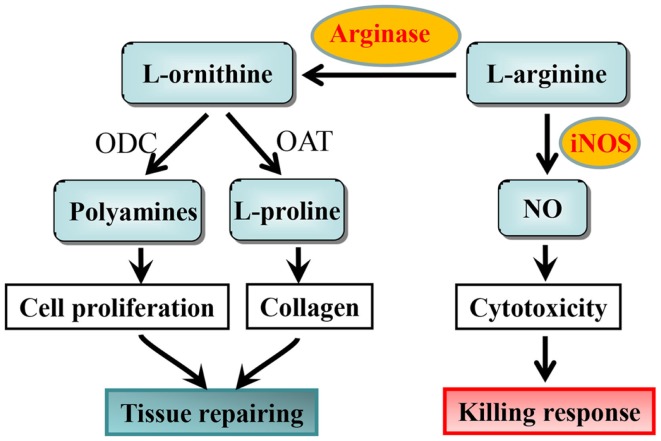
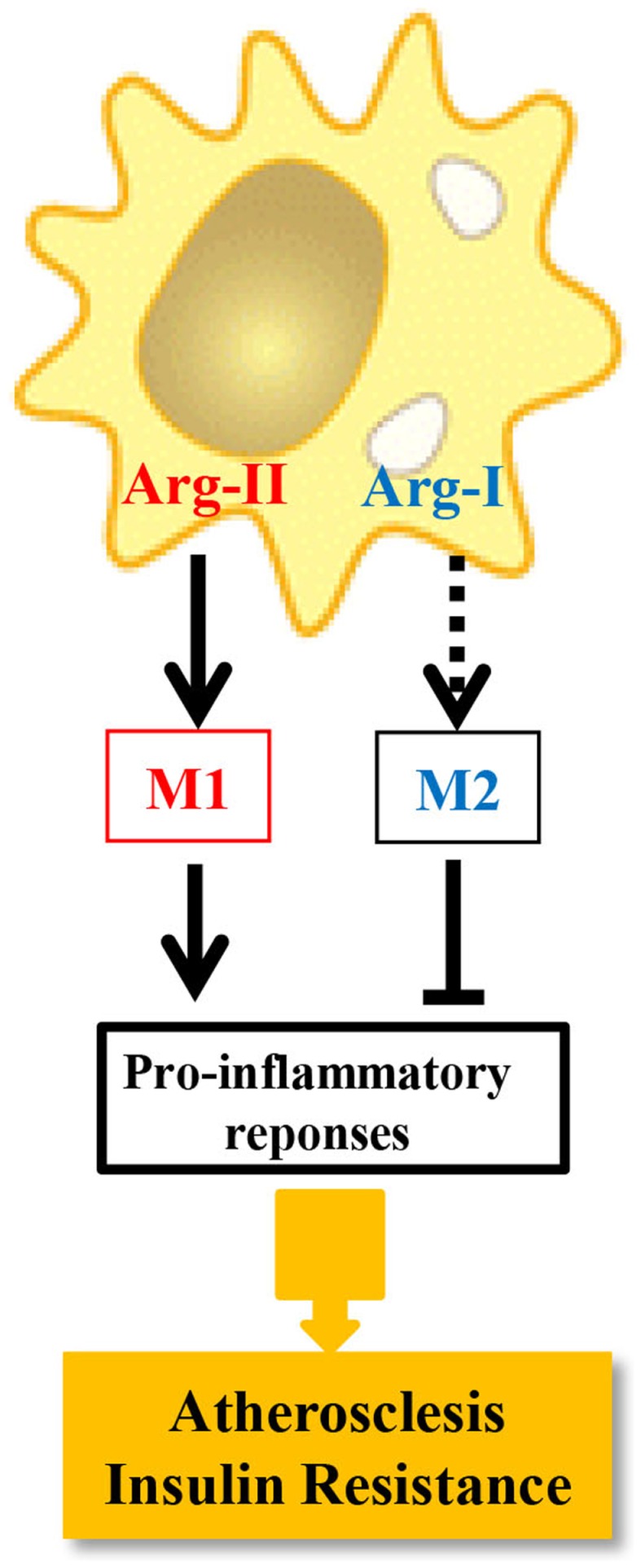
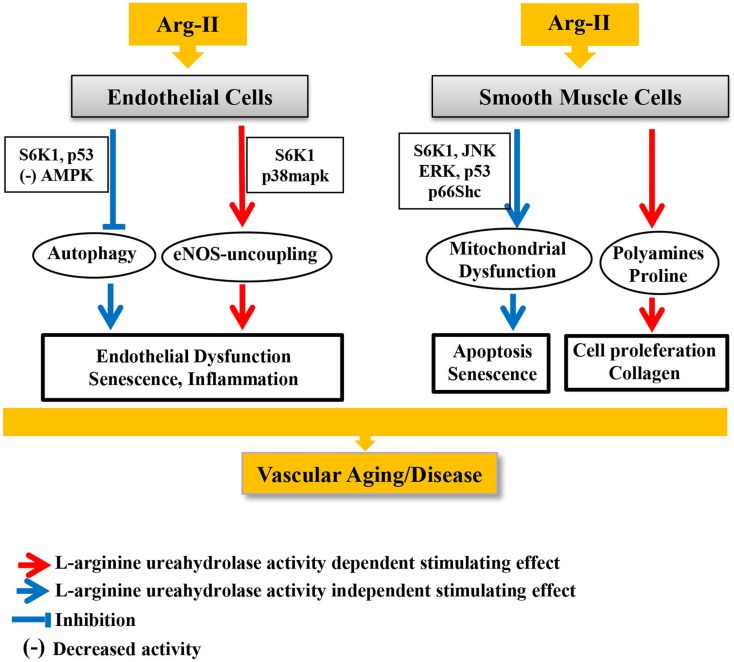
Verification
Claims the paper makes
The claims and statistics of this paper haven’t been checked yet.
Run the check — free, no account needed. It reads the open-access text and checks the sources it cites.
Claims other papers make about this one
Each is checked against this paper’s own text: does it say what the citing paper says it does?
In the citing paper
“ARG1 in myeloid cells mainly functions as an enzyme to hydrolyze arginine to produce ornithine as part of the urea cycle, which both promotes tissue repair through generation of polyamines and collagens, and also reduces nitric oxide production from inducible nitric oxide synthase through decreasing intracellular arginine availability (76–78).”
From Trem2 promotes anti-inflammatory responses in microglia and is suppressed under pro-inflammatory conditions (2020) · cites this paper as [76]
Self-check
Percentages, sums and reported differences re-computed from the paper’s own numbers.
The self-check needs the paper’s full text.
Citations
Cites
Atherosclerosis--an inflammatory disease
Ross, R. (1999) · New England Journal of Medicine · doi:10.1056/nejm199901143400207 · Cited by 21,725
Exploring the full spectrum of macrophage activation
Mosser, D. M., & Edwards, J. P. (2008) · Nature Reviews Immunology · doi:10.1038/nri2448 · Cited by 9,144 · cited 1×
“, macrophage plasticity, in response to specific signals as a consequence of adaptation to local tissue environmental cues (6, 7).”
BackgroundMacrophage plasticity and polarization: in vivo veritas
Sica, A., & Mantovani, A. (2012) · Journal of Clinical Investigation · doi:10.1172/jci59643 · Cited by 6,335
Inflammation and insulin resistance
Shoelson, S. E. (2006) · Journal of Clinical Investigation · doi:10.1172/jci29069 · Cited by 4,769
The M1 and M2 paradigm of macrophage activation: Time for reassessment
Martinez, F. O., & Gordon, S. (2014) · F1000Prime Reports · doi:10.12703/p6-13 · Cited by 4,689
Macrophage biology in development, homeostasis and disease
Wynn, T. A., Chawla, A., & Pollard, J. W. (2013) · Nature · doi:10.1038/nature12034 · Cited by 4,684 · cited 3×
“, macrophage plasticity, in response to specific signals as a consequence of adaptation to local tissue environmental cues (6, 7).”
BackgroundTumor-Associated Macrophages: From Mechanisms to Therapy
Noy, R., & Pollard, J. W. (2014) · Immunity · doi:10.1016/j.immuni.2014.06.010 · Cited by 4,089
M-1/M-2 Macrophages and the Th1/Th2 Paradigm
Mills, C. D., Kincaid, K., Alt, J. M., Heilman, M. J., & Hill, A. M. (2000) · The Journal of Immunology · doi:10.4049/jimmunol.164.12.6166 · Cited by 3,287 · cited 1×
“Later on, it was characterized that M1 macrophages are more easily activated by LPS to produce cytotoxic NO via iNOS, whereas M2 macrophages generate little NO but more ornithine from the same substrate l-arginine via arginase (15).”
BackgroundAlternative Activation of Macrophages: An Immunologic Functional Perspective
Martinez, F. O., Helming, L., & Gordon, S. (2009) · Annual Review of Immunology · doi:10.1146/annurev.immunol.021908.132532 · Cited by 2,745
Macrophages, inflammation, and insulin resistance
Olefsky, J. M., & Glass, C. K. (2010) · Annual Review of Physiology · doi:10.1146/annurev-physiol-021909-135846 · Cited by 2,733
Cited by
Sorted by citations
Arginase: A Multifaceted Enzyme Important in Health and Disease
Caldwell, R. W., Rodriguez, P. C., Toque, H. A., Narayanan, S. P., & Caldwell, R. B. (2018) · Physiological Reviews · doi:10.1152/physrev.00037.2016 · Cited by 495
“For instance, arginase-induced increases in polyamines and proline production can lead to thickening, fibrosis, and stiffening of blood vessels and airways, hypertrophy and fibrosis of the heart and kidneys, neurodegeneration, and growth of tumors (51, 127, 164, 238).”
BackgroundArginase: an old enzyme with new tricks
Caldwell, R. B., Toque, H. A., Narayanan, S. P., & Caldwell, R. W. (2015) · Trends in Pharmacological Sciences · doi:10.1016/j.tips.2015.03.006 · Cited by 358
Arginine and Endothelial Function
Gambardella, J., Khondkar, W., Morelli, M. B., Wang, X., Santulli, G., & Trimarco, V. (2020) · Biomedicines · doi:10.3390/biomedicines8080277 · Cited by 266
The PI3K/Akt Pathway in Meta-Inflammation
Acosta‐Martínez, M., & Cabail, M. Z. (2022) · International Journal of Molecular Sciences · doi:10.3390/ijms232315330 · Cited by 259
“Arginase 1 is one of the hallmarks of alternatively activated macrophages and contributes to the resolution of inflammation and tissue repair by degrading arginine and preventing the generation of cytotoxic nitric oxide [79].”
BackgroundToledo, B., Chen, L. Z., Paniagua-Sancho, M., Marchal, J. A., Perán, M., & Giovannetti, E. (2024) · Journal of Hematology & Oncology · doi:10.1186/s13045-024-01559-0 · Cited by 255
Metadata
- Authors
- Yang, Z., & Ming, X.-F.
- Affiliations
- University of Fribourg (CH)
- Corresponding author
- Yang, Zhihong
- Ming, Xiu-Fen
- Venue
- Frontiers in Immunology
- Publisher
- Frontiers Media SA
- Published
- 2014-10-27
- Volume
- 5
- Pages
- 533-533
- ISSN
- 1664-3224 (ISSN-L)
- PMC
- PMC4209887
- OpenAlex
- W2018261122
- Cited by
- 290
- References
- 107
- Citations by year
- 2026: 20 · 2025: 31 · 2024: 32 · 2023: 39 · 2022: 30 · 2021: 29 · 2020: 40 · 2019: 23 · 2018: 15 · 2017: 16 · 2016: 5 · 2015: 10
- FWCI
- 1.01
- Type
- journal article
- Language
- en
- Open access
- gold
- doi.org
- Licence
- cc-by
- Locations
- Frontiers in Immunology (publishedVersion, cc-by)
- Europe PMC (PubMed Central) (publishedVersion, cc-by)
- PubMed Central (publishedVersion, cc-by)
- PubMed (publishedVersion)
- DOAJ (DOAJ: Directory of Open Access Journals) (submittedVersion)
- Funders
- National Science Foundation (120435, 310030)
- Schweizerischer Nationalfonds zur Förderung der Wissenschaftlichen Forschung (310000-120435/1, 141070, 120435, 310000, 310030)
- Schweizerische Herzstiftung
- Topics
- Life Sciences › Immunology and Microbiology › Immunology › Immune cells in cancer
- Health Sciences › Medicine › Physiology (medical) › Nitric Oxide and Endothelin Effects
- Health Sciences › Medicine › Cardiology and Cardiovascular Medicine › Renin-Angiotensin System Studies
- Keywords
- macrophage polarization, M1/M2 macrophage phenotype, inducible nitric oxide synthase, macrophage inflammation, cardiovascular disease, metabolic disorders, obesity
About these checks
Registry, retraction, Cites and statistics results are computed, not judged, with one exception: a printed reference that no index lists is read once by a model before it counts as a citation error. Claims are extracted by a model and kept only when their quote appears verbatim in the text; each cited source is then checked, with a model’s help, for whether it says what the claim relies on. Those verdicts can be wrong — read the claim’s quote and the cited source before relying on one.
Statistics and arithmetic are recomputed, not judged.
Confidence bands are shown only for fields calibrated on our annotated test set. None is calibrated yet, so no band is shown.
What counts as a claim ›How we measure confidence ›How we check this ›
Are you an author, or do you see a problem with this page? Request a review
