

The DOI matches its Crossref record.
Human Mast Cell Tryptase Is a Potential Treatment for Snakebite Envenoming Across Multiple Snake Species
Overview
The claims and statistics of this paper haven’t been checked yet.
Run the check — free, no account needed. It reads the open-access text and checks the sources it cites.
Integrity signals
Registry
Cites
Statistics
Figures
Verification
Claims the paper makes
The claims and statistics of this paper haven’t been checked yet.
Run the check — free, no account needed. It reads the open-access text and checks the sources it cites.
Claims other papers make about this one
Each is checked against this paper’s own text: does it say what the citing paper says it does?
In the citing paper
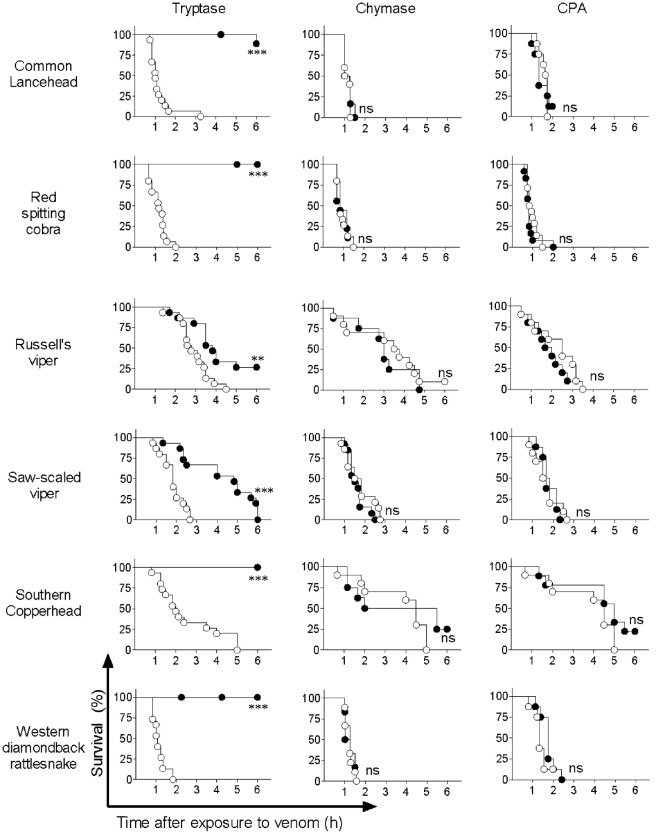
“Moreover, evidence derived from in vitro studies with embryonic zebra fish shows that human mast cell tryptase (but not human mast cell chymase or CPA3), can markedly reduce the toxicity of the venoms of six different poisonous snakes [84].”
From Mast cells and IgE in defense against lethality of venoms: Possible “benefit” of allergy (2020) · cites this paper as [84]
In the citing paper
“Indeed, a recent study of human mast cell-derived proteases shows that tryptase (rather than chymase or CPA3) is more important at reducing the toxicity of the venoms of six different poisonous snakes, when embryonic zebra fish are used to assess such toxicity in vitro [84].”
From Mast cells and IgE in defense against lethality of venoms: Possible “benefit” of allergy (2020) · cites this paper as [84]
Self-check
Percentages, sums and reported differences re-computed from the paper’s own numbers.
The self-check needs the paper’s full text.
Citations
Cites
No references could be resolved yet.
Research works printed but not linked: 35
- Kasturiratne, 2008, The global burden of snakebite: a literature analysis and modelling based on regional estimates of envenoming and deaths, PLoS Med, 5, e218, 10.1371/journal.pmed.0050218 · DOI
- Chippaux, 1998, Snake-bites: appraisal of the global situation, Bull World Health Organ, 76, 515
- Warrell, 2010, Snake bite, Lancet, 375, 77, 10.1016/S0140-6736(09)61754-2 · DOI
- Williams, 2010, The global snake bite initiative: an antidote for snake bite, Lancet, 375, 89, 10.1016/S0140-6736(09)61159-4 · DOI
- Kasturiratne, 2017, The socio-economic burden of snakebite in Sri Lanka, PLoS Negl Trop Dis, 11, e0005647, 10.1371/journal.pntd.0005647 · DOI
- 2017, Snake-bite envenoming: a priority neglected tropical disease, Lancet, 390, 2, 10.1016/S0140-6736(17)31751-8 · DOI
- Williams, 2011, Ending the drought: new strategies for improving the flow of affordable, effective antivenoms in Asia and Africa, J Proteomics, 74, 1735, 10.1016/j.jprot.2011.05.027 · DOI
- de Silva, 2011, Low-dose adrenaline, promethazine, and hydrocortisone in the prevention of acute adverse reactions to antivenom following snakebite: a randomised, double-blind, placebo-controlled trial, PLoS Med, 8, e1000435, 10.1371/journal.pmed.1000435 · DOI
- Stone, 2013, Immune response to snake envenoming and treatment with antivenom; complement activation, cytokine production and mast cell degranulation, PLoS Negl Trop Dis, 7, e2326, 10.1371/journal.pntd.0002326 · DOI
- de Silva, 2016, Adverse reactions to snake antivenom, and their prevention and treatment, Br J Clin Pharmacol, 81, 446, 10.1111/bcp.12739 · DOI
- Vongphoumy, 2016, Prospective, consecutive case series of 158 snakebite patients treated at Savannakhet provincial hospital, Lao People’s Democratic Republic with high incidence of anaphylactic shock to horse derived F(ab′)2 antivenom, Toxicon, 117, 13, 10.1016/j.toxicon.2016.03.011 · DOI
- Metz, 2006, Mast cells can enhance resistance to snake and honeybee venoms, Science, 313, 526, 10.1126/science.1128877 · DOI · Paper page
- Schneider, 2007, Molecular mechanism of mast cell mediated innate defense against endothelin and snake venom sarafotoxin, J Exp Med, 204, 2629, 10.1084/jem.20071262 · DOI · Paper page
- Akahoshi, 2011, Mast cell chymase reduces the toxicity of Gila monster venom, Scorpion venom, and vasoactive intestinal polypeptide in mice, J Clin Invest, 121, 4180, 10.1172/JCI46139 · DOI · Paper page
- Kirshenbaum, 2003, Characterization of novel stem cell factor responsive human mast cell lines LAD 1 and 2 established from a patient with mast cell sarcoma/leukemia; activation following aggregation of FcepsilonRI or FcgammaRI, Leuk Res, 27, 677, 10.1016/S0145-2126(02)00343-0 · DOI
- Babina, 2001, Retinoic acid up-regulates myeloid ICAM-3 expression and function in a cell-specific fashion – evidence for retinoid signaling pathways in the mast cell lineage, J Leukoc Biol, 69, 361, 10.1189/jlb.69.3.361 · DOI
- Vukman, 2012, Mast cells cultured from IL-3-treated mice show impaired responses to bacterial antigen stimulation, Inflamm Res, 61, 79, 10.1007/s00011-011-0394-6 · DOI
- Bahri, 2018, Mast cell activation test in the diagnosis of allergic disease and anaphylaxis, J Allergy Clin Immunol, 10.1016/j.jaci.2018.01.043 · DOI
- Tsvilovskyy, 2018, Deletion of Orai2 augments endogenous CRAC currents and degranulation in mast cells leading to enhanced anaphylaxis, Cell Calcium, 71, 24, 10.1016/j.ceca.2017.11.004 · DOI
- Niles, 1998, Recombinant human mast cell tryptase beta: stable expression in Pichia pastoris and purification of fully active enzyme, Biotechnol Appl Biochem, 28, 125, 10.1111/j.1470-8744.1998.tb00522.x · DOI
- Schaschke, 2005, Affinity chromatography of tryptases: design, synthesis and characterization of a novel matrix-bound bivalent inhibitor, Chembiochem, 6, 95, 10.1002/cbic.200400217 · DOI
- Schaschke, 2001, Bivalent inhibition of human beta-tryptase, Chem Biol, 8, 313, 10.1016/S1074-5521(01)00011-4 · DOI
- Kolarich, 2012, Determination of site-specific glycan heterogeneity on glycoproteins, Nat Protoc, 7, 1285, 10.1038/nprot.2012.062 · DOI
- Seifert, 2009, AAPCC database characterization of native U.S. Venomous snake exposures, 2001-2005, Clin Toxicol (Phila), 47, 327, 10.1080/15563650902870277 · DOI
- Alirol, 2010, Snake bite in South Asia: a review, PLoS Negl Trop Dis, 4, e603, 10.1371/journal.pntd.0000603 · DOI
- Segura, 2010, Preclinical assessment of the neutralizing capacity of antivenoms produced in six Latin American countries against medically-relevant Bothrops snake venoms, Toxicon, 56, 980, 10.1016/j.toxicon.2010.07.001 · DOI
- Guhl, 2010, Mast cell lines HMC-1 and LAD2 in comparison with mature human skin mast cells – drastically reduced levels of tryptase and chymase in mast cell lines, Exp Dermatol, 19, 845, 10.1111/j.1600-0625.2010.01103.x · DOI
- 2010, WHO Guidelines for the Production, Control and Regulation of Snake Antivenom Immunoglobulins
- Metz, 2007, Mast cells in the promotion and limitation of chronic inflammation, Immunol Rev, 217, 304, 10.1111/j.1600-065X.2007.00520.x · DOI
- Du, 2002, Snake venom L-amino acid oxidases, Toxicon, 40, 659, 10.1016/S0041-0101(02)00157-5 · DOI
- Gutierrez, 2014, A multicomponent strategy to improve the availability of antivenom for treating snakebite envenoming, Bull World Health Organ, 92, 526, 10.2471/BLT.13.132431 · DOI
- Weber, 2003, Pattern analysis of human cutaneous mast cell populations by total body surface mapping, Br J Dermatol, 148, 224, 10.1046/j.1365-2133.2003.05090.x · DOI
- Sommerhoff, 1999, The structure of the human betaII-tryptase tetramer: fo(u)r better or worse, Proc Natl Acad Sci U S A, 96, 10984, 10.1073/pnas.96.20.10984 · DOI
- Gutierrez, 2000, Snake venom metalloproteinases: their role in the pathogenesis of local tissue damage, Biochimie, 82, 841, 10.1016/S0300-9084(00)01163-9 · DOI
- Sommerhoff, 2000, The human mast cell tryptase tetramer: a fascinating riddle solved by structure, Biochim Biophys Acta, 1477, 75, 10.1016/S0167-4838(99)00265-4 · DOI
Cited by
Sorted by citations
Mast cells and IgE in defense against lethality of venoms: Possible “benefit” of allergy
Galli, S. J., Metz, M., Starkl, P., Marichal, T., & Tsai, M. (2020) · Allergo Journal International · doi:10.1007/s40629-020-00118-6 · Cited by 57
Self-citation
Metadata
- Authors
- Anderson, E., Stavenhagen, K., Kolarich, D., Sommerhoff, C. P., Maurer, M., & Metz, M.
- Venue
- Frontiers in Immunology
- Publisher
- Frontiers Media SA
- Published
- 2018-07-09
- Volume
- 9
- ISSN
- 1664-3224
- PMC
- PMC6047305
- Cited by
- 30
- References
- 0
- Funders
- Deutsche Forschungsgemeinschaft (ME 2668/3-2, ME 2668/2-1, SO 249/1-1)
- Else Kröner-Fresenius-Stiftung
- Max-Planck-Gesellschaft
About these checks
Registry, retraction, Cites and statistics results are computed, not judged, with one exception: a printed reference that no index lists is read once by a model before it counts as a citation error. Claims are extracted by a model and kept only when their quote appears verbatim in the text; each cited source is then checked, with a model’s help, for whether it says what the claim relies on. Those verdicts can be wrong — read the claim’s quote and the cited source before relying on one.
Statistics and arithmetic are recomputed, not judged.
Confidence bands are shown only for fields calibrated on our annotated test set. None is calibrated yet, so no band is shown.
What counts as a claim ›How we measure confidence ›How we check this ›
Are you an author, or do you see a problem with this page? Request a review
