

The DOI matches its Crossref record.
Molecular mechanism of mast cell–mediated innate defense against endothelin and snake venom sarafotoxin
Abstract
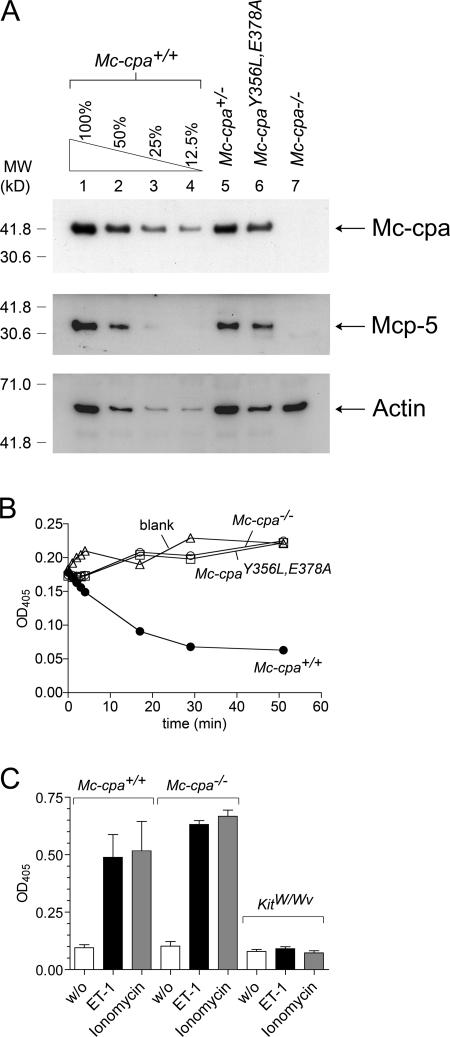
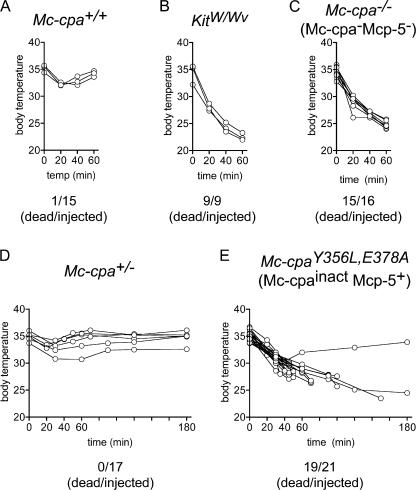
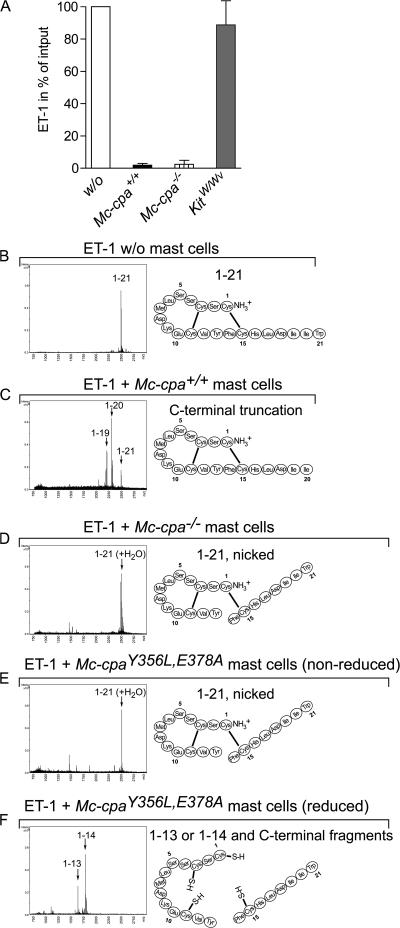
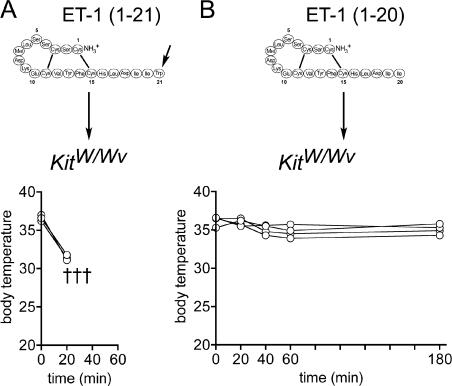
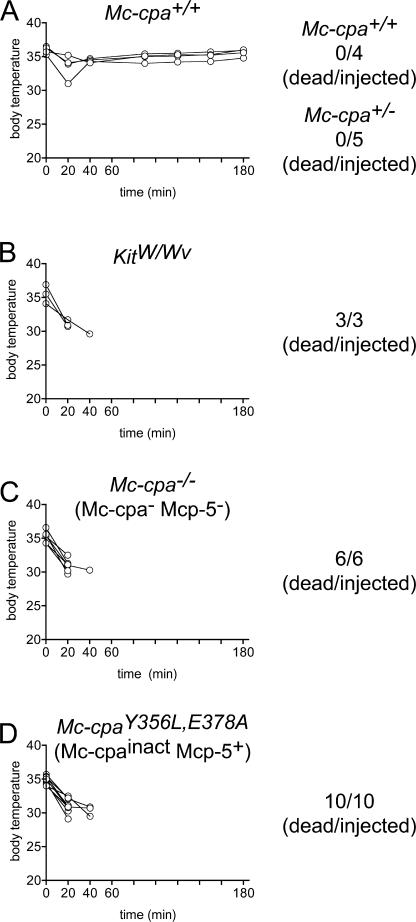
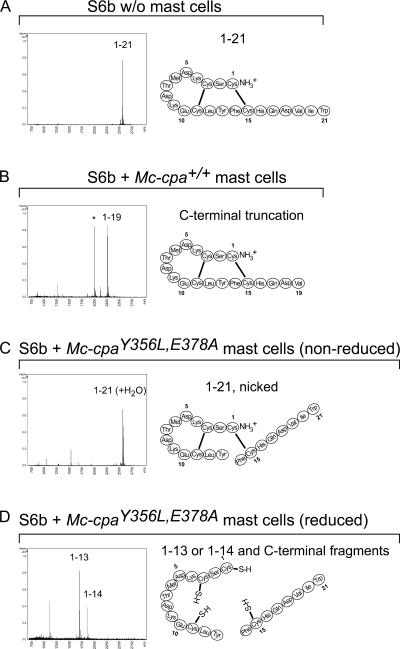
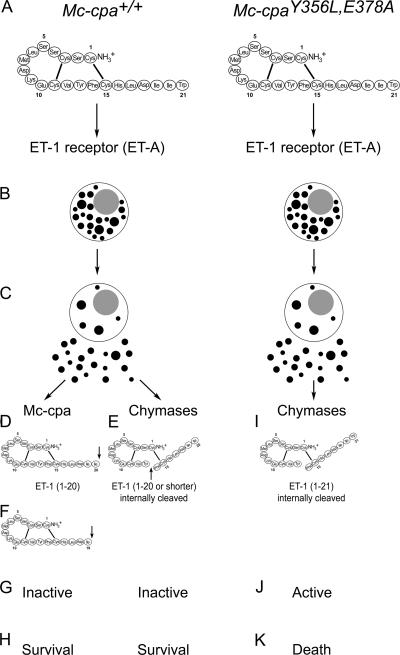
Mast cells are protective against snake venom sarafotoxins that belong to the endothelin (ET) peptide family. The molecular mechanism underlying this recently recognized innate defense pathway is unknown, but secretory granule proteases have been invoked. To specifically disrupt a single protease function without affecting expression of other proteases, we have generated a mouse mutant selectively lacking mast cell carboxypeptidase A (Mc-cpa) activity. Using this mutant, we have now identified Mc-cpa as the essential protective mast cell enzyme. Mass spectrometry of peptide substrates after cleavage by normal or mutant mast cells showed that removal of a single amino acid, the C-terminal tryptophan, from ET and sarafotoxin by Mc-cpa is the principle molecular mechanism underlying this very rapid mast cell response. Mast cell proteases can also cleave ET and sarafotoxin internally, but such “nicking” is not protective because intramolecular disulfide bridges maintain peptide function. We conclude that mast cells attack ET and sarafotoxin exactly at the structure required for toxicity, and hence sarafotoxins could not “evade” Mc-cpa's substrate specificity without loss of toxicity.
Overview
The claims and statistics of this paper haven’t been checked yet.
Run the check — free, no account needed. It reads the open-access text and checks the sources it cites.
Integrity signals
Registry
Cites
Statistics
Figures
Verification
Claims the paper makes
The claims and statistics of this paper haven’t been checked yet.
Run the check — free, no account needed. It reads the open-access text and checks the sources it cites.
Claims other papers make about this one
Each is checked against this paper’s own text: does it say what the citing paper says it does?
In the citing paper
“However, later work by our group, employing both pharmacological approaches and shRNA knock down of CPA3 in adoptively-transferred mast cells [15], as well as elegant studies by Schneider et al., who exploited a mouse they created which expressed only a catalytically inactive CPA3 [81], indicated that CPA3 is the key mast cell-derived protease that detoxifies both ET-1 and sarafotoxin 6b.”
From Mast cells and IgE in defense against lethality of venoms: Possible “benefit” of allergy (2020) · cites this paper as [81]
Self-check
Percentages, sums and reported differences re-computed from the paper’s own numbers.
The self-check needs the paper’s full text.
Citations
Cites
No references could be resolved yet.
Research works printed but not linked: 44
- 1996, Nature., 381, 75, 10.1038/381075a0 · DOI
- 1996, Nature., 381, 77, 10.1038/381077a0 · DOI
- 1999, Br. Med. Bull., 55, 30, 10.1258/0007142991902286 · DOI
- 2000, Eur. J. Pharmacol., 407, 1, 10.1016/S0014-2999(00)00675-0 · DOI
- 2003, Can. J. Physiol. Pharmacol., 81, 635, 10.1139/y03-050 · DOI
- 1995, N. Engl. J. Med., 333, 356, 10.1056/NEJM199508103330607 · DOI
- 1990, J. Exp. Med., 172, 1741, 10.1084/jem.172.6.1741 · DOI
- 1996, Crit. Care Med., 24, 721, 10.1097/00003246-199604000-00033 · DOI
- 2004, Eur. J. Immunol., 34, 1910, 10.1002/eji.200424912 · DOI
- 2004, Nature., 432, 512, 10.1038/nature03085 · DOI · Paper page
- 2006, Science., 313, 526, 10.1126/science.1128877 · DOI · Paper page
- 1998, J. Clin. Immunol., 18, 169, 10.1023/A:1020574820797 · DOI
- 2002, Mol. Immunol., 38, 1353, 10.1016/S0161-5890(02)00087-1 · DOI
- 2006, FEBS J., 273, 1871, 10.1111/j.1742-4658.2006.05211.x · DOI
- 2005, Mol. Cell. Biol., 25, 6199, 10.1128/MCB.25.14.6199-6210.2005 · DOI
- 2004, J. Biol. Chem., 279, 40897, 10.1074/jbc.M405856200 · DOI
- 1996, FASEB J., 10, 1307
- 1987, J. Immunol., 139, 3771, 10.4049/jimmunol.139.11.3771 · DOI
- 2004, Biochem. J., 379, 217, 10.1042/bj20031230 · DOI
- 1989, J. Biol. Chem., 264, 20094, 10.1016/S0021-9258(19)47223-2 · DOI
- 2002, J. Biol. Chem., 277, 18579, 10.1074/jbc.M110356200 · DOI
- 2001, Cell. Mol. Life Sci., 58, 1790, 10.1007/PL00000819 · DOI
- 1998, Biochemistry., 37, 16555, 10.1021/bi981678i · DOI
- 2001, Biochemistry., 40, 10197, 10.1021/bi010807j · DOI
- 1978, Blood., 52, 447, 10.1182/blood.V52.2.447.447 · DOI · Paper page
- 1990, Proc. Natl. Acad. Sci. USA., 87, 4702, 10.1073/pnas.87.12.4702 · DOI
- 2002, Arterioscler. Thromb. Vasc. Biol., 22, 268, 10.1161/hq0202.103994 · DOI
- 2005, Trends Immunol., 26, 235, 10.1016/j.it.2005.03.007 · DOI
- 1988, Science., 242, 268, 10.1126/science.2845579 · DOI
- 2000, J. Exp. Med., 192, 1849, 10.1084/jem.192.12.1849 · DOI · Paper page
- 2006, Nat. Med., 12, 999, 10.1038/nm0906-999 · DOI
- 1988, Biochem. Biophys. Res. Commun., 156, 1182, 10.1016/S0006-291X(88)80757-5 · DOI
- 2000, Biophys. J., 79, 3083, 10.1016/S0006-3495(00)76543-X · DOI
- 1995, Eur. J. Surg., 161, 9
- 2000, Biochim. Biophys. Acta., 1501, 211, 10.1016/S0925-4439(00)00025-9 · DOI
- 2002, Shock., 18, 415, 10.1097/00024382-200211000-00005 · DOI
- 2004, J. Perinat. Med., 32, 522
- 1989, Neuropeptides., 14, 231, 10.1016/0143-4179(89)90051-6 · DOI
- 1998, Gut., 42, 696, 10.1136/gut.42.5.696 · DOI
- 2000, Life Sci., 67, 1947, 10.1016/S0024-3205(00)00783-9 · DOI
- 2004, Blood., 104, 1688
- 2000, Nucleic Acids Res., 28, E78, 10.1093/nar/28.16.e78 · DOI
- 2002, Biol. Chem., 383, 793
- 1994, Nat. Struct. Biol., 1, 311, 10.1038/nsb0594-311 · DOI
Cited by
Sorted by citations
Galli, S. J., Borregaard, N., & Wynn, T. A. (2011) · Nature Immunology · doi:10.1038/ni.2109 · Cited by 1,055
Galli, S. J., & Tsai, M. (2010) · European Journal of Immunology · doi:10.1002/eji.201040559 · Cited by 403
Widespread Immunological Functions of Mast Cells: Fact or Fiction?
Rodewald, H.-R., & Feyerabend, T. B. (2012) · Immunity · doi:10.1016/j.immuni.2012.07.007 · Cited by 240
Self-citationMast cells and IgE in defense against venoms: Possible “good side” of allergy?
Galli, S. J., Starkl, P., Marichal, T., & Tsai, M. (2016) · Allergology International · doi:10.1016/j.alit.2015.09.002 · Cited by 73
Mast cells and IgE in defense against lethality of venoms: Possible “benefit” of allergy
Galli, S. J., Metz, M., Starkl, P., Marichal, T., & Tsai, M. (2020) · Allergo Journal International · doi:10.1007/s40629-020-00118-6 · Cited by 57
Metadata
- Authors
- Schneider, L. A., Schlenner, S. M., Feyerabend, T. B., Wunderlin, M., & Rodewald, H.-R.
- Venue
- The Journal of Experimental Medicine
- Publisher
- Rockefeller University Press
- Published
- 2007-10-08
- Volume
- 204
- Issue
- 11
- Pages
- 2629-2639
- ISSN
- 1540-9538
- 0022-1007
- PMC
- PMC2118486
- Cited by
- 145
- References
- 0
- Language
- en
About these checks
Registry, retraction, Cites and statistics results are computed, not judged, with one exception: a printed reference that no index lists is read once by a model before it counts as a citation error. Claims are extracted by a model and kept only when their quote appears verbatim in the text; each cited source is then checked, with a model’s help, for whether it says what the claim relies on. Those verdicts can be wrong — read the claim’s quote and the cited source before relying on one.
Statistics and arithmetic are recomputed, not judged.
Confidence bands are shown only for fields calibrated on our annotated test set. None is calibrated yet, so no band is shown.
What counts as a claim ›How we measure confidence ›How we check this ›
Are you an author, or do you see a problem with this page? Request a review
How to cite
Cite CoChat for the checks on this page, and the paper for its own findings.
- This page
- CoChat. (2026). Citation check: Molecular mechanism of mast cell–mediated innate defense against endothelin and snake venom sarafotoxin. https://app.cochat.ai/papers/10.1084/jem.20071262
- The paper
- Schneider, L. A., Schlenner, S. M., Feyerabend, T. B., Wunderlin, M., & Rodewald, H.-R. (2007). Molecular mechanism of mast cell–mediated innate defense against endothelin and snake venom sarafotoxin. The Journal of Experimental Medicine. https://doi.org/10.1084/jem.20071262
