

The DOI matches its Crossref record; 445 of the 446 references it cites were found in a registry or an index, and 1 are not checked yet.
Immunomodulatory Role of the Extracellular Matrix Within the Liver Disease Microenvironment
Open accessAbstract
Chronic liver disease when accompanied by underlying fibrosis, is characterised by an accumulation of extracellular matrix (ECM) proteins and chronic inflammation. Although traditionally considered as a passive and largely architectural structure, the ECM is now being recognised as a source of potent DAMPs with immune-active peptides and domains. In parallel, the ECM anchors a range of cytokines, chemokines and growth factors, all of which are capable of modulating the immune responses. A growing body of evidence shows that ECM proteins themselves are capable of interacting both directly, via a wide range of receptors including integrins and TLRs, and indirectly with immune cells. ECM deposition and remodelling during fibrosis can result in release or formation of ECM-DAMPs, which can drive immune cellular infiltration and sterile inflammation. Both the ECM and immune response are interlinked and integral in driving fibrosis, although their precise interactions in the context of chronic liver disease are poorly understood. This review aims to shed light on the ECM-immune interactions underlying liver disease, in particular fibrosis of different aetiologies, by describing the main ECM intact proteins and ECM-DAMPs with known immune regulatory activity. We also discuss how tissue engineering could provide new opportunities to explore ECM-immune cell interactions in bioreactor-based dynamic 3D models containing intact decellularized ECM scaffolds. A better understanding of these interactions would aid in the identification of new antifibrotic and immunomodulatory targets for treatment and biomarkers in liver disease.
Overview
The claims and statistics of this paper haven’t been checked yet.
Run the check — free, no account needed. It reads the open-access text and checks the sources it cites.
Integrity signals
Registry
Cites
Statistics
Figures
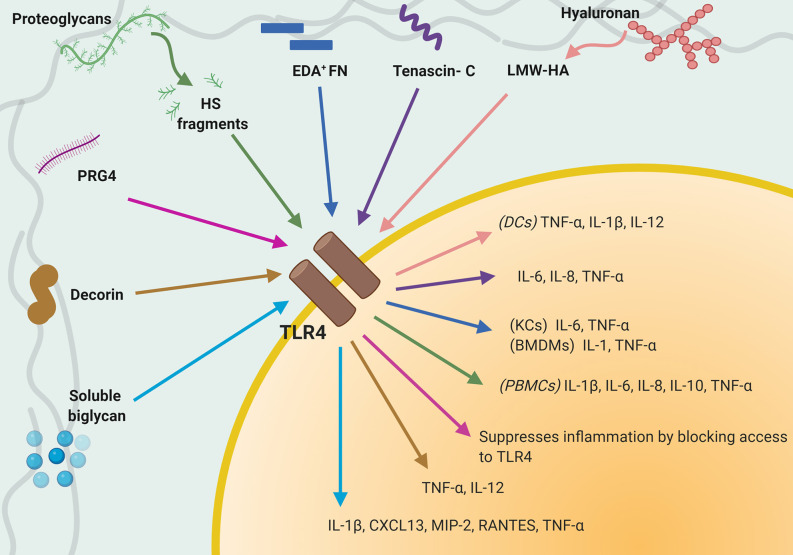
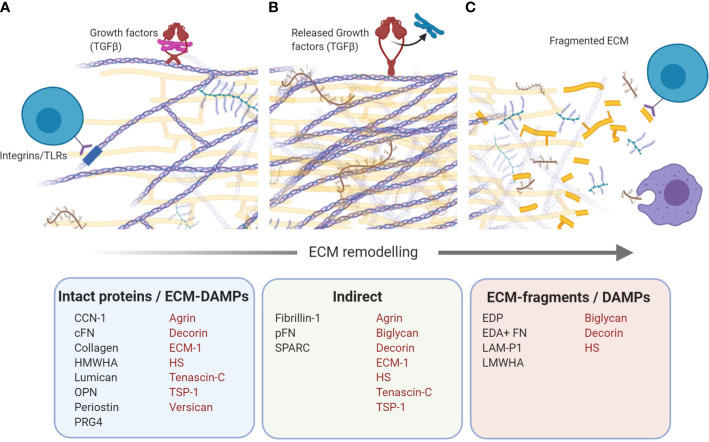
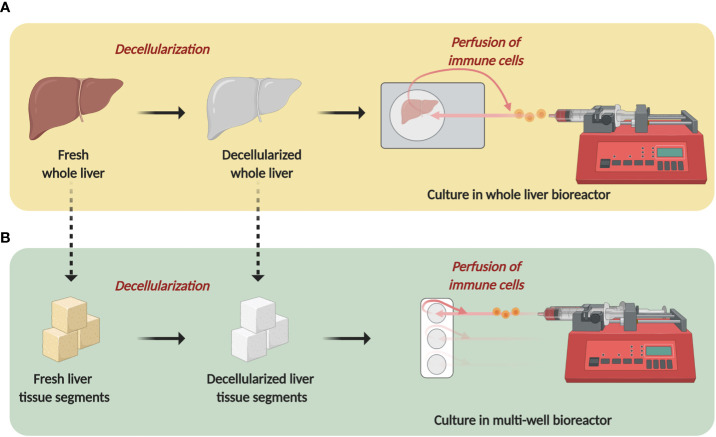
Verification
Claims the paper makes
The claims and statistics of this paper haven’t been checked yet.
Run the check — free, no account needed. It reads the open-access text and checks the sources it cites.
Claims other papers make about this one
Each is checked against this paper’s own text: does it say what the citing paper says it does?
The source backs part of the claim, not all of it — or backs it for a different population, condition or comparison.
In the citing paper
“In contrast to HMWHAs, low molecular weight hyaluronic acids (LMWHAs) are released during ECM damage or degradation, which act as DAMPs and drive inflammatory responses such as enhancing immune cells chemotaxis, DCs maturation, and M1 polarization of macrophages via the same receptors (CD44 and TLRs) [63, 100].”
From Immunogenicity of decellularized extracellular matrix scaffolds: a bottleneck in tissue engineering and regenerative medicine (2023) · cites this paper as [100]
Experimental — accuracy not yet measuredThe source backs part of the claim, not all of it — or backs it for a different population, condition or comparison.
In the citing paper
“Activation of these receptors accompanies a decrease in DC maturation and promotion in the polarization of macrophages toward M2 phenotype besides differentiation of T cells into regulatory phenotype and induction of apoptosis in activated T cells.”
From Immunogenicity of decellularized extracellular matrix scaffolds: a bottleneck in tissue engineering and regenerative medicine (2023) · cites this paper as [100]
Experimental — accuracy not yet measuredThe source backs part of the claim, not all of it — or backs it for a different population, condition or comparison.
In the citing paper
“Immunomodulatory traits of dECM scaffolds are largely attributed to the ability of their collagens to trigger leukocyte-associated immunoglobulin-like receptors-1 (LAIR-1) of immune cells and consequently downregulation of immune cell activity [100].”
From Immunogenicity of decellularized extracellular matrix scaffolds: a bottleneck in tissue engineering and regenerative medicine (2023) · cites this paper as [100]
Experimental — accuracy not yet measuredThe source backs part of the claim, not all of it — or backs it for a different population, condition or comparison.
In the citing paper
“In another example, high molecular weight hyaluronic acids (HMWHAs), well-known GAGs of dECM, exert anti-inflammatory effects by impeding antigen-antibody interaction and triggering toll-like receptors (TLRs), a subgroup of PRRs, and CD44 receptors of innate and adaptive immune cells.”
From Immunogenicity of decellularized extracellular matrix scaffolds: a bottleneck in tissue engineering and regenerative medicine (2023) · cites this paper as [100]
Experimental — accuracy not yet measuredThe cited source says what the claim attributes to it.
In the citing paper
“ECM is a reservoir for the cryptic particles that activate or suppress inflammation and orchestrates innate and adaptive immune responses [100, 101].”
From Immunogenicity of decellularized extracellular matrix scaffolds: a bottleneck in tissue engineering and regenerative medicine (2023) · cites this paper as [100]
The check wasn’t confident either way, so it gives no verdict — never disputed.
In the citing paper
“For instance, harsh decellularization procedures may unveil certain cryptic helical and terminal antigenic sites of collagen, prompting the initiation of antibody production against the ECM [73].”
From Liver tissue engineering using decellularized scaffolds: Current progress, challenges, and opportunities (2024) · cites this paper as [73]
Experimental — accuracy not yet measured
Self-check
Percentages, sums and reported differences re-computed from the paper’s own numbers.
The self-check needs the paper’s full text.
Citations
Cites
Molecular Mechanisms of Stress-Responsive Changes in Collagen and Elastin Networks in Skin
Aziz, J., Shezali, H., Radzi, Z., Yahya, N. A., Abu Kassim, N. H., Czernuszka, J., & Rahman, M. T. (2016) · Skin Pharmacology and Physiology · doi:10.1159/000447017 · Cited by 7,323
Cellular senescence: when bad things happen to good cells
Campisi, J., & d'Adda di Fagagna, F. (2007) · Nature Reviews Molecular Cell Biology · doi:10.1038/nrm2233 · Cited by 4,441
Mechanisms of hepatic stellate cell activation
Tsuchida, T., & Friedman, S. L. (2017) · Nature Reviews Gastroenterology & Hepatology · doi:10.1038/nrgastro.2017.38 · Cited by 2,909
A complex secretory program orchestrated by the inflammasome controls paracrine senescence
Acosta, J. C., Banito, A., Wuestefeld, T., Georgilis, A., Janich, P., Morton, J. P., Athineos, D., Kang, T.-W., Lasitschka, F., Andrulis, M., et al. (2013) · Nature Cell Biology · doi:10.1038/ncb2784 · Cited by 2,278
Munger, J. S., Huang, X., Kawakatsu, H., Griffiths, M. J. D., Dalton, S. L., Wu, J., Pittet, J.-F., Kaminski, N., Garat, C., Matthay, M. A., et al. (1999) · Cell · doi:10.1016/s0092-8674(00)80545-0 · Cited by 2,076
Senescence of Activated Stellate Cells Limits Liver Fibrosis
Krizhanovsky, V., Yon, M., Dickins, R. A., Hearn, S., Simon, J., Miething, C., Yee, H., Zender, L., & Lowe, S. W. (2008) · Cell · doi:10.1016/j.cell.2008.09.015 · Cited by 2,027
T-helper Type 2–driven Inflammation Defines Major Subphenotypes of Asthma
Woodruff, P. G., Modrek, B., Choy, D. F., Jia, G., Abbas, A. R., Ellwanger, A., Arron, J. R., Koth, L. L., & Fahy, J. V. (2009) · American Journal of Respiratory and Critical Care Medicine · doi:10.1164/rccm.200903-0392oc · Cited by 1,832
Pathogenesis of Liver Fibrosis
Hernandez-Gea, V., & Friedman, S. L. (2011) · Annual Review of Pathology: Mechanisms of Disease · doi:10.1146/annurev-pathol-011110-130246 · Cited by 1,809
Making sense of latent TGFβ activation
Annes, J. P., Munger, J. S., & Rifkin, D. B. (2002) · Journal of Cell Science · doi:10.1242/jcs.00229 · Cited by 1,624
Mechanobiology of YAP and TAZ in physiology and disease
Panciera, T., Azzolin, L., Cordenonsi, M., & Piccolo, S. (2017) · Nature Reviews Molecular Cell Biology · doi:10.1038/nrm.2017.87 · Cited by 1,461
Cited by
Sorted by citations
Fibroblasts: Origins, definitions, and functions in health and disease
Plikus, M. V., Wang, X., Sinha, S., Forte, E., Thompson, S. M., Herzog, E. L., Driskell, R. R., Rosenthal, N. A., Biernaskie, J. A., & Horsley, V. (2021) · Cell · doi:10.1016/j.cell.2021.06.024 · Cited by 1,247
The extracellular matrix and the immune system: A mutually dependent relationship
Sutherland, T. E., Dyer, D. P., & Allen, J. E. (2023) · Science · doi:10.1126/science.abp8964 · Cited by 519
Kasravi, M., Ahmadi, A., Babajani, A., Mazloomnejad, R., Hatamnejad, M. R., Shariatzadeh, S., Bahrami, S., & Niknejad, H. (2023) · Biomaterials Research · doi:10.1186/s40824-023-00348-z · Cited by 316
Bhattacharya, M., & Ramachandran, P. (2023) · Nature Immunology · doi:10.1038/s41590-023-01551-9 · Cited by 148
The Role of Epithelial Damage in the Pulmonary Immune Response
Burgoyne, R. A., Fisher, A. J., & Borthwick, L. A. (2021) · Cells · doi:10.3390/cells10102763 · Cited by 153
Metadata
- Authors
- McQuitty, C. E., Williams, R., Chokshi, S., & Urbani, L.
- Affiliations
- King's College London (GB)
- Corresponding author
- Urbani, Luca
- Venue
- Frontiers in Immunology
- Publisher
- Frontiers Media SA
- Published
- 2020-11-11
- Volume
- 11
- Pages
- 574276-574276
- ISSN
- 1664-3224 (ISSN-L)
- PMC
- PMC7686550
- OpenAlex
- W3098031338
- Cited by
- 146
- References
- 446
- Citations by year
- 2026: 23 · 2025: 22 · 2024: 34 · 2023: 31 · 2022: 19 · 2021: 17
- FWCI
- 2.23
- Type
- journal article
- Language
- en
- Open access
- gold
- doi.org
- Licence
- Locations
- Frontiers in Immunology (publishedVersion, cc-by)
- PubMed Central (publishedVersion, cc-by)
- PubMed (publishedVersion)
- DOAJ (DOAJ: Directory of Open Access Journals) (submittedVersion, cc-by-sa)
- Topics
- Health Sciences › Medicine › Hepatology › Liver physiology and pathology
- Health Sciences › Medicine › Hepatology › Liver Diseases and Immunity
- Health Sciences › Medicine › Surgery › Tissue Engineering and Regenerative Medicine
- Keywords
- extracellular matrix, chronic liver disease, liver fibrosis, damage-associated molecular patterns, sterile inflammation, integrins, TLRs, immune cell infiltration, tissue engineering, biomarkers
- MeSH terms
- Anti-Inflammatory Agents, Extracellular Matrix, Humans, Inflammation, Liver, Liver Cirrhosis, Liver Diseases, Cytokines, Extracellular Matrix Proteins, Immunomodulation
About these checks
Registry, retraction, Cites and statistics results are computed, not judged, with one exception: a printed reference that no index lists is read once by a model before it counts as a citation error. Claims are extracted by a model and kept only when their quote appears verbatim in the text; each cited source is then checked, with a model’s help, for whether it says what the claim relies on. Those verdicts can be wrong — read the claim’s quote and the cited source before relying on one.
Statistics and arithmetic are recomputed, not judged.
Confidence bands are shown only for fields calibrated on our annotated test set. None is calibrated yet, so no band is shown.
What counts as a claim ›How we measure confidence ›How we check this ›
Are you an author, or do you see a problem with this page? Request a review
