

Role of MCP-1 as an inflammatory biomarker in nephropathy
Open accessThe DOI matches its Crossref record; 81 of the 81 references it cites were found in a registry or an index.
Abstract
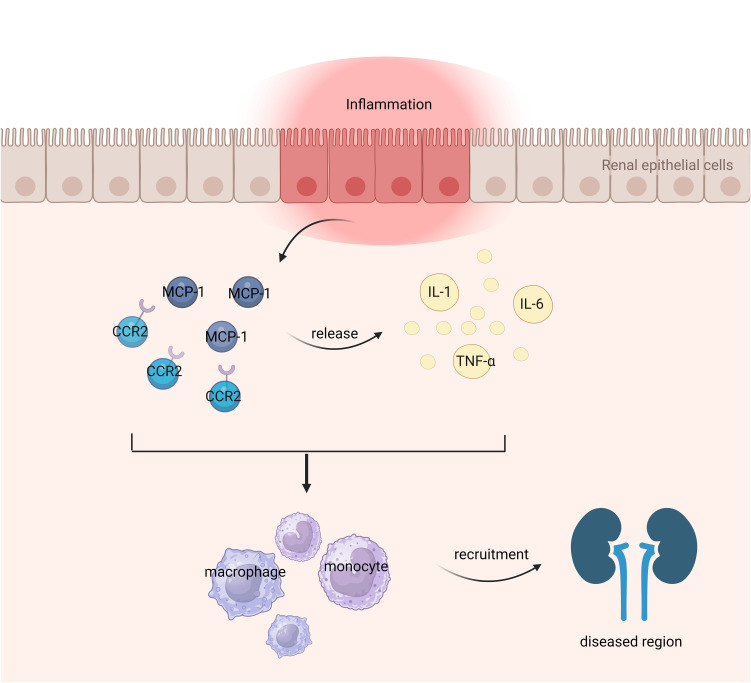
The Monocyte chemoattractant protein-1 (MCP-1), also referred to as chemokine ligand 2 (CCL2), belongs to the extensive chemokine family and serves as a crucial mediator of innate immunity and tissue inflammation. It has a notable impact on inflammatory conditions affecting the kidneys. Upon binding to its receptor, MCP-1 can induce lymphocytes and NK cells’ homing, migration, activation, differentiation, and development while promoting monocytes’ and macrophages’ infiltration, thereby facilitating kidney disease-related inflammation. As a biomarker for kidney disease, MCP-1 has made notable advancements in primary kidney diseases such as crescentic glomerulonephritis, chronic glomerulonephritis, primary glomerulopathy, idiopathic proteinuria glomerulopathy, acute kidney injury; secondary kidney diseases like diabetic nephropathy and lupus nephritis; hereditary kidney diseases including autosomal dominant polycystic kidney disease and sickle cell kidney disease. MCP-1 not only predicts the occurrence, progression, prognosis of the disease but is also closely associated with the severity and stage of nephropathy. When renal tissue is stimulated or experiences significant damage, the expression of MCP-1 increases, demonstrating a direct correlation with the severity of renal injury.
Overview
The claims and statistics of this paper haven’t been checked yet.
Free: it reads the open-access text and checks the first 5 claims that cite a source we can check. Create a free account to check every claim.
Integrity signals
Registry
Cites
Statistics
Figures
Verification
Claims the paper makes
The claims and statistics of this paper haven’t been checked yet.
Free: it reads the open-access text and checks the first 5 claims that cite a source we can check. Create a free account to check every claim.
Self-check
Percentages, sums and reported differences re-computed from the paper’s own numbers.
The self-check needs the paper’s full text.
Citations
Cites
A guide to chemokines and their receptors
Hughes, C. E., & Nibbs, R. J. B. (2018) · The FEBS Journal · doi:10.1111/febs.14466 · Cited by 1,412 · cited 1×
“They play a crucial role in the migration of innate and adaptive immune cells and are closely associated with the initiation and maintenance of in fl ammatory response (2).”
BackgroundMCP-1: Function, regulation, and involvement in disease
Singh, S., Anshita, D., & Ravichandiran, V. (2021) · International Immunopharmacology · doi:10.1016/j.intimp.2021.107598 · Cited by 883 · cited 2×
“Within its primary structure, there are two crucial regions for biological activity: amino acids 10 to 13 and amino acids 34 to 35 (3).”
BackgroundLv, W., Booz, G. W., Wang, Y., Fan, F., & Roman, R. J. (2018) · European Journal of Pharmacology · doi:10.1016/j.ejphar.2017.12.016 · Cited by 338
Pathophysiologic Mechanisms and Potential Biomarkers in Diabetic Kidney Disease
Jung, C.-Y., & Yoo, T.-H. (2022) · Diabetes & Metabolism Journal · doi:10.4093/dmj.2021.0329 · Cited by 262
Chemokines from a Structural Perspective
Miller, M., & Mayo, K. (2017) · International Journal of Molecular Sciences · doi:10.3390/ijms18102088 · Cited by 235 · cited 1×
“Four conserved cysteine residues can be found at positions 11, 12, 36, and 52 within the MCP-1 protein molecule (20).”
BackgroundMonocyte chemoattractant protein-1 and the kidney
Haller, H., Bertram, A., Nadrowitz, F., & Menne, J. (2016) · Current Opinion in Nephrology and Hypertension · doi:10.1097/mnh.0000000000000186 · Cited by 184
The Promise of Tubule Biomarkers in Kidney Disease: A Review
Ix, J. H., & Shlipak, M. G. (2021) · American Journal of Kidney Diseases · doi:10.1053/j.ajkd.2021.03.026 · Cited by 180 · cited 2×
“The evaluation of interstitial fi brosis and tubular atrophy (IFTA) necessitates invasive and delayed renal biopsy, which hampers the ability to continuously monitor disease progression (12, 13).”
BackgroundSchrauben, S. J., Shou, H., Zhang, X., Anderson, A. H., Bonventre, J. V., Chen, J., Coca, S. G., Furth, S. L., Greenberg, J. H., Gutiérrez, O. M., et al. (2020) · Journal of the American Society of Nephrology · doi:10.1681/asn.2020040487 · Cited by 164
Role of the CCL2-CCR2 axis in cardiovascular disease: Pathogenesis and clinical implications
Zhang, H., Yang, K., Chen, F., Liu, Q., Ni, J., Cao, W., Hua, Y., He, F., Liu, Z., Li, L., et al. (2022) · Frontiers in Immunology · doi:10.3389/fimmu.2022.975367 · Cited by 134
Role of Macrophages and Related Cytokines in Kidney Disease
Cantero‐Navarro, E., Rayego‐Mateos, S., Orejudo, M., Tejedor-Santamaria, L., Tejera‐Muñoz, A., Sanz, A. B., Márquez‐Expósito, L., Marchant, V. A., Santos‐Sanchez, L., Egido, J., et al. (2021) · Frontiers in Medicine · doi:10.3389/fmed.2021.688060 · Cited by 129
Cited by
Alobaidi, S. A. (2025) · Diagnostics · doi:10.3390/diagnostics15101225 · Cited by 114
“Recent studies have demonstrated that PENK strongly correlates with measured GFR, supporting its potential role as an early predictor of CKD progression [70].”
Lupus Nephritis from Pathogenesis to New Therapies: An Update
Roveta, A., Parodi, E. L., Brezzi, B., Tunesi, F., Zanetti, V., Merlotti, G., Francese, A., Maconi, A., & Quaglia, M. (2024) · International Journal of Molecular Sciences · doi:10.3390/ijms25168981 · Cited by 89
“MCP-1 can induce migration and infiltration of lymphocytes, NK cells, and monocytes [155].”
BackgroundRen, Y., Chen, Y., Zheng, W., Kong, W., Liao, Y., Zhang, J., Wang, M., & Zeng, T. (2025) · Diabetes, Obesity and Metabolism · doi:10.1111/dom.16366 · Cited by 59
Role of Uremic Toxins in Vascular Inflammation Associated with Chronic Kidney Disease
Chermiti, R., Burtey, S., & Dou, L. (2024) · Journal of Clinical Medicine · doi:10.3390/jcm13237149 · Cited by 44
Lin, Q., Song, S., Pei, J., Zhang, L., Chen, X., & Jin, H. (2024) · Food Bioscience · doi:10.1016/j.fbio.2024.104647 · Cited by 24
Metadata
- Authors
- Liu, Y., Xu, K., Xiang, Y., Ma, B., Li, H., Li, Y., Shi, Y., Li, S., & Bai, Y.
- Affiliations
- Health Commission of Heilongjiang Province (CN)
- Heilongjiang University of Chinese Medicine (CN)
- First Affiliated Hospital of Harbin Medical University (CN)
- Corresponding author
- Li, Shuju
- Bai, Yan
- Venue
- Frontiers in Immunology
- Publisher
- Frontiers Media SA
- Published
- 2024-01-04
- Volume
- 14
- Pages
- 1303076-1303076
- ISSN
- 1664-3224 (ISSN-L)
- PMC
- PMC10794684
- OpenAlex
- W4390584046
- Cited by
- 93
- References
- 81
- Citations by year
- 2026: 31 · 2025: 45 · 2024: 17
- FWCI
- 6.12
- Type
- journal article
- Language
- en
- Open access
- gold
- doi.org
- Licence
- Locations
- Frontiers in Immunology (publishedVersion, cc-by)
- PubMed Central (publishedVersion, cc-by)
- PubMed (publishedVersion)
- DOAJ (DOAJ: Directory of Open Access Journals) (submittedVersion, cc-by-sa)
- Topics
- Health Sciences › Medicine › Nephrology › Renal Diseases and Glomerulopathies
- Health Sciences › Medicine › Nephrology › Chronic Kidney Disease and Diabetes
- Health Sciences › Medicine › Oncology › Chemokine receptors and signaling
- Keywords
- MCP-1, chemokines, renal inflammation, kidney disease, inflammatory markers, crescentic glomerulonephritis, chronic glomerulonephritis, diabetic nephropathy, lupus nephritis, polycystic kidney disease, sickle cell nephropathy, acute kidney injury, proteinuria, disease severity
- MeSH terms
- Diabetic Nephropathies, Glomerulonephritis, Humans, Inflammation, Lupus Nephritis, Biomarkers, Chemokine CCL2
About these checks
Registry, retraction, Cites and statistics results are computed, not judged, with one exception: a printed reference that no index lists is read once by a model before it counts as a citation error. Claims are extracted by a model and kept only when their quote appears verbatim in the text; each cited source is then checked, with a model’s help, for whether it says what the claim relies on. Those verdicts can be wrong — read the claim’s quote and the cited source before relying on one.
Statistics and arithmetic are recomputed, not judged.
Confidence bands are shown only for fields calibrated on our annotated test set. None is calibrated yet, so no band is shown.
What counts as a claim ›How we measure confidence ›How we check this ›
Are you an author, or do you see a problem with this page? Request a review
Data sources
Bibliographic data: Semantic Scholar, OpenAlex, Crossref.
Contains information from the Semantic Scholar Academic Graph Datasets, made available under the ODC Attribution License (ODC-BY 1.0).
Semantic Scholar’s data is described in: Kinney, R., et al. (2023). The Semantic Scholar Open Data Platform. arXiv:2301.10140.
