

Myeloid-derived suppressor cells and regulatory T cells in colorectal cancer: a synergistic immunosuppressive axis and emerging therapeutic opportunities
Open accessThe DOI matches its Crossref record; 177 of the 177 references it cites were found in a registry or an index.
Abstract
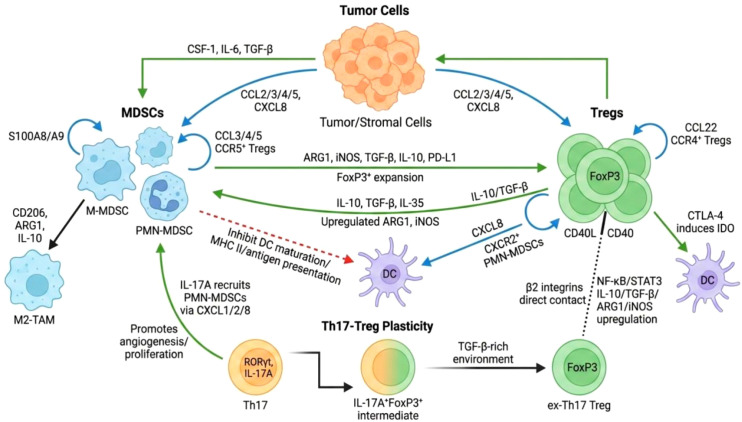
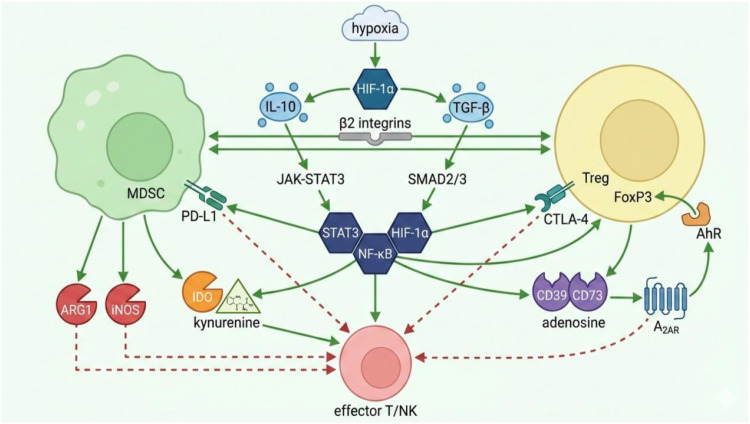
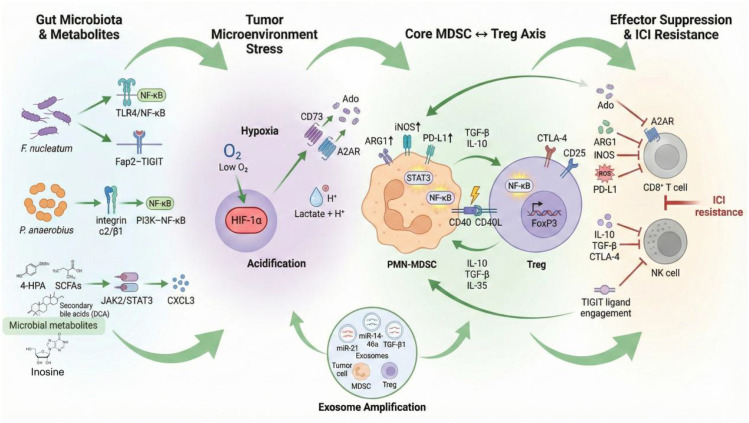
Microsatellite-stable (MSS)/proficient mismatch-repair (pMMR) colorectal cancer (CRC) accounts for more than 85% of cases but responds poorly to single-agent immune checkpoint inhibitors (ICIs), with objective response rates remaining below 5%. A principal barrier to effective immunotherapy in these tumors is a durable immunosuppressive axis formed by myeloid-derived suppressor cells (MDSCs) and regulatory T cells (Tregs) within the tumor microenvironment. This axis impedes antitumor immunity through multilayered mechanisms including bidirectional chemotactic recruitment, reciprocal cytokine signaling, metabolic suppression and exosome-mediated communication. CRC is uniquely influenced by the gut microbiota: Fusobacterium nucleatum promotes MDSC/Treg enrichment via TLR4–NF-κB and Fap2–TIGIT pathways; Peptostreptococcus anaerobius acts through integrin–PI3K–NF-κB signaling; and microbial metabolites such as 4-HPA activate JAK2/STAT3–CXCL3 signaling to expand MDSC populations. Concurrently, a hypoxia–lactate–HIF-1α–CD73/A2AR circuit further stabilizes suppressive phenotypes, forming a “microbiota–metabolism–hypoxia–MDSC–Treg” cascade. Emerging clinical and translational data indicate that disrupting this axis can sensitize MSS-CRC to ICIs: for example, Zanzalintinib combined with Atezolizumab reported survival benefit in the STELLAR-303 trial, and dual blockade of novel checkpoints with PD-(L)1 has been associated with enhanced immune activation in solid tumors. Targeting the MDSC–Treg axis therefore represents a promising strategy to overcome immunotherapy resistance in MSS/pMMR CRC.
Overview
The claims and statistics of this paper haven’t been checked yet.
Free: it reads the open-access text and checks the first 5 claims that cite a source we can check. Create a free account to check every claim.
Integrity signals
Registry
Cites
Statistics
Figures
Verification
Claims the paper makes
The claims and statistics of this paper haven’t been checked yet.
Free: it reads the open-access text and checks the first 5 claims that cite a source we can check. Create a free account to check every claim.
Self-check
Percentages, sums and reported differences re-computed from the paper’s own numbers.
The self-check needs the paper’s full text.
Citations
Cites
Bray, F., Laversanne, M., Sung, H., Ferlay, J., Siegel, R. L., Soerjomataram, I., & Jemal, A. (2024) · CA: a cancer journal for clinicians · doi:10.3322/caac.21834 · Cited by 27,064
Regulatory T cells: mechanisms of differentiation and function
Josefowicz, S. Z., Lu, L.-F., & Rudensky, A. Y. (2012) · Annual Review of Immunology · doi:10.1146/annurev.immunol.25.022106.141623 · Cited by 2,866
Rubinstein, M. R., Wang, X., Liu, W., Hao, Y., Cai, G., & Han, Y. W. (2013) · Cell Host & Microbe · doi:10.1016/j.chom.2013.07.012 · Cited by 2,476 · cited 1×
“Its outer-membrane protein Fap2 engages TIGIT or Gal-GalNAc to suppress NK and T-cell cytotoxicity (105), while FadA activates Wnt/ b -catenin signaling in tumor cells, promoting in fl ammatory and immunosuppressive mediators (106).”
Miyara, M., Yoshioka, Y., Kitoh, A., Shima, T., Wing, K., Niwa, A., Parizot, C., Taflin, C., Heike, T., Valeyre, D., et al. (2009) · Immunity · doi:10.1016/j.immuni.2009.03.019 · Cited by 2,291
Noman, M. Z., Desantis, G., Janji, B., Hasmim, M., Karray, S., Dessen, P., Bronte, V., & Chouaib, S. (2014) · Journal of Experimental Medicine · doi:10.1084/jem.20131916 · Cited by 2,166
Overman, M. J., Lonardi, S., Wong, K. Y. M., Lenz, H.-J., Gelsomino, F., Aglietta, M., Morse, M. A., Van Cutsem, E., McDermott, R., Hill, A., et al. (2018) · Journal of Clinical Oncology · doi:10.1200/jco.2017.76.9901 · Cited by 2,079
Myeloid-derived suppressor cells in the era of increasing myeloid cell diversity
Veglia, F., Sanseviero, E., & Gabrilovich, D. I. (2021) · Nature Reviews Immunology · doi:10.1038/s41577-020-00490-y · Cited by 1,940
TGF-β-induced Foxp3 inhibits TH17 cell differentiation by antagonizing RORγt function
Zhou, L., Lopes, J. E., Chong, M. M. W., Ivanov, I. I., Min, R., Victora, G. D., Shen, Y., Du, J., Rubtsov, Y. P., Rudensky, A. Y., et al. (2008) · Nature · doi:10.1038/nature06878 · Cited by 1,863 · cited 1×
“Such transdifferentiation occurs in TGF-b -rich microenvironments, where Th17 cells — originally polarized by IL-6 and IL-23 — downregulate ROR g t and induce FOXP3 expression (44).”
Huang, B., Pan, P.-Y., Li, Q., Sato, A. I., Levy, D. E., Bromberg, J., Divino, C. M., & Chen, S.-H. (2006) · Cancer Research · doi:10.1158/0008-5472.can-05-1299 · Cited by 1,435
Microbiome-derived inosine modulates response to checkpoint inhibitor immunotherapy
Mager, L. F., Burkhard, R., Pett, N., Cooke, N. C. A., Brown, K., Ramay, H., Paik, S., Stagg, J., Groves, R. A., Gallo, M., et al. (2020) · Science · doi:10.1126/science.abc3421 · Cited by 1,407 · cited 2×
“Similarly, inosine, a purine-derived metabolite produced by certain bene fi cial commensal bacteria such as Bi fi dobacterium pseudolongum, exerts context-dependent immunomodulatory effects that can enhance antitumor immunity (121).”
Cited by
Liu, Y., Nie, X., & Gao, X. (2026) · Advanced Science · doi:10.1002/advs.202600027 · Cited by 10
Zhang, H., Liu, W., Zhang, Y., 陈舒晨, & Sun, G. (2026) · Frontiers in Cell and Developmental Biology · doi:10.3389/fcell.2026.1840613 · Cited by 5
“Patients with tumors characterized by high microsatellite instability or deficient mismatch repair may achieve meaningful therapeutic responses, whereas the majority of patients with microsatellite-stable (MSS) CRC derive minimal benefit from ICB monotherapy (Zhang et al., 2026).”
Microbiome and cancer: mechanistic insights, diagnostic potential, and therapeutic strategies
Kumar, V., Chaudhary, A., Gautam, M., Verma, P., & Singh, M. (2026) · Frontiers in Cell and Developmental Biology · doi:10.3389/fcell.2026.1844436 · Cited by 3
“Certain bacterial species, such as F . nucleatum , promote inflammation-driven tumorigenesis by recruiting myeloid-derived suppressor cells (MDSCs) and regulatory T cells (Tregs), both of which suppress anti-tumor immune responses (Li et al., 2025; Zhang et al., 2026).”
Immune Checkpoint-Based Therapies in Colorectal Cancer—Current Approaches and Future Perspectives
Nakielska, K., Plewka, J., & Lenart, M. (2026) · International Journal of Molecular Sciences · doi:10.3390/ijms27104628 · Cited by 2
Wang, D., Wang, Y., & Wang, X. (2026) · Frontiers in Immunology · doi:10.3389/fimmu.2026.1874066 · Cited by 2
“MSS-CRC is therefore better described as an immune-excluded and functionally inactivated state rather than as a static, cell-empty cold tumor (9).”
InfluentialHenrykowska, G., Bartusik-Aebisher, D., Dynarowicz, K., Ramesh, T. S., Smolak, B., & Aebisher, D. (2026) · Pharmaceuticals · doi:10.3390/ph19071041 · Cited by 1
“Tumor-associated macrophages (TAMs) [52], regulatory T cells (Tregs), and myeloid-derived suppressor cells (MDSCs) create an immunosuppressive environment that promotes tumor progression and limits the antitumor immune response [53].”
Bispecific antibodies in gastrointestinal cancers: current applications and future perspectives
Ismail, M., Al‐Gizey, N., Al-Najjar, E., Alabed, Z., Mustafa, N., Hamdaneh, Y., & Esmail, A. (2026) · Frontiers in Oncology · doi:10.3389/fonc.2026.1927829 · Cited by 1
“In contrast, microsatellite-stable (MSS) and pro fi cient mismatch repair (pMMR) tumors, which comprise the vast majority of metastatic CRC, remain largely refractory to checkpoint inhibition, with objective response rates generally below 5% (57, 58).”
Xu, Y., Cheng, Q., & Yang, H. U. I. (2026) · Frontiers in Oncology · doi:10.3389/fonc.2026.1846793 · Cited by 1
Gangadaran, P., Rajendran, R. L., Kavitha, M. S., & Ahn, B. (2026) · Current Issues in Molecular Biology · doi:10.3390/cimb48070704
“TDEs also promote the proliferation and activation of myeloid-derived sup-https pressor cells and regulatory T cells, thereby reinforcing an immunosuppressive tumor microenvironment that supports tumor progression [24].”
Chen, B., Gao, S., Chen, X., Shi, Q., Mingli, S., & Han, J. (2026) · International Journal of Molecular Sciences · doi:10.3390/ijms27167495 · Cited by 1
“Colorectal cancer (CRC) remains one of the most lethal malignancies worldwide, and its resistance to immune checkpoint inhibitors (ICIs), particularly in the microsatellite-stable (MSS) subtype, which accounts for 85–95% of cases, represents a major clinical challenge [1,2].”
InfluentialThe microbiota-NK cell axis in colorectal cancer: a spatial and subset-centric framework
Wen, J., Gao, Y., Xu, M., Li, M., Dong, X., Zhao, M., Xuan, B., Meng, X., He, L., Zhang, W., et al. (2026) · Frontiers in Immunology · doi:10.3389/fimmu.2026.1934819
“T cell antitumor immunity (135).”
Self-citationPan, K., & Ma, C. (2026) · Frontiers in Immunology · doi:10.3389/fimmu.2026.1930718
Myeloid-derived suppressor cells in cancer: biology, regulatory networks and theranostic prospects
Deng, R., Bai, X., Yang, J., Ye, W., Liu, Q., Xing, Y., Yao, Y., He, X., Lü, A., & Liu, Y. (2026) · Signal Transduction and Targeted Therapy · doi:10.1038/s41392-026-02998-6
“89,90 93 Moreover, the recruitment process of MDSCs is not just a bilateral interaction between circulating myeloid cells and tumor cells.”
Zhang, C., Wu, S.-H., Lei, J., Lu, L., Li, J., & Jin, S. (2026) · World Journal of Gastrointestinal Oncology · doi:10.4251/wjgo.124022
Intratumoral microbiota: implications for colorectal cancer pathogenesis and therapy
Liu, J., & Qi, Z. (2026) · Frontiers in Immunology · doi:10.3389/fimmu.2026.1832875
“…(MDSCs), M2-polarized macrophages, and regulatory T cells (Tregs), coupled with functional suppression of CD8 ⁺ T cells and natural killer (NK) cells, establishes an immune evasion network mediated by IL-10, transforming growth factor-b (TGF-b ), and C-C motif chemokine ligand 28 (CCL28) (41, 42).”
Self-citationLiu, A., Tan, R., Zhou, X., Wang, P., & Wang, X. (2026) · Frontiers in Immunology · doi:10.3389/fimmu.2026.1908629
Mitochondrial dysfunction as a metabolic checkpoint of immunotherapy response in colorectal cancer
Tomassini, L., Colella, M., Monteleone, G., Stolfi, C., & Laudisi, F. (2026) · Frontiers in Immunology · doi:10.3389/fimmu.2026.1908222
“(17, 19) Hypoxia/lactate In fl amed tumors may acquire metabolic adaptations associated with acquired resistance Hypoxia and lactate stabilize suppression and immune escape.”
Zhu, M., He, L., Quan, L., Cui, C., Li, D., Lou, T., & Jia, X. (2026) · Discover Nano · doi:10.1186/s11671-026-04887-x
“HIF-1α, which accumulates extensively under hypoxic conditions, not only triggers vascular abnormalities by driving the transcription of vascular endothelial growth factor (VEGF) but also further upregulates the expression of glycolytic enzymes [60, 61].”
Mechanisms of immune resistance in microsatellite-stable colorectal cancer
牛冬光, Liu, P., Chen, X., Li, J., Zhenqing, S., Kuang, Z., & Yu, H. (2026) · Frontiers in Oncology · doi:10.3389/fonc.2026.1893907
“…microenvironment (TME) is enriched with immunosuppressive populations, including regulatory T cells (Tregs), tumor-associated macrophages (TAMs), and myeloid-derived suppressor cells (MDSCs), which suppress antitumor immunity through inhibitory cytokine production and metabolic competition (7 – 9).”
Wan, K., Tang, K., Wang, L., Tian, Q., Zheng, M., Qian, C., & 刘丽梅 (2026) · MedComm · doi:10.1002/mco2.71028
“Persistent STAT3 activation is associated with aggressive disease and poor outcomes [ 20, 126, 135 ].”
Minimal invasive biomarkers in colorectal cancer
Γιαννοπούλου, Β. Ν. (2026) · University of Thessaly Institutional Repository (University of Thessaly)
Jeon, J., Baek, H. S., Park, K., Park, M., Heo, N. H., Cheon, S., Kim, G., & Kim, S. (2026) · International Journal of Molecular Sciences · doi:10.3390/ijms27209134
“Stromal remodeling and suppressive myeloid populations constitute major non-tumor-cell-mediated barriers to immunotherapy in CRC [40,221,255].”
InfluentialDing, L., Staskiewicz, A., Kao, J., & Wang, X. (2026) · Frontiers in Pharmacology · doi:10.3389/fphar.2026.1960752
Xu, J., Ni, C., Wang, P., & Qin, L. (2026) · Molecular Biology Reports · doi:10.1007/s11033-026-13054-5
Saeed, A. F., Ashraf, M. N., & Iqbal, M. Z. (2026) · Frontiers in Immunology · doi:10.3389/fimmu.2026.1920004
Khan, A., Tareen, A., Farid, A. A. M., Amin, A., Khan, H. N., Hadi, D. K., Khan, S. R., & Raza, A. (2026) · Frontiers in Oncology · doi:10.3389/fonc.2026.1985675
“Microbial metabolites may further reinforce immune exclusion, contributing to the limited ef fi cacy of checkpoint inhibitors in microsatellite-stable CRC (78).”
Celentano, A., Mohammed, A. I., Cirillo, N., Kujan, O., McCullough, M. J., & O’Reilly, L. A. (2026) · Frontiers in Cell and Developmental Biology · doi:10.3389/fcell.2026.1996524
Xu, H., Kong, H.-X., Lin, Y., Zhou, Y.-J., Liang, W.-L., & Huang, H.-L. (2026) · World Journal of Gastrointestinal Oncology · doi:10.4251/wjgo.126454
Metadata
- Authors
- Zhang, W., Jin, C., Liu, S., Wan, X., Li, Y., Liu, J., Duan, Z., Ma, J., & Gao, Y.
- Affiliations
- Liaoning University of Traditional Chinese Medicine (CN)
- Dalian Medical University (CN)
- Affiliated Hospital of Liaoning University of Traditional Chinese Medicine (CN)
- Department of General Surgery, The First Affiliated Hospital of Dalian Medical University
- First Affiliated Hospital of Dalian Medical University (CN)
- Corresponding author
- Duan, Zhijun
- Ma, Jingyuan
- Gao, Yunhai
- Venue
- Frontiers in Immunology
- Publisher
- Frontiers Media SA
- Published
- 2026-01-29
- Volume
- 17
- Pages
- 1757513-1757513
- ISSN
- 1664-3224 (ISSN-L)
- PMC
- PMC12894373
- OpenAlex
- W7125904396
- Cited by
- 22
- References
- 177
- Citations by year
- 2026: 22
- FWCI
- 20.05
- Type
- journal article
- Language
- en
- Open access
- gold
- doi.org
- Licence
- Locations
- Frontiers in Immunology (publishedVersion, cc-by)
- Europe PMC (PubMed Central) (publishedVersion, cc-by)
- PubMed (publishedVersion)
- PubMed Central (publishedVersion, cc-by)
- Topics
- Health Sciences › Medicine › Oncology › Cancer Immunotherapy and Biomarkers
- Life Sciences › Immunology and Microbiology › Immunology › Immune cells in cancer
- Life Sciences › Immunology and Microbiology › Immunology › Immunotherapy and Immune Responses
- Keywords
- myeloid-derived suppressor cells, regulatory T cells, colorectal cancer, microsatellite stable colorectal cancer, immune checkpoint inhibitors, tumor immunosuppression, gut microbiota, Fusobacterium nucleatum, Peptostreptococcus anaerobius, TLR4/NF-κB signaling, microbial metabolites, 4-hydroxyphenylacetic acid, tumor hypoxia, HIF-1α, immunotherapy resistance, atezolizumab, PD-1/PD-L1 blockade, tumor microenvironment
- MeSH terms
- Gastrointestinal Microbiome, Myeloid-Derived Suppressor Cells, Animals, Humans, Colorectal Neoplasms, Signal Transduction, T-Lymphocytes, Regulatory, Tumor Microenvironment
About these checks
Registry, retraction, Cites and statistics results are computed, not judged, with one exception: a printed reference that no index lists is read once by a model before it counts as a citation error. Claims are extracted by a model and kept only when their quote appears verbatim in the text; each cited source is then checked, with a model’s help, for whether it says what the claim relies on. Those verdicts can be wrong — read the claim’s quote and the cited source before relying on one.
Statistics and arithmetic are recomputed, not judged.
Confidence bands are shown only for fields calibrated on our annotated test set. None is calibrated yet, so no band is shown.
What counts as a claim ›How we measure confidence ›How we check this ›
Are you an author, or do you see a problem with this page? Request a review
Data sources
Bibliographic data: Semantic Scholar, OpenAlex, Crossref.
Contains information from the Semantic Scholar Academic Graph Datasets, made available under the ODC Attribution License (ODC-BY 1.0).
Semantic Scholar’s data is described in: Kinney, R., et al. (2023). The Semantic Scholar Open Data Platform. arXiv:2301.10140.
