

The DOI matches its Crossref record; 387 of the 389 references it cites were found in a registry or an index.
Unmet Medical Needs in Chronic, Non-communicable Inflammatory Skin Diseases
Open accessAbstract
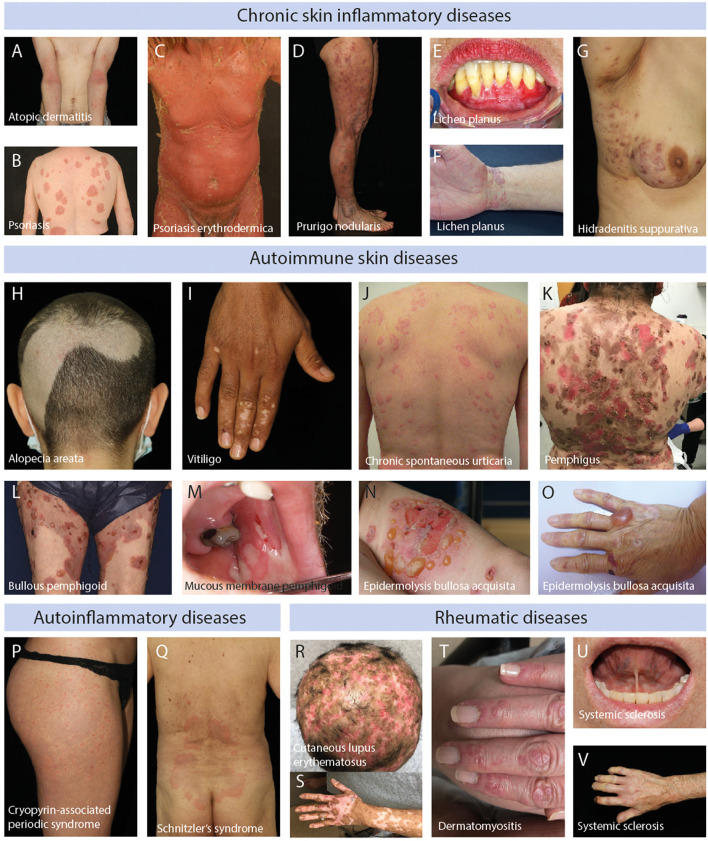
An estimated 20-25% of the population is affected by chronic, non-communicable inflammatory skin diseases. Chronic skin inflammation has many causes. Among the most frequent chronic inflammatory skin diseases are atopic dermatitis, psoriasis, urticaria, lichen planus, and hidradenitis suppurativa, driven by a complex interplay of genetics and environmental factors. Autoimmunity is another important cause of chronic skin inflammation. The autoimmune response may be mainly T cell driven, such as in alopecia areata or vitiligo, or B cell driven in chronic spontaneous urticaria, pemphigus and pemphigoid diseases. Rare causes of chronic skin inflammation are autoinflammatory diseases, or rheumatic diseases, such as cutaneous lupus erythematosus or dermatomyositis. Whilst we have seen a significant improvement in diagnosis and treatment, several challenges remain. Especially for rarer causes of chronic skin inflammation, early diagnosis is often missed because of low awareness and lack of diagnostics. Systemic immunosuppression is the treatment of choice for almost all of these diseases. Adverse events due to immunosuppression, insufficient therapeutic responses and relapses remain a challenge. For atopic dermatitis and psoriasis, a broad spectrum of innovative treatments has been developed. However, treatment responses cannot be predicted so far. Hence, development of (bio)markers allowing selection of specific medications for individual patients is needed. Given the encouraging developments during the past years, we envision that many of these challenges in the diagnosis and treatment of chronic inflammatory skin diseases will be thoroughly addressed in the future.
Overview
The claims and statistics of this paper haven’t been checked yet.
Run the check — free, no account needed. It reads the open-access text and checks the sources it cites.
Integrity signals
Registry
Cites
Statistics
Figures
Verification
Claims the paper makes
The claims and statistics of this paper haven’t been checked yet.
Run the check — free, no account needed. It reads the open-access text and checks the sources it cites.
Self-check
Percentages, sums and reported differences re-computed from the paper’s own numbers.
The self-check needs the paper’s full text.
Citations
Cites
The NLRP3 Inflammasome: an overview of mechanisms of activation and regulation
Kelley, N., Jeltema, D., Duan, Y., & He, Y. (2019) · International Journal of Molecular Sciences · doi:10.3390/ijms20133328 · Cited by 3,539
Atopic Dermatitis: Global Epidemiology and Risk Factors
Nutten, S. (2015) · Annals of Nutrition and Metabolism · doi:10.1159/000370220 · Cited by 3,124
Palmer, C. N. A., Irvine, A. D., Terron-Kwiatkowski, A., Zhao, Y., Liao, H., Lee, S. P., Goudie, D. R., Sandilands, A., Campbell, L. E., Smith, F. J. D., et al. (2006) · Nature Genetics · doi:10.1038/ng1767 · Cited by 2,978 · cited 1×
“Among European Caucasians, filaggrin mutations are associated with early-onset and severe AD (43).”
BackgroundGriffiths, C. E. M., Armstrong, A. W., Gudjonsson, J. E., & Barker, J. N. W. N. (2021) · The Lancet · doi:10.1016/s0140-6736(20)32549-6 · Cited by 2,643
Boehncke, W., & Schön, M. P. (2015) · The Lancet · doi:10.1016/s0140-6736(14)61909-7 · Cited by 2,609
Risk of myocardial infarction in patients with psoriasis
Gelfand, J. M., Neimann, A. L., Shin, D. B., Wang, X., Margolis, D. J., & Troxel, A. B. (2006) · JAMA · doi:10.1001/jama.296.14.1735 · Cited by 1,899
Kong, H. H., Oh, J., Deming, C., Conlan, S., Grice, E. A., Beatson, M. A., Nomicos, E., Polley, E. C., Komarow, H. D., Program, N. C. S., et al. (2012) · Genome Research · doi:10.1101/gr.131029.111 · Cited by 1,808 · cited 1×
“Patients with AD have a higher burden of Staphylococcus aureus which contributes to the inflammation (46).”
BackgroundHoffman, H. M., Mueller, J. L., Broide, D. H., Wanderer, A. A., & Kolodner, R. D. (2001) · Nature Genetics · doi:10.1038/ng756 · Cited by 1,679
Lundberg, I. E., Tjärnlund, A., Bottai, M., Werth, V. P., Pilkington, C., de Visser, M., Alfredsson, L. S., Amato, A. A., Barohn, R. J., Liang, M. H., et al. (2017) · Annals of the Rheumatic Diseases · doi:10.1136/annrheumdis-2017-211468 · Cited by 1,597
Zuberbier, T., Abdul Latiff, A. H., Abuzakouk, M., Aquilina, S., Asero, R., Baker, D., Ballmer‐Weber, B., Bangert, C., Ben‐Shoshan, M., Bernstein, J. A., et al. (2022) · Allergy · doi:10.1111/all.15090 · Cited by 1,263
Cited by
Sorted by citations
Bieber, K., Hundt, J. E., Yu, X., Ehlers, M., Petersen, F., Karsten, C. M., Köhl, J., Kridin, K., Kalies, K., Kasprick, A., et al. (2022) · Autoimmunity Reviews · doi:10.1016/j.autrev.2022.103236 · Cited by 135
Comprehensive Insight into Lichen Planus Immunopathogenesis
Vičić, M., Hlača, N., Kaštelan, M., Brajac, I., Tokmadžić, V. S., & Massari, L. P. (2023) · International Journal of Molecular Sciences · doi:10.3390/ijms24033038 · Cited by 123
“Skin LP is generally followed by severe pruritus, whose intensity corresponds to the affected surface but lacks visible scratches or secondary infections [5].”
BackgroundInfluentialHidradenitis suppurativa: new insights into disease mechanisms and an evolving treatment landscape
Krueger, J. G., Frew, J. W., Jemec, G. B. E., Kimball, A. B., Kirby, B., Bechara, F. G., Navrazhina, K., Prens, E. P., Reich, K., Cullen, E., et al. (2023) · British Journal of Dermatology · doi:10.1093/bjd/ljad345 · Cited by 115
Systematic Review of Deep Learning Image Analyses for the Diagnosis and Monitoring of Skin Disease
Choy, S. P., Kim, B. J., Paolino, A., Tan, W. R., Lim, S. M. L., Seo, J., Tan, S. P., Francis, L., Tsakok, T., Simpson, M., et al. (2023) · npj Digital Medicine · doi:10.1038/s41746-023-00914-8 · Cited by 105
Therapeutic strategies for oral lichen planus: State of the art and new insights
Didona, D., Caro, R. D. C., Santos, A. M. S., Solimani, F., & Hertl, M. (2022) · Frontiers in Medicine · doi:10.3389/fmed.2022.997190 · Cited by 101
“89% and it is more commonly diagnosed in the female population (1, 2).”
Background
Metadata
- Authors
- Ujiie, H., Rosmarin, D., Schön, M. P., Ständer, S., Boch, K., Metz, M., Maurer, M., Thaci, D., Schmidt, E., Cole, C., Amber, K. T., Didona, D., Hertl, M., Recke, A., Graßhoff, H., Hackel, A., Schumann, A., Riemekasten, G., Bieber, K., Sprow, G., Dan, J., Zillikens, D., Sezin, T., Christiano, A. M., Wolk, K., Sabat, R., Kridin, K., Werth, V. P., & Ludwig, R. J.
- Affiliations
- Hokkaido University (JP)
- Tufts Medical Center (US)
- Universitätsmedizin Göttingen (DE)
- University Hospital Münster (DE)
- University of Lübeck (DE)
- Humboldt-Universität zu Berlin (DE)
- Rush University Medical Center (US)
- Philipps University of Marburg (DE)
- Philadelphia VA Medical Center (US)
- Columbia University Irving Medical Center (US)
- Charité – Universitätsmedizin Berlin (DE)
- Bar-Ilan University (IL)
- Corresponding author
- Ludwig, Ralf J.
- ORCID
- Ujiie, Hideyuki
- Rosmarin, David
- Schön, Michael P.
- Ständer, Sonja
- Boch, Katharina
- Metz, Martin
- Maurer, Marcus
- Schmidt, Enno
- Cole, Connor
- Amber, Kyle T.
- Didona, Dario
- Hertl, Michael
- Recke, Andreas
- Graßhoff, Hanna
- Hackel, Alexander
- Riemekasten, Gabriela
- Bieber, Katja
- Dan, Joshua
- Zillikens, Detlef
- Sezin, Tanya
- Christiano, Angela M.
- Wolk, Kerstin
- Sabat, Robert
- Kridin, Khalaf
- Werth, Victoria P.
- Ludwig, Ralf J.
- Venue
- Frontiers in Medicine
- Publisher
- Frontiers Media SA
- Published
- 2022-06-09
- Volume
- 9
- Pages
- 875492-875492
- ISSN
- 2296-858X (ISSN-L)
- PMC
- PMC9218547
- OpenAlex
- W4285740668
- Cited by
- 158
- References
- 389
- Citations by year
- 2026: 20 · 2025: 40 · 2024: 49 · 2023: 37 · 2022: 12
- FWCI
- 6.14
- Type
- journal article
- Language
- en
- Open access
- gold
- doi.org
- Licence
- Locations
- Frontiers in Medicine (publishedVersion, cc-by)
- PubMed Central (publishedVersion, cc-by)
- PubMed (publishedVersion)
- DOAJ (DOAJ: Directory of Open Access Journals) (submittedVersion, cc-by-sa)
- Fraunhofer-Publica (Fraunhofer-Gesellschaft) (submittedVersion)
- GoeScholar The Publication Server of the Georg-August-Universität Göttingen (Georg-August-Universität Göttingen) (submittedVersion, cc-by)
- Funders
- Deutsche Forschungsgemeinschaft (EXC 2167, FOR 2497, FOR 2690, RI/1056-11,, SFB 1526)
- National Institutes of Health (R01AR071653, R01AR076766)
- Schweizerischer Nationalfonds zur Förderung der Wissenschaftlichen Forschung (CRSII5_202301/1)
- Topics
- Health Sciences › Medicine › Dermatology › Dermatology and Skin Diseases
- Life Sciences › Immunology and Microbiology › Immunology › Psoriasis: Treatment and Pathogenesis
- Health Sciences › Medicine › Rheumatology › Systemic Sclerosis and Related Diseases
- Keywords
- chronic inflammatory skin disease, unmet medical needs, atopic dermatitis, psoriasis, urticaria, lichen planus, hidradenitis suppurativa, alopecia areata, vitiligo, pemphigus, pemphigoid diseases, cutaneous lupus erythematosus, dermatomyositis, autoinflammatory disease, systemic immunosuppression, biomarkers, treatment response prediction, early diagnosis
About these checks
Registry, retraction, Cites and statistics results are computed, not judged, with one exception: a printed reference that no index lists is read once by a model before it counts as a citation error. Claims are extracted by a model and kept only when their quote appears verbatim in the text; each cited source is then checked, with a model’s help, for whether it says what the claim relies on. Those verdicts can be wrong — read the claim’s quote and the cited source before relying on one.
Statistics and arithmetic are recomputed, not judged.
Confidence bands are shown only for fields calibrated on our annotated test set. None is calibrated yet, so no band is shown.
What counts as a claim ›How we measure confidence ›How we check this ›
Are you an author, or do you see a problem with this page? Request a review
