

The DOI matches its Crossref record; 61 of the 62 references it cites were found in a registry or an index; 3 of the 61 sources its claims cite were checked for support.
Microbial Diversity in Sulfate-Reducing Marine Sediment Enrichment Cultures Associated with Anaerobic Biotransformation of Coastal Stockpiled Phosphogypsum (Sfax, Tunisia)
Open accessAbstract
Anaerobic biotechnology using sulfate-reducing bacteria (SRB) is a promising alternative for reducing long-term stockpiling of phosphogypsum (PG), an acidic (pH ~3) by-product of the phosphate fertilizer industries containing high amounts of sulfate. The main objective of this study was to evaluate, for the first time, the diversity and ability of anaerobic marine microorganisms to convert sulfate from PG into sulfide, in order to look for marine SRB of biotechnological interest. A series of sulfate-reducing enrichment cultures were performed using different electron donors (i.e. acetate, formate or lactate) and sulfate sources (i.e. sodium sulfate or PG) as electron acceptors. Significant sulfide production was observed from enrichment cultures inoculated with marine sediments, collected near the effluent discharge point of a Tunisian fertilizer industry (Sfax, Tunisia). Sulfate sources impacted sulfide production rates from marine sediments as well as the diversity of SRB species belonging to Deltaproteobacteria. When PG was used as sulfate source, Desulfovibrio species dominated microbial communities of marine sediments, while Desulfobacter species were mainly detected using sodium sulfate. Sulfide production was also affected depending on the electron donor used, with the highest production obtained using formate. In contrast, low sulfide production (acetate-containing cultures) was associated with an increase in the population of Firmicutes. These results suggested that marine Desulfovibrio species, to be further isolated, are potential candidates for bioremediation of PG by immobilizing metals and metalloids thanks to sulfide production by these SRB.
Overview
AI snapshot
Written from the paper’s full text.
TL;DR
This study evaluated sulfate-reducing enrichment cultures from Tunisian coastal marine sediments for anaerobic biotransformation of phosphogypsum (PG), showing that sulfide was produced from PG and sodium sulfate. Formate gave the highest H2S production, and the sulfate source shifted SRB communities: Desulfovibrio dominated PG cultures while Desulfobacter were mainly detected with sodium sulfate.
Key findings
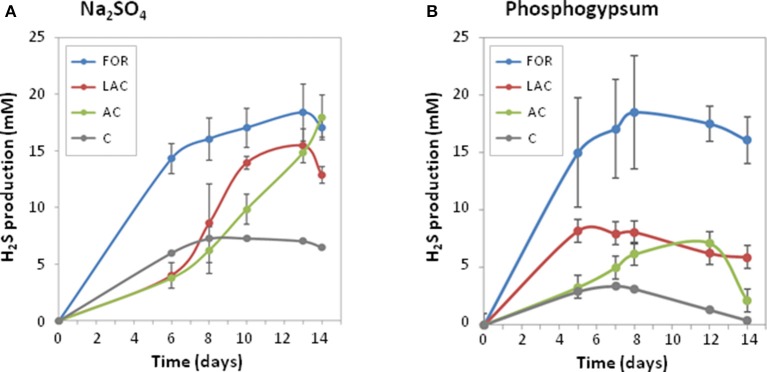
- Sulfide production occurred from marine sediment enrichments with either Na2SO4 or PG; formate gave the highest rates (2.4 ± 0.2 mM/day with Na2SO4 and 3.0 ± 0.2 mM/day with PG), while acetate gave <1 mM/day. In PG cultures, maximum H2S was highest with formate (19.7 ± 3.7 mM), about twice that with acetate or lactate.
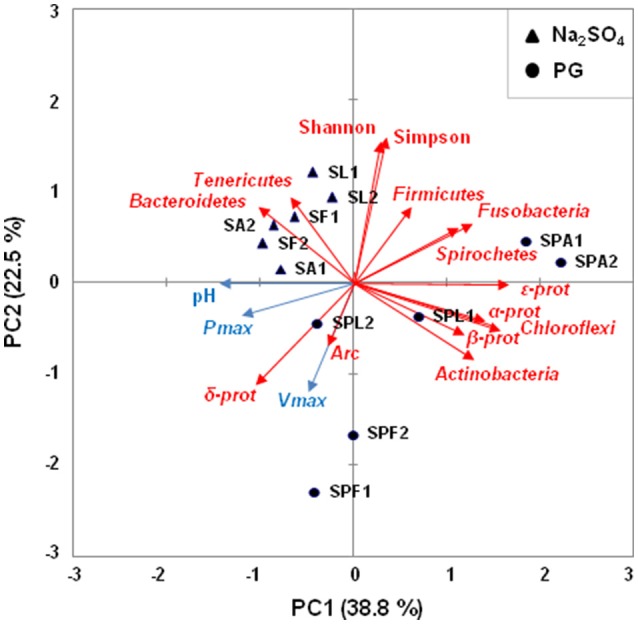
- Sulfate source affected SRB diversity: PG cultures were dominated by Desulfovibrio spp., whereas Desulfobacter spp. were only retrieved in Na2SO4 cultures, suggesting inhibition by PG. Deltaproteobacteria proportions correlated positively with final pH (r = 0.94), maximum H2S (r = 0.83), and maximum H2S rate (r = 0.89); Simpson index correlated negatively with these H2S performance measures.
- Initial marine sediment had higher microbial diversity than PG: 1,686 OTUs, Shannon 8.98, Simpson 0.99 in sediment versus 224 OTUs, Shannon 4.51, Simpson 0.88 in PG. PG was acidic (pH 3.1), contained 55% sulfate of dry weight, and had low organic carbon (0.53 ± 0.15%).
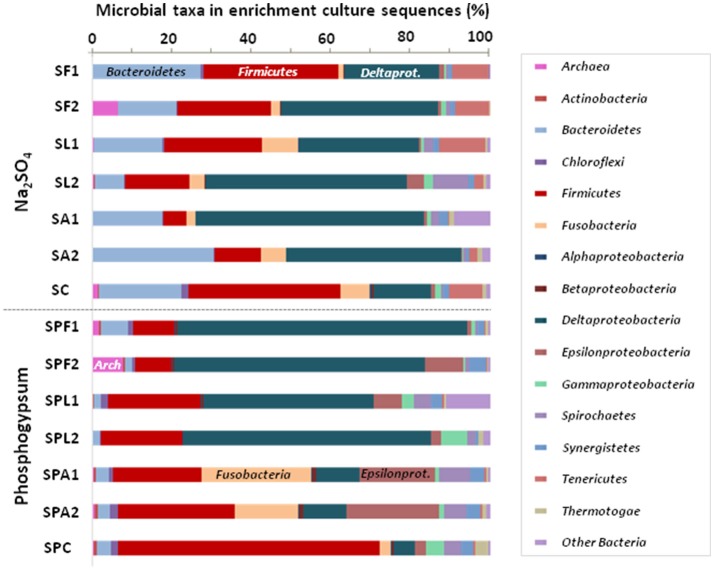
- Low sulfide production in acetate + PG cultures was associated with increased Firmicutes: Deltaproteobacteria represented only 10.9%, while Firmicutes were 25.8 ± 3.6%, Fusobacteria 21.6 ± 5.8%, Epsilonproteobacteria 21.1 ± 2.2%, and Spirochaetes 6.6 ± 1.2%.
Methods
- Samples were collected in March 2016 from the Sfax phosphate fertilizer complex, Tunisia: marine sediment near the acid effluent discharge and PG from a stockpile. Chemical analyses included pH, dissolved oxygen, sulfate, C/H/N/S, total organic carbon, and trace metals by HR-ICP-MS.
- Duplicate sulfate-reducing enrichment cultures were prepared in 120 mL bottles with basal medium, Na2SO4 (1.58 g/L) or PG (2 g/L) as sulfate source, and acetate (20 mM), lactate (40 mM), or formate (80 mM) as electron donors. Cultures were inoculated with 5 mL marine sediment or non-autoclaved PG, incubated at 37°C for 2 weeks, and monitored for H2S; electron donors and sulfate were analyzed by HPLC and ion chromatography.
- DNA was extracted from environmental samples and enrichment pellets, and 16S rRNA gene amplicons were sequenced on Illumina MiSeq. QIIME/UCLUST clustered OTUs at 97% identity; diversity indices, phylogenetic trees, ANOVA with Bonferroni post-hoc tests, Spearman correlations, and PCA were used.
Limitations
- Stated: further work is needed to isolate SRB from marine sediments, especially Desulfovibrionales species, to test their metal resistance and performance in PG biotransformation. The paper also notes that the DNA extraction method following sampling and storage may affect the revealed community structure.
- Evident: the study measured H2S production and microbial community composition but did not directly measure immobilization or fate of trace metals or radionuclides in the enrichment cultures, despite proposing metal immobilization as a bioremediation mechanism.
- Evident: results come from short-term (14-day) laboratory microcosms with two biological replicates, so field-scale performance and long-term stability are not established.
Model-written summary. Check it against the paper before relying on it.
Integrity signals
Registry
Cites
Statistics
Figures
Verification
Claims the paper makes
57 Own result · 22 Own interpretation · 17 No full text of the sources · 17 Not checked yet · 4 No basis given · 3 Own method · 2 Sources not found · 1 Supported · 1 Supported so far · 1 Partly supported · accuracy not yet measured
The sources with a verdict support this claim; the rest weren’t checked yet, have no full text we could read, or their verdicts aren’t rated yet.
In the paper
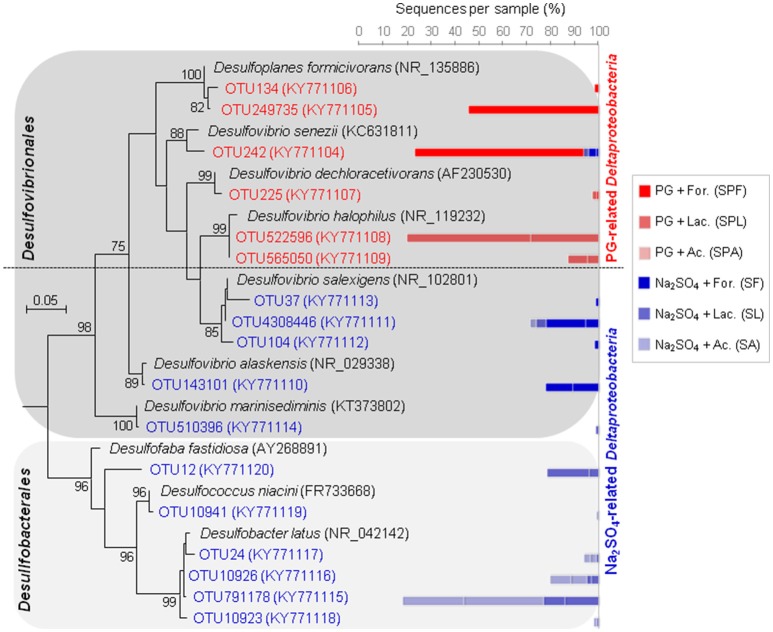
“The highest H2S-producing FOR + PG cultures were dominated by two OTUs phylogenetically related to halotolerant sulfate-, thiosulfate- and sulfite-reducing species, Desulfovibrio senezii (94% identity) and Desulfoplanes formicivorans (98% identity), which use FOR and LAC as electron donors (Tsu et al., 1998; Watanabe et al., 2015).”
§ Microbial Diversity in Sulfate-Reducing Marine Sediment Enrichment Cultures Associated with Anaerobic Biotransformation of Coastal Stockpiled Phosphogypsum (Sfax, Tunisia) > Results and discussion > Dominant bacterial species in the enrichment cultures containing phosphogypsum or sodium sulfate
What the sources say
- Not checked — no full text of the sourcecites Tsu et al., 1998 source
- Supportedcites Watanabe et al., 2015 source
The Description of Desulfoplanes formicivorans states that formate (FOR) and lactate (LAC) are electron donors in the presence of sulfate. Watanabe et al. supports the part of the jointly cited sentence concerning D. formicivorans; the sentence also cites Tsu et al. for D. senezii. (LLM, conf=0.93)
plaindirect- Asserted: passes — The authors put it forward as true.
- Checkable: passes — It can be checked against evidence.
- Load-bearing: unclear — It is unclear whether the paper’s conclusions depend on it.
- Based: passes — The paper gives a reason why it holds.
The cited sources support only part of this claim — read each source’s verdict below.
In the paper
“These toxic elements prevent the effective reuse of PG in various industrial or agricultural activities (Papastefanou et al., 2006; Tayibi et al., 2009).”
§ Microbial Diversity in Sulfate-Reducing Marine Sediment Enrichment Cultures Associated with Anaerobic Biotransformation of Coastal Stockpiled Phosphogypsum (Sfax, Tunisia) > Introduction
What the sources say
- Not checked — no full text of the sourcecites Papastefanou et al., 2006 source
- Partly supportedcites Tayibi et al., 2009 sourceExperimental — accuracy not yet measured
Section 4 says impurities restrict PG applications and that treatment is recommended to make PG usable; Section 3.1 describes a radionuclide-based restriction on agricultural use. But the Introduction says 15% of PG is recycled for building and agricultural uses, so the claim overstates the barrier by saying toxic elements prevent reuse outright. (LLM, conf=0.84)
plaindirect- Asserted: passes — The authors put it forward as true.
- Checkable: passes — It can be checked against evidence.
- Load-bearing: passes — The paper’s conclusions depend on it.
- Based: passes — The paper gives a reason why it holds.
A result the paper reports from its own data — it cites no other source for it, so there is none to check. The quote shows it is in the paper.
In the paper
“During sulfate reduction, pH increased with increasing H2S production (Table 2).”
§ Microbial Diversity in Sulfate-Reducing Marine Sediment Enrichment Cultures Associated with Anaerobic Biotransformation of Coastal Stockpiled Phosphogypsum (Sfax, Tunisia) > Results and discussion > Microbial H2S production using sodium sulfate or phosphogypsum as sulfate source
plaincorrelational- Asserted: passes — The authors put it forward as true.
- Checkable: passes — It can be checked against evidence.
- Load-bearing: unclear — It is unclear whether the paper’s conclusions depend on it.
- Based: passes — The paper gives a reason why it holds.
A result the paper reports from its own data — it cites no other source for it, so there is none to check. The quote shows it is in the paper.
In the paper
“Two abundant deltaproteobacterial OTUs were closely related to Desulfobacter latus (3.2% of the sequences) and Desulfocella halophila (2.7%).”
§ Microbial Diversity in Sulfate-Reducing Marine Sediment Enrichment Cultures Associated with Anaerobic Biotransformation of Coastal Stockpiled Phosphogypsum (Sfax, Tunisia) > Results and discussion > Microbial diversity in marine sediment and phosphogypsum samples
plaincorrelational- Asserted: passes — The authors put it forward as true.
- Checkable: passes — It can be checked against evidence.
- Load-bearing: unclear — It is unclear whether the paper’s conclusions depend on it.
- Based: passes — The paper gives a reason why it holds.
A result the paper reports from its own data — it cites no other source for it, so there is none to check. The quote shows it is in the paper.
In the paper
“In contrast, low sulfide production (acetate-containing cultures) was associated with an increase in the population of Firmicutes.”
§ Microbial Diversity in Sulfate-Reducing Marine Sediment Enrichment Cultures Associated with Anaerobic Biotransformation of Coastal Stockpiled Phosphogypsum (Sfax, Tunisia) > Abstract
plaincorrelational- Asserted: passes — The authors put it forward as true.
- Checkable: passes — It can be checked against evidence.
- Load-bearing: unclear — It is unclear whether the paper’s conclusions depend on it.
- Based: passes — The paper gives a reason why it holds.
A result the paper reports from its own data — it cites no other source for it, so there is none to check. The quote shows it is in the paper.
In the paper
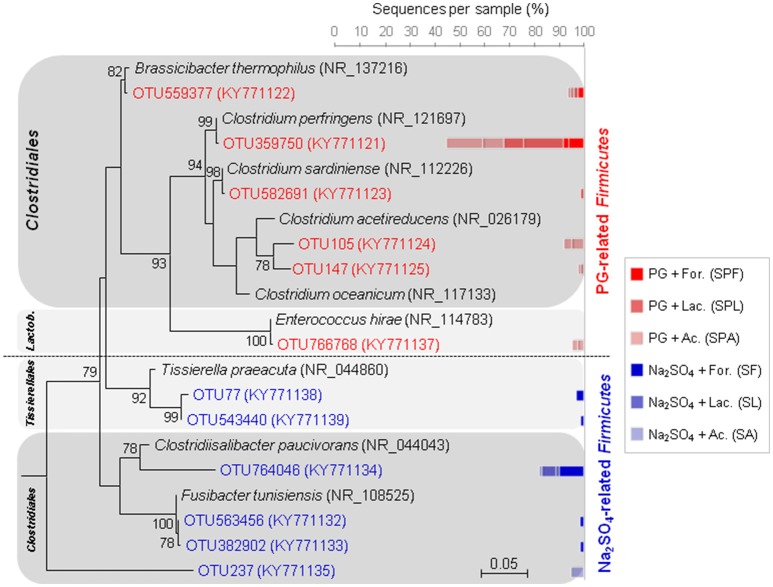
“In PG cultures, the majority of abundant Firmicutes were related to clostridial species (Figure 6), such as the non-sulfate-reducing bacterium, Clostridium perfringens, which may use thiosulfate and sulfite as electron acceptors (Fuchs and Bonde, 1957; André et al., 2010), or the potential sulfate, thiosulfate- or sulfite-reducer, Brassicibacter thermophilus (Wang et al., 2015).”
§ Microbial Diversity in Sulfate-Reducing Marine Sediment Enrichment Cultures Associated with Anaerobic Biotransformation of Coastal Stockpiled Phosphogypsum (Sfax, Tunisia) > Results and discussion > Dominant bacterial species in the enrichment cultures containing phosphogypsum or sodium sulfate
plaincorrelational- Asserted: passes — The authors put it forward as true.
- Checkable: passes — It can be checked against evidence.
- Load-bearing: unclear — It is unclear whether the paper’s conclusions depend on it.
- Based: passes — The paper gives a reason why it holds.
A result the paper reports from its own data — it cites no other source for it, so there is none to check. The quote shows it is in the paper.
In the paper
“The type of sulfate source (PG or Na2SO4) had a significant effect on Shannon diversity index (p < 0.05; Table 1).”
§ Microbial Diversity in Sulfate-Reducing Marine Sediment Enrichment Cultures Associated with Anaerobic Biotransformation of Coastal Stockpiled Phosphogypsum (Sfax, Tunisia) > Results and discussion > Microbial diversity in the enrichment cultures containing phosphogypsum or sodium sulfate
plaindirect- Asserted: passes — The authors put it forward as true.
- Checkable: passes — It can be checked against evidence.
- Load-bearing: passes — The paper’s conclusions depend on it.
- Based: passes — The paper gives a reason why it holds.
A result the paper reports from its own data — it cites no other source for it, so there is none to check. The quote shows it is in the paper.
In the paper
“The majority of AC was oxidized either in the presence of Na2SO4 or that of PG (81.6 ± 18.4% and 95.0 ± 5.0%, respectively), despite the difference in sulfate reduction (97.9 ± 1.5% and 32.0 ± 4.0% of sulfate consumed, respectively; Table 2).”
§ Microbial Diversity in Sulfate-Reducing Marine Sediment Enrichment Cultures Associated with Anaerobic Biotransformation of Coastal Stockpiled Phosphogypsum (Sfax, Tunisia) > Results and discussion > Microbial H2S production using sodium sulfate or phosphogypsum as sulfate source
plaincorrelational- Asserted: passes — The authors put it forward as true.
- Checkable: passes — It can be checked against evidence.
- Load-bearing: passes — The paper’s conclusions depend on it.
- Based: passes — The paper gives a reason why it holds.
In the paper
“The most abundant archaeal OTUs from PG were distantly related to Methanomassiliicoccus luminyensis, reported as a hydrogenotrophic methanogen using methanol as terminal electron acceptor (Dridi et al., 2012).”
§ Microbial Diversity in Sulfate-Reducing Marine Sediment Enrichment Cultures Associated with Anaerobic Biotransformation of Coastal Stockpiled Phosphogypsum (Sfax, Tunisia) > Results and discussion > Microbial diversity in marine sediment and phosphogypsum samples
What the sources say
- Not checked — no full text of the sourcecites Dridi et al., 2012 source
plain- Asserted: passes — The authors put it forward as true.
- Checkable: passes — It can be checked against evidence.
- Load-bearing: unclear — It is unclear whether the paper’s conclusions depend on it.
- Based: passes — The paper gives a reason why it holds.
A result the paper reports from its own data — it cites no other source for it, so there is none to check. The quote shows it is in the paper.
In the paper
“These abundant OTUs were mainly assigned to two Deltaproteobacteria groups (Figure 5).”
§ Microbial Diversity in Sulfate-Reducing Marine Sediment Enrichment Cultures Associated with Anaerobic Biotransformation of Coastal Stockpiled Phosphogypsum (Sfax, Tunisia) > Results and discussion > Dominant bacterial species in the enrichment cultures containing phosphogypsum or sodium sulfate
plain- Asserted: passes — The authors put it forward as true.
- Checkable: passes — It can be checked against evidence.
- Load-bearing: passes — The paper’s conclusions depend on it.
- Based: passes — The paper gives a reason why it holds.
- Probably not a substantial claim. 22
- It may state two separate claims as one. 24
- The quote only partly states this claim. 1
Every source the paper cites for this claim was checked and supports it.
In the paper
“which was lower than pH-values of European PG (Martins et al., 2016; Table S2)”
§ Microbial Diversity in Sulfate-Reducing Marine Sediment Enrichment Cultures Associated with Anaerobic Biotransformation of Coastal Stockpiled Phosphogypsum (Sfax, Tunisia) > Results and discussion > Characteristics of marine sediments and phosphogypsum samples
What the sources say
- Supportedcites Martins et al., 2016 source
Section 3.1 (p. 6) reports that Tunisian phosphogypsum had a lower pH (2.85) than the European samples from Portugal (5.43) and Spain (5.25). This supports the cited comparison of PG pH with European PG values. (LLM, conf=0.90)
plain- Asserted: passes — The authors put it forward as true.
- Checkable: passes — It can be checked against evidence.
- Load-bearing: fails — The paper’s conclusions may not depend on it.
- Based: passes — The paper gives a reason why it holds.
Probably not a substantial claim. The paper’s conclusions may not depend on it.
- Supported
A result the paper reports from its own data — it cites no other source for it, so there is none to check. The quote shows it is in the paper.
In the paper
“The porewater of the sampled marine sediment (hereafter defined MS) had a pH-value of 6.3 and low dissolved oxygen concentration (0.27 mg/L; Table S1).”
§ Microbial Diversity in Sulfate-Reducing Marine Sediment Enrichment Cultures Associated with Anaerobic Biotransformation of Coastal Stockpiled Phosphogypsum (Sfax, Tunisia) > Results and discussion > Characteristics of marine sediments and phosphogypsum samples
plainSingle case- Asserted: passes — The authors put it forward as true.
- Checkable: passes — It can be checked against evidence.
- Load-bearing: unclear — It is unclear whether the paper’s conclusions depend on it.
- Based: passes — The paper gives a reason why it holds.
It may state two separate claims as one.
A result the paper reports from its own data — it cites no other source for it, so there is none to check. The quote shows it is in the paper.
In the paper
“Bacteroidetes were also retrieved in low proportion in PG cultures (3.1 ± 1.9%), while they represented 19.0 ± 8.3% in Na2SO4 cultures, indicating that Bacteroidetes species can be inhibited by PG.”
§ Microbial Diversity in Sulfate-Reducing Marine Sediment Enrichment Cultures Associated with Anaerobic Biotransformation of Coastal Stockpiled Phosphogypsum (Sfax, Tunisia) > Results and discussion > Microbial diversity in the enrichment cultures containing phosphogypsum or sodium sulfate
plaincorrelational- Asserted: passes — The authors put it forward as true.
- Checkable: passes — It can be checked against evidence.
- Load-bearing: passes — The paper’s conclusions depend on it.
- Based: passes — The paper gives a reason why it holds.
It may state two separate claims as one.
A result the paper reports from its own data — it cites no other source for it, so there is none to check. The quote shows it is in the paper.
In the paper
“As expected, significant and positive correlations were observed between the Deltaproteobacteria proportions and the final pH (r = 0.94, p < 0.05), Pmax (r = 0.83, p < 0.05), and Vmax (r = 0.89, p < 0.05).”
§ Microbial Diversity in Sulfate-Reducing Marine Sediment Enrichment Cultures Associated with Anaerobic Biotransformation of Coastal Stockpiled Phosphogypsum (Sfax, Tunisia) > Results and discussion > Microbial diversity in the enrichment cultures containing phosphogypsum or sodium sulfate
plaincorrelational- Asserted: passes — The authors put it forward as true.
- Checkable: passes — It can be checked against evidence.
- Load-bearing: passes — The paper’s conclusions depend on it.
- Based: passes — The paper gives a reason why it holds.
It may state two separate claims as one.
A result the paper reports from its own data — it cites no other source for it, so there is none to check. The quote shows it is in the paper.
In the paper
“Archaea accounted for only 0.12% of the microbial communities and were only represented by five potentially hydrogenotrophic methanogenic OTUs (Table S4).”
§ Microbial Diversity in Sulfate-Reducing Marine Sediment Enrichment Cultures Associated with Anaerobic Biotransformation of Coastal Stockpiled Phosphogypsum (Sfax, Tunisia) > Results and discussion > Microbial diversity in marine sediment and phosphogypsum samples
plain- Asserted: passes — The authors put it forward as true.
- Checkable: passes — It can be checked against evidence.
- Load-bearing: unclear — It is unclear whether the paper’s conclusions depend on it.
- Based: passes — The paper gives a reason why it holds.
It may state two separate claims as one.
In the paper
“This PG presents various trace metals, such as Cd (21.7 ± 7.2 mg.kg−1) and Sr (534.6 ± 53.3 mg.kg−1), as previously reported in Tunisian PG (Azabou et al., 2005).”
§ Microbial Diversity in Sulfate-Reducing Marine Sediment Enrichment Cultures Associated with Anaerobic Biotransformation of Coastal Stockpiled Phosphogypsum (Sfax, Tunisia) > Results and discussion > Characteristics of marine sediments and phosphogypsum samples
What the sources say
- Not checked — no full text of the sourcecites Azabou et al., 2005 source
plain- Asserted: passes — The authors put it forward as true.
- Checkable: passes — It can be checked against evidence.
- Load-bearing: fails — The paper’s conclusions may not depend on it.
- Based: passes — The paper gives a reason why it holds.
Probably not a substantial claim. The paper’s conclusions may not depend on it.
A result the paper reports from its own data — it cites no other source for it, so there is none to check. The quote shows it is in the paper.
In the paper
“Sulfate sources impacted sulfide production rates from marine sediments as well as the diversity of SRB species belonging to Deltaproteobacteria.”
§ Microbial Diversity in Sulfate-Reducing Marine Sediment Enrichment Cultures Associated with Anaerobic Biotransformation of Coastal Stockpiled Phosphogypsum (Sfax, Tunisia) > Abstract
plaindirect- Asserted: passes — The authors put it forward as true.
- Checkable: passes — It can be checked against evidence.
- Load-bearing: passes — The paper’s conclusions depend on it.
- Based: passes — The paper gives a reason why it holds.
It may state two separate claims as one.
A result the paper reports from its own data — it cites no other source for it, so there is none to check. The quote shows it is in the paper.
In the paper
“The values of Simpson index were also significantly and negatively correlated with the final pH (r = −0.94, p < 0.05), Pmax (r = −0.83, p < 0.05), and Vmax (r = −0.89, p < 0.05), indicating that PG transformation was associated with low microbial diversity.”
§ Microbial Diversity in Sulfate-Reducing Marine Sediment Enrichment Cultures Associated with Anaerobic Biotransformation of Coastal Stockpiled Phosphogypsum (Sfax, Tunisia) > Results and discussion > Microbial diversity in the enrichment cultures containing phosphogypsum or sodium sulfate
plaincorrelational- Asserted: passes — The authors put it forward as true.
- Checkable: passes — It can be checked against evidence.
- Load-bearing: passes — The paper’s conclusions depend on it.
- Based: passes — The paper gives a reason why it holds.
It may state two separate claims as one.
None of the sources cited for this claim have been checked yet.
In the paper
“The Cd concentration (61.9 mg/kg) was 10.4-fold higher than the average concentration measured in previous coastal sediments of Sfax (7.2 ± 0.9 mg/kg), while Cr and Ni and Zn were 2.2, 2.3, and 5.3 times higher (Ghannem et al., 2010; Gargouri et al., 2011; Houda et al., 2011; Serbaji et al., 2012), indicating a metal enrichment in the MS.”
§ Microbial Diversity in Sulfate-Reducing Marine Sediment Enrichment Cultures Associated with Anaerobic Biotransformation of Coastal Stockpiled Phosphogypsum (Sfax, Tunisia) > Results and discussion > Characteristics of marine sediments and phosphogypsum samples
What the sources say
plain- Asserted: passes — The authors put it forward as true.
- Checkable: passes — It can be checked against evidence.
- Load-bearing: unclear — It is unclear whether the paper’s conclusions depend on it.
- Based: passes — The paper gives a reason why it holds.
It may state two separate claims as one.
A result the paper reports from its own data — it cites no other source for it, so there is none to check. The quote shows it is in the paper.
In the paper
“Deltaproteobacteria were abundant in the majority of cultures, except in AC + PG cultures, which displayed the lowest H2S production, and where they represented only 10.9% of the total communities.”
§ Microbial Diversity in Sulfate-Reducing Marine Sediment Enrichment Cultures Associated with Anaerobic Biotransformation of Coastal Stockpiled Phosphogypsum (Sfax, Tunisia) > Results and discussion > Microbial diversity in the enrichment cultures containing phosphogypsum or sodium sulfate
plain- Asserted: passes — The authors put it forward as true.
- Checkable: passes — It can be checked against evidence.
- Load-bearing: unclear — It is unclear whether the paper’s conclusions depend on it.
- Based: passes — The paper gives a reason why it holds.
It may state two separate claims as one.
A result the paper reports from its own data — it cites no other source for it, so there is none to check. The quote shows it is in the paper.
In the paper
“Archaea in PG accounted for 1.53% of the microbial community and were mainly affiliated with the Euryarchaeota phylum (Table S6).”
§ Microbial Diversity in Sulfate-Reducing Marine Sediment Enrichment Cultures Associated with Anaerobic Biotransformation of Coastal Stockpiled Phosphogypsum (Sfax, Tunisia) > Results and discussion > Microbial diversity in marine sediment and phosphogypsum samples
plain- Asserted: passes — The authors put it forward as true.
- Checkable: passes — It can be checked against evidence.
- Load-bearing: unclear — It is unclear whether the paper’s conclusions depend on it.
- Based: passes — The paper gives a reason why it holds.
It may state two separate claims as one.
A result the paper reports from its own data — it cites no other source for it, so there is none to check. The quote shows it is in the paper.
In the paper
“Firmicutes were also abundant in LAC + PG cultures (21.8 ± 1.3%), but they were found in small proportion in efficient FOR + PG cultures.”
§ Microbial Diversity in Sulfate-Reducing Marine Sediment Enrichment Cultures Associated with Anaerobic Biotransformation of Coastal Stockpiled Phosphogypsum (Sfax, Tunisia) > Results and discussion > Microbial diversity in the enrichment cultures containing phosphogypsum or sodium sulfate
plaincorrelational- Asserted: passes — The authors put it forward as true.
- Checkable: passes — It can be checked against evidence.
- Load-bearing: unclear — It is unclear whether the paper’s conclusions depend on it.
- Based: passes — The paper gives a reason why it holds.
It may state two separate claims as one.
In the paper
“The sulfur-oxidizing Sulfurovum lithotrophicum (Inagaki et al., 2004), also detected as dominant species in MS, represented 1.5% of the PG community, suggesting that it was inherent to PG and that oxidation-reduction of sulfurous compounds may occur in the extreme conditions prevailing in PG.”
§ Microbial Diversity in Sulfate-Reducing Marine Sediment Enrichment Cultures Associated with Anaerobic Biotransformation of Coastal Stockpiled Phosphogypsum (Sfax, Tunisia) > Results and discussion > Microbial diversity in marine sediment and phosphogypsum samples
What the sources say
- Not checked — no full text of the sourcecites Inagaki et al., 2004 source
plain- Asserted: passes — The authors put it forward as true.
- Checkable: passes — It can be checked against evidence.
- Load-bearing: unclear — It is unclear whether the paper’s conclusions depend on it.
- Based: passes — The paper gives a reason why it holds.
It may state two separate claims as one.
A result the paper reports from its own data — it cites no other source for it, so there is none to check. The quote shows it is in the paper.
In the paper
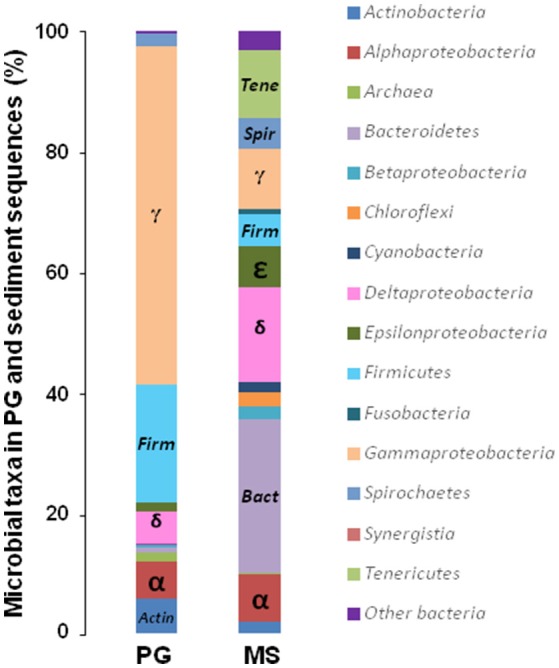
“With regard to the alpha diversity, the MS showed higher bacterial species richness (observed OTU) and species diversity (Shannon, Simpson indices) than the PG (Table 1).”
§ Microbial Diversity in Sulfate-Reducing Marine Sediment Enrichment Cultures Associated with Anaerobic Biotransformation of Coastal Stockpiled Phosphogypsum (Sfax, Tunisia) > Results and discussion > Microbial diversity in marine sediment and phosphogypsum samples
plain- Asserted: passes — The authors put it forward as true.
- Checkable: passes — It can be checked against evidence.
- Load-bearing: unclear — It is unclear whether the paper’s conclusions depend on it.
- Based: passes — The paper gives a reason why it holds.
It may state two separate claims as one.
In the paper
“The PG was characterized by a high sulfate content (55% of the PG dry weight), a very low organic carbon content (0.53 ± 0.15%), and a low pH-value (3.1), as previously reported for Tunisian PG (Azabou et al., 2005), which was lower than pH-values of European PG (Martins et al., 2016; Table S2).”
§ Microbial Diversity in Sulfate-Reducing Marine Sediment Enrichment Cultures Associated with Anaerobic Biotransformation of Coastal Stockpiled Phosphogypsum (Sfax, Tunisia) > Results and discussion > Characteristics of marine sediments and phosphogypsum samples
What the sources say
- Not checked — no full text of the sourcecites Azabou et al., 2005 source
plain- Asserted: passes — The authors put it forward as true.
- Checkable: passes — It can be checked against evidence.
- Load-bearing: unclear — It is unclear whether the paper’s conclusions depend on it.
- Based: passes — The paper gives a reason why it holds.
It may state two separate claims as one.
None of the sources cited for this claim have been checked yet.
In the paper
“Worldwide PG production is estimated to be around 100–280 million tons per year (Mt/year; Tayibi et al., 2009), but only a small part is reprocessed (15%), and the majority is stockpiled.”
§ Microbial Diversity in Sulfate-Reducing Marine Sediment Enrichment Cultures Associated with Anaerobic Biotransformation of Coastal Stockpiled Phosphogypsum (Sfax, Tunisia) > Introduction
What the sources say
- Not checked yetcites Tayibi et al., 2009 source
Checked before — its earlier verdict is held back until a new check runs.
hedged- Asserted: passes — The authors put it forward as true.
- Checkable: passes — It can be checked against evidence.
- Load-bearing: fails — The paper’s conclusions may not depend on it.
- Based: passes — The paper gives a reason why it holds.
Probably not a substantial claim. The paper’s conclusions may not depend on it.
- Not checked yet
What the paper did — it cites no source for this, so there is none to check. The quote shows it is in the paper.
In the paper
“Controls were also prepared without added energy sources.”
- Also stated in: § Phosphogypsum-biotransforming and sulfate-reducing culture enrichments · plain
“with controls being prepared without inocula”
§ Microbial Diversity in Sulfate-Reducing Marine Sediment Enrichment Cultures Associated with Anaerobic Biotransformation of Coastal Stockpiled Phosphogypsum (Sfax, Tunisia) > Materials and methods > Phosphogypsum-biotransforming and sulfate-reducing culture enrichments
plain- Asserted: passes — The authors put it forward as true.
- Checkable: passes — It can be checked against evidence.
- Load-bearing: fails — The paper’s conclusions may not depend on it.
- Based: passes — The paper gives a reason why it holds.
Probably not a substantial claim. The paper’s conclusions may not depend on it. It may state two separate claims as one. The quote only partly states this claim.
- Also stated in: § Phosphogypsum-biotransforming and sulfate-reducing culture enrichments · plain
In the paper
“In Tunisia, one of the main phosphate producing countries in the world, the phosphate fertilizer plants are mainly located around the Gulf of Gabes and produce 1–10 Mt/year PG (Ajam et al., 2009).”
§ Microbial Diversity in Sulfate-Reducing Marine Sediment Enrichment Cultures Associated with Anaerobic Biotransformation of Coastal Stockpiled Phosphogypsum (Sfax, Tunisia) > Introduction
What the sources say
- Not checked — no full text of the sourcecites Ajam et al., 2009 source
plain- Asserted: passes — The authors put it forward as true.
- Checkable: passes — It can be checked against evidence.
- Load-bearing: fails — The paper’s conclusions may not depend on it.
- Based: passes — The paper gives a reason why it holds.
Probably not a substantial claim. The paper’s conclusions may not depend on it. It may state two separate claims as one.
None of the sources cited for this claim have been checked yet.
In the paper
“In PG cultures, the majority of abundant Firmicutes were related to clostridial species (Figure 6), such as the non-sulfate-reducing bacterium, Clostridium perfringens, which may use thiosulfate and sulfite as electron acceptors (Fuchs and Bonde, 1957; André et al., 2010), or the potential sulfate, thiosulfate- or sulfite-reducer, Brassicibacter thermophilus (Wang et al., 2015).”
§ Microbial Diversity in Sulfate-Reducing Marine Sediment Enrichment Cultures Associated with Anaerobic Biotransformation of Coastal Stockpiled Phosphogypsum (Sfax, Tunisia) > Results and discussion > Dominant bacterial species in the enrichment cultures containing phosphogypsum or sodium sulfate
What the sources say
hedgedconditional- Asserted: passes — The authors put it forward as true.
- Checkable: passes — It can be checked against evidence.
- Load-bearing: unclear — It is unclear whether the paper’s conclusions depend on it.
- Based: passes — The paper gives a reason why it holds.
It may state two separate claims as one.
None of the sources cited for this claim have been checked yet.
In the paper
“For instance, Zn can be toxic at concentrations varying between 25 and 150 mg/L, while toxic Cd concentration can range between 4 and 40 mg/L (Hao et al., 1994; Azabou et al., 2007a; Martins et al., 2009).”
§ Microbial Diversity in Sulfate-Reducing Marine Sediment Enrichment Cultures Associated with Anaerobic Biotransformation of Coastal Stockpiled Phosphogypsum (Sfax, Tunisia) > Results and discussion > Dominant bacterial species in the enrichment cultures containing phosphogypsum or sodium sulfate
What the sources say
plain- Asserted: passes — The authors put it forward as true.
- Checkable: passes — It can be checked against evidence.
- Load-bearing: fails — The paper’s conclusions may not depend on it.
- Based: passes — The paper gives a reason why it holds.
Probably not a substantial claim. The paper’s conclusions may not depend on it.
None of the sources cited for this claim have been checked yet.
In the paper
“PG consists mainly of calcium sulfate dihydrate (CaSO4·2H2O), and is characterized by strongly acidic pH (pH ~3) due to the presence of phosphoric acid and sulfuric acid residues (Zairi and Rouis, 1999; Azabou et al., 2005; Zmemla et al., 2016).”
§ Microbial Diversity in Sulfate-Reducing Marine Sediment Enrichment Cultures Associated with Anaerobic Biotransformation of Coastal Stockpiled Phosphogypsum (Sfax, Tunisia) > Introduction
What the sources say
- Not checked — no full text of the sourcecites Zairi and Rouis, 1999
- Not checked — no full text of the sourcecites Azabou et al., 2005 source
- Not matchedcites Zmemla et al., 2016
Couldn’t be matched to a paper in Crossref, so it can’t be checked.
plaindirect- Asserted: passes — The authors put it forward as true.
- Checkable: passes — It can be checked against evidence.
- Load-bearing: passes — The paper’s conclusions depend on it.
- Based: passes — The paper gives a reason why it holds.
It may state two separate claims as one.
In the paper
“reported as a hydrogenotrophic methanogen using methanol as terminal electron acceptor (Dridi et al., 2012)”
§ Microbial Diversity in Sulfate-Reducing Marine Sediment Enrichment Cultures Associated with Anaerobic Biotransformation of Coastal Stockpiled Phosphogypsum (Sfax, Tunisia) > Results and discussion > Microbial diversity in marine sediment and phosphogypsum samples
What the sources say
- Not checked — no full text of the sourcecites Dridi et al., 2012 source
plain- Asserted: passes — The authors put it forward as true.
- Checkable: passes — It can be checked against evidence.
- Load-bearing: fails — The paper’s conclusions may not depend on it.
- Based: passes — The paper gives a reason why it holds.
Probably not a substantial claim. The paper’s conclusions may not depend on it.
What the paper did — it cites no source for this, so there is none to check. The quote shows it is in the paper.
In the paper
“Sulfate-reducing culture enrichments were performed in duplicate using 120 mL glass bottles containing the following basal medium components”
§ Microbial Diversity in Sulfate-Reducing Marine Sediment Enrichment Cultures Associated with Anaerobic Biotransformation of Coastal Stockpiled Phosphogypsum (Sfax, Tunisia) > Materials and methods > Phosphogypsum-biotransforming and sulfate-reducing culture enrichments
plain- Asserted: passes — The authors put it forward as true.
- Checkable: passes — It can be checked against evidence.
- Load-bearing: fails — The paper’s conclusions may not depend on it.
- Based: passes — The paper gives a reason why it holds.
Probably not a substantial claim. The paper’s conclusions may not depend on it.
A claim is checked only against the cited paper’s full text, never its abstract, and none is available for its sources.
In the paper
“These SRB species have been isolated from saline and marine environments (Widdel, 1987; Brandt et al., 1999).”
§ Microbial Diversity in Sulfate-Reducing Marine Sediment Enrichment Cultures Associated with Anaerobic Biotransformation of Coastal Stockpiled Phosphogypsum (Sfax, Tunisia) > Results and discussion > Microbial diversity in marine sediment and phosphogypsum samples
What the sources say
plain- Asserted: passes — The authors put it forward as true.
- Checkable: passes — It can be checked against evidence.
- Load-bearing: fails — The paper’s conclusions may not depend on it.
- Based: passes — The paper gives a reason why it holds.
Probably not a substantial claim. The paper’s conclusions may not depend on it.
None of the sources cited for this claim have been checked yet.
In the paper
“For instance, Zn can be toxic at concentrations varying between 25 and 150 mg/L, while toxic Cd concentration can range between 4 and 40 mg/L (Hao et al., 1994; Azabou et al., 2007a; Martins et al., 2009).”
§ Microbial Diversity in Sulfate-Reducing Marine Sediment Enrichment Cultures Associated with Anaerobic Biotransformation of Coastal Stockpiled Phosphogypsum (Sfax, Tunisia) > Results and discussion > Dominant bacterial species in the enrichment cultures containing phosphogypsum or sodium sulfate
What the sources say
plaindirect- Asserted: passes — The authors put it forward as true.
- Checkable: passes — It can be checked against evidence.
- Load-bearing: fails — The paper’s conclusions may not depend on it.
- Based: passes — The paper gives a reason why it holds.
Probably not a substantial claim. The paper’s conclusions may not depend on it.
In the paper
“Thereafter, H2S may be oxidized into sulfuric acid by sulfide-oxidizing bacteria to be possibly reused in the fertilizer industry to produce phosphoric acid (Pokorna and Zabranska, 2015).”
§ Microbial Diversity in Sulfate-Reducing Marine Sediment Enrichment Cultures Associated with Anaerobic Biotransformation of Coastal Stockpiled Phosphogypsum (Sfax, Tunisia) > Introduction
What the sources say
- Not checked — no full text of the sourcecites Pokorna and Zabranska, 2015 source
hedgedconditional- Asserted: passes — The authors put it forward as true.
- Checkable: passes — It can be checked against evidence.
- Load-bearing: fails — The paper’s conclusions may not depend on it.
- Based: passes — The paper gives a reason why it holds.
Probably not a substantial claim. The paper’s conclusions may not depend on it.
A conclusion the paper draws from its own results — it cites no other source for it, so there is none to check. The quote shows it is in the paper.
In the paper
“This result suggests that PG inhibited growth of some AC- and LAC-utilizing SRB, and/or favored incomplete SRB.”
§ Microbial Diversity in Sulfate-Reducing Marine Sediment Enrichment Cultures Associated with Anaerobic Biotransformation of Coastal Stockpiled Phosphogypsum (Sfax, Tunisia) > Results and discussion > Microbial H2S production using sodium sulfate or phosphogypsum as sulfate source
hedgedconditional- Asserted: passes — The authors put it forward as true.
- Checkable: passes — It can be checked against evidence.
- Load-bearing: passes — The paper’s conclusions depend on it.
- Based: passes — The paper gives a reason why it holds.
It may state two separate claims as one.
What the paper did — it cites no source for this, so there is none to check. The quote shows it is in the paper.
In the paper
“Treatment effects (i.e., sulfate source, type of substrate) on parameters to be analyzed (i.e., H2S production, microbial diversity) were evaluated using a one-way analysis of variance (ANOVA) with a Bonferroni post-hoc test using SPSS version 17.0 (SPSS Statistics, Inc., Chicago, IL, USA). P < 0.05 were considered as statistically significant.”
§ Microbial Diversity in Sulfate-Reducing Marine Sediment Enrichment Cultures Associated with Anaerobic Biotransformation of Coastal Stockpiled Phosphogypsum (Sfax, Tunisia) > Materials and methods > Statistical analyses
plain- Asserted: passes — The authors put it forward as true.
- Checkable: passes — It can be checked against evidence.
- Load-bearing: passes — The paper’s conclusions depend on it.
- Based: passes — The paper gives a reason why it holds.
Probably not a substantial claim. It may state two separate claims as one.
None of the sources cited for this claim have been checked yet.
In the paper
“Worldwide PG production is estimated to be around 100–280 million tons per year (Mt/year; Tayibi et al., 2009), but only a small part is reprocessed (15%), and the majority is stockpiled.”
§ Microbial Diversity in Sulfate-Reducing Marine Sediment Enrichment Cultures Associated with Anaerobic Biotransformation of Coastal Stockpiled Phosphogypsum (Sfax, Tunisia) > Introduction
What the sources say
- Not checked yetcites Tayibi et al., 2009 source
Checked before — its earlier verdict is held back until a new check runs.
plain- Asserted: passes — The authors put it forward as true.
- Checkable: passes — It can be checked against evidence.
- Load-bearing: fails — The paper’s conclusions may not depend on it.
- Based: passes — The paper gives a reason why it holds.
Probably not a substantial claim. The paper’s conclusions may not depend on it. It may state two separate claims as one.
- Not checked yet
In the paper
“During the course of these processes, SRB were shown to be particularly active in sulfate reduction from PG into hydrogen sulfide (H2S; Azabou et al., 2005).”
§ Microbial Diversity in Sulfate-Reducing Marine Sediment Enrichment Cultures Associated with Anaerobic Biotransformation of Coastal Stockpiled Phosphogypsum (Sfax, Tunisia) > Introduction
What the sources say
- Not checked — no full text of the sourcecites Azabou et al., 2005 source
boosteddirect- Asserted: passes — The authors put it forward as true.
- Checkable: passes — It can be checked against evidence.
- Load-bearing: passes — The paper’s conclusions depend on it.
- Based: passes — The paper gives a reason why it holds.
Probably not a substantial claim.
None of the sources cited for this claim have been checked yet.
In the paper
“Various types of inocula, such as soil or sludge, have been tested over the last 10 years (Thabet et al., 2016), but it is only recently that one study has explored microbial diversity in such bioprocess (Martins et al., 2016).”
§ Microbial Diversity in Sulfate-Reducing Marine Sediment Enrichment Cultures Associated with Anaerobic Biotransformation of Coastal Stockpiled Phosphogypsum (Sfax, Tunisia) > Introduction
What the sources say
plain- Asserted: passes — The authors put it forward as true.
- Checkable: passes — It can be checked against evidence.
- Load-bearing: fails — The paper’s conclusions may not depend on it.
- Based: passes — The paper gives a reason why it holds.
Probably not a substantial claim. The paper’s conclusions may not depend on it. It may state two separate claims as one.
In the paper
“In coastal marine environments, where sulfate is present in large quantities, SRB contribute up to 50% of organic matter mineralization (Jørgensen, 1982).”
§ Microbial Diversity in Sulfate-Reducing Marine Sediment Enrichment Cultures Associated with Anaerobic Biotransformation of Coastal Stockpiled Phosphogypsum (Sfax, Tunisia) > Introduction
What the sources say
- Not checked — no full text of the sourcecites Jørgensen, 1982 source
plaindirect- Asserted: passes — The authors put it forward as true.
- Checkable: passes — It can be checked against evidence.
- Load-bearing: fails — The paper’s conclusions may not depend on it.
- Based: passes — The paper gives a reason why it holds.
Probably not a substantial claim. The paper’s conclusions may not depend on it.
None of the sources cited for this claim have been checked yet.
In the paper
“M. luminyensis were also detected in low-pH environments impacted by acid mine drainage (Mendez-Garcia et al., 2014).”
§ Microbial Diversity in Sulfate-Reducing Marine Sediment Enrichment Cultures Associated with Anaerobic Biotransformation of Coastal Stockpiled Phosphogypsum (Sfax, Tunisia) > Results and discussion > Microbial diversity in marine sediment and phosphogypsum samples
What the sources say
- Not checked yetcites Mendez-Garcia et al., 2014 source
Checked before — its earlier verdict is held back until a new check runs.
plain- Asserted: passes — The authors put it forward as true.
- Checkable: passes — It can be checked against evidence.
- Load-bearing: fails — The paper’s conclusions may not depend on it.
- Based: passes — The paper gives a reason why it holds.
Probably not a substantial claim. The paper’s conclusions may not depend on it.
- Not checked yet
None of the sources cited for this claim have been checked yet.
In the paper
“Phosphogypsum (PG) is the main by-product of the production of phosphate fertilizers.”
§ Microbial Diversity in Sulfate-Reducing Marine Sediment Enrichment Cultures Associated with Anaerobic Biotransformation of Coastal Stockpiled Phosphogypsum (Sfax, Tunisia) > Introduction
What the sources say
- Not checked yetcites Tayibi et al., 2009 source
Checked before — its earlier verdict is held back until a new check runs.
- Not matchedcites Gennari et al., 2011
Couldn’t be matched to a paper in Crossref, so it can’t be checked.
plain- Asserted: passes — The authors put it forward as true.
- Checkable: passes — It can be checked against evidence.
- Load-bearing: fails — The paper’s conclusions may not depend on it.
- Based: passes — The paper gives a reason why it holds.
Probably not a substantial claim. The paper’s conclusions may not depend on it.
- Not checked yet
None of the sources cited for this claim have been checked yet.
In the paper
“The performance of PG biotransformation was shown to depend on bacterial species, inoculum size, PG loading, pH, and temperature, but also type of substrates (Azabou et al., 2005; Rzeczycka and Blaszczyk, 2005).”
§ Microbial Diversity in Sulfate-Reducing Marine Sediment Enrichment Cultures Associated with Anaerobic Biotransformation of Coastal Stockpiled Phosphogypsum (Sfax, Tunisia) > Introduction
What the sources say
- Not checked — no full text of the sourcecites Azabou et al., 2005 source
- Not matchedcites Rzeczycka and Blaszczyk, 2005
Couldn’t be matched to a paper in Crossref, so it can’t be checked.
plaindirect- Asserted: passes — The authors put it forward as true.
- Checkable: passes — It can be checked against evidence.
- Load-bearing: fails — The paper’s conclusions may not depend on it.
- Based: passes — The paper gives a reason why it holds.
Probably not a substantial claim. The paper’s conclusions may not depend on it. It may state two separate claims as one.
None of the sources cited for this claim have been checked yet.
In the paper
“Among them, the anaerobic bio-treatment of PG using pure or mixed cultures of sulfate-reducing bacteria (SRB) grown on simple or complex substrates, such as organic industrial and agricultural wastes has been reported (Azabou et al., 2005; Rzeczycka and Blaszczyk, 2005; Wolicka, 2008; Martins et al., 2016).”
§ Microbial Diversity in Sulfate-Reducing Marine Sediment Enrichment Cultures Associated with Anaerobic Biotransformation of Coastal Stockpiled Phosphogypsum (Sfax, Tunisia) > Introduction
What the sources say
plain- Asserted: passes — The authors put it forward as true.
- Checkable: passes — It can be checked against evidence.
- Load-bearing: fails — The paper’s conclusions may not depend on it.
- Based: passes — The paper gives a reason why it holds.
Probably not a substantial claim. The paper’s conclusions may not depend on it.
In the paper
“Contrary to PG cultures, the Na2SO4 cultures were represented by a higher number of haloterant or halophilic genera also affiliated to the Clostridiales order (Figure 6), such as the thiosulfate- and/or sulfur-reducing Fusibacter spp. (Ben Hania et al., 2012) and the non-sugar fermenting Clostridiisalibacter spp. (Liebgott et al., 2008), isolated from olive mill wastewater in Tunisia.”
§ Microbial Diversity in Sulfate-Reducing Marine Sediment Enrichment Cultures Associated with Anaerobic Biotransformation of Coastal Stockpiled Phosphogypsum (Sfax, Tunisia) > Results and discussion > Dominant bacterial species in the enrichment cultures containing phosphogypsum or sodium sulfate
What the sources say
- Not checked — no full text of the sourcecites Liebgott et al., 2008 source
plain- Asserted: passes — The authors put it forward as true.
- Checkable: passes — It can be checked against evidence.
- Load-bearing: fails — The paper’s conclusions may not depend on it.
- Based: passes — The paper gives a reason why it holds.
Probably not a substantial claim. The paper’s conclusions may not depend on it. It may state two separate claims as one.
A conclusion the paper draws from its own results — it cites no other source for it, so there is none to check. The quote shows it is in the paper.
In the paper
“The absence of these clostridial species in PG cultures may result from toxicity of PG or may due to competition with other bacterial species in its presence.”
§ Microbial Diversity in Sulfate-Reducing Marine Sediment Enrichment Cultures Associated with Anaerobic Biotransformation of Coastal Stockpiled Phosphogypsum (Sfax, Tunisia) > Results and discussion > Dominant bacterial species in the enrichment cultures containing phosphogypsum or sodium sulfate
hedgedconditional- Asserted: passes — The authors put it forward as true.
- Checkable: passes — It can be checked against evidence.
- Load-bearing: fails — The paper’s conclusions may not depend on it.
- Based: fails — The paper may give no reason why it holds.
Probably not a substantial claim. The paper’s conclusions may not depend on it. The paper may give no reason why it holds. It may state two separate claims as one.
The paper relies on this without support.
Discharge of PG into seawater or long-term PG stockpiling in close proximity to the sea presents a potential threat to surrounding coastal and marine ecosystems with substantial impact on human and environmental health and activities.
“Moreover, the discharge of PG into the seawater or long-term PG stockpiling in close proximity to the sea present a potential threat to the surrounding coastal and marine ecosystems with substantial impact on human and environmental health and activities.”
The paper relies on this without support.
The composition of total indigenous microbial populations inhabiting Tunisian PG has not yet been reported.
“However, to the best of our knowledge, the composition of total indigenous microbial populations inhabiting Tunisian PG has not yet been reported.”
The paper relies on this without support.
The biotechnological potential and diversity of marine SRB originating from PG-polluted coastal marine ecosystems to carry out such reductive process have not yet been studied.
“Despite the abundance of SRB in marine ecosystems and their efficiencies in PG biotransformation, the biotechnological potential, and diversity of marine SRB, originating from PG-polluted coastal marine ecosystems, to carry out such reductive process have not yet been studied.”
The paper relies on this without support.
Commercial development of PG biotransformation by SRB has been substantially limited by challenges including efficient reduction or immobilization of co-contaminants, use of low-cost and abundant renewable water sources for sulfate reduction, and improvement of sulfate reduction yields.
“Thus, despite some advances in research on PG biotransformation by SRB (bioremediation process), its commercial development has been substantially limited by certain major challenges. These include the efficient reduction or immobilization of co-contaminants (i.e., trace metals, radionuclides), the use of low-cost and abundant renewable water sources for sulfate reduction (e.g., wastewaters and/or”
The paper relies on this without support.
PG contains trace metals.
“The absence of Desulfobacter spp. in PG cultures could be explained by the presence of trace metals in PG.”
The paper relies on this without support.
Desulfovibrio spp. are powerful hydrogenotrophic SRB.
“The first deltaproteobacterial group present in PG cultures comprised Desulfovibrio spp., which are known as powerful hydrogenotrophic SRB.”
The paper relies on this without support.
Desulfobacter spp. are active AC-oxidizing SRB.
“The second deltaproteobacterial group containing Desulfobacter spp. (Figure 5), which are active AC-oxidizing SRB (contrary to Desulfovibrio spp.), was only retrieved in Na2SO4 cultures, suggesting that such members were inhibited by PG.”
Self-check
Percentages, sums and reported differences re-computed from the paper’s own numbers.
Each contradiction between two passages listed here was confirmed by an independent check.
Rated minor: it would not touch a result — a value no result rests on, a p-value that stays on the same side of the significance level, or a conflict that is clerical, resolved elsewhere in the paper, or outside its own findings.
In the paper
“The Cd concentration (61.9 mg/kg) was 10.4-fold higher than the average concentration measured in previous coastal sediments of Sfax (7.2 ± 0.9 mg/kg)”
§ Microbial Diversity in Sulfate-Reducing Marine Sediment Enrichment Cultures Associated with Anaerobic Biotransformation of Coastal Stockpiled Phosphogypsum (Sfax, Tunisia) > Results and discussion > Characteristics of marine sediments and phosphogypsum samples
Reported 10.4 · recomputed 8.597222
Rated minor: it would not touch a result — a value no result rests on, a p-value that stays on the same side of the significance level, or a conflict that is clerical, resolved elsewhere in the paper, or outside its own findings.
In the paper
§ Microbial Diversity in Sulfate-Reducing Marine Sediment Enrichment Cultures Associated with Anaerobic Biotransformation of Coastal Stockpiled Phosphogypsum (Sfax, Tunisia) > Results and discussion > Microbial H2S production using sodium sulfate or phosphogypsum as sulfate source
“3.0 ± 0.2 mM/day with PG”
§ Microbial Diversity in Sulfate-Reducing Marine Sediment Enrichment Cultures Associated with Anaerobic Biotransformation of Coastal Stockpiled Phosphogypsum (Sfax, Tunisia) > Results and discussion > Microbial H2S production using sodium sulfate or phosphogypsum as sulfate source
“| SPF | 19.7 ± 3.7 | 3.0 ± 1.0 | 10.0 ± 2.0 | 7.6 ± 0.0 | 100.0 ± 0.1 | 87.5 ± 6.5 |”
Rated minor: it would not touch a result — a value no result rests on, a p-value that stays on the same side of the significance level, or a conflict that is clerical, resolved elsewhere in the paper, or outside its own findings.
In the paper
§ Microbial Diversity in Sulfate-Reducing Marine Sediment Enrichment Cultures Associated with Anaerobic Biotransformation of Coastal Stockpiled Phosphogypsum (Sfax, Tunisia) > Results and discussion > Microbial diversity in marine sediment and phosphogypsum samples
“Among the sixteen abundant OTUs (>1%)”
§ Microbial Diversity in Sulfate-Reducing Marine Sediment Enrichment Cultures Associated with Anaerobic Biotransformation of Coastal Stockpiled Phosphogypsum (Sfax, Tunisia) > Results and discussion > Microbial diversity in marine sediment and phosphogypsum samples
“| PG | 35018 | 224 | 20 | 275.8 | 0.88 | 4.51 |”
Rated minor: it would not touch a result — a value no result rests on, a p-value that stays on the same side of the significance level, or a conflict that is clerical, resolved elsewhere in the paper, or outside its own findings.
In the paper
§ Microbial Diversity in Sulfate-Reducing Marine Sediment Enrichment Cultures Associated with Anaerobic Biotransformation of Coastal Stockpiled Phosphogypsum (Sfax, Tunisia) > Results and discussion > Microbial diversity in marine sediment and phosphogypsum samples
“the OTUs were mainly assigned to 9 bacterial phyla”
§ Microbial Diversity in Sulfate-Reducing Marine Sediment Enrichment Cultures Associated with Anaerobic Biotransformation of Coastal Stockpiled Phosphogypsum (Sfax, Tunisia) > Results and discussion > Microbial diversity in marine sediment and phosphogypsum samples
“Proteobacteria (42.2% of the sequences), Bacteroidetes (25.5%), Tenericutes (11.2%), Spirochaetes (5.0%), Chloroflexi (2.5%), Actinobacteria (2.0%), Cyanobacteria (1.6%), Fusobacteria (0.8%; Figure 1)”
Citations
Cites
Basic local alignment search tool
Altschul, S. F., Gish, W., Miller, W., Myers, E. W., & Lipman, D. J. (1990) · Journal of Molecular Biology · doi:10.1006/jmbi.1990.9999 · Cited by 98,669
CONFIDENCE LIMITS ON PHYLOGENIES: AN APPROACH USING THE BOOTSTRAP
Felsenstein, J. (1985) · Evolution · doi:10.1111/j.1558-5646.1985.tb00420.x · Cited by 44,791
MUSCLE: multiple sequence alignment with high accuracy and high throughput
Edgar, R. C. (2004) · Nucleic Acids Research · doi:10.1093/nar/gkh340 · Cited by 44,662
MEGA7: Molecular Evolutionary Genetics Analysis Version 7.0 for Bigger Datasets
Kumar, S., Stecher, G., & Tamura, K. (2016) · Molecular Biology and Evolution · doi:10.1093/molbev/msw054 · Cited by 44,609
MEGA6: Molecular Evolutionary Genetics Analysis version 6.0.
Tamura, K., Stecher, G., Peterson, D., Filipski, A., & Kumar, S. (2013) · Molecular biology and evolution · doi:10.1093/molbev/mst197 · Cited by 41,174
QIIME allows analysis of high-throughput community sequencing data
Caporaso, J. G., Kuczynski, J., Stombaugh, J., Bittinger, K., Bushman, F. D., Costello, E. K., Fierer, N., Peña, A. G., Goodrich, J. K., Gordon, J. I., et al. (2010) · Nature Methods · doi:10.1038/nmeth.f.303 · Cited by 34,887
Search and clustering orders of magnitude faster than BLAST
Edgar, R. C. (2010) · Bioinformatics · doi:10.1093/bioinformatics/btq461 · Cited by 21,098
Tamura, K., & Nei, M. (1993) · Molecular Biology and Evolution · doi:10.1093/oxfordjournals.molbev.a040023 · Cited by 11,390
THE POPULATION FREQUENCIES OF SPECIES AND THE ESTIMATION OF POPULATION PARAMETERS
Good, I. J. (1953) · Biometrika · doi:10.1093/biomet/40.3-4.237 · Cited by 3,427
Mineralization of organic matter in the sea bed-the role of sulphate reduction
Jørgensen, B. B. (1982) · Nature · doi:10.1038/296643a0 · Cited by 1,540
Research works printed but not linked: 3
- Ben Amor, 2012, Reforme Politique Concernant la Gestion du Phosphogypse en Tunisie
- Gennari, 2011, Phosphogypsum analysis: total content and extractable element concentrations, 2011
- Inhibition of sulphate-reducing bacteria by metal sulphide formation in bioremediation of acid mine drainage4048 UtgikarV. P. HarmonS. M. ChaudharyN. TabakH. H. GovingR. HainesJ. R. 10.1002/tox.10031Environ. Toxicol.172002 · DOI
Cited by
Sorted by citations
Phosphogypsum Recycling: A Review of Environmental Issues, Current Trends, and Prospects
Chernysh, Y., Yakhnenko, O., Chubur, V., & Roubík, H. (2021) · Applied Sciences · doi:10.3390/app11041575 · Cited by 397
Bounaga, A., Alsanea, A., Lyamlouli, K., Zhou, C., Zeroual, Y., Boulif, R., & Rittmann, B. E. (2022) · Biotechnology Advances · doi:10.1016/j.biotechadv.2022.107949 · Cited by 62
Effects of phosphogypsum on enzyme activity and microbial community in acid soil
Li, C., Dong, Y., Yi, Y., Juan, T., Xuan, C., Wang, Y., Wen, Y., & Cao, J. (2023) · Scientific Reports · doi:10.1038/s41598-023-33191-2 · Cited by 62
Detection of sentinel bacteria in mangrove sediments contaminated with heavy metals.
Fernández‐Cadena, J. C., Ruiz‐Fernández, P., Fernández-Ronquillo, T. E., Dı́ez, B., Trefault, N., Andrade, S. J., & la Iglesia, R. D. (2019) · Marine Pollution Bulletin · doi:10.1016/j.marpolbul.2019.110701 · Cited by 61
Jalali, J., Gaudin, P., Capiaux, H., Ammar, E., & Lebeau, T. (2019) · Ecotoxicology and Environmental Safety · doi:10.1016/j.ecoenv.2019.02.051 · Cited by 55
Metadata
- Authors
- Zouch, H., Karray, F., Armougom, F., Chifflet, S., Hirschler-Réa, A., Kharrat, H., Kamoun, L., Ben Hania, W., Ollivier, B., Sayadi, S., & Quéméneur, M.
- Affiliations
- Centre National de la Recherche Scientifique (FR)
- Centre of Biotechnology of Sfax (TN)
- Groupe Chimique Tunisien (Tunisia) (TN)
- Corresponding author
- Quéméneur, Marianne
- ORCID
- Venue
- Frontiers in Microbiology
- Publisher
- Frontiers Media SA
- Published
- 2017-08-21
- Volume
- 8
- Pages
- 1583-1583
- ISSN
- 1664-302X (ISSN-L)
- PMC
- PMC5566975
- OpenAlex
- W2746696712
- Semantic Scholar
- 7e60d910e4217ccbb139b2207a731176f8d92615
- Cited by
- 37
- References
- 62
- Citations by year
- 2026: 2 · 2025: 3 · 2024: 2 · 2023: 6 · 2022: 2 · 2021: 8 · 2020: 4 · 2019: 8 · 2018: 2
- FWCI
- 1.95
- Type
- journal article
- Language
- en
- Open access
- gold
- doi.org
- Licence
- cc-by
- Locations
- Frontiers in Microbiology (publishedVersion, cc-by)
- Europe PMC (PubMed Central) (publishedVersion, cc-by)
- PubMed Central (publishedVersion, cc-by)
- PubMed (publishedVersion)
- HAL AMU (submittedVersion, other-oa)
- DOAJ (DOAJ: Directory of Open Access Journals) (submittedVersion, cc-by-sa)
- Greater South Information System
- Funders
- Centre National de la Recherche Scientifique (EC2CO)
- Topics
- Physical Sciences › Environmental Science › Environmental Chemistry › Mine drainage and remediation techniques
- Physical Sciences › Environmental Science › Ecology › Microbial Community Ecology and Physiology
- Physical Sciences › Environmental Science › Environmental Engineering › Microbial Fuel Cells and Bioremediation
- Keywords
- phosphogypsum, sulfate-reducing bacteria, marine sediment, enrichment culture, sulfide production, Desulfovibrio, Desulfobacter, Deltaproteobacteria, electron donors, formate, bioremediation, metal immobilization, microbial diversity
About these checks
Registry, retraction, Cites and statistics results are computed, not judged, with one exception: a printed reference that no index lists is read once by a model before it counts as a citation error. Claims are extracted by a model and kept only when their quote appears verbatim in the text; each cited source is then checked, with a model’s help, for whether it says what the claim relies on. Those verdicts can be wrong — read the claim’s quote and the cited source before relying on one.
A language model drew the claims from the paper on 2026-11-10, under version 3 of the claim definition (model deepseek-v4.1-flash, prompt extract-v3).
A second model labelled each claim on 2026-11-10 (model jev-1.13-20260917, definition revision gold-guideline-v0.2).
Cited sources are checked with a language model’s help (gpt-6-sol).
Statistics and arithmetic are recomputed, not judged.
Confidence bands are shown only for fields calibrated on our annotated test set. None is calibrated yet, so no band is shown.
What counts as a claim ›How we measure confidence ›How we check this ›
Are you an author, or do you see a problem with this page? Request a review
