

The DOI matches its Crossref record; 221 of the 221 references it cites were found in a registry or an index.
The Emerging Role of Central and Peripheral Immune Systems in Neurodegenerative Diseases
Open accessAbstract
For decades, it has been widely believed that the blood–brain barrier (BBB) provides an immune privileged environment in the central nervous system (CNS) by blocking peripheral immune cells and humoral immune factors. This view has been revised in recent years, with increasing evidence revealing that the peripheral immune system plays a critical role in regulating CNS homeostasis and disease. Neurodegenerative diseases are characterized by progressive dysfunction and the loss of neurons in the CNS. An increasing number of studies have focused on the role of the connection between the peripheral immune system and the CNS in neurodegenerative diseases. On the one hand, peripherally released cytokines can cross the BBB, cause direct neurotoxicity and contribute to the activation of microglia and astrocytes. On the other hand, peripheral immune cells can also infiltrate the brain and participate in the progression of neuroinflammatory and neurodegenerative diseases. Neurodegenerative diseases have a high morbidity and disability rate, yet there are no effective therapies to stop or reverse their progression. In recent years, neuroinflammation has received much attention as a therapeutic target for many neurodegenerative diseases. In this review, we highlight the emerging role of the peripheral and central immune systems in neurodegenerative diseases, as well as their interactions. A better understanding of the emerging role of the immune systems may improve therapeutic strategies for neurodegenerative diseases.
Overview
The claims and statistics of this paper haven’t been checked yet.
Run the check — free, no account needed. It reads the open-access text and checks the sources it cites.
Integrity signals
Registry
Cites
Statistics
Figures
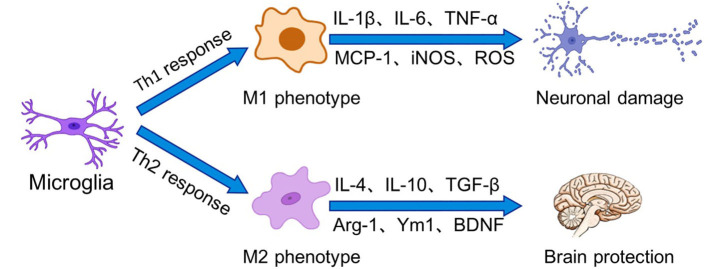
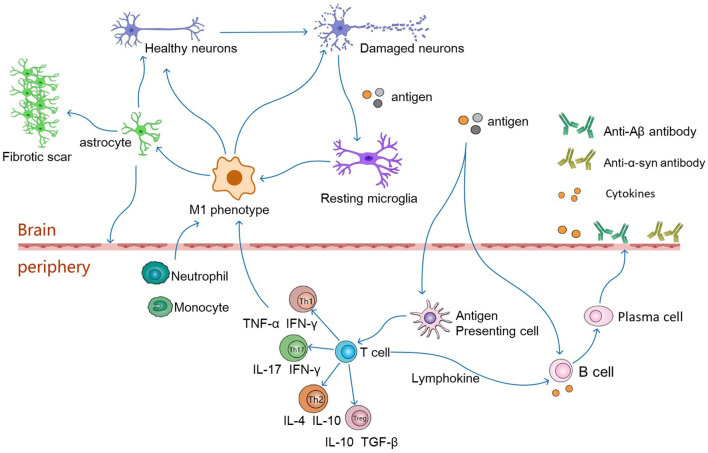
Verification
Claims the paper makes
The claims and statistics of this paper haven’t been checked yet.
Run the check — free, no account needed. It reads the open-access text and checks the sources it cites.
Claims other papers make about this one
Each is checked against this paper’s own text: does it say what the citing paper says it does?
The source backs part of the claim, not all of it — or backs it for a different population, condition or comparison.
In the citing paper
“but when acute, act as messengers to brain immune cells and signals to other local immune cells [44–46].”
From Alzheimer’s disease-associated protective variant Plcg2-P522R modulates peripheral macrophage function in a sex-dimorphic manner (2024) · cites this paper as [46]
Experimental — accuracy not yet measured
Self-check
Percentages, sums and reported differences re-computed from the paper’s own numbers.
The self-check needs the paper’s full text.
Citations
Cites
1 retracted
Items 201–221 of 221
Can immunotherapy treat neurodegeneration?
Schwartz, M. (2017) · Science · doi:10.1126/science.aai8231 · Cited by 47
Zella, M. A. S., Metzdorf, J., Ostendorf, F., Maass, F., Muhlack, S., Gold, R., Haghikia, A., & Tönges, L. (2019) · Cells · doi:10.3390/cells8020105 · Cited by 43
Komiya, H., Takeuchi, H., Ogawa, Y., Hatooka, Y., Takahashi, K., Katsumoto, A., Kubota, S., Nakamura, H., Kunii, M., Tada, M., et al. (2020) · Molecular Brain · doi:10.1186/s13041-020-00607-3 · Cited by 38
Salani, F., Sterbini, V., Sacchinelli, E., Garramone, M., & Bossù, P. (2019) · Frontiers in Immunology · doi:10.3389/fimmu.2019.01768 · Cited by 37
ERLIN1 mutations cause teenage-onset slowly progressive ALS in a large Turkish pedigree
Tunca, C., Akçimen, F., Coşkun, C., Gündoğdu-Eken, A., Koçoğlu, C., Çevik, B., Bekircan‐Kurt, C. E., Tan, E., & Başak, A. N. (2018) · European Journal of Human Genetics · doi:10.1038/s41431-018-0107-5 · Cited by 36
Recent developments in the management of Huntington's disease
Devadiga, S., & Bharate, S. S. (2022) · Bioorganic Chemistry · doi:10.1016/j.bioorg.2022.105642 · Cited by 36
Xu, W., Lau, Z. W. X., Fülöp, T., & Larbi, A. (2020) · Cells · doi:10.3390/cells9051181 · Cited by 36
Yu, J., Guo, M., Lǐ, Y., Zhang, H., Chai, Z., Wang, Q., Yan, Y., Yu, J., Liu, C., Zhang, G., et al. (2019) · Folia Neuropathologica · doi:10.5114/fn.2019.86299 · Cited by 32
Lin, L.-W., Tsai, F.-H., Lan, W.-C., Cheng, Y.-D., Lee, S.-C., & Wu, C.-R. (2019) · Molecular Neurobiology · doi:10.1007/s12035-018-1436-7 · Cited by 31
Haseeb, M., Javaid, N., Yasmeen, F., Jeong, U., Han, J. H., Yoon, J., Seo, J. Y., Heo, J.-K., Shin, H. C., Kim, M. S., et al. (2022) · ACS Chemical Neuroscience · doi:10.1021/acschemneuro.1c00831 · Cited by 30
Tolerogenic Dendritic Cells Reduce Cardiac Inflammation and Fibrosis in Chronic Chagas Disease
Santos, E. D. S., de Aragão-França, L. S., Meira, C. S., Cerqueira, J. V., Vasconcelos, J. F., Nonaka, C. K. V., Pontes-de-Carvalho, L. C., & Soares, M. B. P. (2020) · Frontiers in Immunology · doi:10.3389/fimmu.2020.00488 · Cited by 30
Dendritic Cells as an Alternate Approach for Treatment of Neurodegenerative Disorders
Brezováková, V., Valachova, B., Hanes, J., Novák, M., & Jadhav, S. (2018) · Cellular and Molecular Neurobiology · doi:10.1007/s10571-018-0598-1 · Cited by 29
Sabahi, M., Joshaghanian, A., Dolatshahi, M., Jabbari, P., Rahmani, F., & Rezaei, N. (2021) · Journal of Molecular Neuroscience · doi:10.1007/s12031-021-01818-6 · Cited by 26
Kobo, H., Bar‐Shira, A., Dahary, D., Gan‐Or, Z., Mirelman, A., Goldstein, O., Giladi, N., & Orr‐Urtreger, A. (2015) · Molecular Genetics and Metabolism · doi:10.1016/j.ymgme.2015.09.005 · Cited by 25
Peripheral Routes to Neurodegeneration: Passing Through the Blood–Brain Barrier
Giannoni, P., Claeysen, S., Noè, F. M., & Marchi, N. (2020) · Frontiers in Aging Neuroscience · doi:10.3389/fnagi.2020.00003 · Cited by 25
Dynamic glial response and crosstalk in demyelination-remyelination and neurodegeneration processes
Shields, C. B., Cai, J., Chu, T., Shields, L. B. E., Zeng, W., Zhang, Y., Wang, Y., & Barnes, G. N. (2020) · Neural Regeneration Research · doi:10.4103/1673-5374.300975 · Cited by 21
Harnessing the immune system for the treatment of Parkinson’s disease
Vedam‐Mai, V. (2021) · Brain Research · doi:10.1016/j.brainres.2021.147308 · Cited by 20
Hill, A. E., Wade‐Martins, R., & Burnet, P. W. J. (2021) · Frontiers in Neuroscience · doi:10.3389/fnins.2021.708587 · Cited by 19
Li, C., Chen, Y.-H., & Zhang, K. (2020) · American Journal of Alzheimer's Disease & Other Dementias® · doi:10.1177/1533317520927169 · Cited by 17
Microglia-induced reactive astrocytes — toxic players in neurological disease?
Ridler, C. E. (2017) · Nature Reviews Neurology · doi:10.1038/nrneurol.2017.17 · Cited by 14
Immunosuppressive Effects of the Traditional Chinese Herb Qu Mai on Human Alloreactive T Cells
Reid‐Adam, J., Yang, N., Song, Y., Cravedi, P., Xm, L., & Heeger, P. S. (2013) · American Journal of Transplantation · doi:10.1111/ajt.12180 · Cited by 13
Cited by
Sorted by citations
Adamu, A., Li, S., Gao, F., & Xue, G. (2024) · Frontiers in Aging Neuroscience · doi:10.3389/fnagi.2024.1347987 · Cited by 564
COVID-19 and risk of neurodegenerative disorders: A Mendelian randomization study
Li, C., Liu, J., Lin, J., & Shang, H. (2022) · Translational Psychiatry · doi:10.1038/s41398-022-02052-3 · Cited by 150
Kim, S., Jung, U. J., & Kim, S. R. (2025) · Journal of Clinical Medicine · doi:10.3390/jcm14020386 · Cited by 129
Polyphenols: immunonutrients tipping the balance of immunometabolism in chronic diseases
Ferreira, C., Vieira, P., Sá, H., Malva, J. O., Castelo-Branco, M. S., Reis, F., & Viana, S. (2024) · Frontiers in Immunology · doi:10.3389/fimmu.2024.1360065 · Cited by 110
Kim, M. E., & Lee, J. S. (2024) · Current Issues in Molecular Biology · doi:10.3390/cimb47010008 · Cited by 82
Metadata
- Authors
- Zang, X., Chen, S., Zhu, J., Ma, J., & Zhai, Y.
- Affiliations
- Sheng Jing Hospital (CN)
- Fourth Affiliated Hospital of China Medical University (CN)
- Corresponding author
- Zhai, Yongzhen
- Venue
- Frontiers in Aging Neuroscience
- Publisher
- Frontiers Media SA
- Published
- 2022-04-25
- Volume
- 14
- Pages
- 872134-872134
- ISSN
- 1663-4365 (ISSN-L)
- PMC
- PMC9082639
- OpenAlex
- W4224441906
- Cited by
- 139
- References
- 221
- Citations by year
- 2026: 35 · 2025: 49 · 2024: 35 · 2023: 17 · 2022: 3
- FWCI
- 2.76
- Type
- journal article
- Language
- en
- Open access
- gold
- doi.org
- Licence
- Locations
- Frontiers in Aging Neuroscience (publishedVersion, cc-by)
- PubMed Central (publishedVersion, cc-by)
- PubMed (publishedVersion)
- DOAJ (DOAJ: Directory of Open Access Journals) (submittedVersion, cc-by-sa)
- Topics
- Life Sciences › Neuroscience › Neurology › Neuroinflammation and Neurodegeneration Mechanisms
- Health Sciences › Medicine › Clinical Neurology › Multiple Sclerosis Research Studies
- Life Sciences › Neuroscience › Biological Psychiatry › Tryptophan and brain disorders
- Keywords
- neurodegenerative diseases, neuroinflammation, blood-brain barrier, peripheral immune system, central nervous system, cytokines, microglial activation, astrocytes, immune privilege, neurodegeneration therapy
About these checks
Registry, retraction, Cites and statistics results are computed, not judged, with one exception: a printed reference that no index lists is read once by a model before it counts as a citation error. Claims are extracted by a model and kept only when their quote appears verbatim in the text; each cited source is then checked, with a model’s help, for whether it says what the claim relies on. Those verdicts can be wrong — read the claim’s quote and the cited source before relying on one.
Statistics and arithmetic are recomputed, not judged.
Confidence bands are shown only for fields calibrated on our annotated test set. None is calibrated yet, so no band is shown.
What counts as a claim ›How we measure confidence ›How we check this ›
Are you an author, or do you see a problem with this page? Request a review
