

Effect of resistance training on body composition and physical function in older females with sarcopenic obesity—a systematic review and meta-analysis of randomized controlled trials
Open accessThe DOI matches its Crossref record; 55 of the 55 references it cites were found in a registry or an index.
Abstract
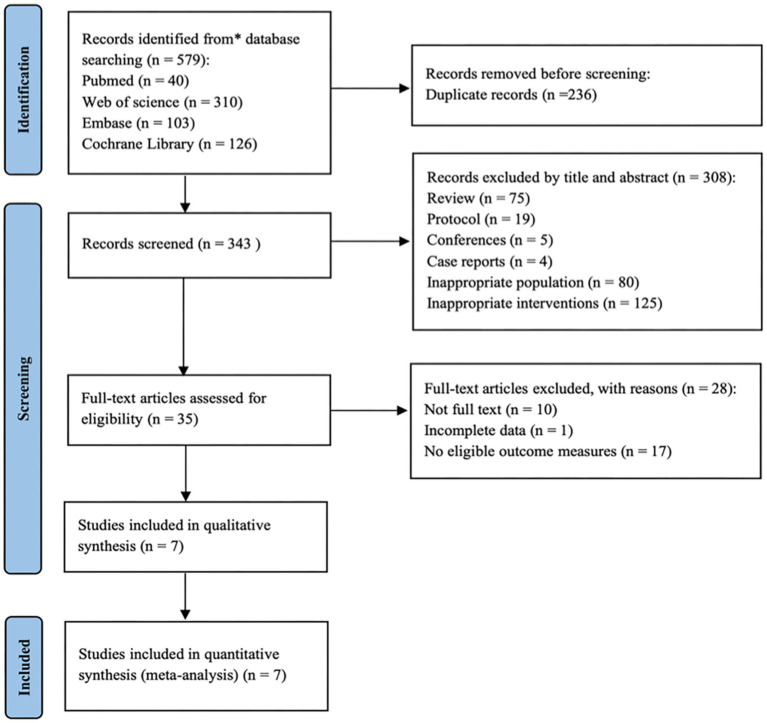
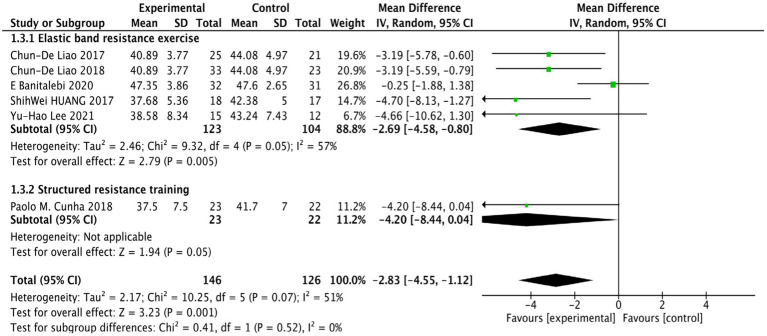
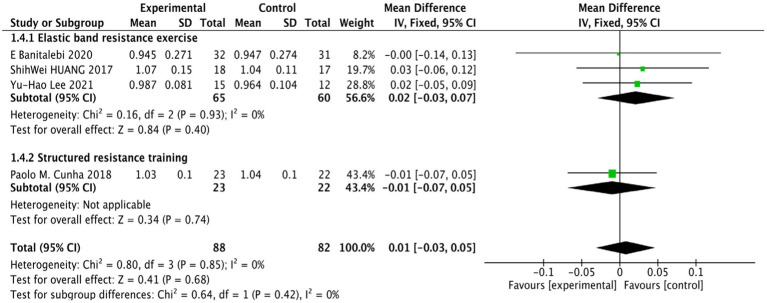
Objectives: A systematic review and meta-analysis was conducted to validate the effects of resistance training (RT) on body composition and physical function in older females with sarcopenic obesity (SO). Design: Systematic review and meta-analysis. Setting and participants: Older females (≥60 years). Methods: Four electronic databases—PubMed, Web of Science, Embase, and the Cochrane Library—were comprehensively searched through June 2024. Randomized controlled trials (RCTs) comparing RT with non-exercise interventions or health education were included. Outcomes measured included key indicators such as body composition and physical function. The quality of the included studies was evaluated using the Physiotherapy Evidence Database (PEDRO) score, and the risk of bias was assessed utilizing the Cochrane Risk of Bias 2.0 Tool (RoB 2). Ultimately, a meta-analysis was conducted using RevMan 5.4. Results: Results of our meta-analysis revealed that RT partially ameliorated body composition in patients, significantly reducing body fat percentage (BF%; WMD = −2.83, 95% CI: −4.55 to −1.12, p = 0.001). However, through comparative analysis of the control groups, we revealed that it did not significantly influence other indices such as body mass index (BMI; WMD = −0.42, 95% CI: −1.92 to 1.08, p = 0.58), total skeletal muscle mass (TSM; WMD = −0.62, 95% CI: −2.38 to 1.15, p = 0.49), or bone mineral density (BMD; WMD = 0.01, 95% CI: −0.03 to 0.05, p = 0.68). Notably, RT demonstrated substantial efficacy in enhancing physical function, as evidenced by improvements in the 10-meter walk test (10WMT; WMD = 0.22 s, 95% CI: 0.04 to 0.39, p = 0.01), Timed Up and Go test (TUG; WMD = −2.23 s, 95% CI: −2.96 to −1.49, p = 0.00001), and Timed Chair Rise test (TCR; WMD = 5.20 repetitions, 95% CI: 3.98 to 6.43, p = 0.00001). Conclusion: This meta-analysis indicates that RT exerts a significant positive influence on the physical function of older females with SO. Despite these benefits, the impact on body composition parameters, such as BF%, appears to be limited. These findings underscore the need for further investigation into the mechanisms by which RT affects body composition in this patient population. Systematic review registration: INPLASY202430061 https://inplasy.com/inplasy-2024-3-0061/.
Overview
The claims and statistics of this paper haven’t been checked yet.
Free: it reads the open-access text and checks the first 5 claims that cite a source we can check. Create a free account to check every claim.
Integrity signals
Registry
Cites
Statistics
Figures


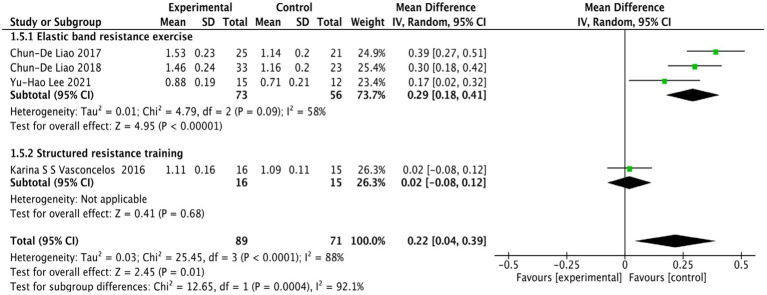


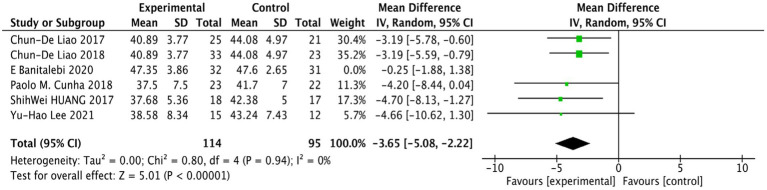
Verification
Claims the paper makes
The claims and statistics of this paper haven’t been checked yet.
Free: it reads the open-access text and checks the first 5 claims that cite a source we can check. Create a free account to check every claim.
Claims other papers make about this one
Each is checked against this paper’s own text: does it say what the citing paper says it does?
The cited source says what the claim attributes to it.
In the citing paper
“Resistance-training-only reviews showed smaller or less consistent BMI changes (19, 20).”
The cited source says what the claim attributes to it.
In the citing paper
“Guo et al. (19) also reported favorable timed up-and-go and chair-rise outcomes in older females undergoing resistance training (19).”
Self-check
Percentages, sums and reported differences re-computed from the paper’s own numbers.
The self-check needs the paper’s full text.
Citations
Cites
The PRISMA 2020 statement: An updated guideline for reporting systematic reviews
Page, M. J., McKenzie, J. E., Bossuyt, P. M., Boutron, I., Hoffmann, T. C., Mulrow, C. D., Shamseer, L., Tetzlaff, J. M., Akl, E. A., Brennan, S. E., et al. (2021) · BMJ · doi:10.1136/bmj.n71 · Cited by 108,283
RoB 2: a revised tool for assessing risk of bias in randomised trials
Sterne, J. A. C., Savović, J., Page, M. J., Elbers, R. G., Blencowe, N. S., Boutron, I., Cates, C. J., Cheng, H.-Y., Corbett, M. S., Eldridge, S. M., et al. (2019) · BMJ · doi:10.1136/bmj.l4898 · Cited by 34,787
Clinimetrics: Physiotherapy Evidence Database (PEDro) Scale
Cashin, A. G., & McAuley, J. H. (2020) · Journal of Physiotherapy · doi:10.1016/j.jphys.2019.08.005 · Cited by 975 · cited 1×
“We used the Grades of Recommendation, Assessment, Development, and Evaluation (GRADE) criteria to rate the quality of evidence for the outcomes (Cashin and McAuley, 2020).”
Testosterone Physiology in Resistance Exercise and Training: The Up-Stream Regulatory Elements
Vingren, J. L., Kraemer, W. J., Ratamess, N. A., Anderson, J. M., Volek, J. S., & Maresh, C. M. (2010) · Sports Medicine · doi:10.2165/11536910-000000000-00000 · Cited by 472
Physical frailty and body composition in obese elderly men and women
Villareal, D. T., Banks, M., Siener, C., Sinacore, D. R., & Klein, S. (2004) · Obesity Research · doi:10.1038/oby.2004.111 · Cited by 459 · cited 2×
“These metabolic deficits interact with aberrant adipose tissue hyperplasia to establish a bidirectional vicious cycle, collectively exacerbating the progression of obesity (Villareal et al., 2004).”
Rondanelli, M., Klersy, C., Terracol, G., Talluri, J., Maugeri, R., Guido, D., Faliva, M. A., Solerte, B. S., Fioravanti, M., Lukaski, H., et al. (2016) · The American Journal of Clinical Nutrition · doi:10.3945/ajcn.115.113357 · Cited by 412
Anabolic Resistance of Muscle Protein Synthesis with Aging
Burd, N. A., Gorissen, S. H., & van Loon, L. J. C. (2013) · Exercise and Sport Sciences Reviews · doi:10.1097/jes.0b013e318292f3d5 · Cited by 384 · cited 1×
“…10 frontiersin.org resistance is influenced by multiple factors including digestive efficiency, nutrient absorption, synthesis of anabolic signaling proteins, visceral amino acid sequestration, physical activity levels, and postprandial amino acid availability/delivery (Burd et al., 2013).”
Liao, C.-D., Tsauo, J.-Y., Wu, Y.-T., Cheng, C.-P., Chen, H.-C., Huang, Y.-C., Chen, H.-C., & Liou, T.-H. (2017) · The American Journal of Clinical Nutrition · doi:10.3945/ajcn.116.143594 · Cited by 317 · cited 1×
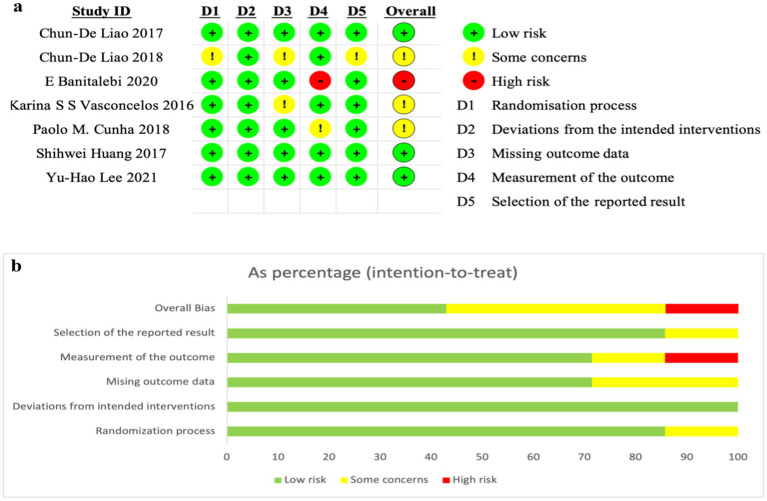
“Among the four included studies (Liao et al., 2017; Liao et al., 2018; Vasconcelos et al., 2016; Lee et al., 2021), the results of Chun-De Liao 2017, Chun-De Liao 2018, and Yu-Hao Lee (Liao et al., 2017; Liao et al., 2018; Lee et al., 2021) were consistent.”
Egan, B., & Sharples, A. P. (2023) · Physiological Reviews · doi:10.1152/physrev.00054.2021 · Cited by 278 · cited 1×
“The potential mechanism is that RT improves neuro muscular parameters, including better motor unit recruitment, intra and inter-muscular coordination, and firing frequency (Stoever et al., 2018; Egan and Sharples, 2023).”
Exercise attenuates the weight-loss-induced reduction in muscle mass in frail obese older adults
FRIMEL, T. N., SINACORE, D. R., & VILLAREAL, D. T. (2008) · Medicine & Science in Sports & Exercise · doi:10.1249/mss.0b013e31816a85ce · Cited by 230 · cited 1×
“Therefore, it is recommended to continue RT for at least 6 months to observe more significant improvements in TSM in older populations (Frimel et al., 2008).”
Cited by
Ran, J., Yang, J., Li, N., Yang, J., Yang, W., Chen, M., Sun, P., & Liao, Y. (2025) · BMC Geriatrics · doi:10.1186/s12877-025-06559-4 · Cited by 21
“The second subgroup analysis indicated that RT also benefits sarcopenic obese older adults, improving both grip strength and functional measures such as the Timed Up and Go [36, 37].”
Ma, X., Sun, G., Liu, C., Yan, X., Liang, W., & Ma, Z. (2026) · Frontiers in Nutrition · doi:10.3389/fnut.2026.1859967
“Representative published estimates included MD − 0.85 percentage points in Hita-Contreras et al. (14) (19, 20).”
InfluentialАдамович, О. О., Довган, Р. Р., Согуйко, Р. Р., Рудницька, Х. І., Орел, М. Г., & Масна, З. З. (2025) · Bulletin of Problems Biology and Medicine · doi:10.29254/2523-4110-2025-4-179/addition-15-17
АНАЛІЗ ДИНАМІКИ ЩІЛЬНОСТІ КІСТКОВОЇ ТКАНИНИ СТЕГНОВОЇ КІСТКИ НА ТЛІ ЕКСПЕРИМЕНТАЛЬНОЇ ГІПОДИНАМІЇ
Dovgan, R. R., & Масна, З. З. (2025) · Bulletin of Problems Biology and Medicine · doi:10.29254/2077-4214-2025-4-179-312-317
Wang, J., Mao, L., Yang, Y., Peng, W., Bao, W., Li, H., Wu, R., Yao, Z., Zhu, X., Wang, D., et al. (2026) · BMC Geriatrics · doi:10.1186/s12877-026-07207-1
“These findings are consistent with previous meta-analyses examining the effect of RT on body composition in SO patients [54, 55].”
Metadata
- Authors
- Guo, C., Dai, T., Zhang, H., Luo, M., Gao, J., & Feng, X.
- Affiliations
- Heilongjiang University of Chinese Medicine (CN)
- Henan University of Chinese Medicine (CN)
- First Affiliated Hospital of Henan University of Traditional Chinese Medicine (CN)
- Corresponding author
- Gao, Jing
- Feng, Xiaodong
- Venue
- Frontiers in Aging Neuroscience
- Publisher
- Frontiers Media SA
- Published
- 2025-04-30
- Volume
- 17
- Pages
- 1495218-1495218
- ISSN
- 1663-4365 (ISSN-L)
- PMC
- PMC12075210
- OpenAlex
- W4409974961
- Cited by
- 7
- References
- 55
- Citations by year
- 2026: 4 · 2025: 3
- FWCI
- 0.92
- Type
- journal article
- Language
- en
- Open access
- gold
- doi.org
- Licence
- Locations
- Frontiers in Aging Neuroscience (publishedVersion, cc-by)
- PubMed Central (publishedVersion, cc-by)
- PubMed (publishedVersion)
- DOAJ (DOAJ: Directory of Open Access Journals) (submittedVersion, cc-by-sa)
- Funders
- State Administration of Traditional Chinese Medicine of the People's Republic of China
- Topics
- Health Sciences › Medicine › Physiology (medical) › Nutrition and Health in Aging
- Health Sciences › Medicine › Public Health, Environmental and Occupational Health › Physical Activity and Health
- Life Sciences › Biochemistry, Genetics and Molecular Biology › Molecular Biology › Muscle Physiology and Disorders
- Keywords
- resistance training, sarcopenic obesity, older women, body composition, physical function, body fat percentage, skeletal muscle mass, bone mineral density, walking speed, Timed Up and Go test, 10-meter walk test, exercise intervention, sarcopenia, obesity in older adults, body mass index, balance and mobility, fall risk
About these checks
Registry, retraction, Cites and statistics results are computed, not judged, with one exception: a printed reference that no index lists is read once by a model before it counts as a citation error. Claims are extracted by a model and kept only when their quote appears verbatim in the text; each cited source is then checked, with a model’s help, for whether it says what the claim relies on. Those verdicts can be wrong — read the claim’s quote and the cited source before relying on one.
Statistics and arithmetic are recomputed, not judged.
Confidence bands are shown only for fields calibrated on our annotated test set. None is calibrated yet, so no band is shown.
What counts as a claim ›How we measure confidence ›How we check this ›
Are you an author, or do you see a problem with this page? Request a review
How to cite
Cite CoChat for the checks on this page, and the paper for its own findings.
- This page
- CoChat. (2026). Citation check: Effect of resistance training on body composition and physical function in older females with sarcopenic obesity—a systematic review and meta-analysis of randomized controlled trials. https://app.cochat.ai/papers/10.3389/fnagi.2025.1495218
- The paper
- Guo, C., Dai, T., Zhang, H., Luo, M., Gao, J., & Feng, X. (2025). Effect of resistance training on body composition and physical function in older females with sarcopenic obesity—a systematic review and meta-analysis of randomized controlled trials. Frontiers in Aging Neuroscience. https://doi.org/10.3389/fnagi.2025.1495218
Data sources
Bibliographic data: Semantic Scholar, OpenAlex, Crossref.
Contains information from the Semantic Scholar Academic Graph Datasets, made available under the ODC Attribution License (ODC-BY 1.0).
Semantic Scholar’s data is described in: Kinney, R., et al. (2023). The Semantic Scholar Open Data Platform. arXiv:2301.10140.
